47. A Thousand Layer Cake – Indonesian Spekkoek Spice Cake

Indonesian Thousand Layer Cake

Indonesian Thousand Layer Cake

I’ve had my eye on this gorgeous Indonesian Thousand Layer Cake (Spekkoek) for quite some time. With it’s perfectly symmetrical stripes of spice interwoven with ribbons of vanilla. Spekkoek or lapis legit is a rich layered cake and is very expensive to buy due to the amount of time it takes to create it, so it’s normally eaten at special occasions and celebrations such as Christmas, weddings or festivals in Indonesian.

Layers and layers and layers

Layers and layers and layers

It requires a bit of planning and preparation and a lot of hitting the pause button if you choose to watch a film whilst trying to bake it, as each layer is baked individually for 11 minutes precisely. But it’s well worth the effort.

Most recipes for a Thousand Layer cake ask for up to 30 eggs! I thought this was a bit extreme and not the most healthy of cakes so scaled it back to a mere 10 eggs. Much more affordable too. It’s definitely a special cake lavished with lots of love and attention it had to taste wonderful.

If you’re going to attempt this cake I recommend

  • You own an electric whisk – this would be quite an ordeal to whisk by hand!
  • You have at least 2 large bowls to whisk the eggs in
  • You add lots of spice!
Beat the egg yolks and 100g sugar together

Beat the egg yolks and 100g sugar together

I’m lucky that I own a Kitchenaid and it could take the strain of whisking the egg whites for me whilst I busied myself whisking the yolks. But you could do it in 3 separate stages if you like. You don’t have to multi task to the extreme if you don’t want to. Me, I enjoy adding a bit of danger to my bakes. Doing everything at once. I’ll balance my bowls on top of many ingredients on the work surfaces and hope for the best, like spinning plates, but in my case it’s batter.

Whilst whisking the egg whites with about 100g of the sugar with a hand held electric whisk I set the Kitchenaid away to whisk the egg whites until fluffy.
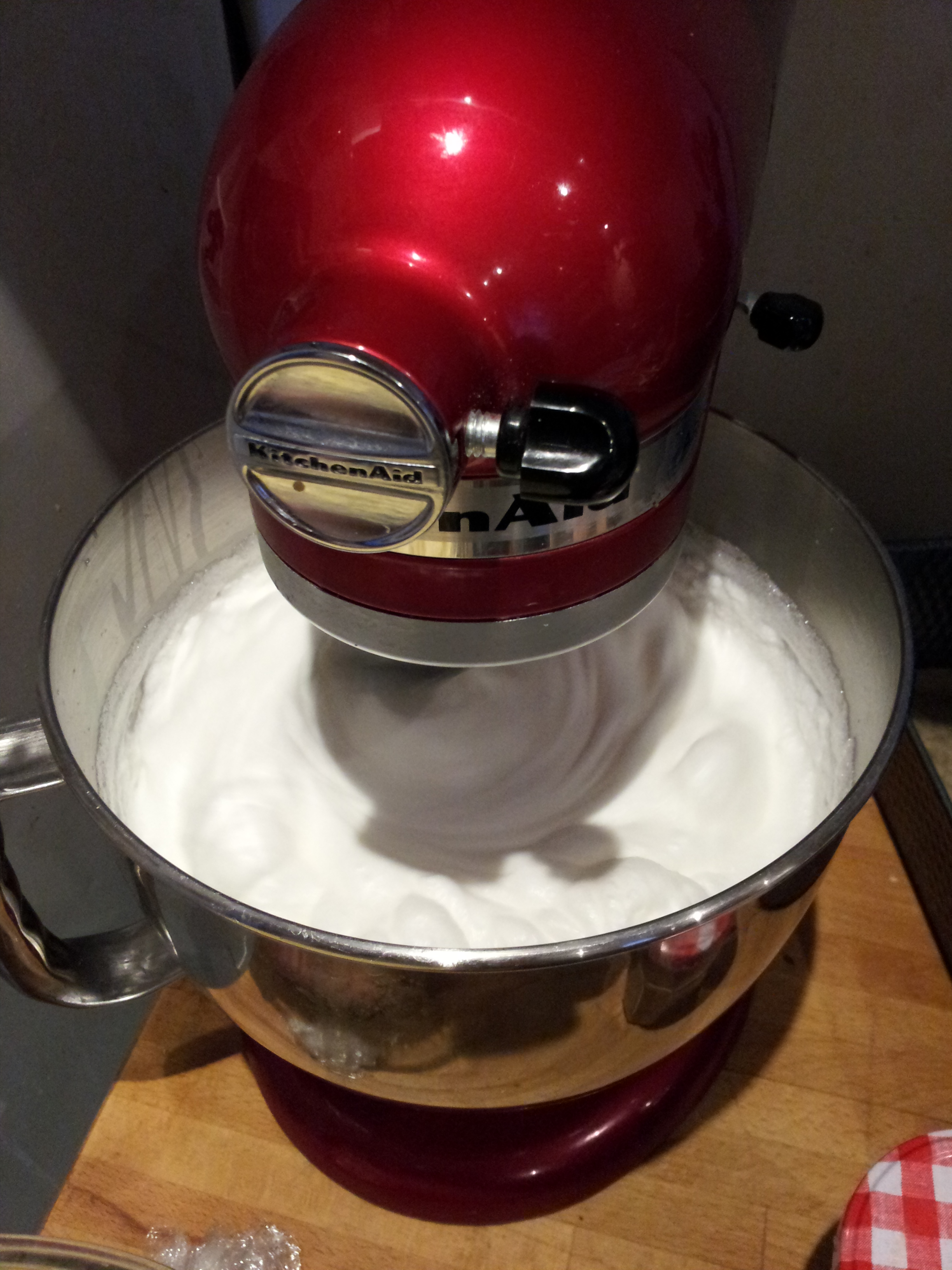
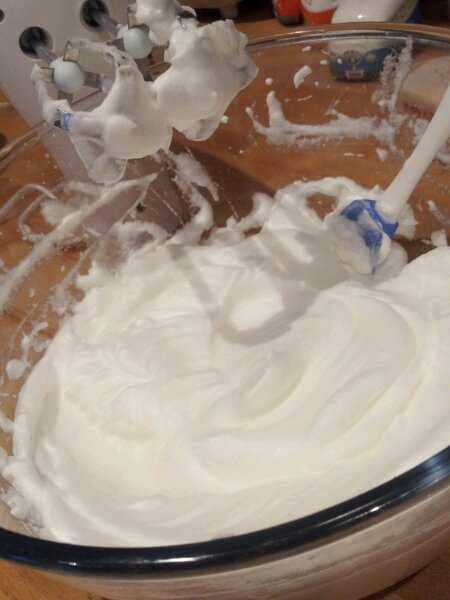
Whisking the egg whites until they start to stiffen

Whisking the egg whites until they start to stiffen

Once the whites start to stiffen add 100g of sugar (bit by bit) and continue to whisk until they reach stiff peaks and look glossy.

Beat together the butter, vanilla and sugar

Beat together the butter, vanilla and sugar

Then as if you’re not busy enough, beat together the remaining sugar, with the butter and vanilla extract until light and fluffy.

Mix together the butter and egg yolk mixtures in one large bowl

Mix together the butter and egg yolk mixtures in one large bowl

You’re going to need the biggest bowl that you own to incorporate all of the ingredients together. Start with mixing the egg yolk batter and the butter/sugar paste together.

All together now - butter, sugar, and egg yolks batter

Butter, sugar, and egg yolks batter all together

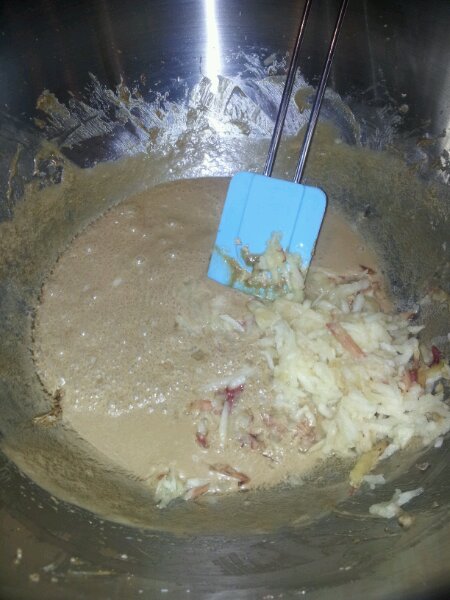
Once all of the ingredients are mixed well (I used my electric hand whisk) the delicate process of folding in the egg whites to the batter can begin. Using a metal spoon fold in gently the egg whites to preserve the air in the batter.

There's a lot of egg whites to fold in!

There’s a lot of egg whites to fold in!

It will start to look like scrambled eggs but persevere until the batter looks smooth.

Yum scrambled eggs!

Yum scrambled eggs! Keep going with the folding

Next up is the relatively small amount of plain flour considering how much egg and butter is in this cake! It also needs to be folded in carefully to the batter with a metal spoon.

Fold in the flour

Fold in the flour

To achieve the two tone and two flavour effect half of the batter needs to be flavoured with spices and the other half left to be as it is, with a hint of vanilla.

Fold in a vast quantity of spice

Fold in a vast quantity of spice to half the batter

Split the batter in half (you’re going to need yet another bowl here!) and fold the spices into half of the batter.
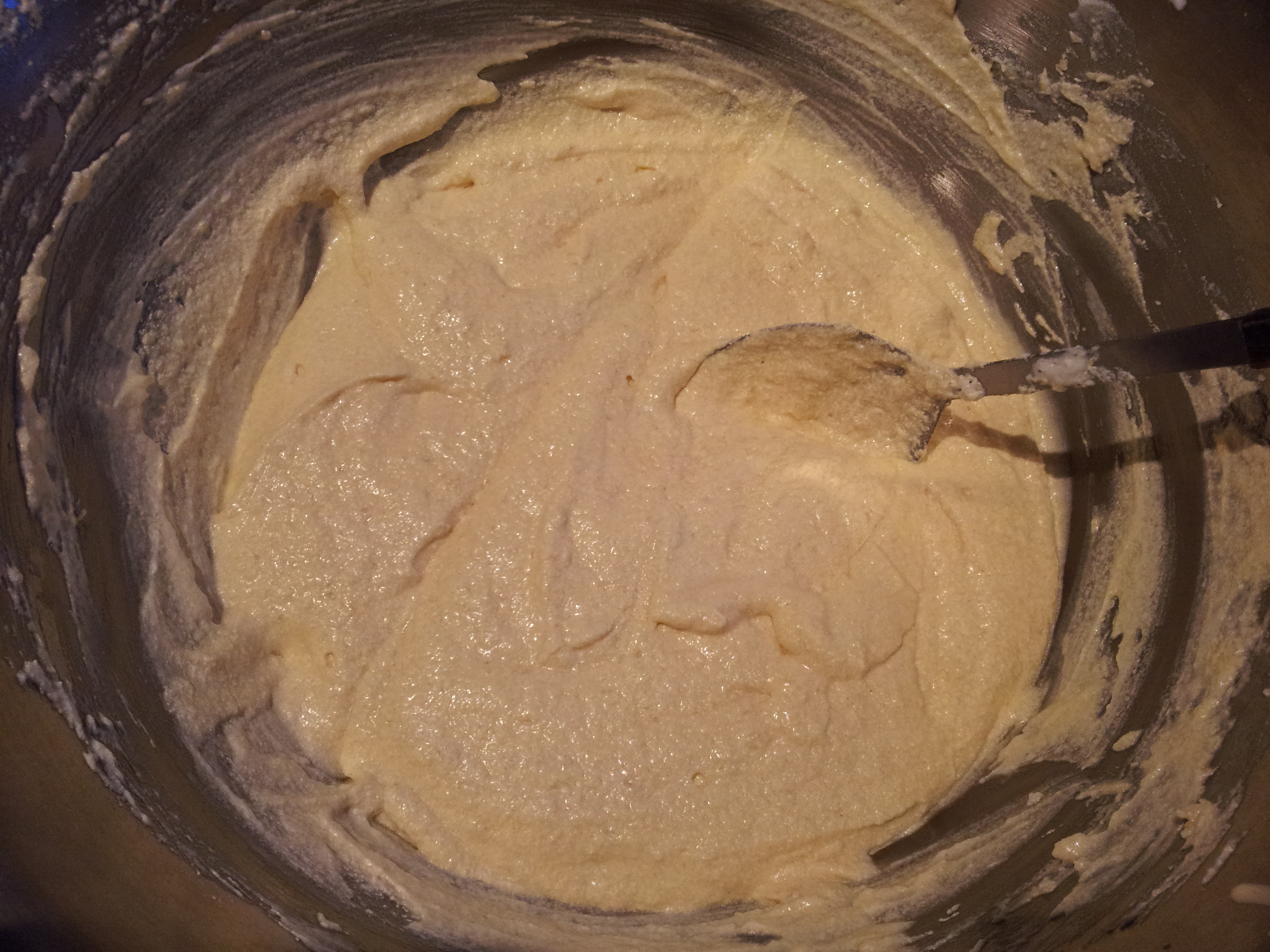
Leave the other half of the batter as it is in a separate bowl

Vanilla batter – Leave the other half of the batter as it is in a separate bowl

The spiced batter should look slightly browner in colour. this will help you to remember which layer you’re up to when it comes to cooking the cake!

Spiced batter

Spiced batter

With your two bowls of batter ready, it’s time to spoon a thin layer (about 5mm) into greased and lined baking tin. I used my new extra long German loaf tin 30cm x 10cm. Make sure you push the batter into all of the corners and smooth it down. Give it a very gentle tap on the worksurface to remove any air bubbles and pop it in the oven for 11 minutes. Some recipes say to follow this bake with a minute under the grill, however my oven doesn’t have a separate grill and oven.  The grill would have to be warmed up each time which to me seemed a bit too laborious. Instead I added an extra minute to the baking time to compensate for the lack of grilling and it worked a treat.
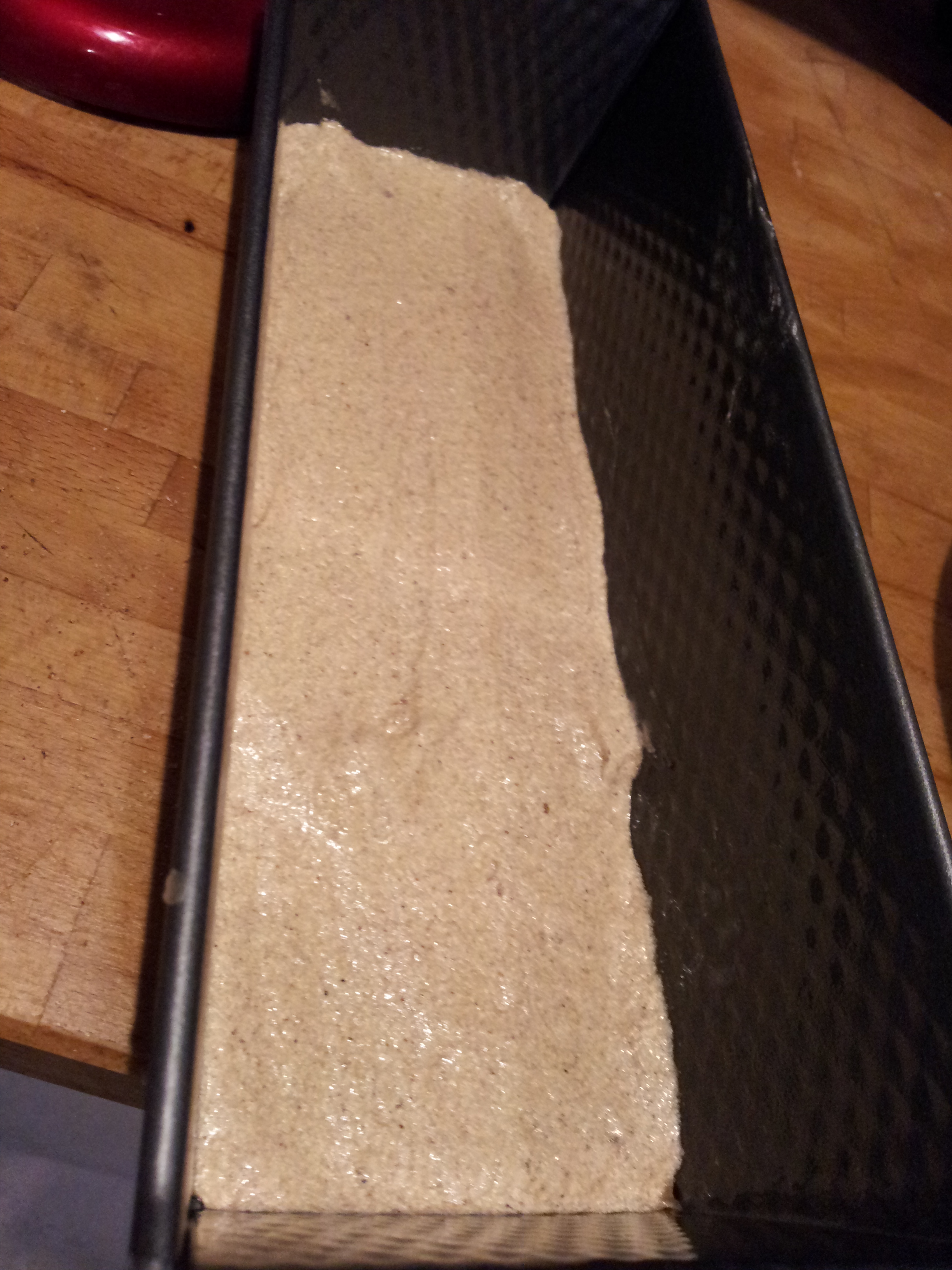
The first layer in the extra long loaf tin

The first vanilla batter layer in the extra long loaf tin

It’s a bit tricky to get the first layer into all of the corners as the batter is quite stiff. I wiped the inside edges of the tin round with a clean finger to remove any extra batter to avoid any smudging of the layers later on. The last thing you want is a smear of burnt batter up the sides your beautiful layer cake.
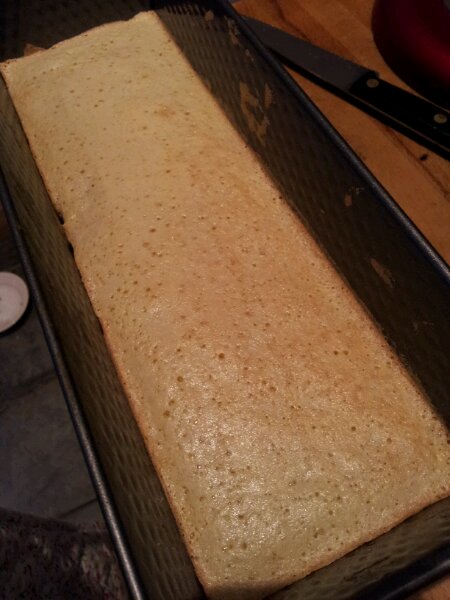
The first baked layer in the extra long loaf tin

The first baked layer in the extra long loaf tin

After 11 minutes in the oven the first layer should be slightly golden brown and evenly baked. Ready for the addition of the next layer straight on top of the hot cake. The heat from the first layer helps to melt the butter and spread the batter evenly around the tin. Remember to alternate your batters! One layer vanilla, one layer spice and repeat.

Raw spiced batter straight on top of the cooked cake below

Raw spiced batter straight on top of the cooked cake below

As your cake bakes it will probably shrink back from the sides of the tin a little, so don’t be alarmed if some of the raw batter disappears down the sides of the cake and into the layer below. A liberal dusting of icing sugar hides all manner of mishaps to a finished cake!
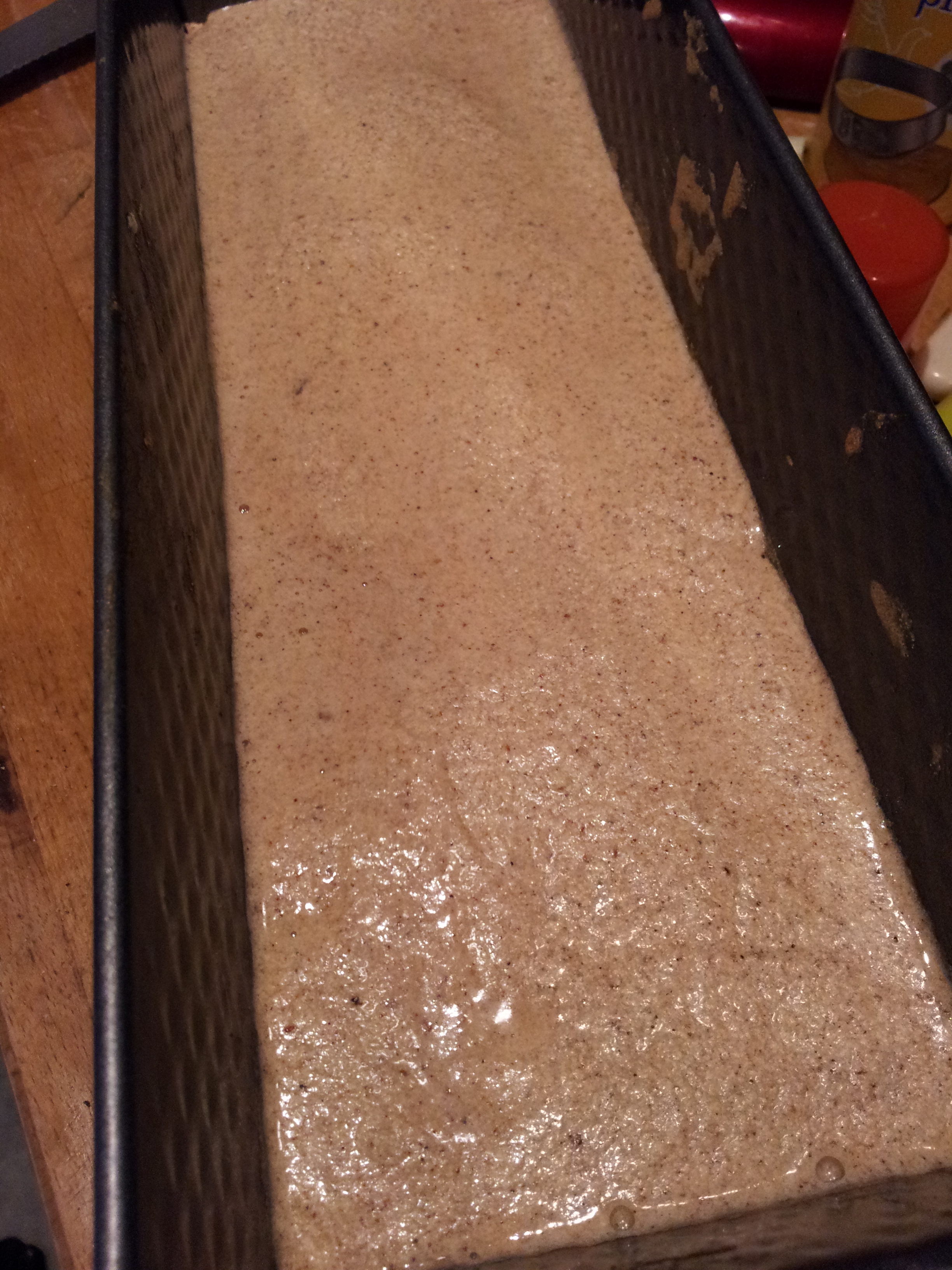
The second spiced layer

The second spiced layer, smooth and ready for the oven

Keep alternating the batters. Repeating the layering, spreading, baking and even more layering until you’ve no more batter left. This process is not for the time restricted or feint hearted. Baking the cake took at least 4 hours, but it’s almost like a work out, leaping up off the sofa to take the cake out of the oven every 11 minutes.
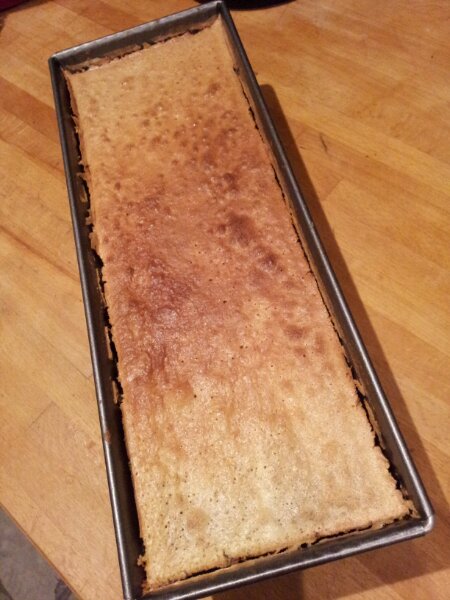
I grilled the final layer a bit for extra authenticity... It looks a bit burnt but tasted good!

I grilled the final layer a bit for extra authenticity… It looks a bit burnt but tasted good!

Let the cake cool in the tin for about 2o minutes before gently loosening the cake from the tin with a palette knife and attempting to remove it from the tin. I grilled the final layer a bit for extra authenticity… It looks a bit burnt but tasted good!
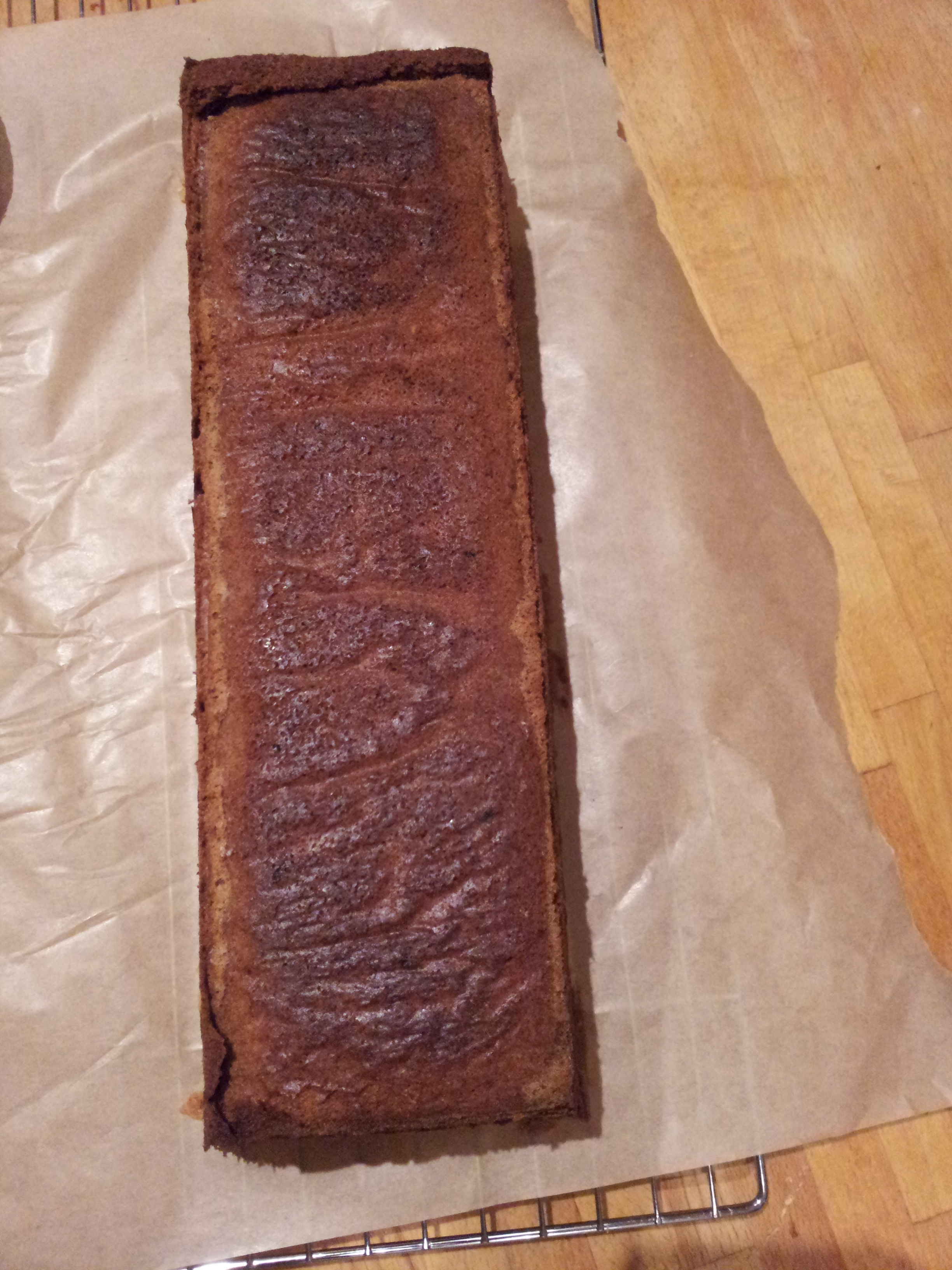
The final long layered cake out of it's tin

The final long layered cake out of it’s tin

I must admit I was a tad alarmed at how dark the cake was when I removed it from the tin. I did wonder how the initial layers would hold up after being baked time and time again. Would they be burnt and tough? I baked at least 18 layers into my cake, that’s a whole lot of oven time for the first few cms of the cake.
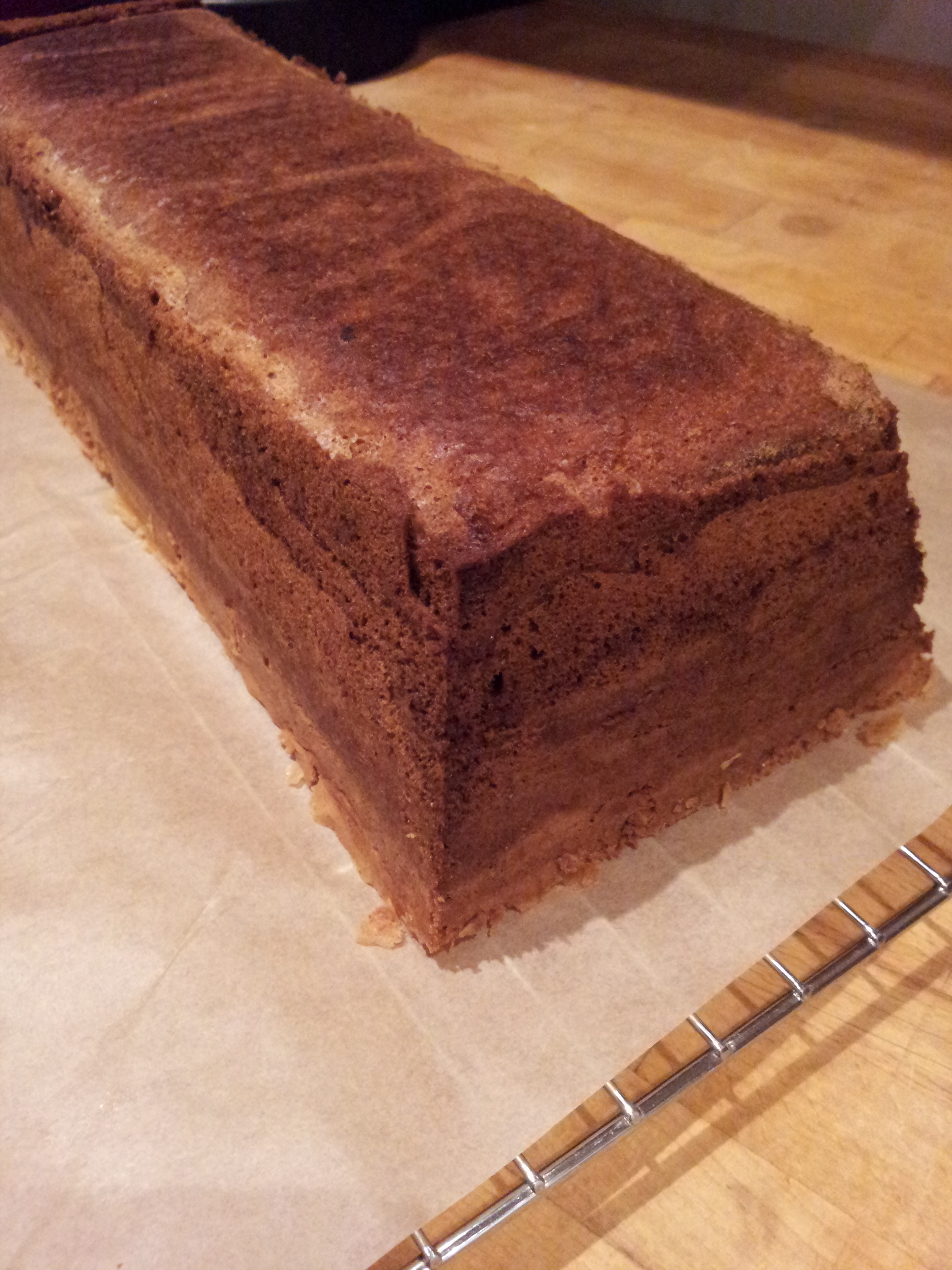
Indonesian Layer Cake

Indonesian Layer Cake

The liquid batter did seep under the greaseproof paper inside the tin. The cake had baked around the paper which made it a his made it a bit difficult remove, but not impossible. However this meant the top was a little uneven, so I trimmed it slightly and dusted it with icing sugar! (shh no one will know!)

Trimmed and dusted to reveal the lovely layers inside

Trimmed and dusted to reveal the lovely layers inside

The white icing sugar gave the layers an extra lift against the contrasting spice. I baked my Indonesian Thousand  Layer Cake for a special Clandestine Cake Club ‘Here comes the sun’ themed event. I was hurrying along to the cakey gathering but just had enough time to slice up some homemade candied orange and lemon citrus peel (Thank you Sharyn at The Kale Chronicles for the how to!) in long thin strips to create my very own sunburst effect, adding a trio of star anise (one of the key spices in the cake) to bring the summery spicey cake to life. As Mary Berry always says, you should include a bit of what’s inside the cake, outside the cake to whet people’s appetites.

Here comes the sun - Indonesian Layer Cake

Here comes the sun – Indonesian Layer Cake

As the tin that I used is supposed to be for bread, I don’t own a cake stand or plate big enough to house such a lengthy cake. I resorted to carrying the cake ,open topped on a chopping board instead. Note to self, icing sugar sitting on a cake will not stay there for long on a windy day. Precariously seated on my passenger seat and me also liberally coated in icing sugar we made our way to the Clandestine Cake Club!

Indonesian Thousand Layer Cake

Indonesian Thousand Layer Cake

I’m so pleased I took the time to attempt the Indonesian Thousand Layer Cake cake although technically not exactly 1000 layers it feels close enough! A challenge of the patience and my washing up ability it may be but this cake promises so much more than a frustrating time in the kitchen. It is such an unusual tasting cake, quite delicate and surprisingly light, I guess due to the sparse amount of flour and the endless whisking.

Layers and layers and layers

Layers and layers and layers

This cake is magic. There must be something in the enormous amounts of eggs that go into the batter that prevent the layers from burning or drying up to a miserable shrivelled mess. It’s moist, spicy and sweet, although not too sweet. It’s a proper grown up cake, sophisticated in it’s beautiful layers and exotic taste. It also improves with age. I had half a piece left from the Cake Club which I shared with Chris 4 days after baking it and it was delicious not dry in the slightest. I think spice cake always deepens in flavour with time. If you want to savour the cake you can even peel each individual layer and eat them separately. I enjoyed devouring it with a strong coffee. I will be baking this again when I have an afternoon to spare and maybe attempting more stripey cakes in the future. I think I’m hooked!

Things I used to make my Indonesian Layer Cake

  • 375g sugar (100g added to egg whites, 100g added to egg yolks, and 175g added to butter mixture)
  • 10 egg whites
  • 8 egg yolks
  • 2 tsp cinnamon
  • 1 tsp ground cassia bark
  • 1 tsp ground cardamom
  • 1/2 tsp ground star anise
  • 1/4 of a grated fresh nutmeg
  • 250g butter
  • 185g plain flour
  • 2 tsp vanilla extract
  1. In separate bowl – Whisk egg whites til fluffy add 100g sugar gradually. Whisk til shiny and stiff
  2. In separate bowl – Cream 175g sugar and the butter together til light and fluffy
  3. In separate bowl – Whisk egg yolks and 100g sugar together til fluffy
  4. In a big bowl – Whisk egg mixture and butter mixture together
  5. Fold in egg whites
  6. Fold in flour
  7. Split the batter in half
  8. Fold the spices into one half of the batter
  9. Pour a thin 5mm layer of vanilla batter into tin
  10. Bake for 11 minutes at 160 degrees C.
  11. Pour a thin layer of spiced batter onto cooked layer
  12. Bake
  13. Repeat alternating the batters until all the batter is cooked.
  14. Cool, remove from tin, decorate and eat!

Where to start when icing a 5 Tier Wedding Cake?

Me and my pride an joy - The 5 Tier iced wedding cake with ribbon in Kate's wonderful kitchen

Me and my pride and joy – The 5 Tier iced wedding cake with ribbon in Kate’s wonderful kitchen

If you’ve ever visited my tiny flat you will quickly realise that there is very little room to turn around never mind ice, stack and store 5 tiers of fruit cake. Thankfully I have a wonderful friend called Cake Poppins who kindly offered to spend the day with me in her amazing kitchen complete with all of her expertise and wonderful non stick cake decorating equipment. I cannot thank Kate enough for her help and guidance. If you haven’t checked out Kate’s blog I thoroughly recommend it !

Cath Kidston Jamaican Black Cake

Cath Kidston Jamaican Black Cake –  one of my previous attempts at cake icing

Never before have I attempted any sort of technical cake assemblage that requires dowling. I have attempted rather slap dash icing of cakes with layers of marzipan and fondant icing. My results have been passable, but on my wedding cake passable would not suffice. It needed to be perfect. No pressure there then.

One of the 5 Tiers of Fruit Cake

One of the 5 Tiers of Fruit Cake

Before the cakes could even go near any icing a great deal of planning and shopping was required. I packed up a car full of cake and sugar based goods and headed round to Kate’s. The fumes eminating from the cakes made for a very happy journey.

To start with you need to purchase drum style cake boards (the ones that are half an inch thick to add extra height to the cakes). Each board needs to be exactly the same size as the cake. I purchased a 4, 6, 8 10, and 12 inch round boards. The 4 inch was pretty difficult to find but you can definitely buy them online.

I have absolutely no idea how much marzipan and fondant icing we went through and so engrossed was I in mastering the kneading, rolling and enveloping the cakes in icing I forgot to take any photos along the way. (sorry!) My guess is that about 6 packets of marzipan disappeared in the process, which would be around 6 x 500g = 3 kg of marzipan. As a rough guess the same amount of fondant ivory icing was used to cover the 5 cakes.

A slosh of vodka was required (not for me) but to sterilise the cake boards.

3 jars of apricot jam were used to coat the cakes and the boards prior to the application of the marzipan. This helps to stick the marzipan to the cake and the cake to the board.

There was a lot of tea, cake and rolling going on that Sunday afternoon. Gaps in the cake need to be filled with marzipan, a bit like smoothing putty into cracks in a wall before you paint it. You can even add a sausage of marzipan around the edge of the cake to fit it neatly to the board, if there’s a gap. I learnt so many brillliant tips.

Kate introduced me to cake spacers. A truly wonderful invention. They consist of 2 equally thick pieces of wood (rather ruler shaped) which you place on either side of your marzipan or fondant. You then place the rolling pin onto the rulers and roll away from you (preferably on a non stick board). Turning the fondant at regular intervals so it doesn’t stick. This means you get evenly flattened fondant, giving a smooth and much less holey finish than I often achieve. You have to press with all your weight rolling from your hands all the way up to your elbows evenly. If like me your a rolling novice you then get equally spaced bruises up your arms too. Kate’s an absolute pro!

Once the marzipan layer is on the cake, it’s best to get the layer of fondant on whilst it’s still tacky so it all sticks together. The less you touch the final fondant layer the better finish you get. Only touch the fondant covered cake with the backs of your hands to avoid leaving any fingers prints please. Smoothing the edges down with a plastic cake smoother, pushing the excess fondant down and squeezing it out in to the bottom of the skirt of the cake. Which can then be trimmed away with a lovely sharp palette knife, being careful not to cut into the cake (!)

Once all 5 cakes have a double coat of icing you carefully wrap a thin ribbon around the bottom of each cake. Double sided sticky tape is useful to stick the ribbon together. This gives a really professional looking image. I chose ivory ribbon to blend into the fondant and give a really sleek finish.

The Iced Wedding Cake

The Iced Wedding Cake – you can see the ribbon edging neating up each cake tier

Icing the 5 cakes took around about 5 hours. Then Kate showed me how to make sure the cakes are level, how to cut the dowels to size, where to insert dowels (plastic rods) to hold the weight of the cake above and how to stack the 5 tiers together.

Using a spirit level, a hack saw, a dowling guide template and a marker pen we forced the plastic dowels strategically into all 4 iced cakes, all in the right places so you can’t see any plastic dowels on the finished cake! The top tier didn’t need any dowels to as there was no other cake to support above it.

One Tier - complete with a full round of dowls - how to ice a wedding cake

One Boxed Tier – complete with a full round of dowls – ignore the flowers these were added later on…

The final result was very impressive! Seeing all 5 tiers stacked up in their smooth white finish was worth all of the effort! Then all we had to do was carefully take it apart again, box the cake and manouvere it all back into my car. Then the task of finding a suitable storaged place in my tiny flat to rest the cakes whilst the fondant set.

Almost there but not quite yet...

Almost there but not quite yet…

There was still a month to spare before the wedding and I still had to glue all of the hydrangea flowers to the cake, box it back up again, transport it to Jesmond Dene House AND stack the entire cake, glueing each tier together. And then to eat it! So close and yet still so far to go…

This is part 3 of the 4 stages of wedding cake baking! You can read more about my epic wedding cake adventures here…

Part 1 – My 5 tiers of fruit wedding cake – My biggest booziest cake yet 

Part 2 – How many sugar flowers does it take to make a wedding cake?

Part 3 – Where to start icing a 5 tier wedding cake?

Part 4 -The Final Frontier – Decorating & assembling my 5 Tier wedding cake

How many Hydrangea Sugar Flowers does it take to make a Wedding Cake?

SEAN_ELLIOTT_PHOTOGRAPHY-703

After you’ve spent an inordinate amount of time baking 8 enormous boozy fruit cakes, how do you decide which wedding cake design to go for? Do you opt for a classic look, a fashionable design or something to match your colour scheme?? For those that know me, you will know that there has never been a colour scheme in my life. I don’t manage to match things very well. In fact if things clash that’s probably for the better. (

I couldn’t bring myself to decide on just one colour for my bouquet, as I love so many colours so I went for a bit of everything. It was only a last minute decision to leave out the bright pink roses from the bouquet. I decided it may be a little bit too much.  You can even see the blue hydragena flowers peeking out between the hyacinths. It was touch and go as to whether these flowers would bloom with it being a December wedding. It was clearly meant to be!

My wedding flowers

My wedding flowers – a little bit of everything

Part of me longed for a classic cake that I would love forever and part of me me wished for an entire room of different types of cake from around the world. Unfortunately there is not enough space in my freezer to create such an awesome display unless I baked them all the day before the wedding which in reality, was never going to happen.

Petite Italian Lavender Meringues

Petite Italian Lavender Meringues

As a compromise I baked as many extras as I could possibly manage. Opting for petite Lavender Meringues

Mini Brownie Bundts and Madeleines

Table Treats – Mini Brownie Bundts and Madeleines

and mini bundt brownies and madeleines to adorn the tables with.

I found so many gorgeous cake designs flicking through endless pages of Pintrest and magazines but many were way out of my skills set. One favourite was an impossibly beautiful white damask lace design on a pale green fondant  I made many many trips to my local cake decorating shop and experimented with different technniques,  I was never going to be able to use a stencil. (I practiced with a little one I had in the house and I always managed to smudge it or it oozed out of the sides.)  I was then going to make millions of sugar roses, but I made about 4. It took me ALL night and I felt angry. It was way too fiddly and my roses always turn out ridiculously enormous and ‘rustic’ looking.

Green Damask Lace Cake – The Cake Parlour

Another of my favourite designs was a tiered cake with a cascade of hydragena blossoms. Little did I know that both of these cakes were designed by the same woman the amazing Zoe Clark. (I have since purchased her books as I love her designs!)

I continued in an experimental vein ordering lots of plastic sugar tools online and waited a month for them to arrive. I attempted to make fondant pearls by hand but didn’t think about how they needed to dry so ended up with one lump of sugar pearl. That would never do.

One lump of pearl for me please

Just the one lump of pearl for me please

Back to the drawing board and my two favourite designs. My Mam invested in a hydrangea cutter and mould for me (thank you Mam) rather than watch me struggle with trying to do everything for myself.

Zoe Clark’s design used pink blossoms which is lovely but I’m not much of a pink girl. Instead I experimented with a few different colours including, lilac, baby blue, teal and finally decided upon ‘hydrangena blue’. I coloured some florists paste with food colouring and added a little more to get the right colour. I also left some to dry for a couple of weeks to see how the colour developed as it can fade as it dries out fully. I had found my winner. I made 3 slightly different shades of hydrangea blue paste to give the flowers more of a natural look and variety in the final cascade.

Using a tooth pick add a dot of your chosen food colour gel to the florists sugar paste and knead it until it's the colour you need.I chose hydrangea blue. Beware adding too much colour in one go, once it's in you can't take it out! You may need to colour your paste in advance to allow it to dry a little so it's not too sticky!

Using a tooth pick add a dot of your chosen food colour gel to the florists sugar paste and knead it until it’s the colour you need. I chose hydrangea blue. Beware adding too much colour in one go, once it’s in you can’t take it out! You may need to colour your paste in advance to allow it to dry a little so it’s not too sticky!

When adding food colouring gel to sugar paste it always makes the paste sticky. I find it much easier to handle if I colour it a few days before I need to use it.

Roll out the colourful florist's paste on a lightly dusted surface - making sugar flowers hydrangea

Roll out the colourful florist’s paste on a lightly dusted surface

You can add a little icing powder to the worksurface when you’re rolling it out but not too much as it will dry the paste out and it will crack. Florists paste isn’t cheap but it has a special ingredient (albumen) which allows you to work it into much thinner and more delicate shapes than normal sugar paste. It also dries really hard quite quickly so it keeps it’s shape. I tried to make my own (I know this was not my best idea!) I thought it would be cheaper to buy powdered albumen and knead it into sugar paste. In reality this was an extra faff on that I didn’t have the time for. It was much easier to just buy pre made florists paste and mix my own colour. If you’re feeling extravagant you could even buy yours in the shade you really want.

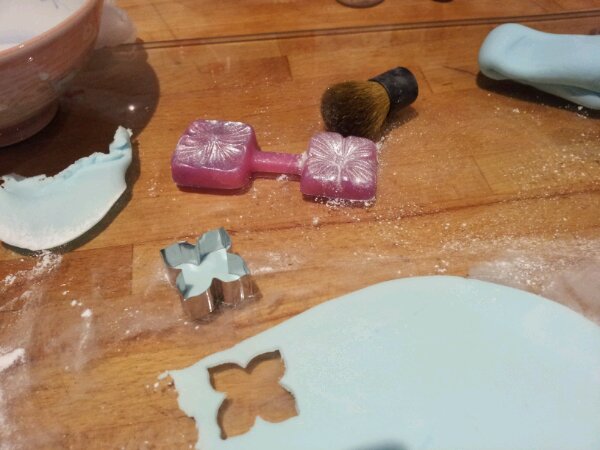
strategically press your cutter into the paste and carefully lift it away from the paste - sugar flowers hydrangea

Strategically press your cutter into the paste and carefully lift it away from the paste

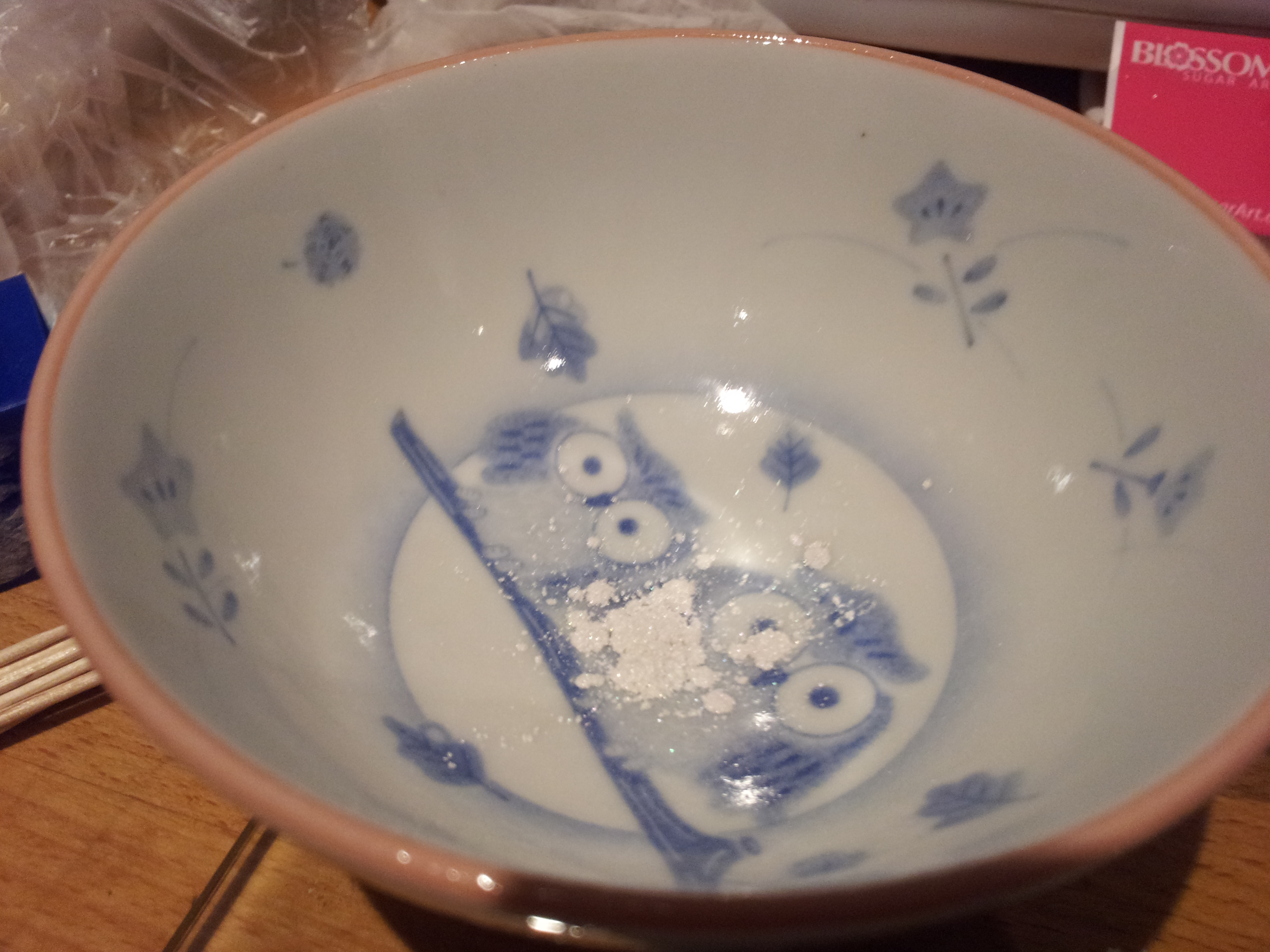
My hydrangea cutter and mould instructions informed me that I needed vegetable fat to smear on the silicon mould to prevent the paste from sticking to the mould. It was late, I was all ready to cut out some flowers so I wasn’t going to make it to any shops. Improvising I took some pearl lustre powder and popped it in a shallow bowl.

Pearl Lustre Powder makes a great alternative to vegetable fat and icing sugar

Pearl Lustre Powder makes a great alternative to vegetable fat and icing sugar

Using a brand new clean blusher brush I coated the mould liberally with a combination of edible pearl and baby blue lustre powders.

Dust like your life depends on it

Dust like your life depends on it

Et voila. I have satisfactorily released flowers with a touch a sparkle and glamour that I was going to have to paint on afterwards. Success and time saved!

Using a clean blusher brush first the mould with lustre powder to stop it sticking. You can use trex but I discovered this saved me a job later on!

Using a clean blusher brush first the mould with lustre powder to stop it sticking. You can use trex but I discovered this saved me a job later on!

The little mould that I loved to hate. The first 50 flowers were a breeze but your fingers do start to ache after so much cutting, folding and pressing! The trick is to fold the mould over carefully so you don’t dislodge the flower inside. Or if the paste is too thick it oozes out of the sides of the mould when pressed…

image

There is a lot of patience and gentleness required in this process…

The pressed Hydrangea Blossom

The pressed Hydrangea Blossom – look at that beautiful detail

If you’ve lustred up the mould enough it should pop out quite easily but you might need to coax it out if it’s a bit stubborn. (Spot the cocktail sticks in the background). Flipping over the mould allows gravity to do the work for you and release the lovely detailed blossom into your palm.

Gently coax the flower out of the mould by peeling the mould away from the flower or let gravity do it's job

Gently coax the flower out of the mould by peeling the mould away from the flower or let gravity do it’s job

The final result! I also added a little baby blue edible lustre powder to the mix to ad depth and variation to the blossoms. I was glittering for a week after this!

Hey presto! You have a sugar flower all sparkly and full of lustre which helps bring it to life

Hey presto! You have a sugar flower all sparkly and full of lustre which helps bring it to life

I found a good way to make the flowers look more realistic was to gently roll themeach one in my cupped hand before leaving them to dry. This gives more shape to the petals, so they don’t appear too flat and fake. Then repeat times a million… This is probably an extreme exaggeration but I lost count of how many flowers I actually pressed. I used about 2 and half 500g packs of florists paste to create maybe around 150 hydrangea blossoms. Not all of them ended up on the cake however as I dropped some on the floor… Some snapped after they dried. They are quite delicate little flowers! And some flowers just weren’t that pretty (sorry flowers but some had to be prised apart and suffered the consequences) so they didn’t make the cut.

Gently roll the flower in your hand to encourage the edges to bend in slightly and create a bit of variety

Gently roll the flower in your hand to encourage the edges to bend in slightly and create a bit of variety

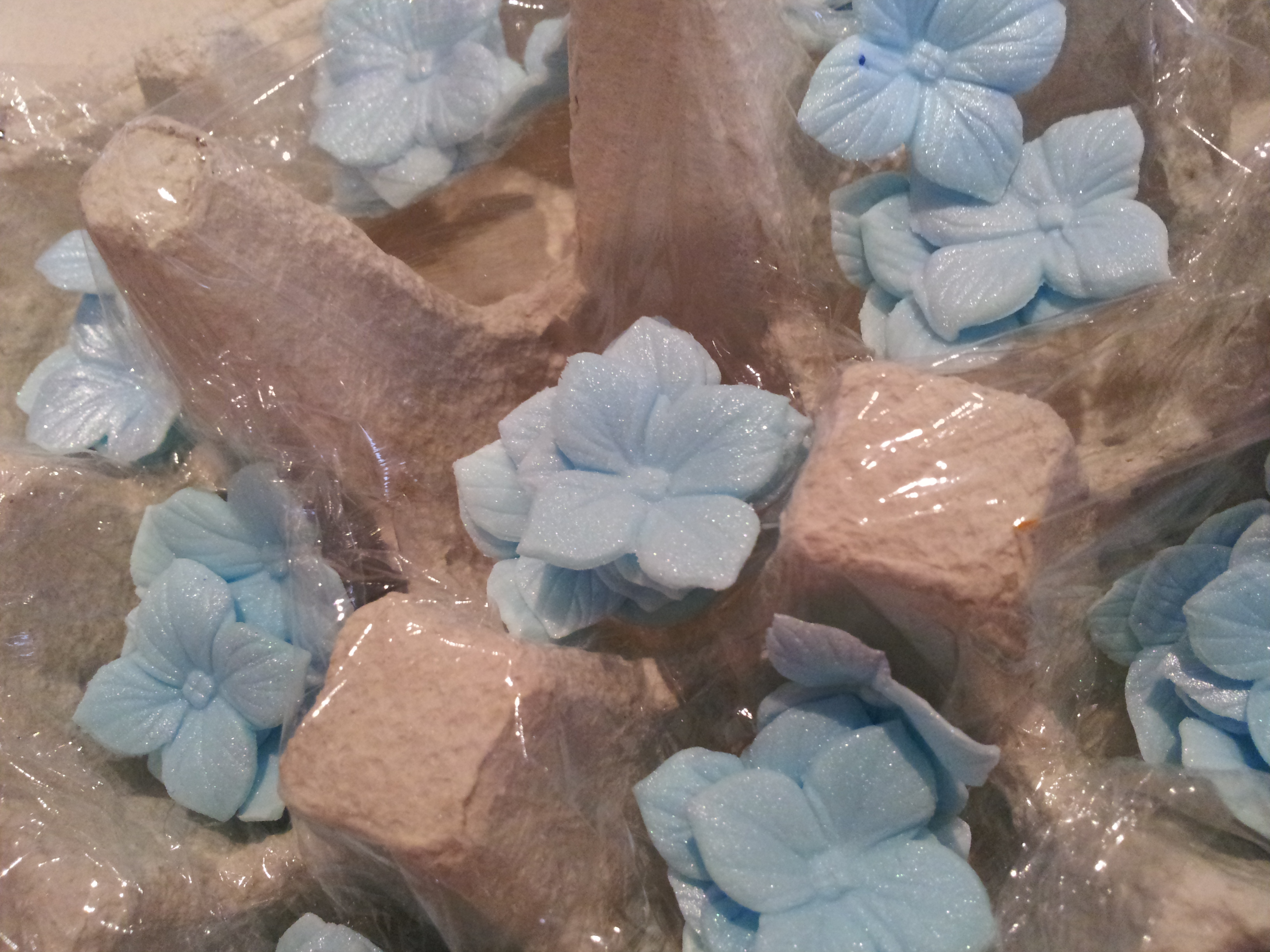
The flowers need to be held in shape whilst they dry. You can splash out on a special sugar paste foam mat if you like, or you can wrap an egg box in cling film and pile them all up like me. Crinkled up tin foil works really well too. It may also be a good idea to add layers of cling film to stop the flowers sticking together. I know I’m biased but don’t they look pretty all sparkly and delicate??

Line an egg box with cling film and pop all your pretty flowers in to hold their shape whilst they dry. Repeat repeat repeat...

Line an egg box with cling film and pop all your pretty flowers in to hold their shape whilst they dry. Repeat repeat repeat…

It takes about a day for the flowers to dry out. I made mine in stages so I could spend an hour or two at a time pressing hydragenas until I thought I had enough. Then  all that’s left to do is ice the 5 tiers of fruit cake and assemble it all.

The Final Result! The Wedding Cake

The Final Result! The Wedding Cake

This is part 2 of the 4 stages of wedding cake baking! You can read more about my epic wedding cake adventures here…

Part 1 – My 5 tiers of fruit wedding cake – My biggest booziest cake yet 

Part 2 – How many sugar flowers does it take to make a wedding cake?

Part 3 – Where to start icing a 5 tier wedding cake?

Part 4 -The Final Frontier – Decorating & assembling my 5 Tier wedding cake

Coconut Crazy! Homemade Italian Coconut Gelato

How to make Homemade Italian Coconut Gelato complete with coconut curls

Homemade Italian Coconut Gelato complete with coconut curls

My favourite ice cream in the whole entire world has got to be Italian Coconut Gelato. Now that’s a bold statement I know, but having sampled real Italian Gelato and having lived very close to a Gelato shop in Newcastle I think I’ve tried quite a few flavours and this is without doubt top of my list every time. Yeah chocolate is always lovely but a bit too much of an obvious choice sometimes for my liking. I do love cherry gelato and pistachio is tremendous too but coconut is what is usually what I crave when looking for a cold fix.

dried coconut half

I’ll have half a dried coconut please

I seem to be developing an obsession with coconut, finding ways to incorporate it into all foods. Be that coconut milk, oil, dessicated and dried. In the creation of this gelato I discovered the wonderful ingredient of dried coconut halves which saved me the effort of breaking into a fresh coconut with a hammer and fork (my only suitable kitchen implements I think for such a job!)

Trevi Fountain adventuring in Rome with my Dad

Trevi Fountain adventuring in Rome with my Dad


I visited Rome just last year for the first time with my Dad. It was gorgeous. We spent a few days wandering round, bouncing from the Trevi Fountain to pasta cafes to St Paul’s basilica. Pausing to absorb the beauty and history of our surroundings and to take on more fuel in the form of pasta and gelato. I dragged my Dad to many cake shops and the beautiful and oldest gelataria in Rome, Giolitti. Not that I heard him complain once 🙂

What a view from the top! Colosseum, Rome

What a view from the top! Colosseum, Rome

The main difference between ice cream and gelato is the taste and texture. Gelato freezes at a higher temperature than ice cream. This gives a much more intense flavour than you get from eating ice cream which is colder and numbs your tastes buds slightly. The warmer the temperature the more you can taste! Gelato is also made with less fat, so good news it’s better for you than ice cream! (Depending on how much you eat of it of course). Gelato is also much softer and smoother in texture than traditional ice cream. All the better for eating!

Heating the milk and cream to infuse flavour into the gelato base

Heating the milk and cream to infuse flavour into the gelato base

The initial stage of heating the milk/cream gives you the perfect opportunity to infuse flavours. You can choose to infuse whatever flavour you fancy into your gelato. Some flavours will require a longer infusion time than others. A vanilla pod may take about 20 minutes over a low heat to impart it’s flavour fully, but something like coffee extract, tea bags, cocoa powder or other flavour extracts will give instant flavour and need little infusion time (maybe about 5 minutes).

You can infuse your base with your favourite flavours, such as vanilla, coffee, tea, lavender, rose, cinnamon, cherry, pistachio and much much more! If you’re going to choose a different flavour it would be wise to choose something with a low liquid content as adding water to the mix may cause ice crystals to form. Adding alcohol in small amounts should be ok, but remember alcohol doesn’t really freeze.

Another flavour option can be created by using a different variety of milk. Even better news for people with food allergies or intolerances! I used coconut milk here but you could just as easily use cows, goats, soy, almond or hazelnut. Each will give you a slightly different flavour and possibly texture. Some milks can become grainy when heated, so it may be wise to try heating up a small amount first to make sure it can stand the heat. before you commit to cooking an entire batch. Or have a fine sieve to hand!

Add your choice of flavour to your milk then heat the cream/milk until it starts to bubble. I added 80g of desiccated coconut to the milk and cream here to infuse even more coconut goodness.

Keep stirring it so a skin doesn’t form on the top.  Allow it to cool slightly. Cream and milk have slightly different boiling points so keep a close eye on the pan, you don’t want it to boil over, or get a thick skin on your coconut cream!

Beat together the eggs and sugar for about 5 minutes - gelato recipe

Beat together the eggs and sugar for about 5 minutes

Beat together the sugar and eggs until smooth and fluffy. They will become a mellow yellow colour after about 5 minutes of beating with an electric whisk/mixer.

The discarded dessicated coconut - nothing will go to waste in my house! - gelato recipe

The discarded desiccated coconut – nothing will go to waste in my house!

Once the cream/milk has cooled slightly pass it through a fine sieve to remove your flavouring if needed. Squeeze all of you milk/cream out of the coconut so you don’t miss a drop of your infused cream. I kept my creamy coconut mixture to use later on.

Gelato recipe - Sieve your hot cream mixture if you need to remove additional flavourings like vanilla pods or dessicated coconut!

Sieve your hot cream mixture if you need to remove additional flavourings like vanilla pods or dessicated coconut!

As the next stage is to make a smooth custard you can’t add any swirls of fruit/flavours at this point. Your custard needs to be smooth and pure so it can thicken fully. Hang on to any additional flavourings that you would like to add for later on.  You can then swirl them in just before the final freeze. After about 5 minutes of beating, the sugar and eggs will inflate slightly and take on a pale yellow colour.

The beaten eggs and sugar - the custard base - Gelato Recipe

The beaten eggs and sugar – the custard base

Whilst continuing to beat the fluffy eggs and sugar slowly pour the hot coconut cream into the eggs. Add the hot cream gradually to avoid scrambling the eggs! Adding very hot cream at this stage will give you lumpy egg custard, I don’t think anyone would enjoy lumpy gelato although it may be an interesting texture on the palette!

Pour the hot cream into the eggs gradually whilst continuing to beat the eggs - gelato recipe

Pour the hot cream into the eggs gradually whilst continuing to beat the eggs

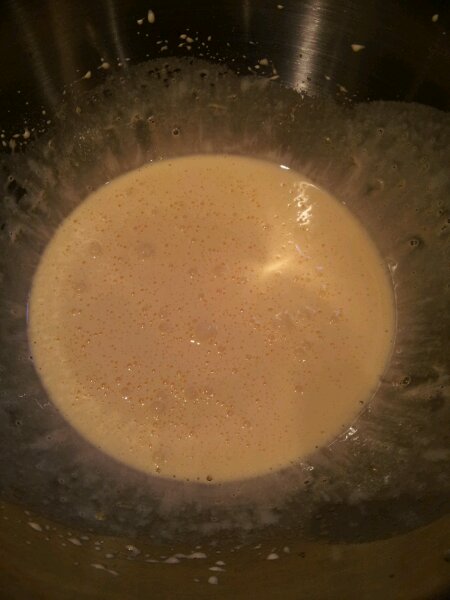
Once you’ve poured all of the cream into the eggs, keep beating the mixture until it’s fully combined. When it’s ready the  custard will start to thicken as the hot cream gently cooks the eggs. The custard will be smooth, fluffy and a very pale yellow in colour due to all those beautiful egg yolks! (Note my leftover egg whites in the jug. I’m saving them for another recipe later on…)

Fluffy coconut custard - how to make gelato

Fluffy coconut custard

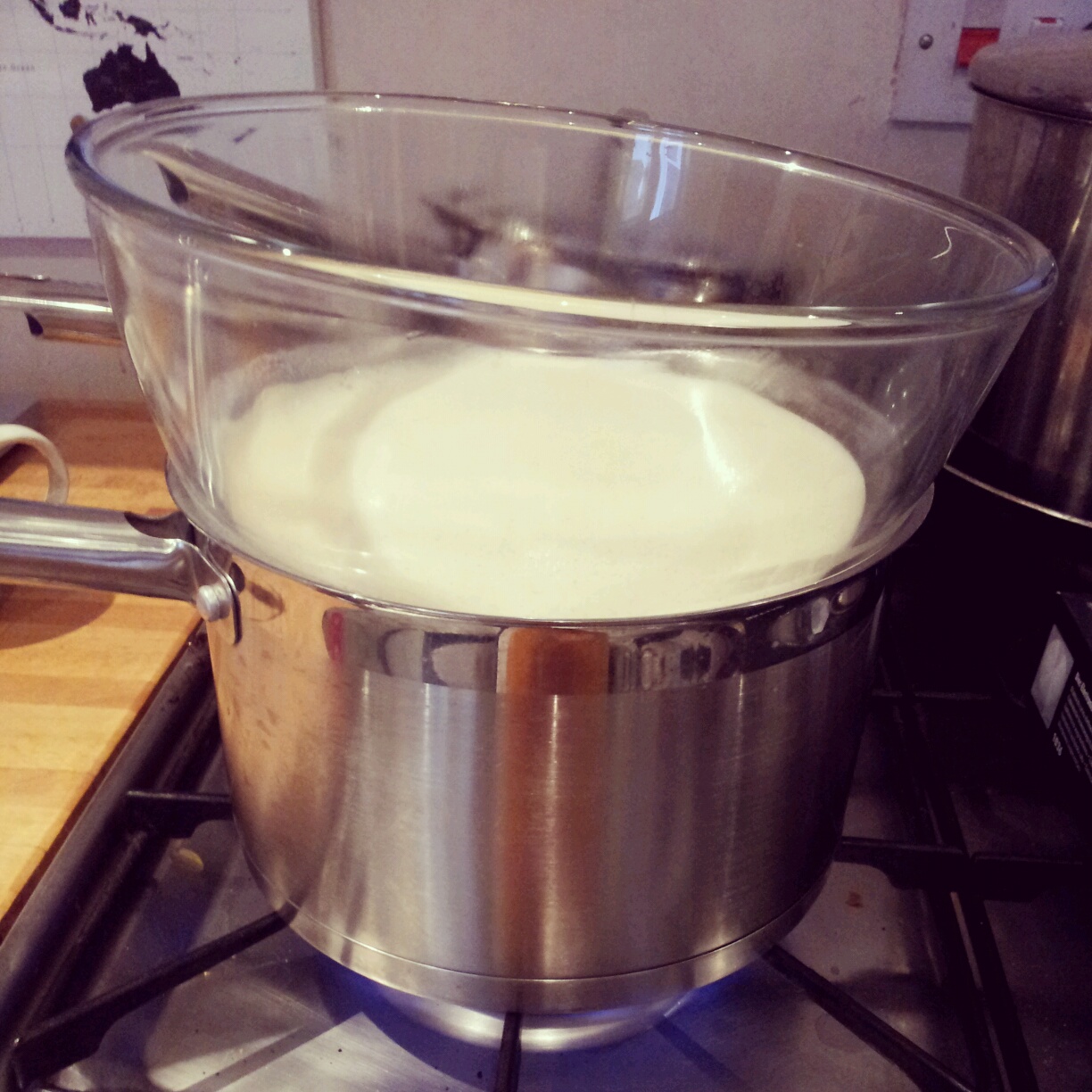
Then all that’s left to do is thicken the custard a bit more. You can do this in a bain marie (in a bowl suspended over a pan of hot water) to avoid burning the custard and gently thicken the mixture. Or if you’re in a hurry, whack it all in a pan and heat the custard over a low heat and stir like mad so nothing burns/sticks to the bottom. The key is to keep stirring to distribute the heat evenly and allow the custard to cook thoroughly.

Thickening up the coconut custard in a bain marie

Not letting the precious coconut custard out of my sight as I thicken it in my home made bain marie

Once the custard is thick enough to coat the back of a spoon it’s good to go! The custard needs to cool before you can freeze it and unfortunately this can take up to 6 hours…. Not great when you need a gelato fix right this second! A quick cheat is to carefully place your hot pan of custard into a bowl (or in my case a sink) of cold water to rapidly cool the custard. Keep stirring it every now and then to stop a skin from forming. You can chill it further in the fridge before cracking out the ice cream maker.

Coconut Custard coating the back of a spoon - thick enough to cool!

Coconut Custard coating the back of a spoon – thick enough to cool!

After all this patience the end result is not far off! I recently bought myself an attachment for my Kitchenaid mixer. The ice cream maker! This was my very first experiment and venture into ice cream making. You will need to follow the instructions for your own ice cream maker as they’re all a bit different, but for the Kitchenaid, I had to freeze the special ice cream bowl in the freezer for 15 hours (it now lives there permanently for all ice cream making emergencies) . Once I had fitted the blade to the Kitchenaid mechanism it’s good to go. One important thing to note is that you should pour the custard in whilst the machine is running as the custard may freeze solid instantly and could break your Kitchenaid if you’re unlucky.

Freeze me up - KitchenAid Ice Cream attachment in action - coconut gelato

Freeze me up – KitchenAid Ice Cream attachment in action

It takes about 20  minutes in the Kitchenaid to freeze the gelato to a ‘soft set’ . I couldn’t resist a sneaky taste of it at this stage and it tasted pretty amazing. It will be quite sweet at this stage as when it’s set further in the freezer the sweetness is reduced.

Letting the KitchenAid do all the hard work freezing my coconut gelato

Letting the KitchenAid do all the hard work freezing my coconut gelato – time for a cup of tea methinks

So with 20 minutes on your hands you’ve got plenty time to have a cup of tea and start the washing up. Once the gelato has reached the ‘soft set stage’ where it starts looking like slightly melted/soft ice cream you can stir in any additional flavours. I added 2 tablespoons of the left over desiccated coconut for good measure. You can see some of it lurking on the top of the blades!

Soft set coconut gelato ready for the freezer

Soft set coconut gelato ready for the freezer

You could probably eat it at the soft set stage if you like your gelato extra soft, or scoop it into a freezer container, smooth it down and leave it in the freezer to set fully for about 5 hours. As Gelato contains less fat it freezes much harder than ice cream, so you may need to take it out of the freezer to soften before serving. You could pop it in the fridge for 15 minutes if it’s a bit difficult to get it into a bowl.

Shaving a coconut to create coconut curls

Shaving a dried coconut to create coconut curls

Taking my trusty vegetable peeler I shaved the dried coconut halves into thin slivers to create some pretty coconut curls. I quite like the dark brown edges of the coconut rind against the white coconut flesh. It’s makes a tasty decoration too! Pop a couple of curls on the top of your gelato for a quick and sophisticated looking decoration.

Coconut Gelato complete with coconut curls

Coconut Gelato complete with coconut curls

Sharing Coconut Gelato with friends - I didn't eat it all myself. I promise!

Sharing Coconut Gelato with friends – I didn’t eat it all myself. I promise!

I didn’t eat it all myself. I promise! My friends came round for tea and we all quickly cleared our bowls of gelato which marks it as a clear success! It was smooth, creamy and extremely coconutty. Just my kind of gelato! I liked it so much that when I was washing up after my friends left I decided to start making some more custard, but this time I experimented with Italian Espresso Gelato instead.

Coconut Gelato - it didn't last long

Coconut Gelato – it didn’t last long

Home made Coconut Gelato  - extreme close up

Coconut Gelato – extreme close up

What I used to make  Italian Coconut Gelato (Gelato di Crema)

Coconut Custard

  • 1 x 400ml can of  coconut milk (which is equal to 1 and 3/4 cups)
  • 109ml of double cream (1/2  cup)
  • 55ml  semi skimmed milk (1/4 cup)
  • (you can use your own combination of cream/milk here to total  545 ml or 2 and 1/2 cups of liquid)
  • 5 egg yolks
  • 110g (or 1/2 cup) granulated sugar (I used vanilla infused sugar)
  • 80g (or 1 cup) desiccated coconut (add your flavour to infuse at this stage)
  • Keep 2 tbs of the desiccated coconut back to add to the soft set gelato before putting it into the freezer.

Coconut Gelato Method Summary

  1. Add flavouring and heat cream and milk until boiling
  2. Beat eggs and sugar together until fluffy
  3. Cool cream slightly
  4. Pour hot cream into eggs and sugar while continuing to beat the mixture
  5. Thicken the custard in a bain marie/pan until it coats the back of a spoon
  6. Cool the custard until chilled throughly
  7. Freeze the custard using ice cream maker for about 20 minutes until soft set
  8. Set the ice cream in the freezer for about 5 hours

Many thanks to Thomson Al Fresco who supplied the ingredients for me to make this Italian Gelato creation! If this recipe has whetted your appetite for all things Italian you might enjoy camping in the beautiful Lake Garda, Lazio, Tuscany, Adriatic Coast or the Venetian Riviera. I’m already dreaming of my next Italian adventure.

If you want to make another Italian classic you could try making your own Espresso Gelato, using the same method but a slightly different recipe.

Espresso Gelato 

  • 3 tbs coffee essence
  • 273 ml (1 and 1/2 cups) milk
  • 218 ml (1 cup) double cream
  • 1 tsp cocoa powder
  • 5 egg yolks
  • 110g (or 1/2 cup) granulated sugar (I used vanilla infused sugar)
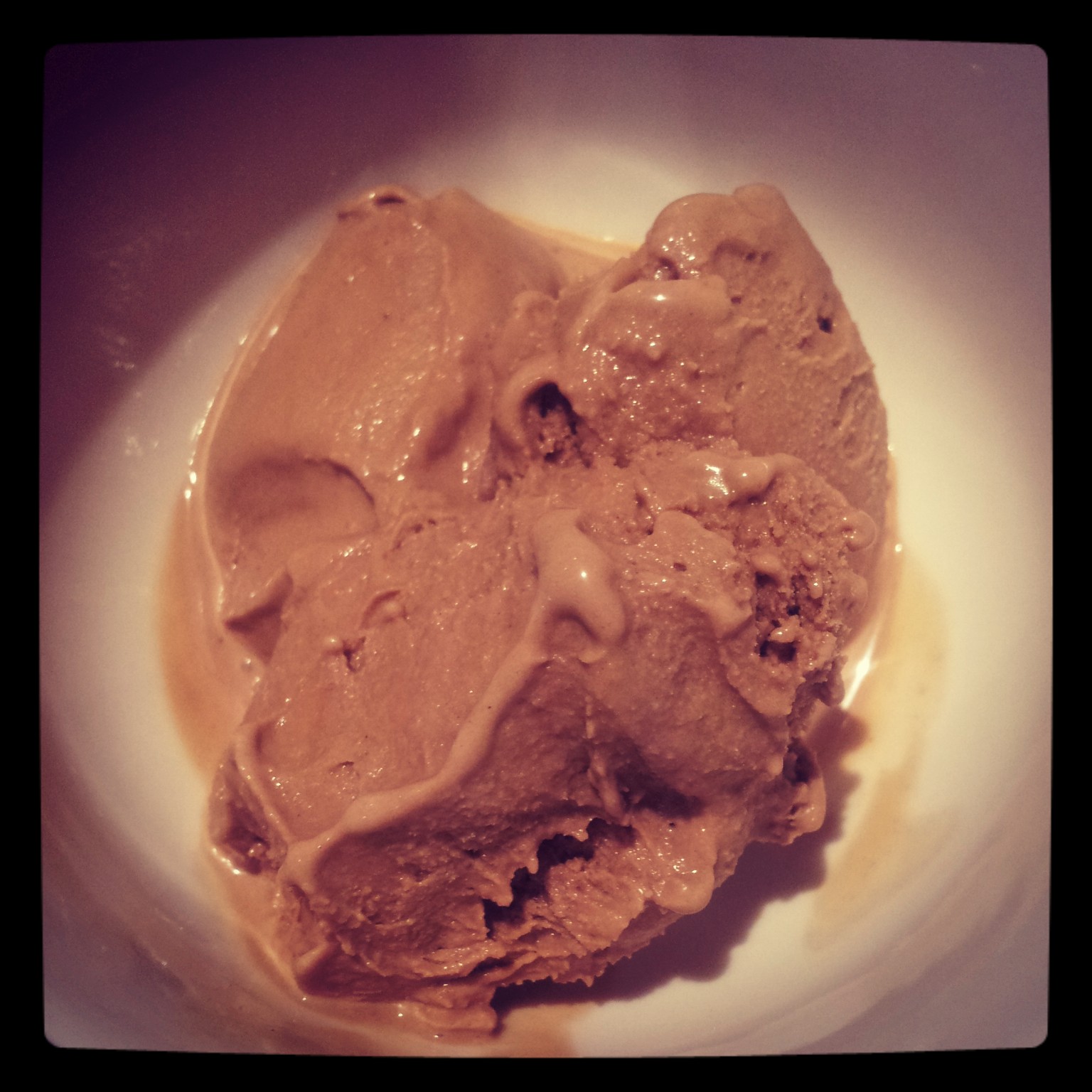
How to make Homemade Espresso Gelato recipe

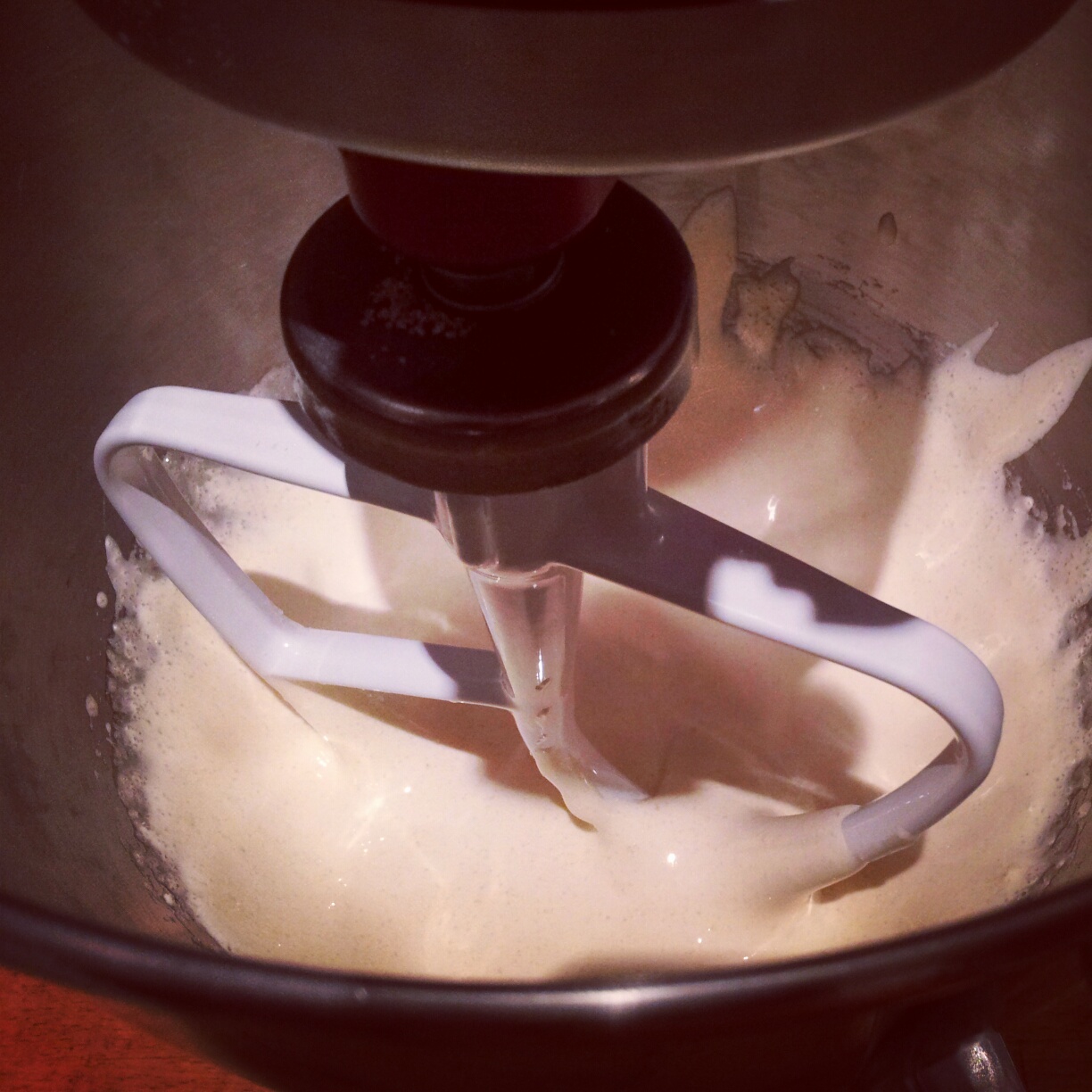
Homemade Espresso Gelato

100 Boozy Birthday Cupcakes and Counting

We have been busy bees recently. I put some of our wedding present vouchers to very good use and invested in a beautiful Candy Apple Kitchenaid Mixer. I have christened her Joni and she has already proven her weight in gold.

Introducing Joni my candy apple buttercream dream making machine Kitchenaid mixer

Introducing Joni my candy apple buttercream dream making machine

My 30th birthday was approaching fast and wanting to mark the occasion my friend Jill (who’s birthday just so happens to be the day before mine!) and I decided to have a little soiree at our local pub. Cupcakes seemed to be a good option for a gathering, so we didn’t have to worry about plates, knives and such like. It also meant that we could go a bit mad with the flavour combinations too.

What a lucky birthday girl I am with 2 surprise birthday cakes!

On my actual birthday! What a lucky birthday girl I am with 2 surprise birthday cakes from my mam and my sister. We’re not going to go hungry. EVER.

The week before our birthdays, Jill and I spent a merry evening baking everything in sight. Modifying Hummingbird Bakery recipes to our hearts content. It’s amazing what can be achieved in 3 hours by two 29 year old girls, armed with a Kitchenaid and a bottle of prosecco. We got very creative indeed.

How many cupcakes can 2 girls make in less than 3 hours whilst drinking a bottle of fizz??

How many cupcakes can 2 girls make in less than 3 hours whilst drinking a bottle of fizz?? There’s still more in the oven…

We baked well over 100 cakes and still made it to the pub afterwards to meet our husbands. I must admit we sampled rather a few along the way so not all of the cakes made it into our freezers to await their icing. It’s hard to resist when you’ve got cupcakes hot out of the oven dancing in front of your eyes.

The beginnings of Pina Colada Bundt cakes from a genuinely German Gugelhupf tin!

The beginnings of Pina Colada Bundt cakes from a genuinely German Gugelhupf tin! Soaking in white rum syrup

The following week we defrosted our cupcakes and spent an entire day icing the lot, with lashings of buttercream, glitter and ganache. The results were very well received by our friends and the bar staff! The Jasmine green tea cupcakes were a surprise success after I accidentally  emptied the entire bottle of Jasmine Extract into the cupcake batter… They are the most fragrant cupcakes I’ve ever created. Perhaps an acquired taste for some and definitely an excellent air freshener accessory.

Amaretto and Coconut Snowball cupcakes

Amaretto and Coconut Snowball cupcakes – my personal favourite. I shall be rolling many more cakes in coconut in the future

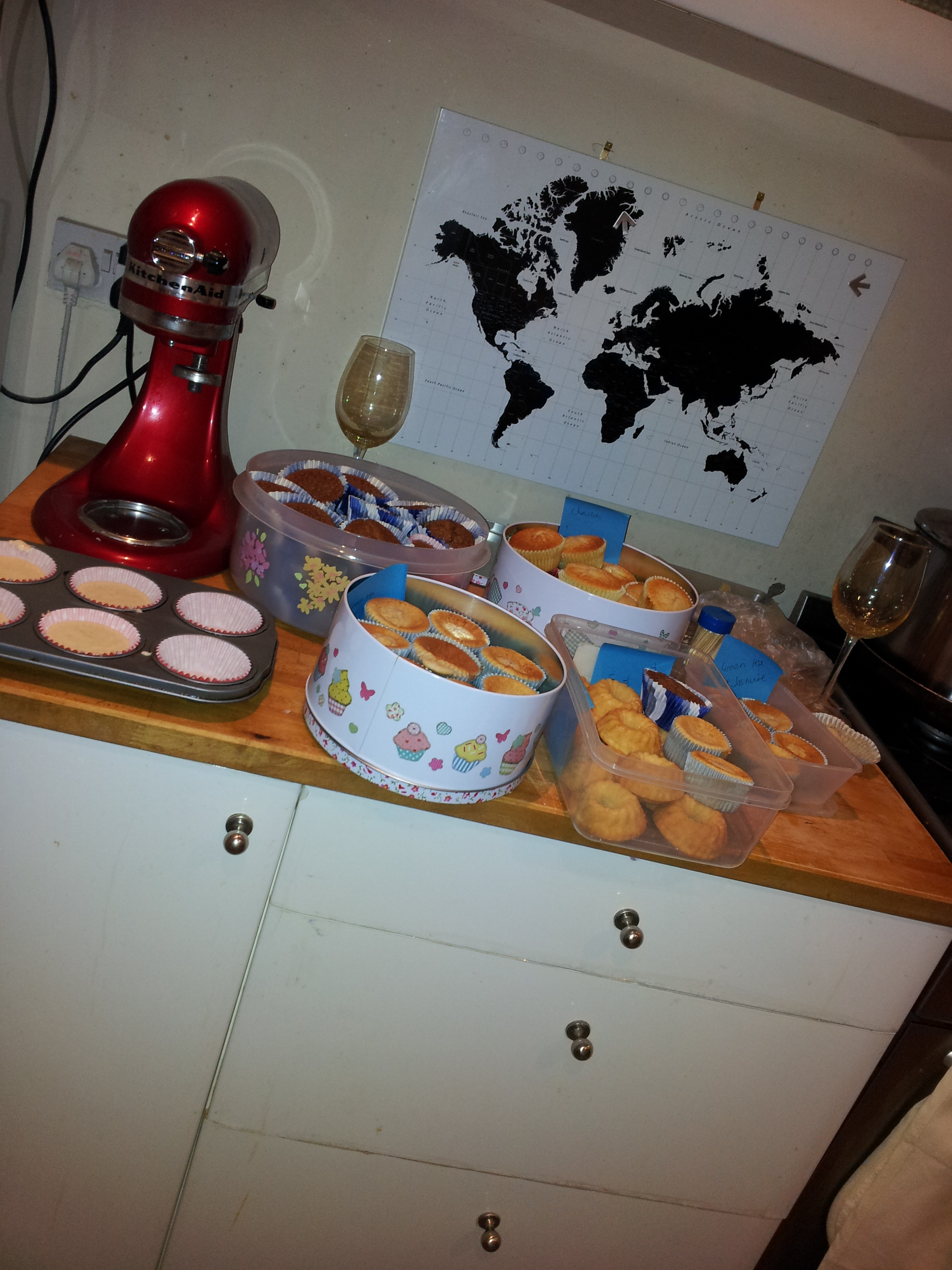
Our 30th birthday party cupcake table

Our 30th birthday party cupcake table! (From left to right; coconut mini bundt cakes, amaretto snowballs cakes, pina colada bundts, jasmine green tea, double chocolate, more jasmine green tea, amaretto sours, and peppermint cream cupcakes,)

Amaretto Sour Swirl Cupcakes

Amaretto Sour Swirl Cupcakes

Pina Colada Gugelhupf cakes

Pina Colada Bundt (Gugelhupf) cakes

Extremely fragrant Green Tea and Jasmine Vintage Rose Swirl Cupcakes (With obligatory birthday glitter and lustre powder)

Extremely fragrant Green Tea and Jasmine Vintage Rose Swirl Cupcakes (With obligatory birthday glitter and lustre powder)

Double chocolate Cupcakes complete with golden lustre, glossy ganache and white chocolate hearts

Double chocolate Cupcakes complete with golden lustre, glossy ganache and white chocolate hearts

Chocolate and Peppermint Cream Cupcakes

Chocolate and Peppermint Cream Cupcakes

Happy birthday to us! What a wonderful start to the new decade!

The Creative Cupcake Modification Method

I’m not entirely sure if this is the scientific way to create your own recipes but it seems to work for me. My basic understanding of creative baking is to find a recipe that works for you then add and subtract from it. Experiment to the extreme! My general guidelines are

  1. Don’t alter the specified oven temperature (unless you have to because you’re using a fan/non fan oven) cupcakes bake at around 170-180 degrees Celsius and should take about 20 minutes depending on the size of your cases
  2. Maintain the combination of wet to dry ingredients
  3. Use whatever is in your cupboards
  4. Feel free to double the quantities if you need to bake lots but be prepared to bake them in stages
  5. Naked cupcakes freeze really well and can keep for a month. Freeze them as soon as they’re cooled in freezer bags/Tupperware and this holds all of the moisture in sponge. Leaving you with a wonderfully moist cupcake when you choose to ice it later on.
  6. You normally need more buttercream than you think so again feel free to make a double batch!
  7. The more you beat buttercream the better it is.
  8. Feel free to experiment with shapes if you have a Madeleine tin, Gugelhupf or mini bunt tin they work really well too
  9. A squiggle of melted chocolate works wonders if you can’t be bothed to whip up buttercream to top your cakes and a sprinkle of coconut and glitter hides a multitude of sins

The Basic Cupcake Recipe

Makes 12-16 cupcakes (using cupcake not muffin sized cases)

For the sponge:
Rub together (using an electric whisk if you have one) the sugar, butter, flour salt and baking powder. When it all looks quite sandy beat in the wet ingredients including your choice of flavouring!

Then pour the smooth liquid batter into prepared cupcake cases in a muffin tin.
Bake for 20-25 minutes in the centre of the oven at 170 degrees celsius until golden brown and springs back when pressed. To be extra certain they’re cooked insert a cocktail stick and if it comes out clean it’s definitely done.

The Basic Cupcake Sponge Ingredients

  • 120g  (4½oz) plain flour
  • 140g (5oz/) caster sugar
  • 1½ tsp baking powder
  • A pinch of salt
  • 40g (1½oz) unsalted butter, at room temperature
  • 120ml (4½floz) milk
  • 1/4 tsp vanilla extract
  • 1 egg

Cupcake Roulette!
Choose from an array of flavour combinations such as

Green Tea

  • 3 Jasmine Green Tea bags steeped in 3tbsp just-boiled water (reduce the amount of milk by 3
  • Replace 30 ml of milk with jasmine extract

Vanilla

  • 1 vanilla pod
  • Replace caster sugar with vanilla flavoured sugar (if you have pre-prepared some but if not don’t worry!)
  • 1 tsp vanilla extract

Amaretto

  • Replace 40ml of milk with amaretto
  • You can also add almond extract for extra oomph

Amaretto Sour

  • Replace 40ml of milk with amaretto
  • Add 1 tsp lemon extract
  • Add zest of one lemon

Coconut

  • Replace 25g of flour with desiccated coconut
  • Use coconut milk instead of normal milk

Chocolate

  • Replace 20g of flour with cocoa powder

Lavender

  • Steep the milk in 1 tbs of dried lavender flowers overnight
  • Infuse the sugar with 2tbs of dried lavender flowers for a week
  • Sieve the lavender petals out of the sugar and milk before use
  • Blitz 1 tsp of lavender into the sugar before use

Rose

  • same as lavender but using dried rose petals
  • Replace 1 tbs of milk with rose water

Piña Colada

  • Replace 40ml of milk with Malibu
  • Replace 25 g of flour with desiccated coconut
  • Use coconut milk instead of milk
  • (soak cupcakes in rum syrup whilst still warm)

Chocolate Brandy

  • Replace 40ml of milk with brandy
  • Replace 20g flour with cocoa powder

Orange

  • Use orange extract instead of vanilla
  • Add orange zest

The possibilities are endless! Create your own flavour combinations!!

You could choose your own favourite liquor, (Gin?)  cordial (sasparilla, blackcurrant), extract (Orange Blossom, violet), and just follow this idea. I’m very tempted to create some Brandy Alexander cocktail cupcakes very soon…

Then to choose your topping to enhance your flavour combination even further…


The Basic Buttercream Recipe
Depending on your style of icing you may want to double the quantities of buttercream. Piping swirls and roses uses a lot more icing than creating a palette knife swirl.

  • 25 ml milk
  • 250g icing sugar
  • 80g unsalted butter, softened

Icing Flavour Options

Vanilla

  • 1 tsp vanilla extract

Amaretto Sour

  • Replace 25 ml milk with amaretto
  • 1 tsp lemon extract
  • Zest of 1 lemon

Coconut

  • use coconut milk

Peppermint

  • Use 1 tsp peppermint extract

The General Buttercream Guidelines

You can see here the rules are simple. Add whatever flavour extracts you like. Substitute milk for liquid or boozy flavourings.  Zests are good to add as they are dry so won’t effect the consistency of the buttercream. If your icing is looking a bit sloppy beat in some more icing sugar and return it to the fridge to set a bit if it’s too runny.

Use a piping bag and star shaped nozzle to pipe swirls,  Mr Whippy peaks, stars or roses onto your cupcakes. Or use a palette knife to smooth a swirl of buttercream onto your cakes.

Syrup

If you would like extra moist cakes you can add a syrup to the sponge whilst it’s still warm.

Tropical White Rum Syrup

  • 200ml white rum
  • 60g sugar

Warm the sugar and rum in a pan over a low heat. Simmer it until it’s reduced by half in volume. Once cooled pour over your cakes. Allow it to soak in before icing your cakes. Feel free to use other flavours too! Lemon juice, rose water, cordial etc make a really good syrup!

Colourings

Using a cocktail stick add a couple of drops of your food colour gel of choice and beat until its fully incorporated. You can always add more if needed.

If you want to swirl 2 colours together, split your buttercream in half. Colour each half whatever you fancy. Pipe one colour buttercream down one side of a piping bag and then pipe the different colour down the other side of the bag. You will then get a lovely swirl of colours on you cupcakes when piping the two colours simultaneously from the same bag!

Chocolate Ganache

  1. Heat up 300ml of double cream to just about boiling
  2. Take it off the heat
  3. Smash up equal amount of dark plain chocolate 300g
  4. Stir the chocolate into the hot cream until completely smooth
  5. Spoon a generous blob onto cupcakes and let gravity do the work to create a smooth level shiny ganache top

You could use white chocolate if you add more white chocolate to the mix as it contains less cocoa solids so it won’t set until there’s more chocolate than cream in the mixture.

  • 150ml double cream
  • 250ml white chocolate

Decoration
Arm yourself with a selection of…

  1. Sprinkles
  2. Glitter
  3. Desiccated coconut
  4. Chocolate shavings
  5. Hand made chocolate swirls (melt chocolate squiggle it onto some grease proof paper allow it to cool and hey presto fancy looking chocolate bits)
  6. Lustre powders
  7. Popping candy
  8. Pearls
  9. Cupcake wrappers (if you have some)

And go wild!

Cupcake Combinations That Work Well

  • Chocolate sponge and peppermint buttercream
  • Jasmine green tea sponge and vanilla buttercream
  • Chocolate sponge and chocolate ganache
  • Amaretto sour sponge and amaretto sour buttercream
  • Piña colada sponge and coconut buttercream
  • Amaretto sponge and coconut buttercream

46. Say hello to my Brazilian Roll ~ Rocambole Cake

image

Brazil is yet another country on my still to visit list. However I do have a lovely Brazilian friend who was an exchange student at my sixth form. We became firm friends over A Level Media Studies and parties. Thinking of you Gabriella when baking my Brazilian Roll or as you may call it in Brazil a Rocambole.

image

This bake reminds me of Mary Berry’s Chocolate Roulade (one of my very first around the world in 80 bakes more technical challenges). Both are very similar to the wonderful Swiss Roll however the distinguishing factor of the Rocambole and the Roulade is that they use whisked egg whites to fluff up the sponge. This means it’s a fragile cake but very light. Where as the Swiss Roll is more like a sponge cake, less delicate and probably (in my opinion) a bit easier to bake and to handle.

Traditionally the filling in a Rocambole is a Doce de Leite. This is a Brazilian favourite. It’s a creamy milky toffee sauce made from slowly reduced condensed milk. (It’s quite similar to the Italian toffee sauce dolce de leche). It’s reduced down over a low heat until caramelised to produce a thick fudgey gooey paste. As the filing takes quite some time to prepare it’s best to start with this! You need to be really careful with this as if the pan is left to boil dry the can could explode and really hurt yourself (and your kitchen).

how to make doce de leit Simmer an unopened can of condensed in a pan of water for at least 2 and a half hours

Simmer an unopened can of condensed in a pan of water for at least 2 and a half hours

Take one unopened can of condensed milk (Most cans in the UK randomly contain a very precise amount of condensed milk of 395ml. Who knows why? But the process is the same regardless of the size of your tin). Place your unopened can of condensed milk in a pan of boiling water and simmer it for 2 and a half hours. Keep an eye on the pan and keep topping up the water so the water level remains.always around 2 thirds of the way up the can. Allow the can to cool for about 30 minutes before opening it.

Evaporated milk isn’t the same and unfortunately won’t work as a substitute, as evaporated milk doesn’t have as much sugar in it. Never to be defeated I have managed to make doce de leite with evaporated milk. If you’re up for an experiment and evaporated milk is all you’ve got, you could get away with adding sugar to evaporated milk and dissolving it slowly over a low heat to create your own toffee sauce. (I have free styled this recipe before and it gave a rather more liquid toffee sauce so it can be done! Just add enough sugar until you reach your desired level of toffee colour and taste.)

how to make doce de leite

The grand reveal! My doce de leite looks suspiciously like condensed milk. No hint of toffee here. Back in the pan you go

Unfortunately I failed to let the water bubble (being a little too cautious – very unlike me!) so when I opened my can it still looked like condensed milk, just a bit thicker. However undeterred I threw it all into the pan and heated it on the stove to make my doce de leite directly in the pan. It does require a bit more attention and elbow grease however…

The slightly reduce condensed milk straight from the can, the bottom revealed some thicker doce de leit

The slightly reduce condensed milk straight from the can, the bottom of the can revealed  the beginnings of some thicker doce de leit. It’s a bit lumpy so needs a good whisk

I’m a little impatient and wanted it to thicken up quickly so kept increasing the heat and whisking by hand until it bubbled, then removed the pan from the heat to allow the residual heat to continue to cook the condensed milk. You need strong arms to keep whisking continuously as the milk thickens! (My arms weren’t feeling the strongest after a full day of Yoga handstands the day before but I still managed)

Whisking the condensed milk over a low heat to make doce de leit

Whisking the condensed milk over a low heat to make doce de leite

My impatience led my doce de leite to become extremely thick and it pulled the head off my hand whisk! However a little cold milk reduced the heat of the sugar to calm the doce de leite down. It allowed me to get the sauce back to a slightly more spreadable state. To stop the cooking process I placed the hot pan into a sink of cold water. In my ‘wisdom’ I then dipped my finger into the doce de leite to test if it was cool enough to spread! It was most definitely NOT cool enough and welded to my finger. I managed to pull the molten lava doce de leite off my finger and ran it under the cold tap. Did you know a piece of frozen melon makes a wonderful cold compress to take the heat out of a burn? Clutching my melon I managed awkwardly to continue to whisk the sauce still undefeated by my blistering finger. I ended up clutching on to more frozen fruit whilst spreading the doce de leit and rolling up the cake.

After a good 5 minutes of whisking and heating it turns a golden brown colour and becomes quite thick! Add a bit of milk to loosen the mixture if it needs it.

After a good 5 minutes of whisking and heating it turns a golden brown colour and becomes quite thick! Add a bit of milk to loosen the mixture if it needs it.

The cake itself takes hardly any time at all to prepare. The whisking is the most time consuming part of the Rocambole. Like a Roulade you have to whisk the ALL of the egg whites (there’s 5 eggs in this cake! That’s a lot of egg!) on a high speed setting. (If you have an electric whisk, if not prepare your arms for a bit of a work out!) until stiff and shiny. This takes about 5 to 7 minutes. The egg whites will double in size. I love this bit!

Whisking the egg whites to make Rocambole

Whisking the egg whites to make Rocambole

One slight difference between the Rocambole to a Roulade is that the egg yolks are then also whisked into the egg whites. (With a Roulade you whisk the yolks with the sugar and chocolate then fold it into the egg whites.) The Rocambole is a bit quicker banging it all together and whisking to your hearts content. You don’t want to knock any of the air out of the egg whites, so it’s best to beat the yolks lightly first so they are runny. You can then pour the egg yolks in as you whisk.

Adding egg yolks to whisked egg whites - rocambole

Whisking in the egg yolks to the egg whites – lovely creamy yellow colour and very fluffy!

Then to whisk in the sugar. The traditional Brazilian Rocambole recipe doesn’t include any flavourings or spices, it is a plain egg sponge. (A bit like my Chinese Egg Yolk Sponge favourite!)  Ever the experimenter I wanted to add a bit of flavour to this bake so I used vanilla sugar. I made this really simply by shoving a leftover vanilla pod, which I had scraped the seeds from for another bake, into a bag of sugar. I then left it to infuse it’s vanillary goodness for a couple of weeks. It smells lovely and gently flavours the sugar with a hint of vanilla. It’s a good way to get your moneys worth out of those more expensive ingredients as I hate to throw the pods away. I often pop a vanilla pod into any spirit that I have in my cupboard too. Vanilla Brandy or Vanilla Rum anyone?

Then to whisk in 5 tablespoons of water into the eggs and sugar - Rocambole

Then to whisk in 5 tablespoons of water into the eggs and sugar

The eggs should be seriously expanding and threatening to overflow the bowl by this point as they inflate rapidly. You need to continue to whisk the fluffy and shiny eggs whilst pouring in 5 tablespoons of water. This takes around 5 minutes of whisking.

Fold in the tiny amount of flour and baking powder

Fold in the tiny amount of flour and baking powder

In order to maximise the air in the cake and to avoid knocking the air out of the wonderfully fluffy eggs, sift in all 5 tablespoons of plain flour and half a teaspoon of baking powder. Then using your  best metal spoon fold in the dry ingredients gently. This is probably the smallest amount of flour that I’ve ever folded into a cake. It felt a bit odd as the flour just disappeared to the bottom of the bowl, but trust in the recipe, it definitely works!

Rocambole Carefully pour the mixture into a rectangular baking tin

Carefully pour the mixture into a rectangular baking tin

Line and grease a rectangular baking tin. I used a tin 37cm long by 22cm wide and 5cm high. Use a deep tin as it will rise in the oven.  This mixture is really delicate so to avoid knocking the air out of it, hold your bowl of mixture as close to your tin as possible and pour. It’s a very liquid mixture so try to pour it into all of the corners so you don’t have to move it around too much in the tin. Gently level the mixture with a spatula to avoid an uneven bake.

A fully cooked and curled Rocambole

A fully cooked and curled Rocambole

After baking it in a preheated oven (350 F/170 degrees Celsius) for 15-20 minutes, it will become golden brown and feel slightly firm and springy to the touch. I always check that a cake is cooked by using a cocktail stick, if it comes out clean from the sponge you know it’s done. Unfortunately I was trying my Mary Berry recommended foil backed parchment paper and it doesn’t always do what it’s told. In the heat of the oven it curled up and into the cake! Maybe a wider variety of paper is needed for this tin so that it reached the edges of the tin and can be scrumpled down over the lip of the tin to hold it in place?

Carefully lift your cake from the tin and prise any baking paper out of the sponge (if needed)

Carefully lift your cake from the tin and prise any baking paper out of the sponge (if needed)

Allow the cake to cool in the tin slightly so it holds it’s shape. Then carefully lift the cake out of the tin, by the baking paper. But don’t remove the baking paper.

Spread the Doce de Leite carefully onto the sponge - try not to take the cake with you

Spread the Doce de Leite carefully onto the sponge – try not to take the cake with you

Using a spatula and a palette knife , I tried to spread  a thin layer of doce de leite across the cake. This is easier said than done whilst holding a piece of frozen fruit on your burnt finger. The Doce de leite is very gooey and if it’s as thick as mine, it could pull holes in your cake (note the holes in my sponge above…) But who is going to check the inside of your cake? When it’s rolled up no one will notice  and it’s going to taste gorgeous anyway so throw it on as best as you can.

Carefully does it ... Roll Roll Roll your Rocambole

Carefully does it … Roll Roll Roll your Rocambole (excuse my slippers)

There is a bit of a knack to rolling up a Rocambole. I decided to neaten up my slightly rough edges, trimming the longest edge as straight as possible with my very best sharp knife. It’s not the easiest cake to trim as the sponge is very moist and delicate (so it sticks to the knife!). I only trimmed one edge in case I destroyed the other side. This cake was to accompany me to the Clandestine Cake Club and I didn’t have time to make another one (or anyone condensed milk!). Trimming the cake does have it’s benefits however, I could make sure it tasted good before serving it up to my friends! 


Ta da! One rolled up Rocambole!

Ta da! One rolled up Rocambole! (And one pan of soapy boiling water on the stove to dissolve all of the doce de leite)

Before I even attempted rolling the cake I made sure I had loosened all of the edges from the baking paper gently with my fingers to avoid tearing the sponge. It’s best to keep the sponge on the paper so you can use the paper to coax the cake over. I started the roll off by pressing a knife into the sponge about half an inch in from the shortest edge. I then folded this lip of sponge over to start the roll and give a really tight spiral. Then to let gravity do it’s job! Lifting the paper over,  letting the cake fall into place whilst coaxing it into a roll with your hands. Once you start it’s easy to get carried away! Hence my lack of photos of this process the Rocambole was all rolled up before Chris could get into the kitchen to take a photo for me!

Rocambole recipe Gently ease any slightly stuck bits  of cake off the paper using your finger tip...

Gently ease any slightly stuck bits of cake off the paper using your finger tip…

All of the pictures I could find of a Rocambole seemed to show a cake with a very long spiral with a very thin sponge so I chose to roll mine from the short edge to the short edge, to maximise my spiral. If you wanted to get more slices out of your Rocambole you could roll from long edge to long edge and get a much longer cake.

Just rolled Rocambole - trimmed edge to the front!

Just rolled Rocambole – trimmed edge to the front!

Once you’ve rolled up your Rocambole all it needs is a liberal dusting with icing sugar and you’re good to go! I recommend eating it quick as the doce de leite has a tendency to ooze out of the sides when left for a night. But if you like this effect then see if you can hang fire for a bit for an extra level of goo.  I can confirm that this a tasty cake. It’s definitely a winner if, like me, you have a sweet tooth as most of the flavour is derived from the sugar in the cake and the milky caramel doce de leite! It’s an extremely tender sponge that almost melts in your mouth. I’ve heard very good things from my Brazilian friend, who’s Grandma makes Rocambole. She covers the entire Rocambole in chocolate buttercream and adds some texture with a fork to create a chocolate log Rocambole! Now there’s a good idea for another Christmas bake to add to my list!

Clandestine Cake Club Newcastle at Pink Lane Coffee

Glorious Cake Collection at the Clandestine Cake Club Newcastle at Pink Lane Coffee

I took my little Rocambole along with me to the Clandestine Cake Club  at the lovely Pink Lane Coffee shop in Newcastle where we were baking around a ‘New’ theme. This could mean a new recipe, new baking tin, new ingredients. This was perfect for me as pretty much every recipe I bake is new to me and a bit of an experiment. There were some amazing cakes that night, my favourite being a chocolate and peanut butter layer cake (7 layers in total!). Check out Lisa’s blog for more gorgeous pictures of the beautiful cakes from all of the bakers who braved the January snow. When there’s cake nothing will get in my way. It was immense. I must admit I took an extra sneaky piece home for later too. I was so happy that all of my Rocambole got eaten.

So if that has whetted your appetite for a spot of Rocambole here’s what I used to make mine.

Ingredients

Doce de Leite Filling

1 unopened can of condensed milk (395 ml)

Alternative fillings…

If you don;t fancy simmering a can of condensed milk down in a pan I’m sure you could put a jar of nutella or jam or guava marmalade (another traditional Brazilian Rocambole filling) to good use here too.

Cake

  • 5 eggs
  • 5 tablespoons of vanilla infused  sugar (or just normal sugar will do)
  • 5 tablespoons of water
  • 5 tablespoons of plain flour
  • 1/2 teaspoon of baking powder

Happy Christmas – The Rosca de Reyes results are in!

A very decadent Rosca de Reyes - 3 Kings Cake

A very decadent Rosca de Reyes – 3 Kings Cake

Wow what a year this has been indeed! We’ve made it over half way around the world in 80 bakes, ran my first half marathon (raising over £700 for Oxfam!), baked (and devoured) some wonderful (and some not so wonderful…) cakes AND been very lucky indeed to win the Blog North Best Food and Drink Blog Award.

Great North Running

Great North Running

And that’s not even the end of this amazing year’s excitement, it doesn’t all finish there! I’m very excited to let you know that I won the online bake off and £500 of holiday vouchers for my Rosca de Reyes 3 Kings Cake! Amazing! Thank you all so much for reading, commenting and also voting for me. I can’t thank you enough for your support and love. We will be using the £500 of Cosmos Holiday vouchers to book our honeymoon in the new year, a trip somewhere hot and relaxing will be perfect after our wintery wedding (which is taking place in less than 2 days…)! Fingers crossed the cake stays upright!

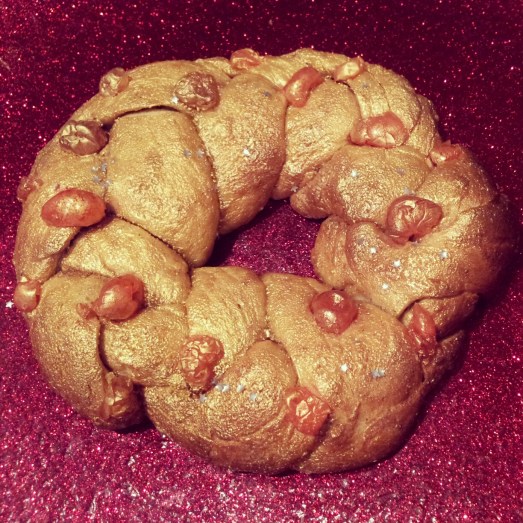
A golden Rosca de Reyes

A golden Rosca de Reyes

The lucky winner of the £50 very.co.uk voucher is Jenny B. The company will contact you directly to arrange your voucher. Thank you so much for voting!

I can’t go without mentioning the 4 brilliant bakers and bloggers, in the Rosca de Reyes bake off. They are exceptionally good bakers and I’ve been enjoying their blogs for over a year now and follow them all on twitter. I really recommend checking out their blogs, if you haven’t done so already. They are very talented and inspirational foodie bloggers.

I hope you all have had a wonderful Christmas and are looking forward to the New Year as much as me. I will be returning shortly as a married baker, with a new name and everything. Looking forward to letting you know how my biggest challenge so far pans out… my 5 tier wedding cake!

Lots of love and happy new year!

Lauren x x x

p.s Now would be a perfect time to have a go at baking your own Rosca de Reyes to celebrate the Epiphany on January 6th.

p.p.s. My golden Rosca de Reyes – 3 Kings Cake even got a mention in the The Mirror within an article about Christmas eats and treats around the world!

45. Rosca De Reyes – Spanish Three Kings Cake

Rosca de Reyes - 3 Kings Cake

Rosca de Reyes – 3 Kings Cake

I’m so excited! I’ve been invited to join an online bake off with 4 amazing bloggers, including the wonderful Yasmin Lambert from the Great  British Bake Off! We’re all baking the Spanish festive bake, Rosca de reyes and the baker with the most votes will win £500 worth of holiday holiday vouchers! (which would come in very handy for our honeymoon which are still yet to arrange following our wedding in less than 3 weeks…) I’m so happy to also be able to offer you the chance to win  £50 of vouchers to spend on the very.co.uk Christmas Shop, perfect for finding those last minute Christmas gifts! My first ever competition on aroundtheworldin80bakes! 

If you would like to enter this competition all you need to do is vote for my Rosca de Reyes (aroundtheworldin80bakes) on the Cosmos Holidays website by leaving a comment at the bottom of the article and a 5 star rating. This would be very gratefully appreciated! You can see the full Rosca de Reyes in all it’s glory over on the Cosmos holiday website. The closing date is Wednesday 19th December. Then please let me know that you have voted by leaving me a comment on (any or all!)

This means I can then contact you if you are the lucky winner. I will choose one winner at random from all of those who vote for me. You could tweet something like “I’ve voted for @laurenprince #roscadereyes  to win£50very.co.uk vouchers http://aroundtheworldin80bakes.com #bakeoff #competition Vote to enter”

Now for the bake itself! I hope you like it!

Rosca de reyes  (Kings’ Cake) is a traditional Spanish  cake with an amazing story. It’s eaten on 6th January, the day that the 3 Kings (or wise men) reached the stable to visit Jesus.  This is also known as the religious holiday the Epiphany, a day where Christians celebrate the Son of God taking on human form as baby Jesus. In some countries this is the day that children open their presents rather than Christmas Day so this day definitely needs a special cake to celebrate!  A little figurine or a bean is usually hidden inside the cake to represent baby Jesus fleeing from King Herod who was trying to kill Jesus. Whoever finds the baby bean/figurine is blessed  as ‘King’ or ‘Queen’ of the banquet and should take the figurine to church with them on February 2nd. In Mexican cultures this person also has to throw the Epiphany banquet party for their families and friends the following year!

I’ve never eaten a Rosca de reyes despite all of our family holidays in Spain as a child. We always visited Spain in the Summer holidays where we contented ourselves eating ice cream and custard filled donuts whilst basking in the sun on the beaches instead. Some of our best family holidays were in Spain, so this recipe intrigued me. I’ve never attempted to hide things inside my cakes before and was unable to find a figurine in my house small enough, or that wouldn’t poison us all so I decided to make one out of sugar paste instead and hope that it doesn’t melt in the oven!

My marzipan interpretation of the baby Jesus...

My marzipan interpretation of the baby Jesus…

Looking for a suitable recipe I discovered there are quite a few variables. The Rosca de reyes is usually a ring shape or it could also be an oval (depending on how many people you’re baking for!). The festive dried fruits usually include wonderful reds, greens and oranges so you could use cherries, apricots, figs, cranberries, or mixed candied peel. The choices are endless.

This is essentially an enriched dough, shaped into a bejewelled festive wreath. It’s a bit of a cake/bread/pastry hybrid and stuffed with beautiful dried fruits.

Whizz up the flour and yeast

Whizz up the flour and yeast

If you’re using instant dried yeast you can throw it straight into your flour and mix it evenly through the flour. Using my Russian Doll measuring cups makes life a bit easier than weighing things out on the scales.

As it’s almost Christmas (we’re celebrating on 15th December this year as our wedding is just around the corner…) I wanted to make light work of this recipe. I struggle to knead dough for a long time, I’m simply not tall enough to put enough weight into it! So I whacked it all into my food processor to ease the process. If you don’t have a food processor you can mix it together by hand instead.

Grind up a star anise

Grind up a star anise

I whizzed the yeast and the flour together first to make sure the yeast is evenly distributed throughout the flour. Then while the food processor was running I added the dry ingredients first, the sugar, salt, cinnamon and ground star anise.  The spices really enhance the colour of the dough giving it a wonderful brown hue.

Rub in the butter

Rub in the butter

Once this is combined I popped the butter in and rubbed/blended it into the flour.

Rub in the butter until it looks sandy

Rub in the butter until it looks sandy

Followed quickly by the  beaten eggs, vanilla pod seeds and water. In the future I probably wouldn’t add any water as this made an extremely wet and sticky dough which meant my food processor went into over drive and actually caught fire! The poor food processor didn’t make it but the dough was thoroughly kneaded!


Beat in the eggs

Beat in the eggs


The food processor may screech a bit in protest but it can (usually!) knead the dough (using the dough hook) for a good 3 minutes before it starts to rock out of control and dance off the work top.

I had to add a little more flour in order to knead the dough by hand as it was more of a paste at this stage.

It was rather a sticky dough...


Once it becomes a firm dough it’s ready for a final knead on the work surface for 5 minutes or so until it bounces back when pressed lightly with a finger.

I had to bring out the cavalry to sort out this sticky mess - dough scraper!


Then to rest the dough for 2 hours in a greased and covered bowl in a warm place until it’s doubled in size. Or if like me you like to do things in stages feel free to let it rise slowly over night in the fridge and shape it at your leisure the next day.

A nice firm brown dough


When the dough has risen, punch it down and knead it thoroughly before starting to shape it into a ring or wreath. This really reminds me of my Swedish Tea Ring attempt. Roll it into a rectangle  about 30cm by 20cm. I oiled the board to stop the dough from sticking rather than dusting it with flour.

Roll it out to an even rectangle about 5mm thick

Roll it out to an even rectangle about 5mm thick

Spread the melted butter all over and give a generous coating to the outside edge of the dough.

Spread a generous coating of melted butter all over


I found I had an extra bit of dough which I trimmed off to make my rectangle extra straight. I used this to make another plaited version of Rosca De Reyes later on.

My second plaited Rosca de Reyes


Line the dough with an even covering of candied fruits, cinnamon and sugar.

Coat with sugar and spice and all things nice


Take your figurine/bean (or in my case a hand crafted marzipan baby Jesus) and hide him amongst the fruit.

Hide your figurine inside the fruit


Then roll it up into one long sausage, from the longest edge to the longest edge.

Roll roll roll your dough


Once you have you sausage shape you can add a smattering of melted butter to one end and coax the 2 edges together to form a ring. Feel free to pop a small greased pudding dish in the centre of the ring to ensure the ring has a hole in the middle as the dough rises.

The final sausage shape


A final egg wash and decoration with your chosen candied fruits, I used glace cherries and mixed peel, and it’s ready for the final proving.

Using lazy egg wash in a can (!) and dotting with cherries


Cover your ring with greased cling film to prevent it sticking and leave it for an hour to double in size on a baking tray greased and lined with greaseproof paper.

Bejewelled and ready to prove itself


After 40 minutes in the oven at 170 degrees C the Rosca De Reyes will have taken on a golden tinge and be firm to the touch. You can check it’s cooked through by tapping the bottom, of the ring, it should sound hollow.

Straight from the oven


Once it’s cooled completely I carried on decorating my Three Kings Cake. I’ve been saving my gold lustre spray for a special occasion and this seemed to be the perfect time to use it! I thought the gold would add a regal touch to the ring and additional symbolism as one of the 3 Kings brought gold as a present for baby Jesus. So I’m presenting a very gold Rosca de Reyes to you!

Then it seemed a bit too gold… so I added a sprinkling of marzipan stars with a dab of brandy on the back of each star to hold it in place. The original plan was to add just the one star, as the 3 Kings followed the star to Bethlehem to find baby Jesus in the stable, however I got a bit carried away with my cutters and made an entire starry night of marzipan instead. Resulting in a very decadent Rosca De Reyes!

A very decadent Rosca de Reyes - 3 King's Cake


With my left over dough I created a plaited Rosca De Reyes and smeared cinnamon, butter and sugar in between the plaits and dotted a few more glace cherries on the top. I hid one whole cherry underneath and tucked it into the dough.

A golden plaited Rosca de Reyes


Once it was baked I also gave it a liberal coating of edible gold lustre.

This bake feels so festive and is a wonderful cake to share with friends and family. It’s a bit like hiding a silver sixpence inside your Christmas pudding, waiting in anticipation to see who finds the baby Jesus inside their piece of bread. I loved this bake and think it may become a regular festive creation in my house. The egg wash gives the outside a fantastic bite to it. I love warming spices and this definitely packs a punch, with the cinnamon and star anise spices in the dough, carried through to the spicy sugary fruit inside. It is also rather reminiscent of a sticky Chelsea bun but even more festive and sparkly!

Cinnamon swirls - a slice of Rosca de Reyes


Marzipan is not traditionally found inside Rosca de reyes, but I adore it and try to fit it into everything that I possibly can. The addition of marzipan made the rosca de reyes slightly stollen-esque and what’s not to love about stollen? (It’s another of my favourite festive bakes – as if I don’t have enough already?!)  I try not to waste any ingredients  and wanted to put my left over marzipan to good use from icing my Wedding and Christmas cakes. You can adapt this recipe to suit your own favourite ingredients and play around with the shape too. Have fun and hope you enjoy it as much as me!


Things I used to make Rosca De Reyes:

Bake for approximately 45 minutes at 350 degrees F or 170 degrees C

  • 1/3 cup warm water (only add as much as you need)
  • 1 packet of yeast (7g dried instant yeast)
  • 4 cups flour
  • 1 cup sugar
  • 4 large eggs, beaten
  • 3/4 cup butter, room temperature
  • 1/4 teaspoon salt
  • 1 1/2 teaspoons cinnamon
  • 1/2 teaspoon ground star anise
  • 4 teaspoons vanilla extract

Filling

  • 2 tablespoons unsalted butter, melted
  • 1/2 cup sugar
  • 2 teaspoon cinnamon/mixed spice
  • A marzipan baby Jesus (or you can use a small figurine or toy or a bean)
  • Dried/candied fruit (about 2 cups of assorted fruit cut into small pieces  such as sultanas, orange/lemon peel, mango or cherries)

Decoration

  • Large dried fruits (so they don’t burn in the oven) such as glace cherries
  • Beaten egg (to wash over the whole ring)
  • Edible gold lustre spray (or glitter) if you wish!
  • Marzipan and star cutters

44. A Healthy Christmas Pudding? – a very English recipe

image

Can this be real? Is there such a thing as a healthy Christmas Pudding when you soak your fruit in booze and add copious amounts of sugar? Well according to the Great British Bake Off (series 2 cookbook) it is. So what’s the difference you may wonder? It’s breadcrumbs, would you believe and no suet!!

image

Obviously I can never leave a tried and tested recipe alone so I accidentally modified it… I decided to make it nut free, adding the equivalent amount of dried fruit in place of the nuts to soak in the booze. Then promptly forgot about my decision and added the nuts as well. This will surely be an extra fruity pudding!

I have only attempted one Christmas Pudding, an original Bero recipe, full of suet and other wonderful stuff. However it didn’t cook all the way through despite it’s initial 3 hours of steaming and the additional steaming on Christmas Day itself.

I got a bit carried away when purchasing fruit for my enormous wedding cake   (which actually turned out to be a good thing – it’s a LONG story- but in a nutshell I ruined 3 cakes in the process of baking my 5 tiers so had to bake 8 fruit cakes in the end!) Even with the additional 3 cakes bakes I still had enough dried fruit to bake 2 Christmas Puddings! Hurrah! (I also have plans for my rather sad 3 wedding cake tiers, they will not go to waste!)

image

As with all good festive fruit recipes I started with soaking the fruit in Booze, Brandy to be exact, along with some lemon juice. The recipe only requires a soak over night but I decided to soak it in a tupperware pot in the fridge for a few days instead. Surprisingly the most effort in this entire pudding is the weighing of ingredients and bread crumbing. (Totally discounting the watching of the pot bubble for 3 hours of course…)

image

The breadcrumbs required a little preparation so a quick blast in the hello kitty toaster and a whizz with the blender makes some lovely breadcrumbs and decorates the kitchen beautifully in bread dust.

Whilst the bread is toasting you have time to whisk together the butter, honey and sugar until light and fluffy. Then to whisk in each egg individually. The more you whisk the lighter the pudding, so whisk away!

wpid-2012-11-25-18.16.09.jpg

Whisked up and fluffy butter, sugar, honey and eggs with a smattering of grated apple

Then to stir in the grated apple, spices, (nuts) and brandy soaked fruit.

Stirring in the spices, nuts and grated apple

Stirring in the spices, nuts and grated apple

With the grand finale stirring in the toasted breadcrumbs along with the dried fruit.

image

This forms quite a pale and loose mixture Once it’s all mixed together well it’s ready to be spooned gently into your pre prepared greased pudding bowls.

image

This recipe is enough to make two Christmas puddings. I used a 1lb bowl and a 3/4 1 lb. bowl.

image

Fill the pudding basins until at least 3/4 full and make sure the pudding is level by pushing the mixture level with a spatula and tapping the bowl gently on the worksurface to release any air bubbles.

image

Then for the exciting bit! I’ve read so much about wrapping puddings in greaseproof paper with a pleat (a double fold about an inch wide) in it to allow room to expand as the pudding steams, but never before have I actually had a go at it!

image

Both puddings needed a lid made out of a layer of greaseproof paper and tinfoil (both with wonderful pleats) before being trussed up like a turkey in lashings of my trusty cotton string.

image

There is definitely a knack to this technique. My theory is always to tie stuff as tight as possible, it needs to be water tight, (you don’t want to drown your pudding when you submerge it in your pan of boiling water) and when in doubt add more string and tin foil. I added a full coat of tin foil, wrapping the pudding basin from the bottom to ensure the water couldn’t seep into the pudding. It seemed to do the trick. I added an additional length of string, tying it to the string around the edge if the puddings to create a handy handle for lifting out in and our of the pot too.

image

Dinner plate face down in the pan

I had planned to economise and steam both puddings together however I failed to measure the pan…. So 2 separate pans were required to steam the little beauties.

image

Pudding basin balanced on top of the plate inside the pan

I popped a dinner plate (face down) into my largest pan and a saucer into my smaller pan to balance the puddings on. I boiled the kettle and carefully poured the boiling water into each pan until it reached 2/3 of the way up the side of the pudding basin. Then to pop on the pot lid (an essential bit of the steaming process to keep the heat and moisture in) and let the puddings steam gently in the simmering water. It’s a good idea to allow some of the steam to escape by creating a vent (I tilted my pan lid and as my other pan lid was broken many moons ago I used even more tin foil with a hole in the top to create a lid) This takes about 3 hours on a low heat. I had to keep my eye on the pans and top up the water a couple of times as a pan should never be left to boil dry (this can cause the pan to explode!). So please be careful! My pans and plates made a few worrying noise over the next few hours, clattering about so perhaps a smaller plate would be a better idea to avoid the rattling!)

image

Double Bubble – 2 pans steaming 2 puddings simultaneously

After 3 hours remove the puddings from the pans and allow to cool. Take off their tin foil and greaseproof paper and wrap them with a fresh coat. This will help to create a seal and prevent any mould from forming on your lovely puddings. I placed a clean saucer on the top of mine to weigh down the paper and create a good seal.

image

Freshly steamed and cooled pudding. Ready for a tin foil coat and a sleep in the fridge

These puddings will keep for up to a month in the fridge or up to 3 months in the freezer, but once defrosted they will need to be eaten within a week. If you were making a traditional pudding with suet they can be kept for about a year to mature so you can make them well in advance! I’ve just read that freezing your pudding helps to speed up the maturation process. So this could be a good option if you haven’t had a chance to prepare it in advance. My puddings are currently having a snooze in the fridge until 15th December as we’re celebrating Christmas a little early in the Prince household! I may even give them both a little drink of brandy to help keep them warm for the next 3 weeks. 🙂

The puddings looked a little paler than I expected after their 3 hours in their steam bath, I think this is due to the breadcrumbs and lack of flour. But I could tell that they were done as one pudding had shrunk back slightly from the side of the basin.  Unfortunately I can’t tell you how they taste yet, as I need to steam them for 3 more hours on Christmas Day (or 15th  December in my case – some of us have a wedding to prepare for and a 5 tier cake to finish decorating!) I will pop back to let you know how they turn out

Things I used to make Healthy Christmas Puddings 

  • 70g dried apple
  • 330g sultanas
  • 200g mixed peel
  • (total 700g of dried fruit – any combination could be used! I added more fruit to replace the nuts if you wanted to make a nut free version just omit the nuts below)
  • Zest of one grapefruit ( I had ran out of oranges so replaced this with the only citrus fruit I had to hand…)
  • 5 dessert spoons of Vanilla Brandy (to soak the fruit in)
  • Juice of 1 lemon (to soak the fruit in)
  • 50g sliced blanched almonds (I accidentally added the nuts which I had added more fruit to compensate for -you could reduce the amount of fruit you use by 100g if you would like to include the nuts?!)
  • 50g ground almonds
  • 75g brown sugar
  • 75g unsalted butter
  • 75g runny honey
  • 2 eggs
  • 1 medium apple grated (with  the skin on)
  • 125g toasted white breadcrumbs
  • 1/2 teaspoon all spice
  • 1/2 teaspoon cinnamon
  • 1/2 teaspoon ginger

(I heavily adapted this recipe to suit what I had in my cupboards. The original included pine nuts and fresh figs, so feel free to play around with the ingredients, your favourite fruit and nuts and what you can afford to include!)

  • 2 pudding basins (1lb each)
  • tin foil
  • greasproof paper
  • 2 saucepans and 2 saucers
  • Steam for 3 hours on a low heat
  • Refrigerate for up to one month or freeze for up to 3 months
  • On the day you wish to eat your pudding steam for 2 hours on a low heat before serving

image

43. Polvorón – Spanish Christmas Cakes or Mexican Wedding Cakes

image

Polvoron – you are always on my mind

I’ve had Polvorón on my mind for some time. I read about these crunchy little biscuits bites, months and months ago and they’ve been sitting patiently in my ‘Things to bake’ pile ever since.

They are quite an unusual discovery, something I had never heard if before. Traditionally Polvorón are eaten as wedding  cakes in Mexico made with pecans or as Christmas cakes in Spain, kind of like a Spanish Shortbread. Now I’m planning my own wedding I thought perhaps now is the time to incorporate an international flair into the festivities. Intrigued I launched into my own interpretation of the traditional recipe, basically determined by whatever ingredients I have in the cupboard.

image

Chopped up dried coconut

I don’t usually buy pecans or walnuts so they had to be substituted for good old almonds (a nut which is ever present in my cupboard and life…) and chunks of dried coconut roughly chopped.

Due to the speedy baking that was necessary (and seems to be happening more and more often in my house) I improvised yet again. No time to assemble to food processor so I grabbed the nearest heavy item (a glass jar), threw the almonds into a sturdy sandwich bag and hammered them with the jar until they were delightfully smushed. Feel free to use a pestle and mortar if you wish to be a tad more refined than I.

image

Beating the butter to a smooth paste

The ingredients are very similar to basic shortbread, with flour, butter and sugar.

image

Thoroughly whipped butter

This is another brilliant biscuit for busy bakers as I managed to whip up the dough first thing on a Saturday morning, chill it whilst I showered. I used my trusty hand held electric whisk to beat the butter and icing (powdered) sugar together. Then to whisk in the flour and vanilla extract.

image

Whisking in icing sugar, vanilla and finally flour

image

My combination of ground almonds, chopped blanched almonds and chopped coconut.

And finally the nuts of your choice.

image

The dough looks a bit scrambled eggy to start with…

image

Take a small amount of loose dough in your hand

I completely misunderstood the recipe which calls for the dough to be chilled. I shapped the dough by hand into about 35 mini golf balls.

image

squash it together and hey presto you have a ball!

I popped them all onto a greased and lined baking sheet covered them with cling film and popped them in the fridge to chill.

image

All the Polvoron lined up in a row – ready for chilling

(I think you’re supposed to chill the whole dough then shape it?!) But this gave me a chance to shower so in effect helped to speed up the process.

image

Delicately golden Polvoron fresh from the oven

I then spaced the little balls out evenly to give them room to spread whilst they baked. I popped the tray in the oven to bake it at 170 degree C for about 18-20 minutes, until they took on a delicately golden hue, whilst I applied clothes and make up.

image

Cooled and ready for a good dusting of spicy icing sugar

Just enough time to then allow the Polvorón to cool on the tray to set their shape for 5 minutes. Then to cool them fully on a wire rack to stop the butter sweating out of them and give them sticky bottoms.

image

Fully coated Polvoron

Once cooled fully I rolled the Polvorón in a bowl of icing sugar swirled with cinnamon giving them a fluffy white coat. As they set the sugar absorbed slightly into the biscuit adding an extra dimension of sweetness to the treat.

image

Happy Birthday Mel!

I then quickly bagged them up, tied with a pretty ribbon and dashed off with my pretty packages of Polvorón to celebrate my friends birthday! With a champagne fueled (10 minute) train journey to Durham. Followed by more food, cocktails and Polvorón.

image

Obviously I had to ensure their quality before sharing them with friends… they passed the test! Crunchy and sweet Polvoron

We declared them a tremendous cocktail accompaniment (and that’s not the frozen strawberry daiquiris talking).

Polvorón are buttery like shortbread but with an added crunch as they are smaller and denser than a traditional shortbread biscuit. The almonds brought a subtle creamy yet crunchy texture along with the coconut. I expect pecans would add even more bite to the biscuit. The Polvorón remind me a little of biscotti or amaretti biscuits which I also adore. What’s not to love about a delicious bite sized treat. Even better, as they’re so small you can obviously eat a whole handful of them in one go!

Polvoron – up close

I love the method of shaping these little biscuits into balls as I find rolling and cutting out biscuits a bit laborious  I quite enjoyed this hand made alternative and I’m already inventing my own nut free recipe for my friends who can’t eat nuts as I think everyone needs a bit of Polvoron in their lives!.

Things I used to make Polvorón

Makes about 35 small biscuits

Preparation: 15 minutes

Chilling time: 30 minutes

Baking time: 18-20minutes at 170degrees c

  • 220g butter (1 cup or 2 sticks)  room temperature
  • 250g powdered sugar (2 cups or 240 grams)
  • 2 teaspoons vanilla extract
  • 250g all purpose flour (2 cups or 240 grams)
  • 120 g (1 cup) almonds/pecans/coconut coarsely ground/chopped
  • 1/4 teaspoon ground cinnamon

Thank you to Sourdoughtheangrybaker for inspiring me to bake Polvoron! I had not heard of these wonderful cakes until you told me about them. Brilliant blog if you haven’t had a look already, I recommend reading.