28. Jamaican Black (Rum) Cake – The most alcoholic cake I’ve ever baked

Jamaican Black Cake

Officially the most alcoholic cake that I have EVER baked. Jamaican Black cake is most definitely not for the faint of heart or soberest of people. Containing 2 bottles of dark rum and a half bottle of Brandy, the fumes emanating from the cake are enough to make you slightly squiffy, never mind devouring a full slice!

Dark Rum (not just any dark rum but Marks and Spencers Dark Rum)

I happened upon the idea of a Jamaican Black cake when looking for Christmas cake recipes and I spotted it for sale at the continental Christmas markets. I required a wonderful cake recipe to bake for my first ever venture into the world of Clandestine Cake Club where the theme was cakes with beverages and also something luxurious for my mam’s mothers day present too. This is how I ended up scouring shops for a ridiculous amount of prunes, raisins, booze and Angostura Bitters. Did you know that they are difficult to find despite their 47% volume and are rumoured to be poisonous in large quantities… Good job this only needed 2 tablespoons of the pink stuff!

rum soaked fruit

I soaked the mammoth amount of dried fruit in an entire bottle (1 litre) of rum for about 2 weeks. I had to split the fruit into 2 jars as I simply did not have a vessel large enough to contain the copious amounts of booze and fruit.

I probably should have read the recipe more carefully as I would then have discovered that this recipe is enough to yield 3 or 4 cakes. I had produced a Jamaican Black Cake factory!! [I’ve revisited this recipe and reduced it down to Just the one Jamaican Black Cake here if you want to bake fewer cakes.]

The recipe also did not specify the volume of the bottles of booze so I shall let you know what worked for me (and as per usual I did end up substituting something for things that I like better. I hope that doesn’t detract from its Jamicanness? (or Trinidad – ianness origin also).

Rum soaked fruit… how much can I cram in to the food processor?

I figured that soaking fruit in this sheer amount of rum as well as being highly decadent is enough to ensure a good result (or get you very drunk so you no longer care what the cake actually tastes like). The idea behind such a long soak is to help macerate the fruit and also creates a much denser and moist texture than traditional fruit cake/Christmas Cake. I also think that it might make a wonderful Christmas pudding.
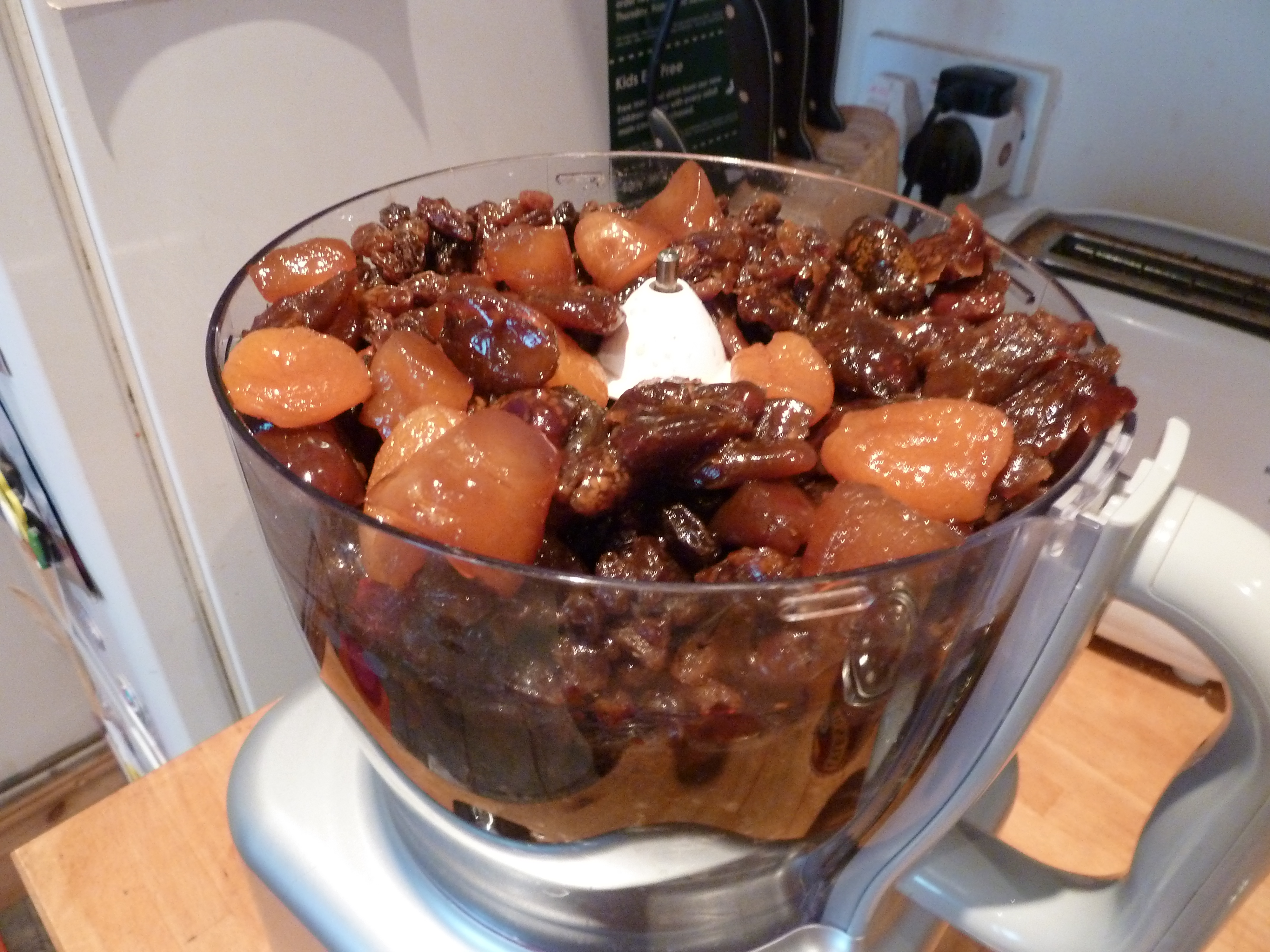
Maybe a bit more…

Following the long rum soak the fruit required mushing up. My weapon of choice was my food processor. Rather dangerously I crammed the entire fruit and rum mix into the bowl and forced the lid on. It took rather a lot of whizzing to get the mix to condense down into a fruit paste but it’s a determined little processor and did a wonderful job. Adding the Angostura bitters left a pink hue to the mixer bowl for future Jamaican Black Cake memories.

Eeek! Full to capacity but valiantly managed to macerate the fruit fully

With the food processor chugging away I had a chance to get on with ‘browning the sugar’. This is a new technique for me and undoubtedly adds to the depth of the final cake colour. Light brown sugar is heated in the pan until it melts to create a caramel. Adding a little water (in total half a cup) at a time. I struggled to get the sugar to melt and in frustration tipped all the water in, which wasn’t a good idea as it crystalised into chunks and required a much more vigorous heat and stir to get a smoother caramel. And even then it was still on the crunchy textured side for my liking. But I figured the heat of the oven would help to incorporate the crystals into the cake, I’m pretty sure I was right too! No sign of crunchy sugar lumps in the final cake.

Bubbling and browning the sugar to a caramel

Perhaps I was multi tasking to the extreme as I then attempted to beat the butter, sugar and eggs together whilst macerating the fruit and drowning/browning the sugar. But hey I have 2 hands, why not use them?!

Creaming the butter and sugar

After a short while I realised I don’t own a bowl big enough to house all of the cake ingredients in. I now had 3 separate and extremely full bowls which were already overflowing!! Once I stirred the browned liquid sugar into the beaten eggs and sugar I then only had 2 massive bowls of stuff to combine…

Mixing the browned sugar into the mix

Tonnes of butter, sugar, eggs and browned butter!

A spot of logical thinking brought me to the conclusion that this was possible, I just needed to divide the mix in order to conquer it.
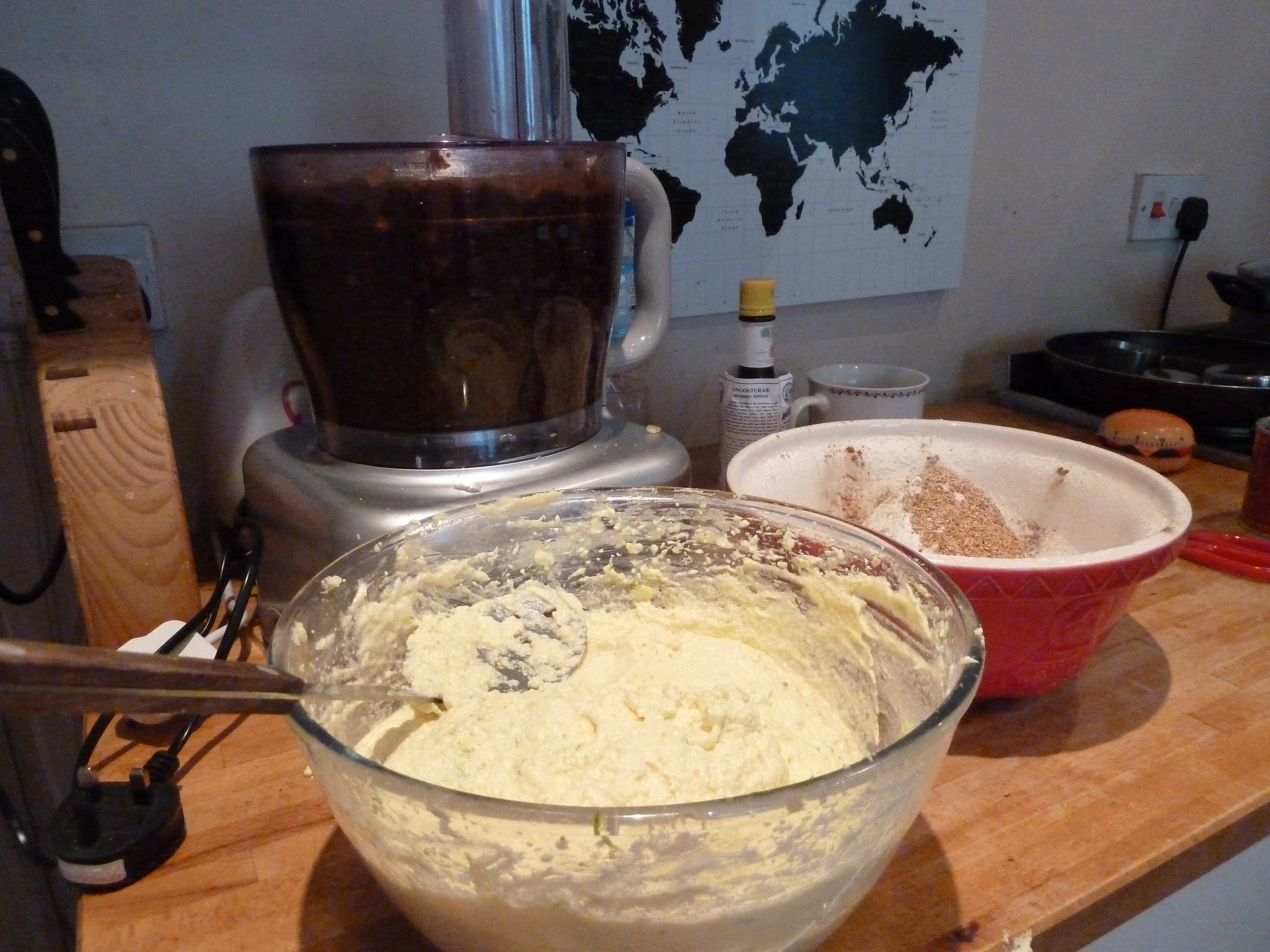
Emmmmm how do I combine all of this???

I poured roughly half the beaten eggs, butter and sugar into one large mixing bowl. I then decanted half of the mushed up fruit and rum on top of the batter. This meant I had some space to fold the mixture together with my metal spoon. Although some ingredients fell over board I feel I salvaged the majority of it.

Hope it doesn’t overflow…

I repeated the process in a separate bowl with the other half of the mixture. Although I’m sure my guess work is highly accurate I couldn’t help but notice one bowl of batter looked a bit blacker than the other which worried me that I had put more fruit in inequality bowl than the other but there was nothing to gain by fretting about it and these monster cakes needed a.good 3 hours in the oven so I had to plough on.

It was a bit of a tight squeeze!!

Fully combined all of the ingredients!!

I had already greased and double lined 2 round springform cake tins with an extra high collar fixed on the outside with string to prevent the cake top from burning. I used a.22cm tin and a 20cm tin and found I still had cake to spare so quickly greased my favourite bundt tin (with a very generous layer of butter as I couldn’t line the moulded tin with paper and wanted to make sure I could get the cake back out again!!) Due to its shape I also couldn’t tie a protective collar of greaseproof paper round the bundt tin so opted for a lid of tin foil over the top. This scrunched up edges to create a seal over the top of the tin and stayed put throughout the baking process.

Doubled lined and dressed in collars – cakes ready for the oven

I smoothed the tops of the cakes as flat as I could as I wasn’t expecting them to rise very much.

I did check on the cakes regularly and turned them slightly so as to avoid burning the edges. But I resisted opening the oven for at least 2 hours to keep the heat in and the cakes rising. No one wants a sunken and heavy cake…

Trio of Jamaican Black Cakes hot out the oven

After 3 hours they were definitely done and the skewer came out clean.

The final touch was to pour half a bottle of rum over the 3 cakes whilst they were still in their tins and warm.
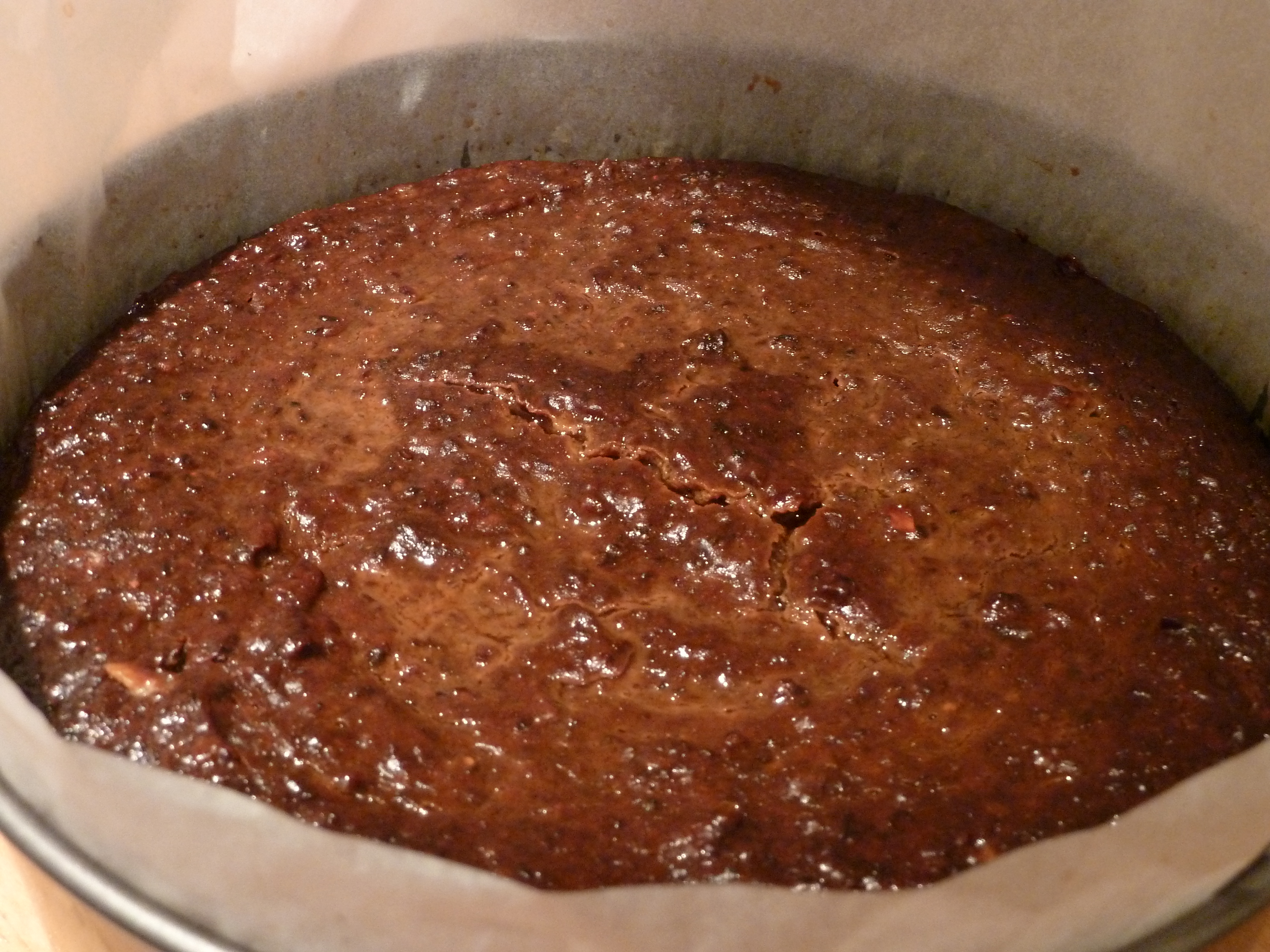
More rum glistening on top

What a wonderful cake! It was definitely worth the extra preparation time and although it’s not traditional to ice a Jamaican Black Cake, my Mam loves marzipan and royal icing so I created a Cath Kidston -esque star design especially for her using the largest of my trio of cakes. This wasn’t the easiest cake to ice as the cake was still rather moist (and full of rum) so I struggled to get the icing to stick. Some say that it is too sweet with the layers of icing, but I actually really quite liked it. It is very similar to a Christmas Cake however it smells so much more of booze and brings a lovely rose to the cheeks.

Cath Kidston Jamaican Black Cake

The second cake which I baked in the bundt tin required some coaxing to remove it from the tin. (I implemented a cocktail stick to loosen the cake around the sides, then I let gravity do the rest of the work, turning the tin upside down on a plate.) I took this to my first ever Clandestine Cake Club and shared the cake with lots of other cake lovers. I will tell you more about this another time 🙂

Jamaican Black Bundt Cake – note the slight cocktail stick indentations… oops but rum hides all sorts of sins

The more traditional shaped Jamaican Black Cake
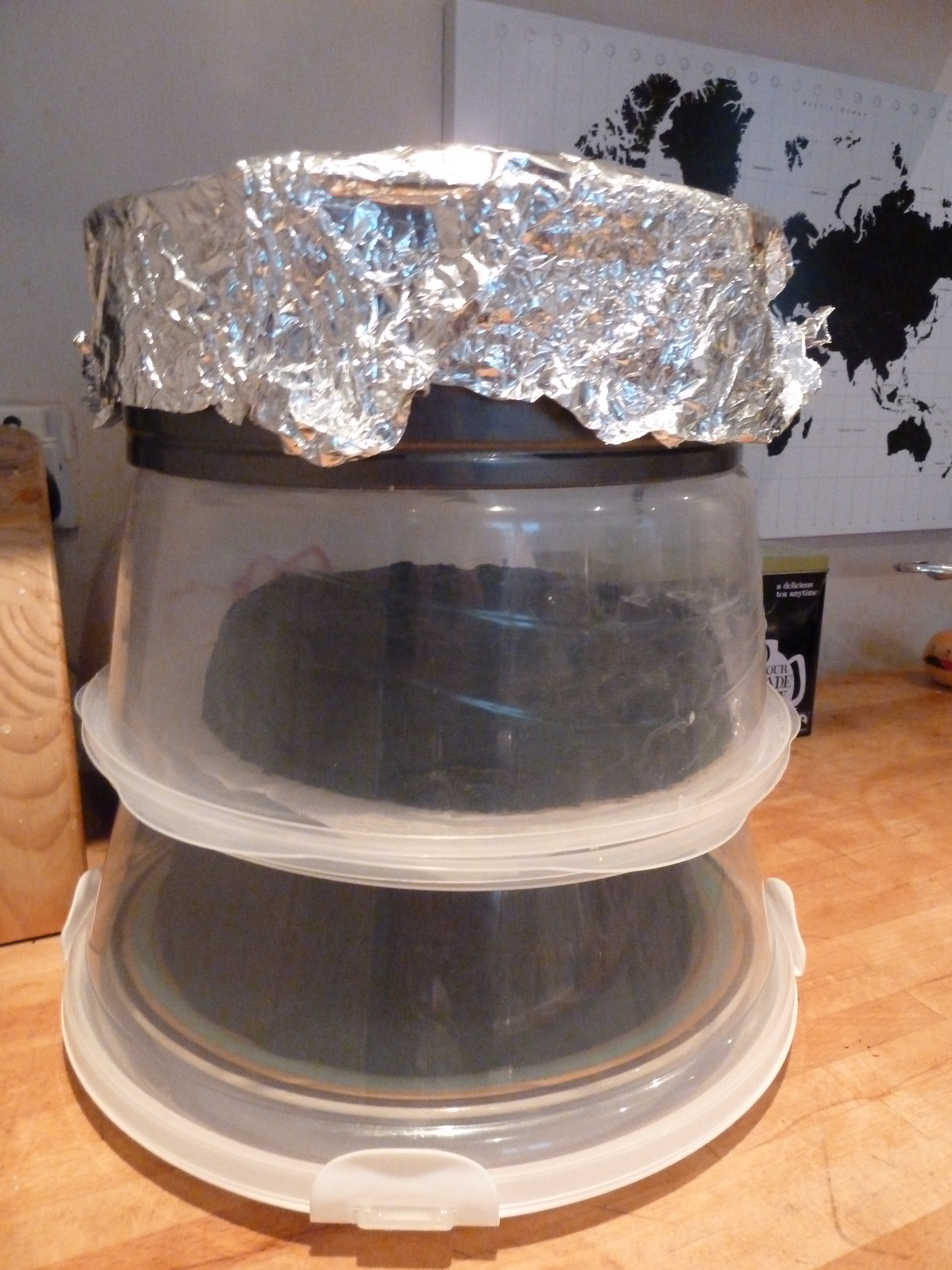
The Towering Trio of Jamaican Black Cakes

Things that I used to make Jamaican Black Cake…

An insane amount of dried fruit and alcohol! Although I didn’t stick completely to the combinations below I think you can play around with which dried fruits you use depending on what is available provided it all adds up to the same total amount of dried fruit. I also worked from 2 different recipes to make sure I had a good all rounder recipe and that I made it as authentically as possible.

[Since creating this recipe I have revisited it and reduced it so you can also now follow a recipe for Just the One Jamaican Black Cake if you prefer!]

Fruit Puree Base:

Soak the fruit in rum for up to 2 weeks (or at least 3 days) prior to macerating

  • 500g prunes
  • 500g dark raisins
  • 750g currants
  • 500g dried cherries
  • 250g mixed candied citrus peel
  • (Total of 5 and 1/4 pounds of dried fruit or 2.4 kilograms)
  • 1 bottle cherry brandy (I had to make do with plain old Brandy and used a 500ml bottle)
  • 1 bottle rum and/or Bailey’s (I used a 1 litre bottle of dark rum. I didn’t include Baileys)  -Other recipes also suggest using Manischewitz Concord grape wine which doesn’t seem to exist in England so I just opted for adding a bit more rum
  • 2 tbsp Angostura bitters

Browning:

Heat the sugar in a heavy based pan until it melts and then add a little bit of the water at a time until it becomes a dark caramel. Careful not to burn it, but it will come very close to being burnt to achieve ‘browned’ perfection.

  • 500g brown sugar
  • 1/2 cup boiling hot water

Cake:

Beat the sugar and eggs together and then beat the eggs in one by one. (You will need a big bowl as it gets a bit messy with 8 eggs!) Add all the flavours to the egg mix.

Sift the dry ingredients together and then fold it into the beaten eggs, sugar and butter.

Then mix in the fruit puree and browned sugar liquid.

Pour into 3 greased and double lined cake tins.

Bake at 120 degrees celsius (250F) for 3 hours

  • 500g unsalted butter
  • 500g sugar
  • 8 eggs
  • 1 tsp lemon essence (I didn’t have this so used lime juice instead…)
  • I used the zest of 2 whole limes (but then realised the recipe said 2 tsp lime rind)
  • 2 tsp almond essence
  • 2 tsp vanilla
  • 500g plain flour (I used plain white flour but you could make this cake gluten free by using your favourite gluten free plain flour or a combination of gluten free flours such as 250g cassava flour + 250g rice flour)
  • 4 tsp baking powder
  • 2 tsp mixed spice
  • 1/2 tsp grated nutmeg

The Final Touch:

Pour a generous amount of rum/brandy onto the top of your cake. It should absorb rather a lot of rum at this point. The cake will get darker with the more rum that you force feed it. It may take a day for the cake to absorb the rum but it will get there.

Wait until the cake has cooled completely before removing it from the tin and pop the cakes in an airtight container. I even left one cake in the tin for a week with tin foil over the top while it absorbed the rum (and I had ran out of containers big enough to keep it in!

MORE RUM 1 500ml bottle of dark rum for pouring on the hot cakes

Keeping Your Jamaican Black Cake:

The cake should keep for (at least) a month in an air tight container. Or perhaps even longer if you can resist eating it as it’s almost pickled with that amount of alcohol in it! Tin foil is also a good idea help seal in the rum and prevent the cake from drying out.

I froze my final cake and I think it will keep for at least a month in the freezer before I decide what to do with it.

This recipe was created using inspiration from Auntie Olga’s Trinidad Black Cake  and the Naparima Girls’ High School Cookbook.

Thank you for reading!
The Clandestine Cake Club Adventure

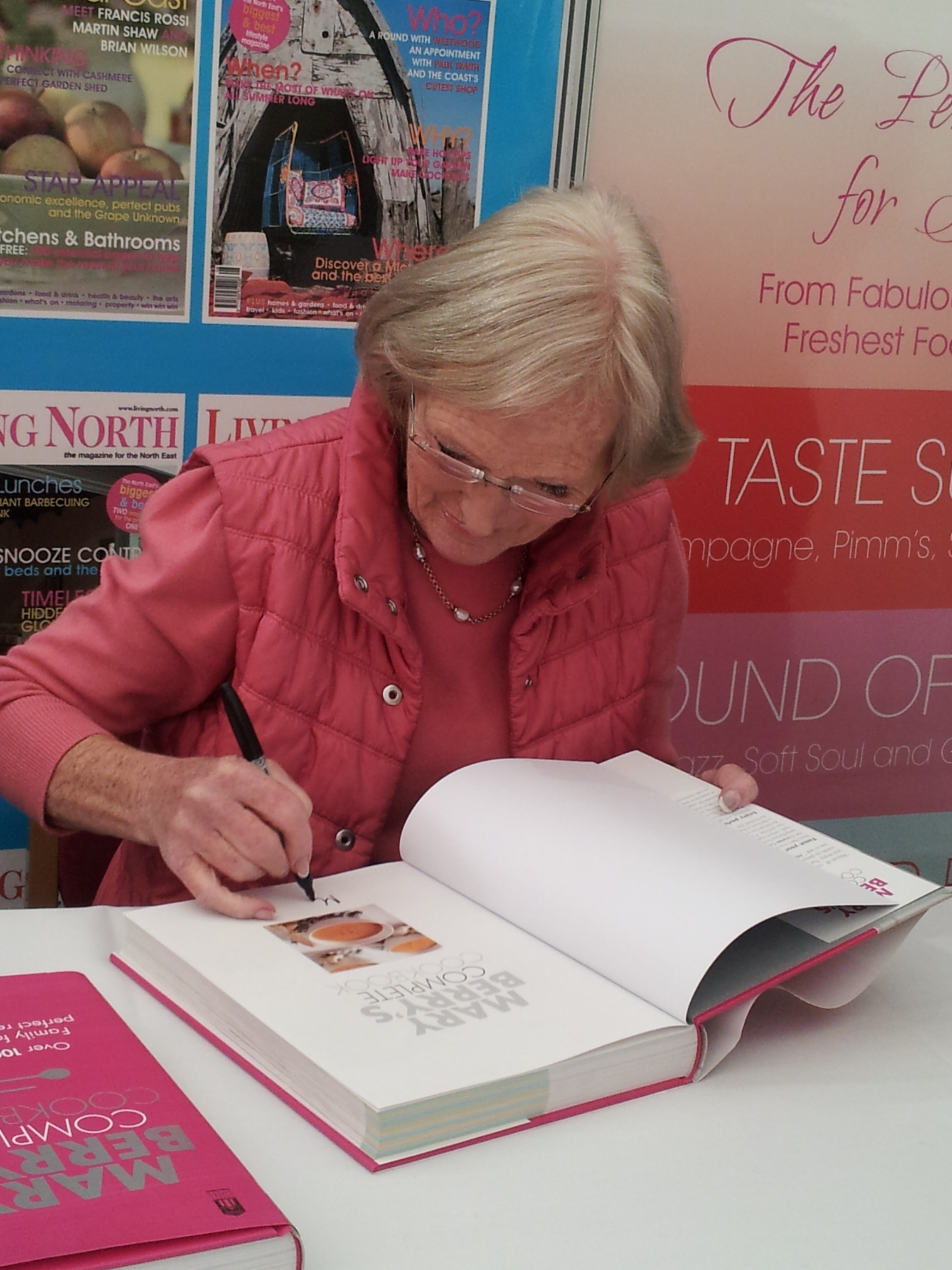
March was a fantastic baking month with my first ever trip to a Clandestine Cake Club and meeting Mary Berry (will tell you more about this asap). It just doesn’t get any better than this.

Meeting Mary Berry!!!! (The full story will follow asap)

I’ve been trying to get a spot at the Clandestine Cake Club (or CCC) for the last couple of months. I secured my place at the secret club and the theme was cakes with beverages. The idea of CCC is that bakers bake a cake around a theme and bring said cake along with a cake eating friend to the secret venue. Then much cake (as many wonderful slices as you can humanly consume) along with copious amounts of tea are devoured and fabulous cakey bakey people meet and discuss cake!

I loved this night. I sampled some AmAzing cakes and met some wonderful people, some of whom I’ve been chatting to on Twitter for a while so it was wonderful to meet in real life!

Clandestine Cake Clubbers in action

There may be a Clandestine Cake Club near you, it’s now an international phenomena with clubs in Australia too. Or you could even start your own club. There’s more information on their website….

For my beverage orientated cake I took along my Jamaican Black cake with it’s 2 bottles of rum and a bottle of brandy oozing from it. I was a little nervous as I knew there was going to be some wonderous cakes and people there. And I wasn’t wrong.

My First ever Clandestine Cake Club Offering - Jamaican Black Cake with tonnes of rum

I sampled a mouth watering 6 layer limencello and orange cake, a pink lemonade cake, a coconut milk cake, a cherry disarano on the rocks cake, a gin and tonic cake! A Shirley Temple cake, an Earl Grey cake and I’m sure I tried a couple more but my memory is fading into a drunken cake haze… We even got to take home pieces of our favourite cakes for later. (So pleased I had brought extra tupperware!)

I was thrilled that my entire Jamaican Black cake got eaten up!! I was worried that it would not be very popular. (As much as I love rum and fruit I’m well aware it’s not everyone’s cup of tea) But phew! It seems that it was enjoyed by my fellow CCC ers.

Unfortunately I failed in my over eagerness to get ANY real photos of the splendiferous cake creations that adorned the table. I remembered at the end to take one of the spectacular banqueting hall at Blackfriars restaurant with it’s stag antler chandeliers and oak dining tables.

The beautiful Blackfriars Restaurant our Clandestine Cake Club Venue for the evening

However my lovely CCC friends and fellow bloggers took some wonderful photos which they’ve put up on their blogs if you fancy a look. I really recommend having a look at these ladies baking blogs too and just in case you’re on twitter you can follow them too… check out

And also while I’m mentioning some of my favourite blogs, I was very lucky and honoured to be nominated for a Liebster Blog Award (see here for a little more information on the Liebster Blog Awards) from 2 fabulous baking bloggers!! These ladies are brilliant bloggers, very skilled and I always look forward to their next posts popping up in my inbox 🙂 IF you’re loking for baking inspiration don’t hesititate to have a read of these blogs…

Lil Ms Squirrels 366 Day Recipe Challenge (@lilmssquirrel)

Laura Loves Cake (@lauralovesbakes)

Thanks so much for reading!!!

26. The 10 Minute Irish Soda Bread Challenge – Ireland

Soda Bread

I’ve heard pretty good things about soda bread but never have I attempted to make it myself. I discovered a recipe from Ballymaloe House in Ireland, in my food processor cookbook that appeared to be very straight forward. Promising to only require 10 minutes preparation and 40 minutes cooking! I took on the 10 minute soda bread challenge and set to work.

This was actually very quick and dare I say it… Easy to bake! With very little kneading or washing up required. Hurrah!!

I literally whacked everything in the food processor…

  • 450g of plain flour (not bread or strong flour)
  • 500g of plain live (active/cultured) yoghurt (or alternatively you can use 350-425ml of buttermilk)
  • 1tsp Bicarbonate of Soda
  • 1tsp salt
  • 1tsp sugar
  • A glug of double cream (just because I needed to use it up)

… and set it to high for a couple of minutes using the dough hook attachment. You could use a bowl and a spoon or even just your hands to combine it all together into a runny, floury mixture.

Once it all comes together the challenge is to remove the sticky mess from the bowl in one swoop and not get coated in runny flour mess. I failed on this count and had to deploy a spatula to encourage the mix out of the bowl.

I tipped it out onto a lightly floured surface (also known as my glass worktop protector thing). Adding more plain flour to the board until I could bring the dough together without it adhering to my hands.

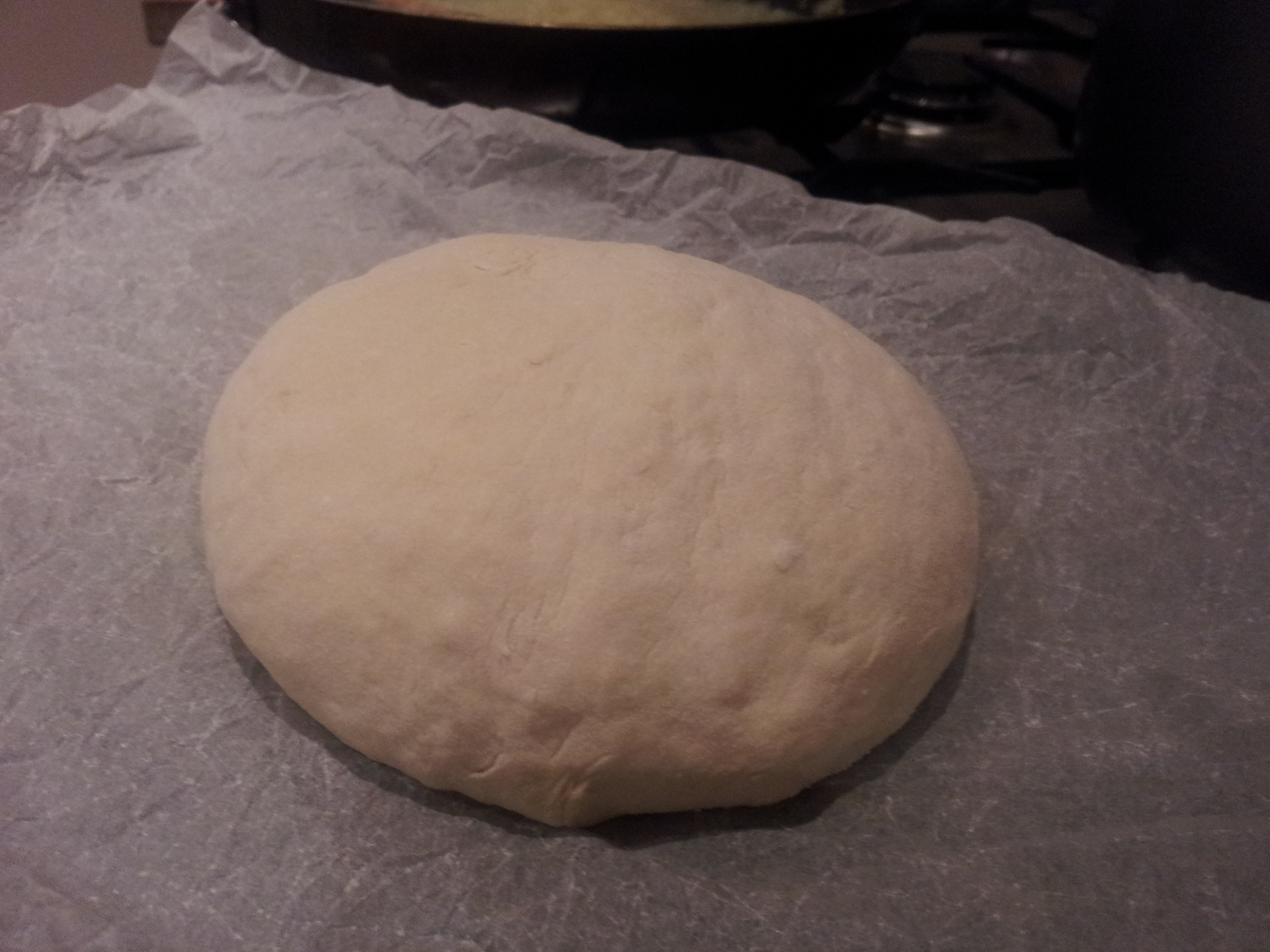
Once it starts to take shape all it needs is some encouragement, folding and lightly kneading the edges into the middle to form a round dough shape about 4 cm deep.

Flattened circle

I greased and floured a flat baking sheet and plopped the smooth circle of dough (folded edge down) onto the sheet.

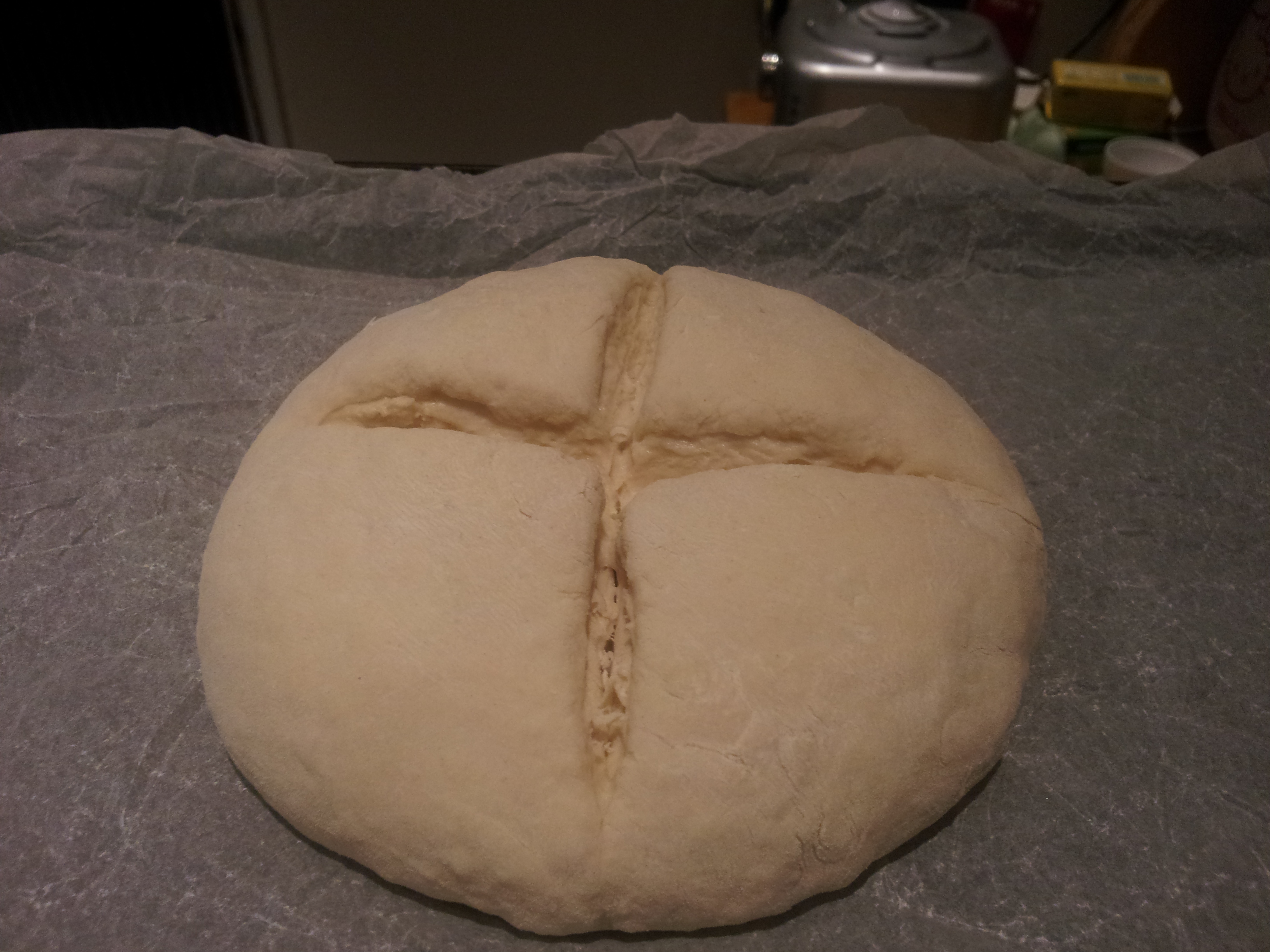
Challenge complete in less than 10 minutes!! Taking my sharpest knife I cut a shallow cross into the top of the loaf and teased the edges out slightly so the cross was more defined. The cross helps the heat penetrate the loaf and cook evenly throughout. Irish folklore also says that that the cross lets the evil spirits out. Good to know.

Criss Cross

Into the oven it went for 10 minutes at 230 degrees c. (gas mark 8). While the oven was heating up I popped a roasting pan in the bottom to get really hot. Then just before shutting the oven door I threw a cup of cold water into the pan to create some steam and a soft crust on the bread. Perfect! (I love this tip – thank you Holly Bell)

After 10 minutes I turned the oven down to 200degrees C (gas mark6) and baked for 30 more minutes until the crust was golden brown and the loaf sounded hollow when tapped on the bottom.

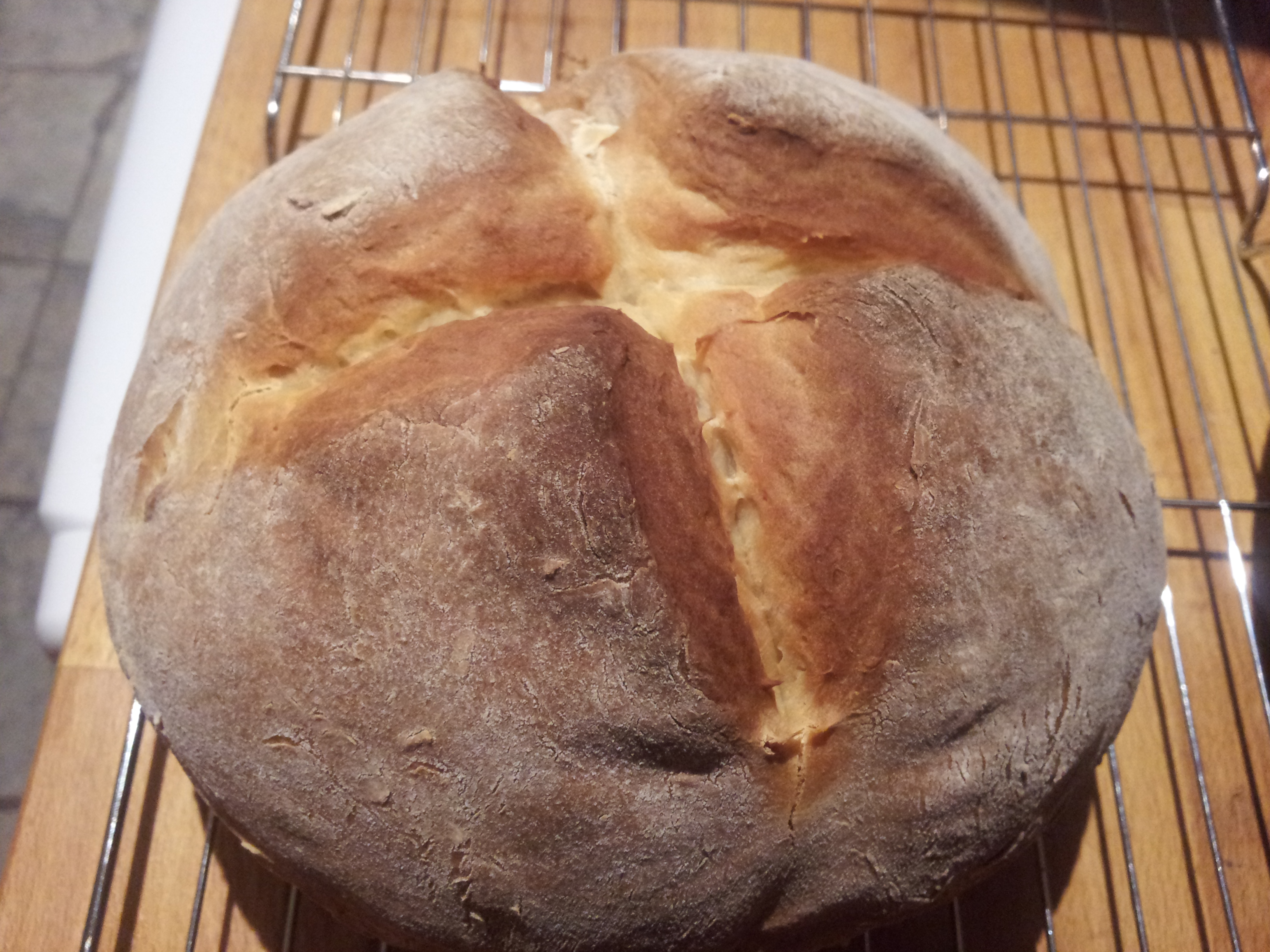
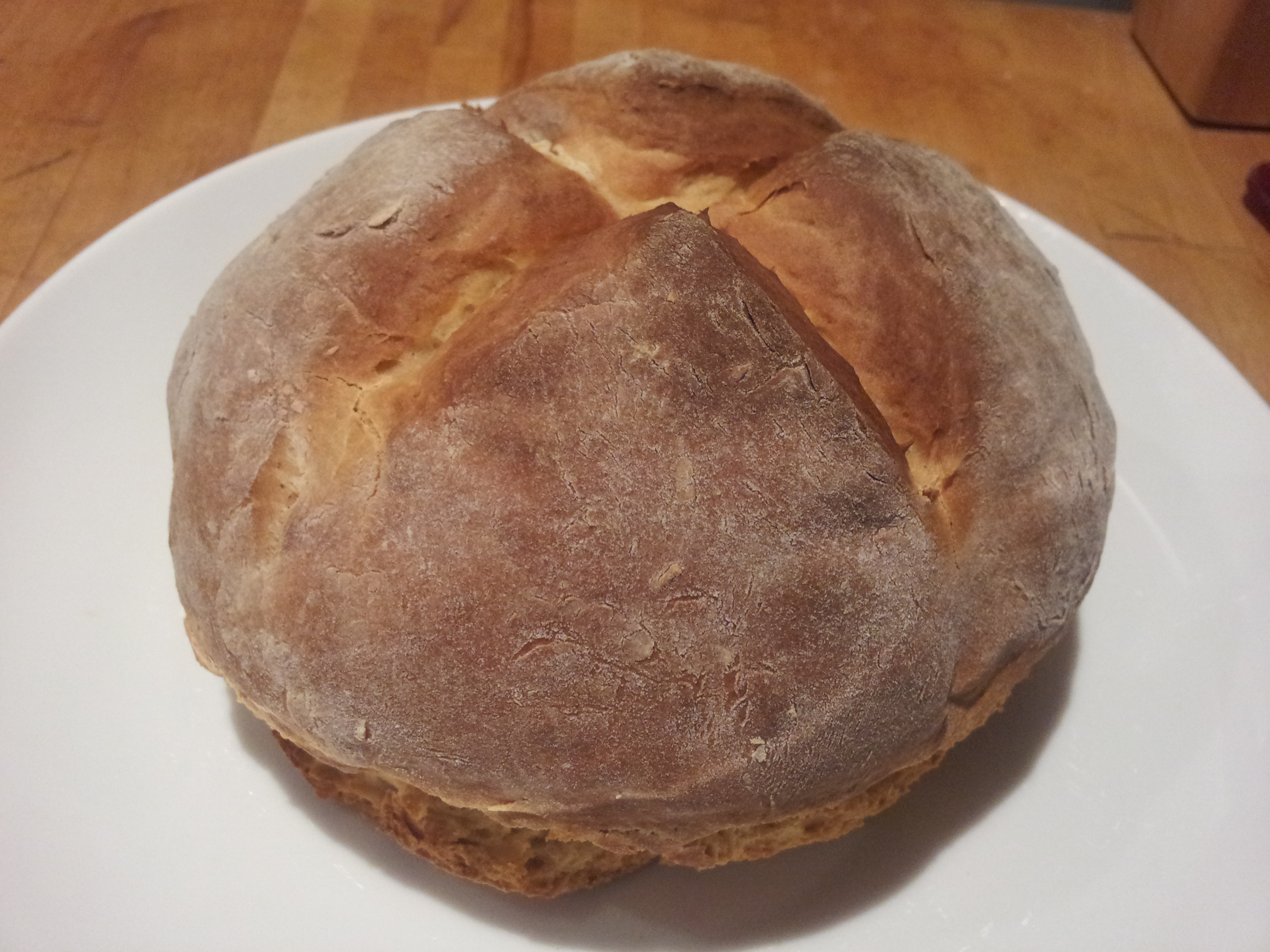
Risen

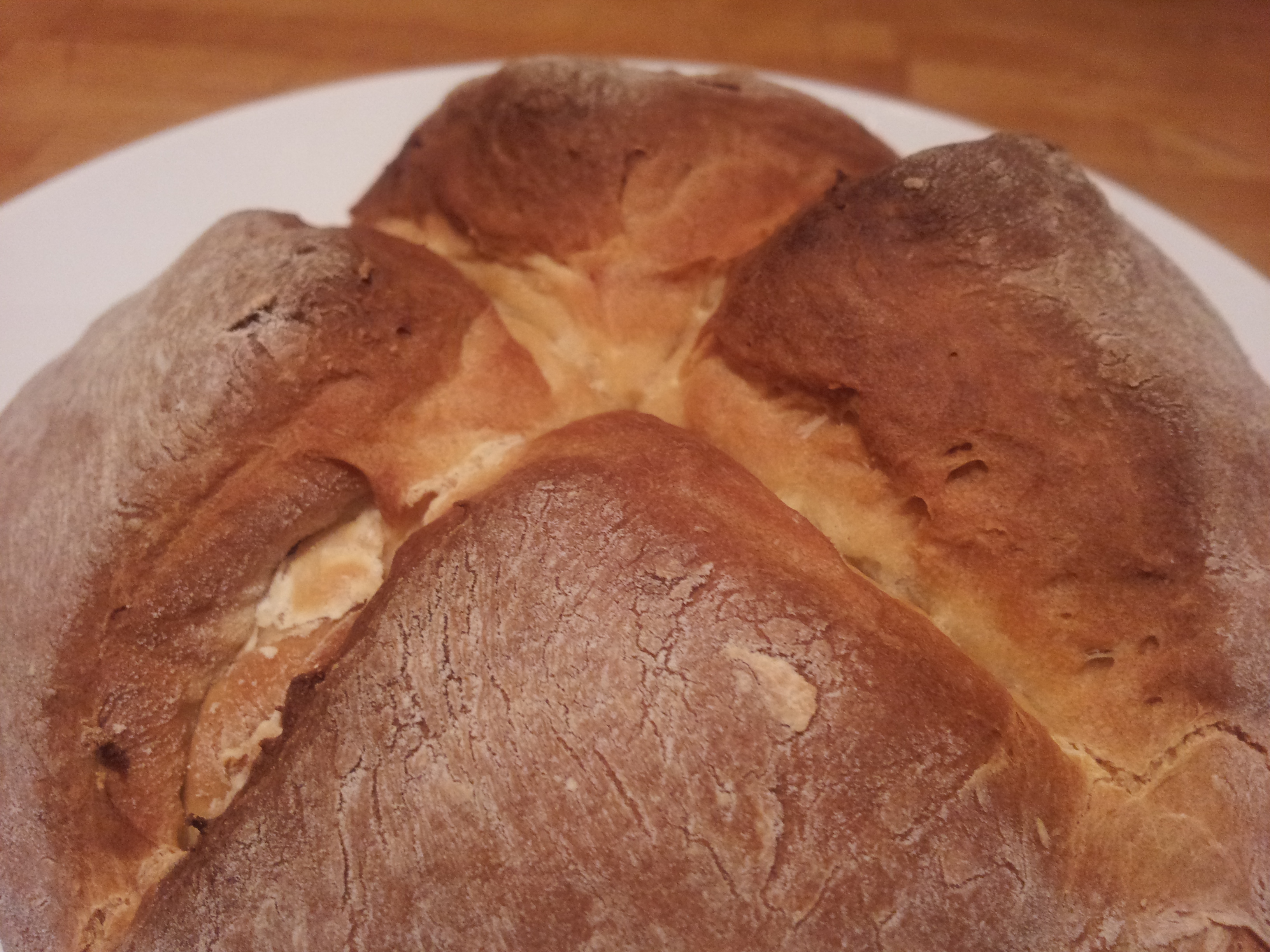
What a result!! I was astounded that a yeast free bread rose so much! It doubled in size and didn’t need any proving or strenuous kneading either! Amazing result for so little effort. It smelt amazing and tasted a bit like a cake too. What could be better than a bread/cake hybrid?!

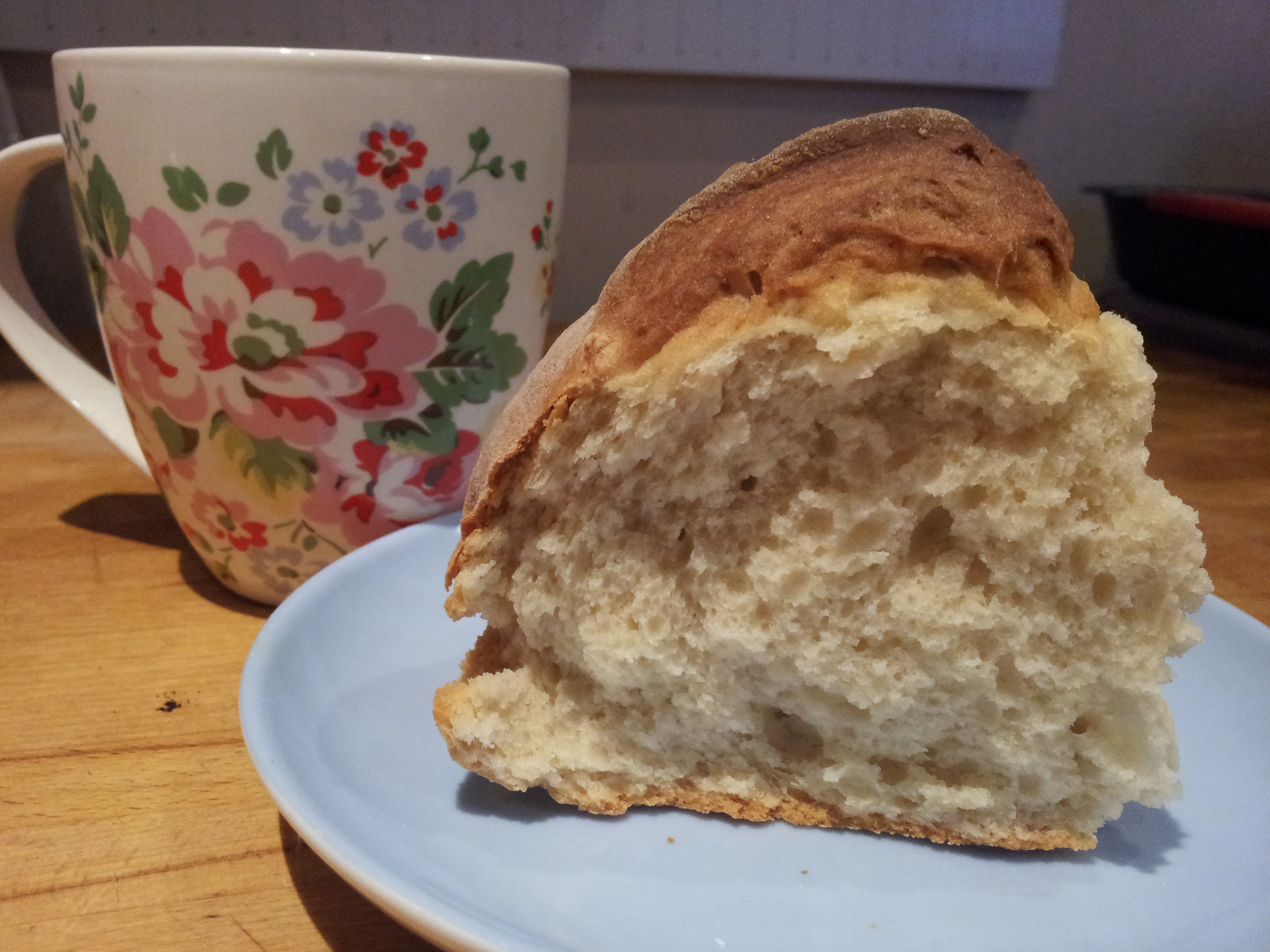
One hunk of Soda Bread

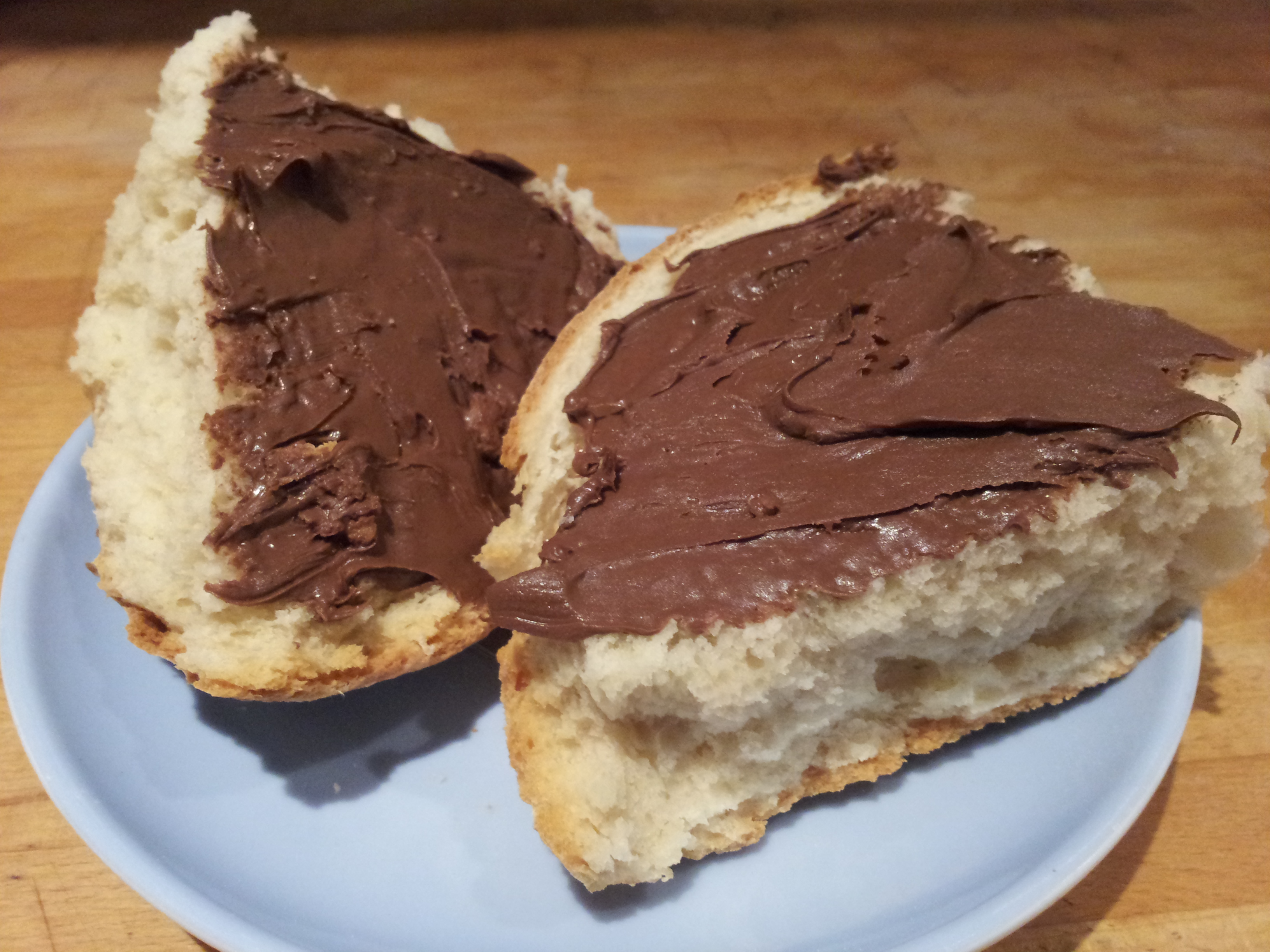
We ate this for breakfast one weekend and I loved it. I could happily eat it without any butter as it’s so moist, but I did put nutella on it (it was Saturday after all). This loaf should serve 4 and is best eaten fresh which is a good thing as I devoured a quarter of the loaf chunk in one sitting.

with lashings of Nutella?

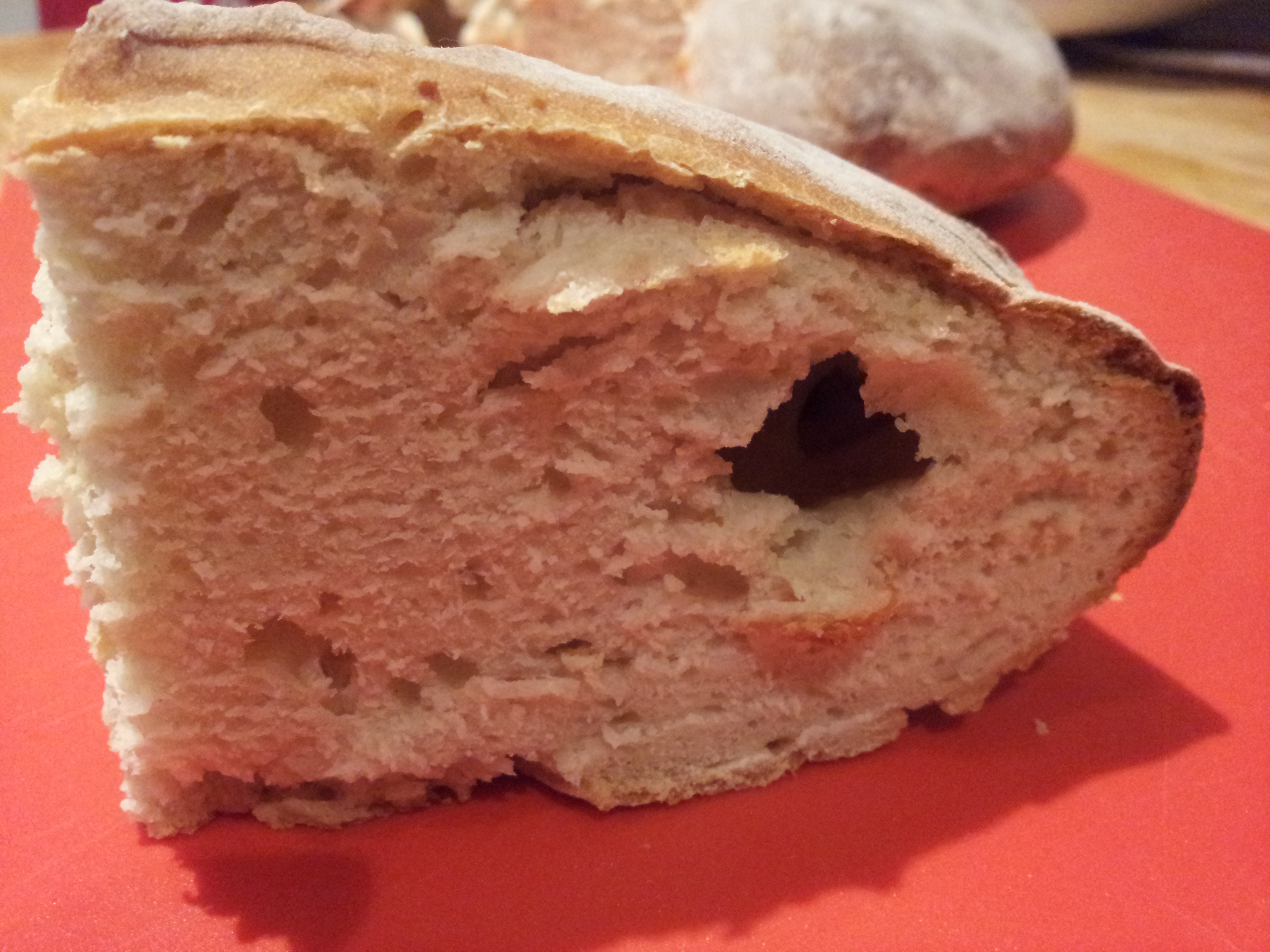
I loved it so much I made it again however I was obviously a bit complacent after my initial success. I used plain yoghurt which wasn’t active but a little past it’s best, assuming this would mean it had grown some cultures. I guessed wrong as this time it didn’t expand as impressively and I was a little disappointed by its lack of height. I will be baking it again but following the recipe properly next time! If you haven’t baked it before I really recommend it! And please let me know how you get on!

The slightly deflated second attempt…

*Recipe taken from Kenwood Creative Food Processor Cooking Book, by Becky Johnson. Thanks!

Irish Soda Bread

<!– Include ONCE for ALL buttons in the page –>

(function() {     window.PinIt = window.PinIt || { loaded:false };     if (window.PinIt.loaded) return;     window.PinIt.loaded = true;     function async_load(){         var s = document.createElement(“script”);         s.type = “text/javascript”;         s.async = true;         if (window.location.protocol == “https:”)             s.src = “https://assets.pinterest.com/js/pinit.js“;         else             s.src = “http://assets.pinterest.com/js/pinit.js“;         var x = document.getElementsByTagName(“script”)[0];         x.parentNode.insertBefore(s, x);     }     if (window.attachEvent)         window.attachEvent(“onload”, async_load);     else         window.addEventListener(“load”, async_load, false); })();

<!– Customize and include for EACH button in the page –> <a href=”http://pinterest.com/pin/create/button/?url=http%3A%2F%2Fprinceproductions.wordpress.com&amp;description=Around%20the%20World%20in%20Eighty%20Bakes%20“>Pin It</a>

Jill and Johnny’s Wedding Day Brownies – Hummingbird Bakery

image

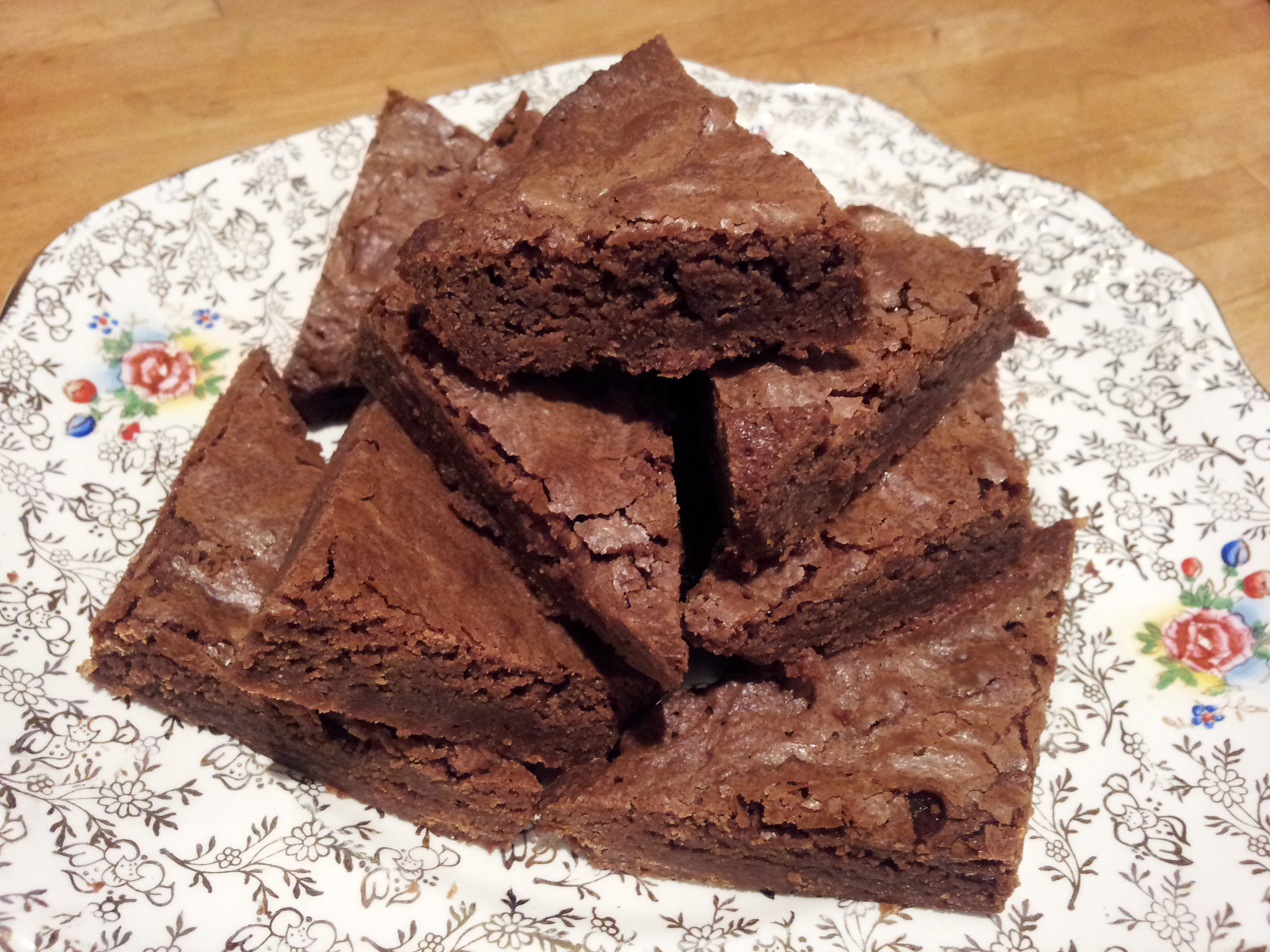
Jill and Johnny's Wedding Day Brownies

I’m baking a little something for my friends’  wedding day. Something that can be piled high and shared. I have baked rather a few Hummingbird Bakery things now from America but this is definitely my favourite brownie recipe. Nevertheless I still wanted to do a trial run to make sure they work (and taste good). When better to try them than at Jill’s hen weekend, this weekend.

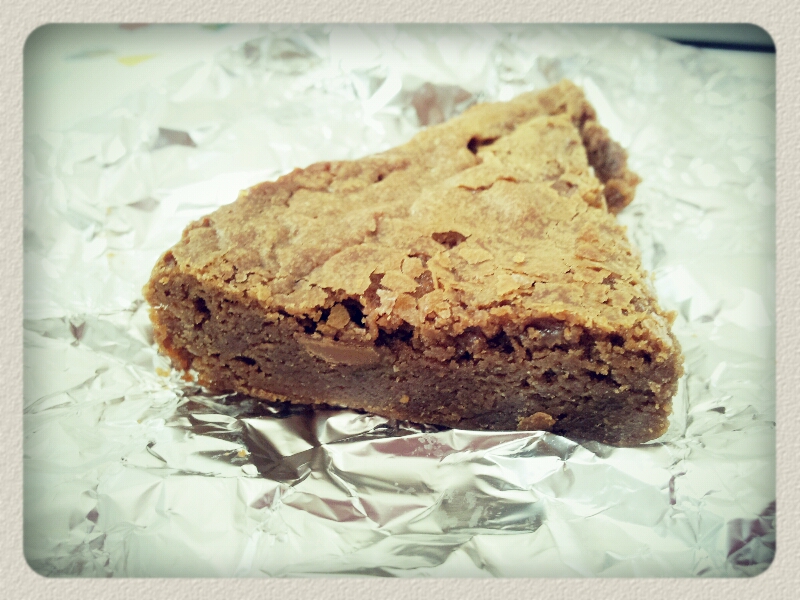
The trial run went so well Chris requested a second batch! These Hummingbird Bakery Chocolate Brownies are rich, sweet and chewy with a delicate crumbly top. Perfect with a strong cup of coffee. A good sugar boost too to keep those energy levels up for wedding dancefloor action.
image

This recipe is so quick I made the first batch in less time than it took me to ruin two lots of pancake batter. The longest bit was waiting for the chocolate to melt.

I love how this recipe requires no whisking or sifting. Simply stirring everything in one bowl with a wooden spoon means hardly any washing up too! You couldn’t even whip these up and freeze them for brownie emergencies.

image

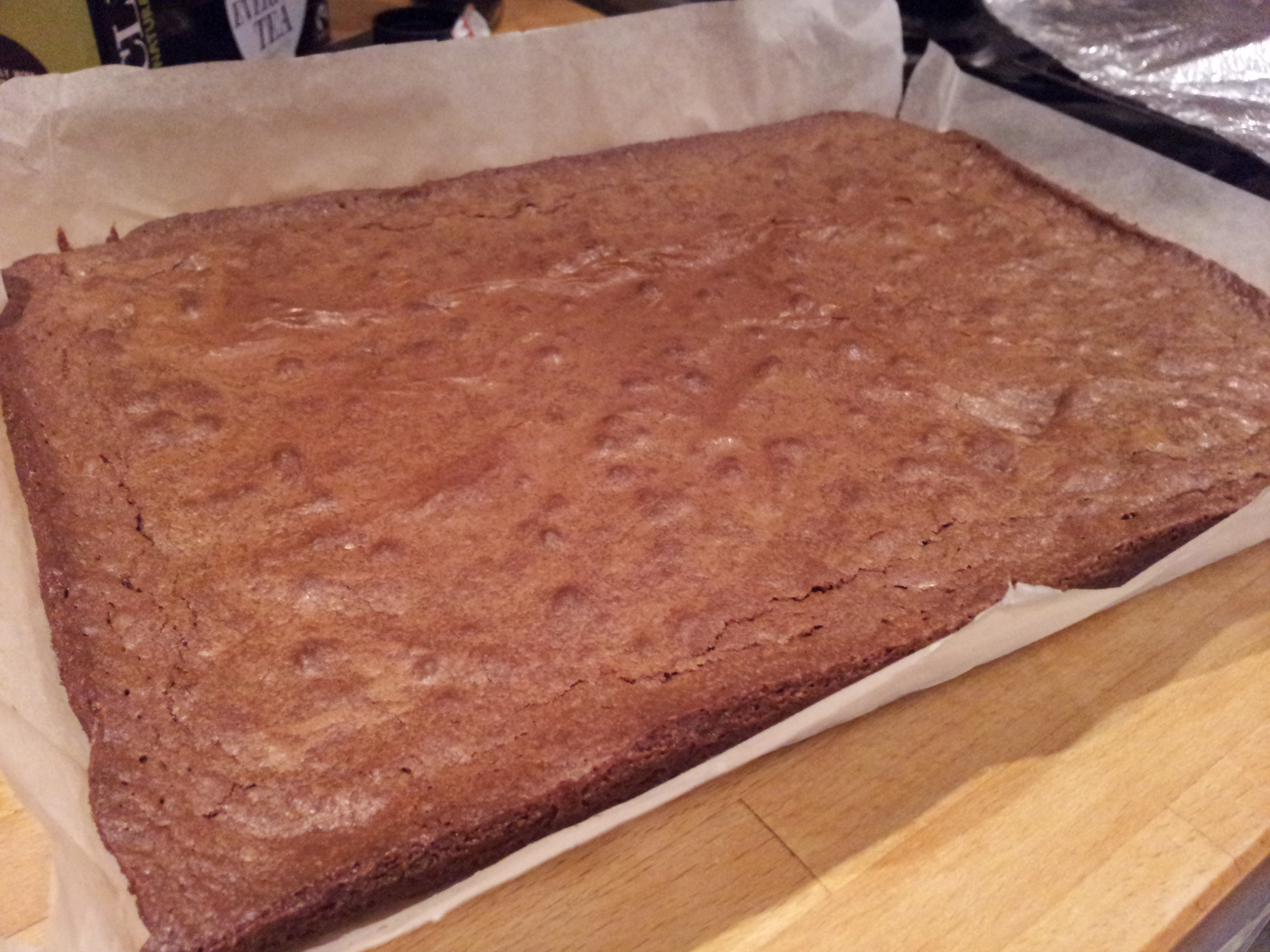
The entire brownie

1. Melt 200 grams of good quality dark chocolate in a bain marie along with 175 grams of butter.
2. Make a cup of tea while this melts gently over a low heat.
3. Once melted stir in 325grams of sugar until it’s all combined.
4. Then stir in 125grams if plain flour.
5. Stir in 3 largest eggs until you have a smooth paste.
6. For extra decadence stir in some chunks of chocolate. I used more dark chocolate. (Whatever amount was left in the cupboard probably about 50grams but I reckon the more chocolate the better as you get gorgeous melty chocolate surprises when you bite in to the brownies.)
7. Pour all the gooey batter into a rectangular baking tin about 23cm by 13cm
8. Bake for 30 mins at 175 degrees
9. Try to wait (if you can resist tucking into the tray with a spoon) until its cooled to chop it up and eat it as it tends to fall apart while it’s still warm… But this might be a good thing especially if you’re eating it with ice cream!

Enjoy!

image

Piles of Brownies

This recipe is supposed to be for 12 portions but I chopped it into smaller triangles and made about 30 servings.

Recipe taken from the Hummingbird Bakery Cookbook.

25. Happy Birthday to me! Triple Lemon, Triple Layer Victoria Sponge – Extravagana – England

image

Triple Lemon, Triple Layer Victoria Sponge

Ok, ok I’ve baked rather a few things already from good old England so it may not be that exotic to choose a Traditional Victoria Sponge. However! I know a true test of baking skill lies in the creation of a perfect sponge. I’ve never made one of these before but I sure have eaten my fair share of them. I have pondered over baking a layered cake for quite some time and debated over experimenting with a Hummingbird Bakery venture delicious although it would have been it involved too many ingredients that I couldn’t find so back to Marguerite Patten! Always wanting to try something a little bit different, and having rather a lot of home made lemon curd still to use up, I made mine a triple lemon triple layered Victoria Sponge…
image

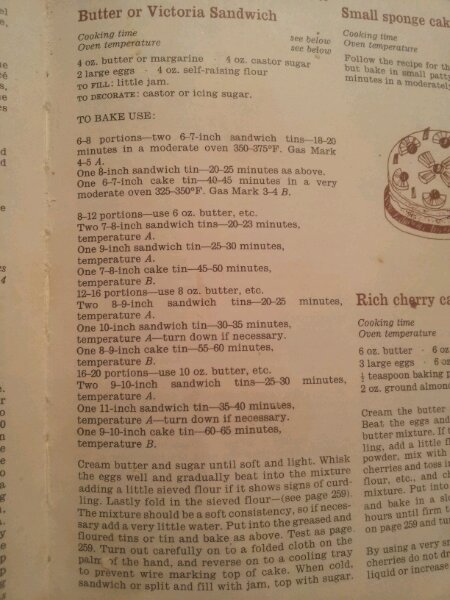
The Marguerite Patten recipe for Victoria Sponge has so many variations I think you need a Home Economics degree to put it all together! After engaging my non mathematical brain I managed to measure out in ounces (reading my scales correctly this time- I recently realised that I’ve been reading Llbs instead of ounces… This may explain why my last sponge cake went SO very wrong…)

The Many Variations of Marguerite

I used the variation for one 10 inch cake tin, the plan being that I would simply split my one cake in half and fill it with buttercream and my lemon curd.

image

Whisking the eggs well

As I was making probably the biggest cake in Marguerite’s recipe options I had to increase all the ingredients from 4oz to 6oz. Simple?

image

Creaming the butter, sugar and lemon zest together

I simplified the method for myself: 6oz of butter and 6 of sugar creamed together. 2 medium eggs to be whisked ‘well’. 2 lemons zest and half a lemons juice added to the butter then beat the eggs gradually into the butter being careful not to curdle the lot.

image

Scrambled eggs?

Then to fold in the 6oz of plain flour and ta da we have a cake mix!

image

Folding in the flour

Careful not to knock the air out of the mixture I lovingly spread it as flat as I could get it into the greased and lined tin. 35minutes at 180 degrees and I had one slightly thinner than I expected lemon sponge.

image

Spread as even as possible in the tin

image

One slightly sad looking thin lemon sponge

This rather sad looking sponge would be impossible split down the middle and ice. So I just had to bake another 2 layers!! It would have been a bit of a disappointing cake had I not. To speed up the process I doubled the ingredients to make enough for 2 cakes in one go. I wasn’t entirely sure this was technically the best thing to do but hey I didn’t want to be on all night. The problem being I only have one round cake tin so I had to bake one sponge at a time in order to re use the tin. This meant cooling the cake quickly and hoping the last sponge wouldn’t be airless and dry after the sponge mix had sat around waiting to be plopped into the tin.

image

Citrus buttercream

Throwing an unmeasured amount of butter and icing sugar into the food processor, (probably around 1 and a half packs of butter and enough icing sugar to make a good smooth sweet texture) I whizzed it all up with a splash of orange extract and vanilla too. I ran out of lemons by this point so thought any citrus would be a good move…

I am not very good at icing cakes with buttercream. My cupcakes always look a bit sad so this was a bit of a trial by fire. I’ve watched Lorraine Pascale ice cakes and it looks easy so I do what I do best and make it up as I go along. Lorraine made a mint sugar syrup and spread it on to her layered sponge cakes before icing, so I thought this must be a good idea although it did mean deviating from Marguerite’s recipe somewhat.

Lemon Syrup

Using what I had left over from the sponges I simmered the juice from all of the zested lemons with some sugar (enough to cover the bottom of the pan) to make a lemon drizzle. When it and the cakes had cooled slightly I spread a generous sticky coating on all 3 sponge layers to add to the lemony flavour and to help keep it moist.

The Terrible Trio

The exciting bit was then whacking on a thick layer of lemon curd followed by buttercream then smushing on a sponge layer (and it cracked slightly but no one will see this once I coat the entire thing in buttercream. The problem was the lemon curd started to dribble out everywhere! For the second layer I put buttercream first then lemon curd which helped hold it in place a bit better.

Layer 1! Lashings of Buttercream

Layer 2. I could stop here for a traditional Victoria Sponge…

Lemon Curding it up

Layer 3! Looking a bit rustic

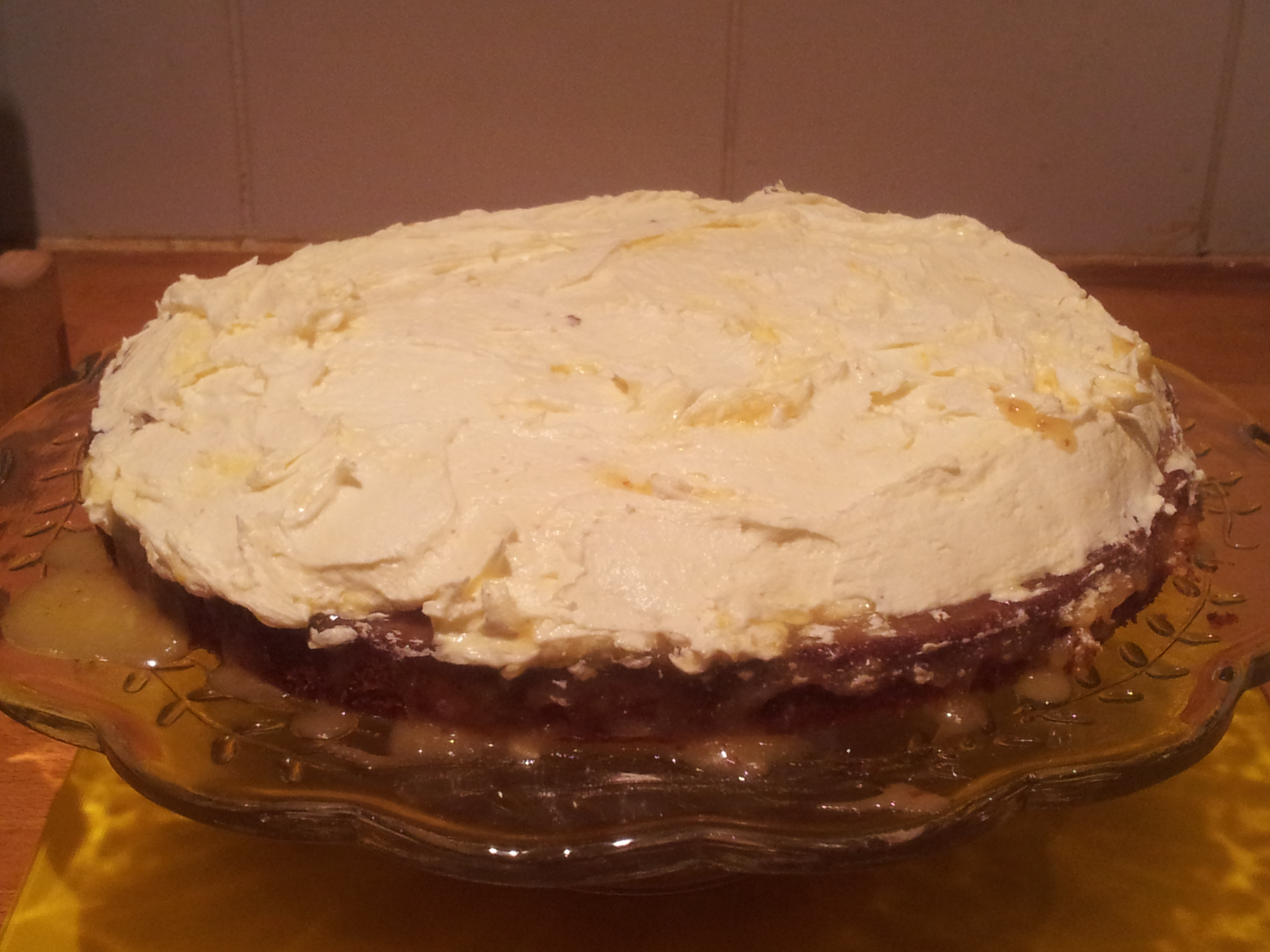
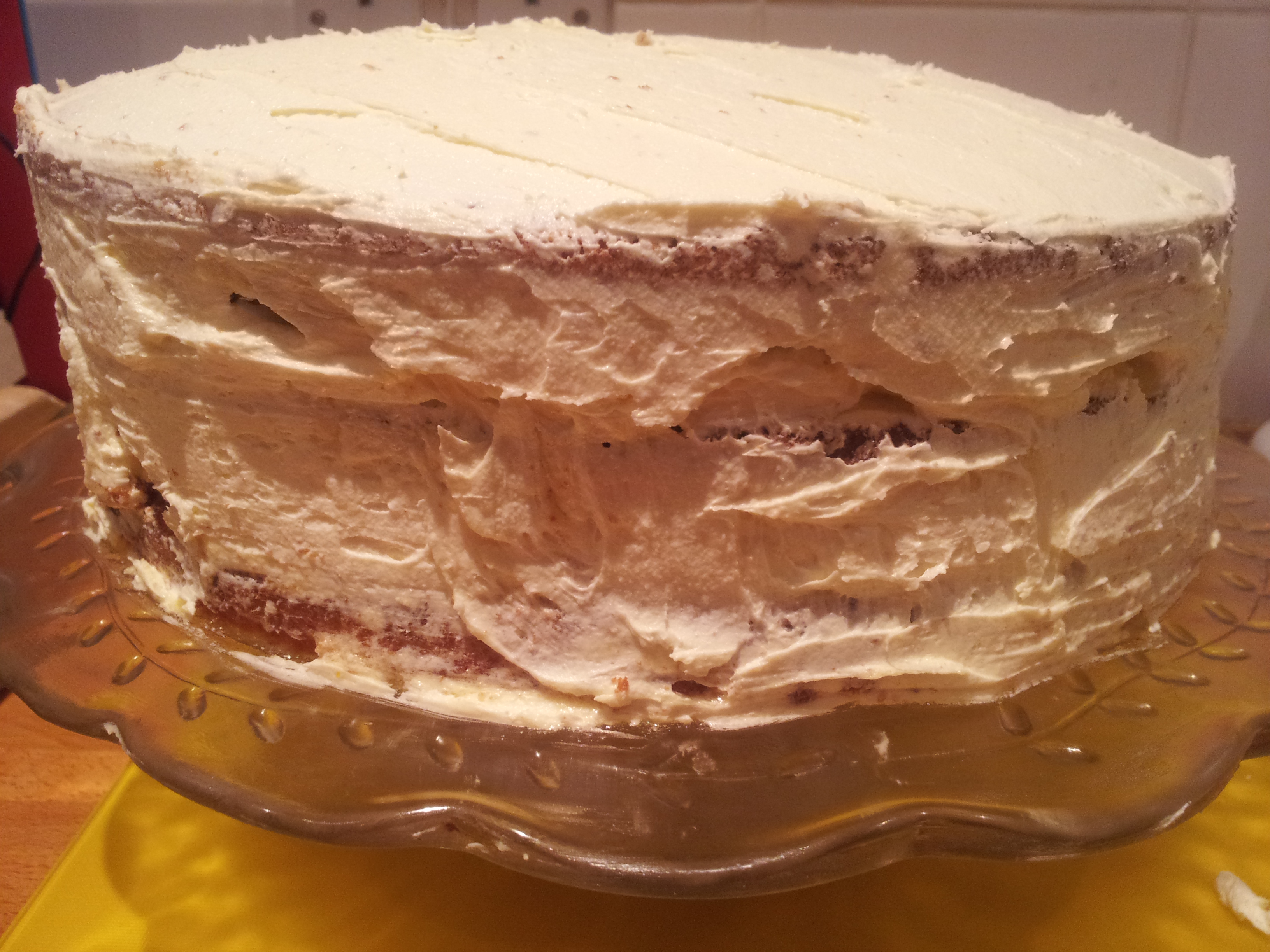
It was looking enormous and slightly lopsided. I had obviously not spread the buttercream evenly but the leaning tower of Pisa look is so in right now (I tell myself). Once the third sponge layer was added I spread the remaining butter cream, around the sides of the cake, sealing all 3 layers in. Smoothing the cream round with a palette knife. I saved a little buttercream to finish it off after the entire cake had a little rest in the fridge to ‘set’.

All 3 leaning layers encased in buttercream

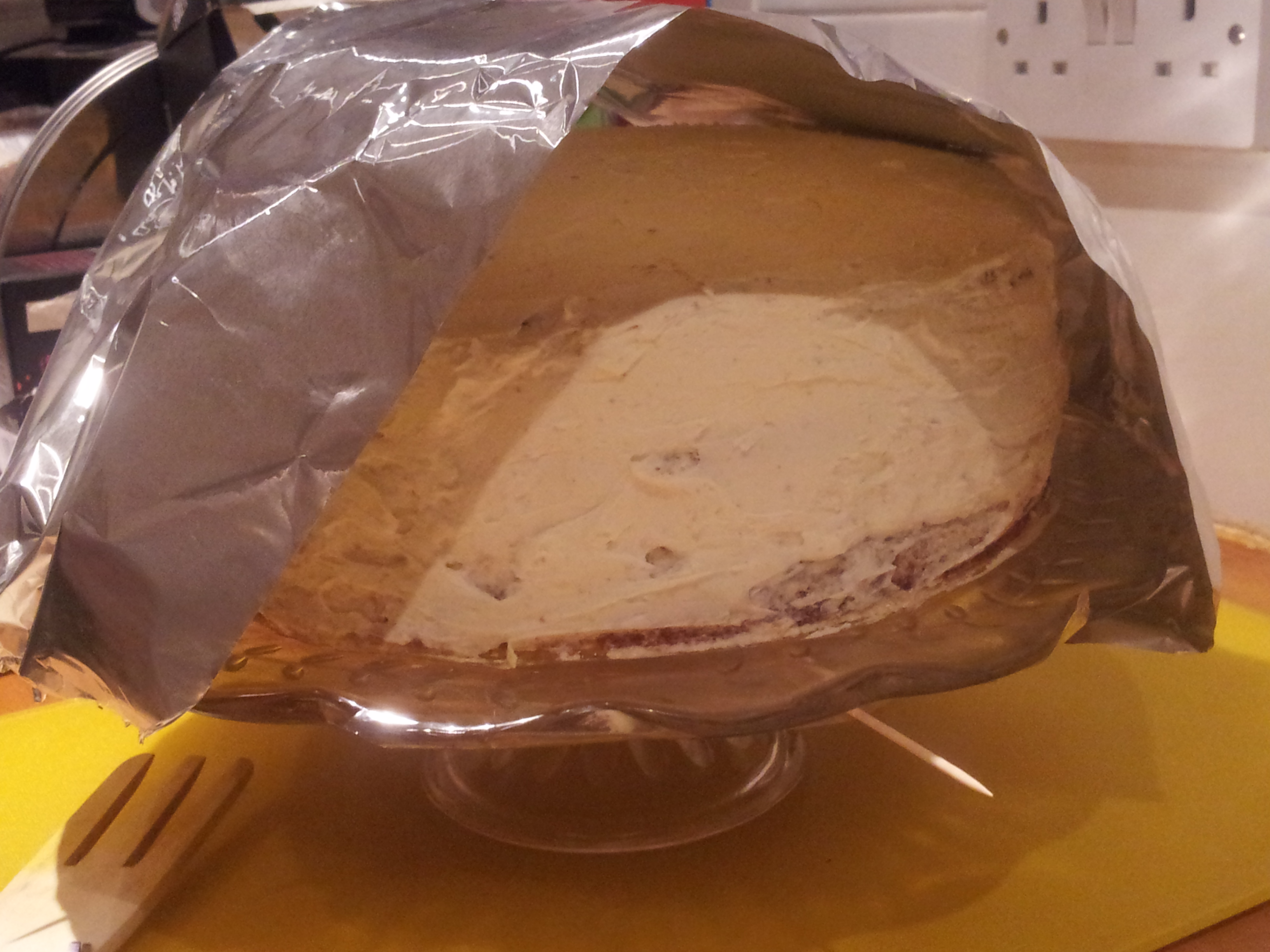
The cake was so massive I had to take some shelves out of the fridge just to squeeze it in! Once I smoothed on the final finishing touches of buttercream in an attempt to hide some of the crumbs that had broken off the sponges and worked their way into the cream I faced a little challenge. How to cover the leaning tower of cake up to keep it fresh in the fridge?! It was too big for any of my cake boxes and I had welded it to my glass cake stand with buttercream so it wasn’t possible to move it.

Cake Tent

I fashioned a rudimentary cake tent by selotaping cocktail sticks underneath the glass cake stand and gently folding 2 sheets of tin foil around the cake and skewering them onto the sticks. The cocktail sticks meant the tin foil didn’t touch the buttercream but would stop it all drying out in the fridge. Perfect!

Triple Lemon, Triple Layer Victoria Sponge

Once you start you can’t stop

This cake was immense!! I loved the sharp lemon flavour of the Curd combined with the gentle citrus buttercream. The sponge was probably a bit dry around the edges (hence the loose crumbs) so I would probably take it out the oven a little sooner if I was making it again. But hey for a first attempt at a layered cake I was happy. The tilt definitely gives it a certain je nais sais quais. I enjoyed the quirky take on the traditional Victoria Sponge. I took some to work and one comment was “that is the best cake that I have ever tasted’ which is high praise indeed!

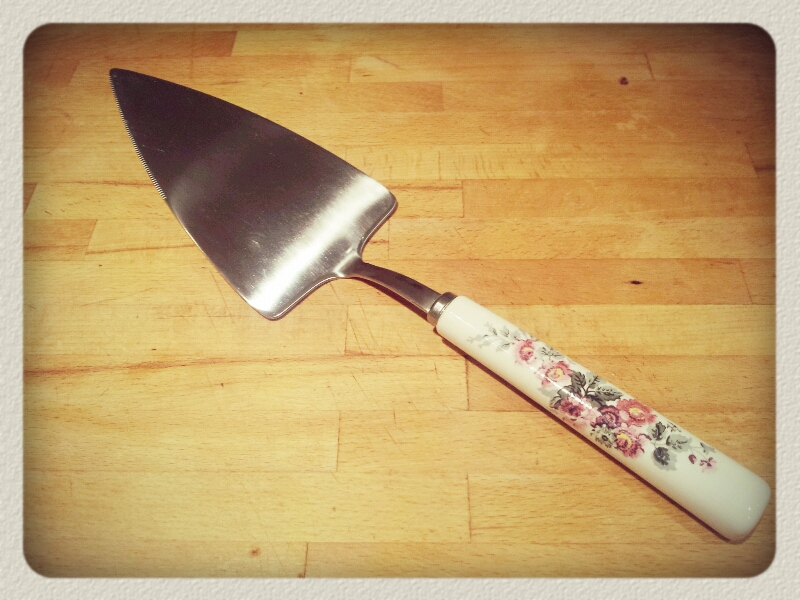
Ps. This cake was perfect for trying out my lovely new cake slice!

24. Knished! – Eastern Europe

After watching a Woody Allan film ‘Whatever Works’, I was intrigued to find out exactly what a Knish is , the food that Larry David’s character loves so much.

image

It turns out that it's a traditionally Jewish Pastry usually filled with oniony mashed potato. Curious, I signed myself up to the Knish challenge.

All of the recipes online varied massively. One site gave a recipe for 5 dozen or 58 knishes. This would be a bit excessive for me and my 5 friends to eat. I settled for a more basic version and (yes you guessed it) modified it slightly.

image

I peeled and boiled 3 large baking potatoes but then proceeded to drop lots of them (and the glass pan lid) into the sink. So after disposing of the sink potatoes I guess I actually had about 2 and a half potatoes mashed up in the end.

image

The chopped onions had to be fried in rather a lot of vegetable oil until soft and translucent whilst I messed around with pastry making.

image

Its a very simple recipe with flour, oil and water. Again I threw it in the food processor to bring all the ingredients together but you could use a spoon instead 🙂

image

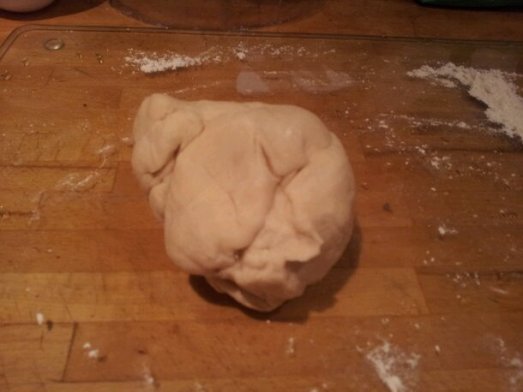
needed kneading

It needed kneading until smooth then it needed a rest in the fridge for 30 minutes. Enough time for a cup of tea and to stir the onions.

The pastry seemed a bit dry. This might be because the recipe that didn’t include an egg, where as some of the other put 1 or 2 eggs in the pastry. To remedy this I kneaded a little more water in until I was happy with it.

image

Divided

/>

I chopped the dough into 12 pieces and rolled each piece into a thin circle about 7 inches in diameter.

image

Then a quick slick of vegetable oil on the pastry before dolloping a lot of oniony mashed potato in the middle. There is no way I accurately measured this. Perhaps a handful of potato? (I’m sure this is how the professionals do it.)

I tucked up the edges and spread a little egg wash where pastry met pastry to help it seal shut (in theory).

12 Knish balls later and they were ready for a generous egg wash and the oven.

image

In hindsight I should have popped a little air vent in the top of each Knish to avoid this Knish mass explosion. There was more mashed potato on the tray rather than in the Knish. This is another danger of making it up as you go along after catching a fleeting glimpse of what it should look like in a film.

image
Knish Catastrophe

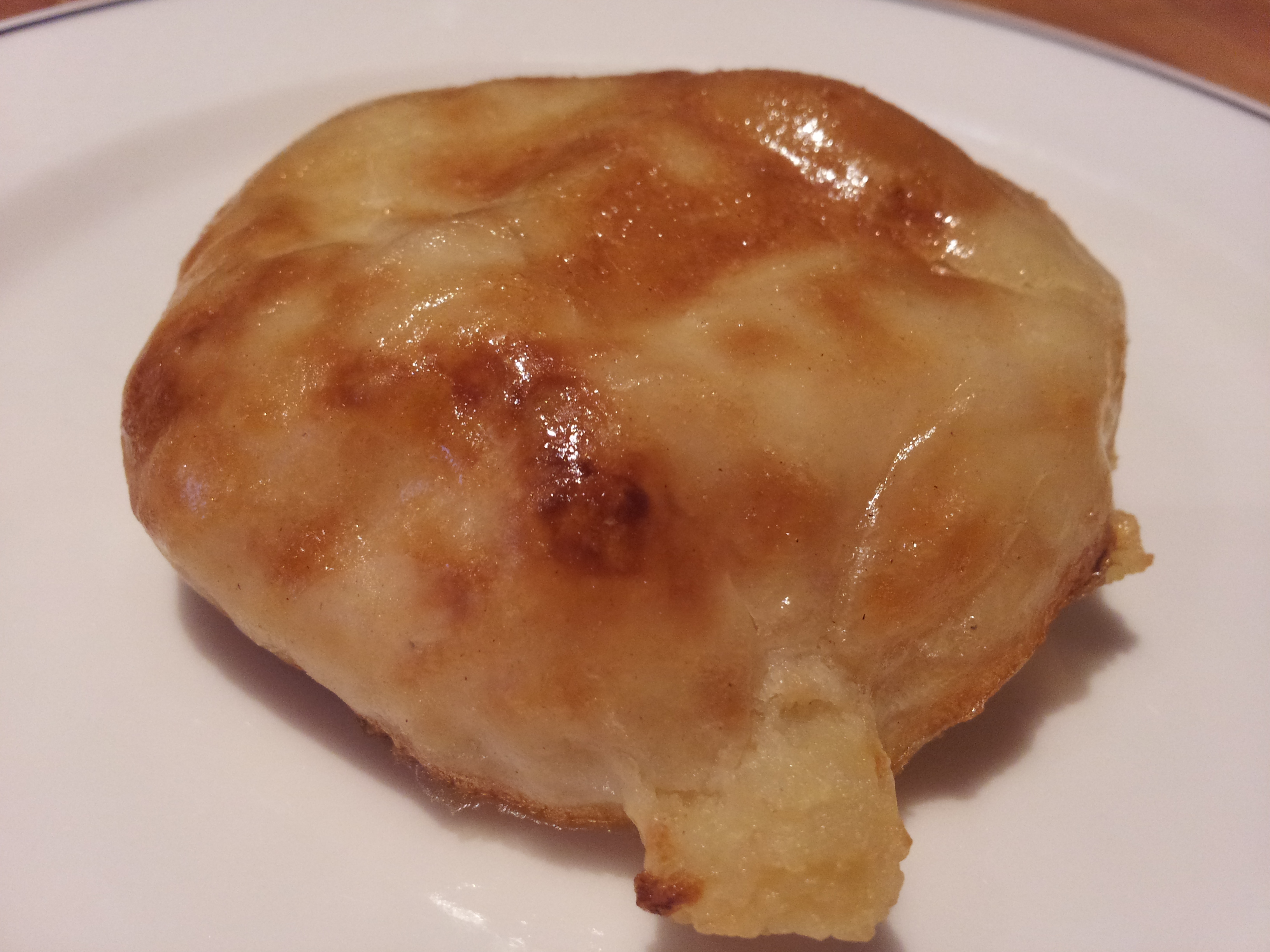
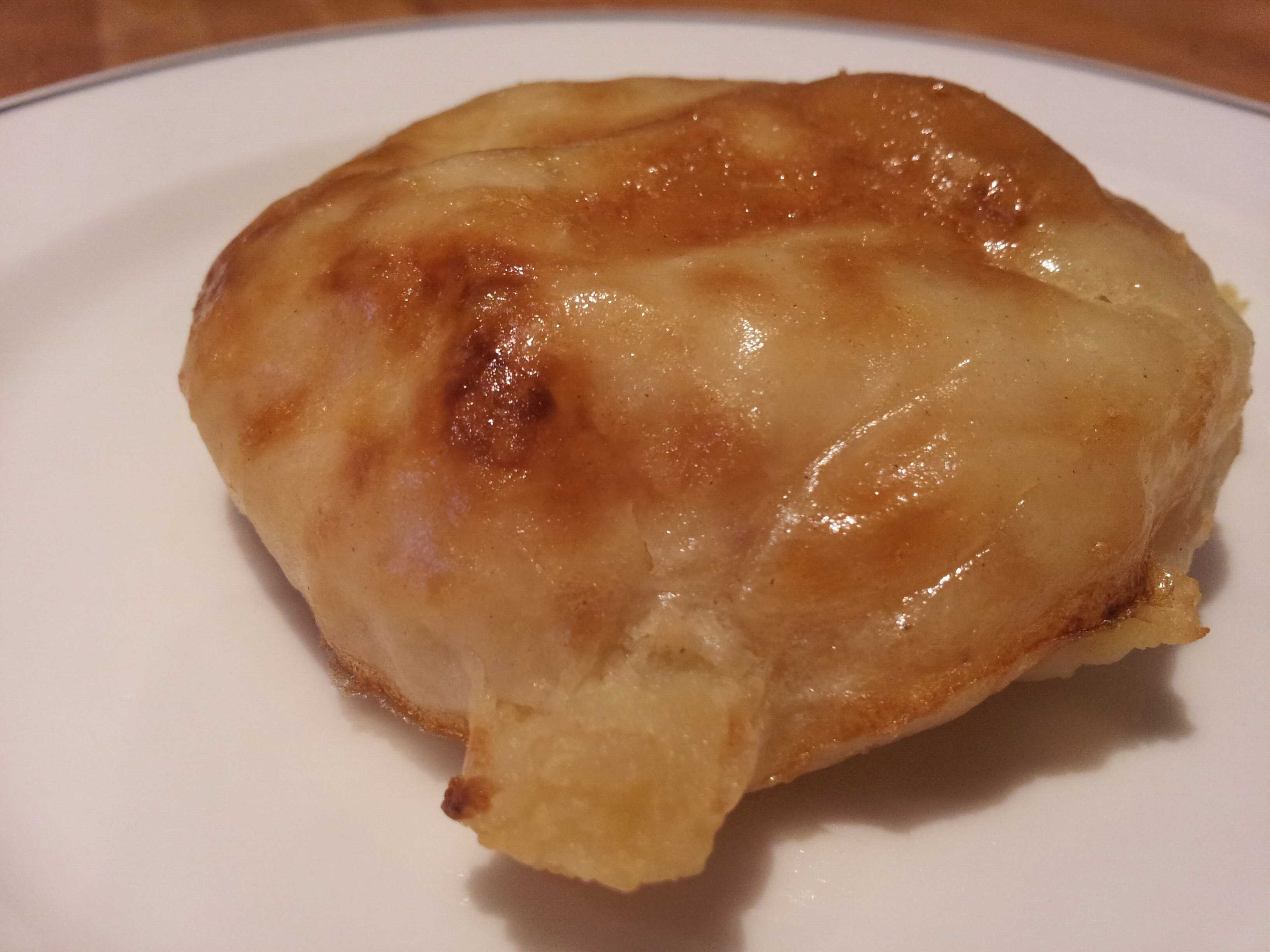
Nevertheless they tasted pretty good. If I’m being a little critical perhaps a tad on the greasy side, but I bet it would be a  perfect hangover cure!

image
If you ignore the mashed potato hanging out the sides of the Knish it looks exactly like how I imagined it would…

There are other flavour variations you can try too if you’re not a mashed potato fan, like meat. I thinkimage its a bit like a pasty so you can have fun with it!

image

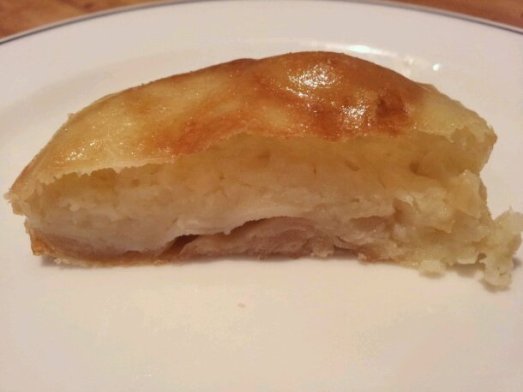
Sideways Knish

Things I used:

Pastry:
1 and half cups of plain flour
1 top baking powder
Half a cup of water ( and more as needed)
1 tbsp vegetable oil

Filling:
2 and a half large baking potatoes
2 large white onions
Salt
Cracked black pepper (to season)
A cup of vegetable oil

1 egg to seal and wash pastry with

23. Herman the German Friendship Cake – shhhh he’s only sleeping

I have never ever heard of such a cake until my friend Rebecca sent me a link to a recipe. However I have met a German by the name of Herman but that’s an entirely different story. Involving me winning the gold medal in the 2011 Garden Olympics taking the women’s record for in “The Hang” event. Who knew I could hang by my arms from a metal pole for over 2 minutes? Any ways I digress…

London 2012 here I come

So Herman the German is apparently a sourdough cake that you ‘start’ and tend to for about 10 days before dividing it up and giving 3 quarters away to your friends, along with a recipe so they can make their own Herman cake too, keeping one quarter for yourself.

*friends beware you may have a Herman the German cake heading your way very soon.

I couldn’t resist such a wonderful story and it fits with my whole international baking adventure so into my new Russian doll bowl its all gone this evening.

imageLets hope I don’t kill my new friend before he’s even started…

imageimageimageI’ll keep you posted on his progress! Click here for more…

22. Blood, Sweat and Baklava – Greece

This is without doubt the most epic bake that I have ever attempted. I’ve eaten Baklava in Greece, Turkey and Morocco. It is divine and very moreish with its honey soaked pastry. It’s one of my favourite sweet treats. I’ve been planning on attempting it for a while but was a bit hesitant to attempt Filo pastry from scratch as every book, including my Greek cookery book, said to buy it ready made pastry!

image

Baklava

Undeterred I asked my foodie friends for some advice on Twitter and was very kindly assisted by @bakingelements who sent me a Michel Roux Filo recipe from his ‘Pastry’ book. Thank you so much for your help. Without those photos I couldn’t have done it!!

Filo requires a lot of time and patience. It’s really not for the faint hearted. The dough itself is quite a basic concoction, flour, water, salt mixed in the food processor with a dough hook. Seems simple enough…

image

Then pour in oil while its mixing and wait until its all combined.

image

It becomes rather sticky and stringy at this point.

image

My new food processor was thoroughly christened in sticky dough in the process too… Cotton buds to the rescue!

image

Then it required about 5 minutes of extra working on a cornfloured board. I had to add a lot of extra flour as it was SO incredibly sticky

image

When it was worked sufficiently I measured it precisely (can you believe it? With scales and everything!) into 60g chunks. They had to rest in a cool place for 2hours on a floured tray covered in cling film so it didn’t dry out.

image

Pain in the pistachios

This gave me enough time to de shell and husk a whole bag of pistachio nuts. (Note to self. Please buy nuts without their shells in the future.) This is 45minutes of my life I will never, EVER get back. I broke a couple of nails and showered the kitchen in shells when in desperation I smashed the nuts with the stick bit of the pestle and mortar. Not to mention the nips and cuts the little blighters gave me.

image

Mixed Nuts

Into the food processor 1lb of mixed nuts I threw, the damn pistachios, whole almonds and walnuts. A quick whizz to chop them up and I added sugar, cloves, cinnamon and some pre chopped almonds.

image

To help speed up the chilling process I popped the pastry into the fridge for a bit whilst prepping the pastry board and a vast supply of cornflour.

Now for the tricky and even more time consuming bit. Michel Roux had sensibly instructed me to prepare 60g balls of dough so I had manageable chunks to roll out. However I was also working with 2 separate Baklava recipes which suggested working with a round cake tin and a rectangular tray. Whilst trying to stretch this delicate pastry out I realised there was no way on earth I was ever going to get it to the length and width needed to fit such a long tray and of course roll it to the required 0.5mm thinness!!

image

Still a bit too thick...

I decided to use a smaller square tin and ad lib from all 3 recipes that I was following. I greased and lined the tin in preparation.

image

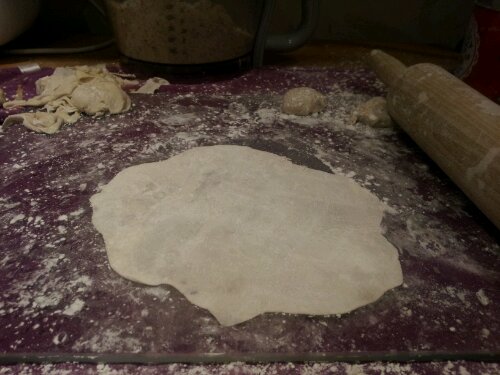
The first piece of rolling was lovely, dusting it with flour and gently rolling it out. I can’t believe I actually thought ‘brilliant this is going to be fun’. I lost count of how many sheets of Filo I rolled but as soon as you kind of get it to the right size and try to pick it up, it stretches, so its too big for the tin! Then it tears! And somehow your supposed to brush it with butter evenly too whilst it crinkles up and become more of a patchwork quilt. I had to trim bit here and there and add extra bits to cover the holes but I got there in the end.

image

The first fantastically even and smooth layer. Look it reaches the edges (almost)!

I realised that 60g was too much per layer so had to divide each chunk into 4 to get the right thinness and to ensure I had enough layers to go round. I have feeling you’re supposed to let the pastry rest after rolling it but I didn’t have the time. I also had to stretch each piece to fit inside the tin so it was really practicable either.

image

The actual amount of dough per layer pre rolling

image

Post rolling (not quite a square...)

I also missed the step in the recipe that said you’re supposed to start with 8 layers of pastry on the bottom before you add any layers of nuts and sugar. I had 2 bottom layers and there was no going back. I was in Baklava lasagna mania and only had 2 hours to finish the whole thing.

image

So so thin

I’m not sure how much butter I used but I had to refill the pan 3 times along the way.

image

Excuse the messy Filo jigsaw

My theory was 2 layers of pastry then a layer of nuts. I attempted to butter both sides of the Filo that was to sit on top of the nuts, which is probably totally unnecessary but the paranoia of dry Filo was setting in. Each time I added a layer I had to cover the pan in cling film too to stop it drying out too.

image

The top layer with 8 layers of Filo and a generous butter coating!!

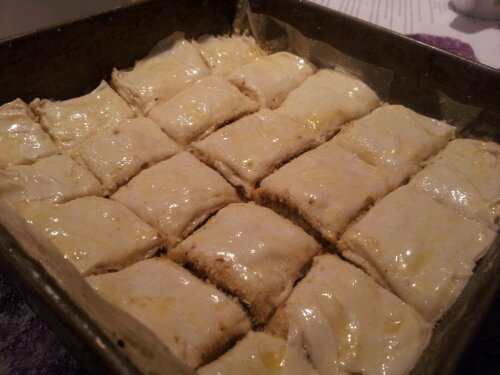
Before cooking it I took my sharpest knife and cut it into cubes

image

Precarious cutting through many layers.

I popped it in the fridge (but forgot the cling film!!) then set about simmering the syrup of honey, lemon juice, sugar, water and cinnamon. I added some rose water too.

image

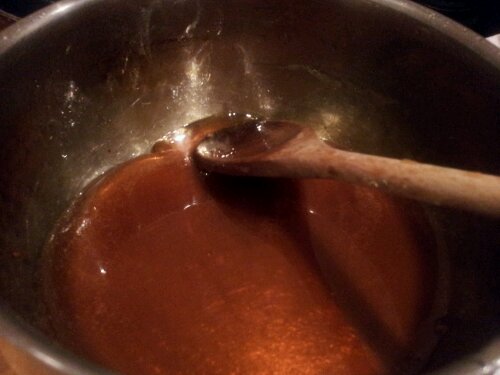
Start of syrup.

The Baklava needed 35mins of baking while the pan simmered. I almost burnt the syrup as I wanted to reduce it further and salvaged it by dunking the hot pan into cold water to stop it cooking.

image

Nicely caramalised... Definitely not burnt.

Once the Baklava was crisp and golden it was ready to be drown in thick syrup.

image

Crisp and golden Baklava

image

Syrup soaked

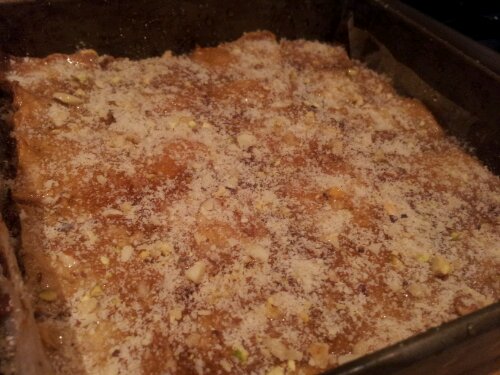
I added a garnish of chopped nuts (I still have a bag left over so probably wouldn’t make as much next time) and some more syrup to top it off. Apparently it needs 4 hours to cool so I wrapped it in a towel and carried it to my friends house for our pudding. It definitely didn’t last long enough to cool for 4 hours!!

image

Toppings

image

Baklava Heaven

I was hoping after all the time and effort it would be ok and it really really was. The syrup soaked into every layer making a gorgeously sticky delight! Even with less pastry on the bottom it held together and cooked all the way through!

image

Piles and piles of Baklava

I’m happy with my Filo experiment. I generally hate making pastry and this almost killed me. There was a lot of energy spent in making this so I don’t feel guilty in the slightest that I ate 2 massive pieces in one go. It did take an entire day to make but what an achievement! Now I’ve made Filo once I know I can do it but perhaps I might buy some ready made if I was going to attempt it again.

I’m now going for a lie down 🙂

*Recipes taken from:

Filo Pastry Michel Roux – Pastry Requires: 400g plain flour; 6g fine salt; 330ml water heated to 50 degrees C; 30ml olive oil; cornflour to dust

Baklava Recipe  Requires: 1 quantity of Filo Pastry; 1lb chopped nuts, cloves, cinnamon, 1 cup of butter, 1/3 cup of sugar

Syrup: 1 cup water; 1 cup sugar; 1/2 cup honey; 1 cinnamon stick; (I added an extra sprinkle of ground cinnamon); 2 tablespoons of lemon juice and I added 1 tablespoon of essence of rose water too.

The Traditional Greek Cookery Book Toubis Edition 2006


<a href=”http://www.bloglovin.com/blog/3326777/around-the-world-in-eighty-bakes?claim=mngmk6jv65c”>Follow my blog with Bloglovin</a>

21. Whatcha cooking Lebkucken – Germany

Lebkuchen

I’ve always loved lebkuchen. It always seem like Christmas when the shops start selling these chewy and crunchy pink and white sugar coated cookies. This year seemed the right time to attempt to make my own. I’ve not visited Germany (yet) but if the continental Christmas markets are anything to go by I know that I will love it.

A quick google later and I came up with a simple yet effective BBC Good Food Recipe. (I seem to use this website a lot for my continental recipes!) They seemed fairly easy to make with honey, eggs, spices (cloves, ginger, nutmeg and cinnamon)  ground almonds, a bit of flour, black pepper and butter. Simple! Although in my case I had nothing to smash up the cloves with, so improvising with a sandwich bag and a jam jar I hammered them into rough chunks. It kind of did the job, but some biscuits were definitely more clovey than others…

Spicy Stuff

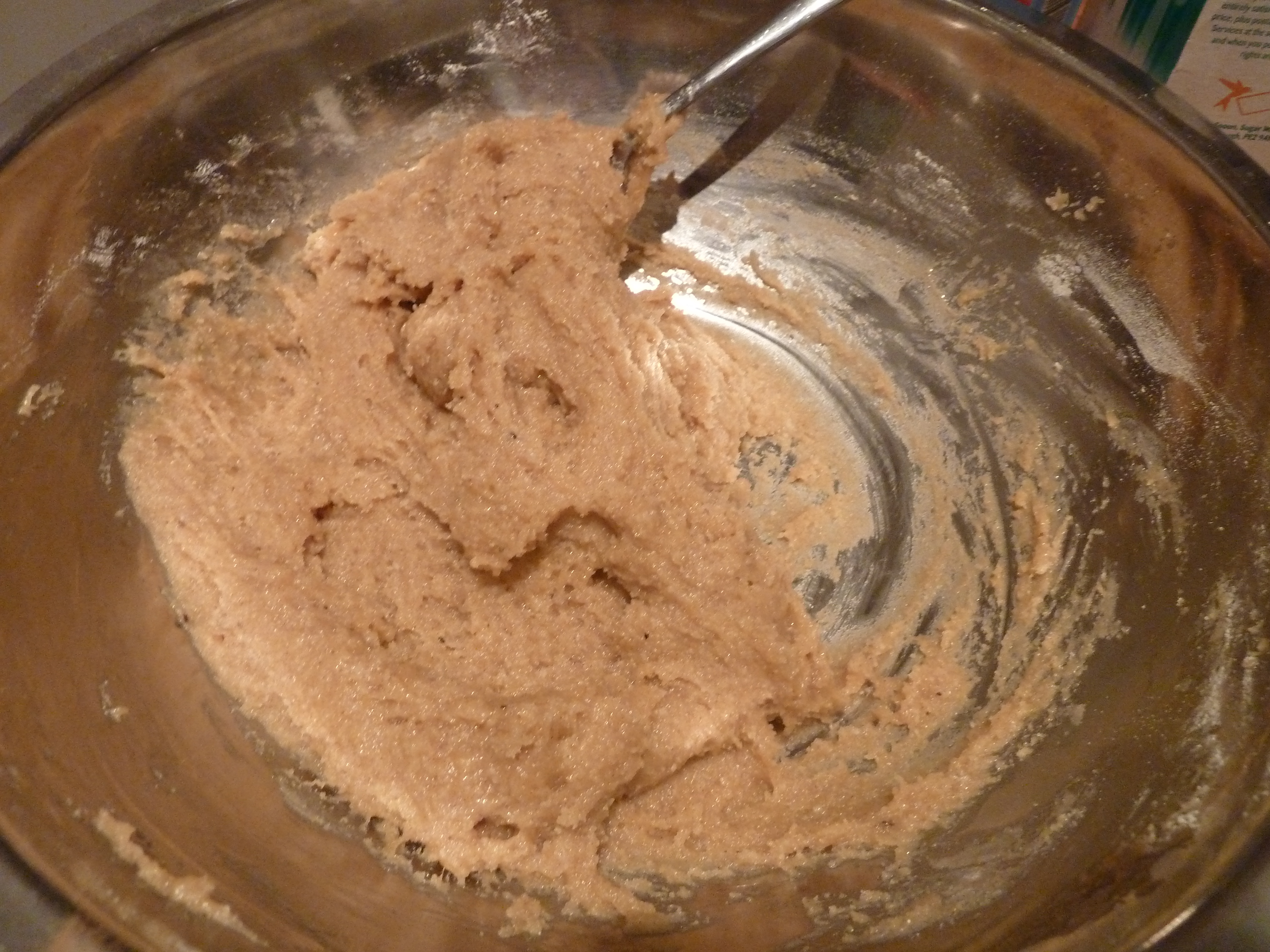
This is definitely a different type of gingerbread to the Sunderland Gingerbread, very rich and sweet. But like Sunderland Gingerbread you throw this all in a pan and melt it together! Fantastic!

Butter, honey and sugar

Then throw in the dry stuff and spice

It needs quite a good stir to mix it all together..

Seemed a bit sticky but trust in the recipe

At this point I started to get a bit worried as it seemed a bit on the sticky side and I couldn’t imagine how on earth I was a) going to roll the dough out or b) cut it into Christmassy shapes… Nevertheless I continued and read the recipe through again and realised it needed some time to cool down. Throwing it into the fridge I popped the kettle on and had a well deserved rest (whilst starting the washing up!)

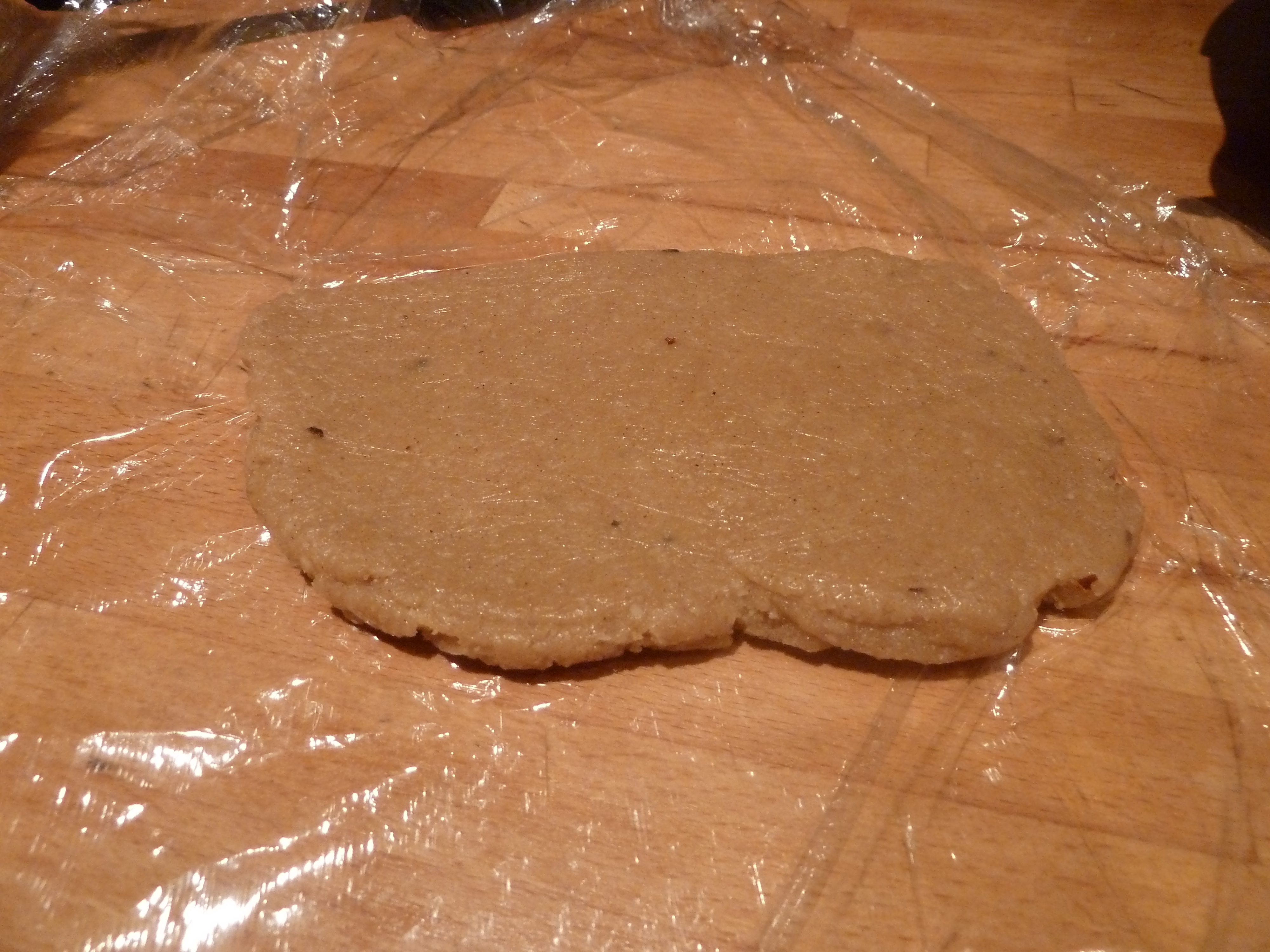
Now that's more like it!

In a bid to speed things up I divided the dough in half and froze half for other Christmas baking emergencies. I then folded cling film around the dough to roll it out without needing my pastry board and to prevent it sticking to the rolling pin.

Cling Film Queen

Choosing my most Christmassy cookie cutters I cut out the festive shapes and popped them into the oven for a mere 15 minutes.

Off to the oven with you

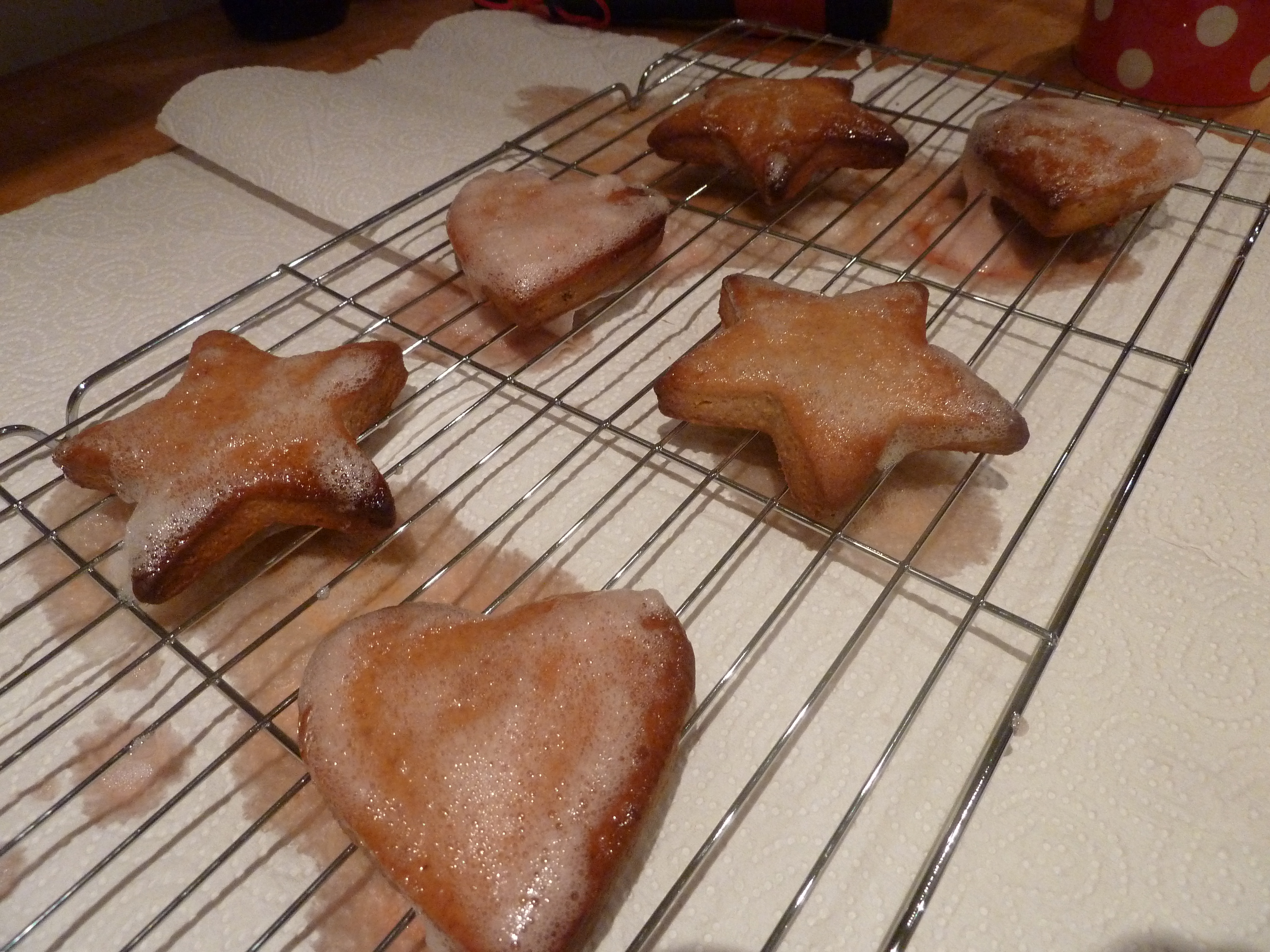
Then all they needed was a glossy sugary coating once they cooled down enough. Whisking an egg white up with some icing sugar to create a glaze is something that I’ve never done before. There’s another first to cross off my list.

Glazing

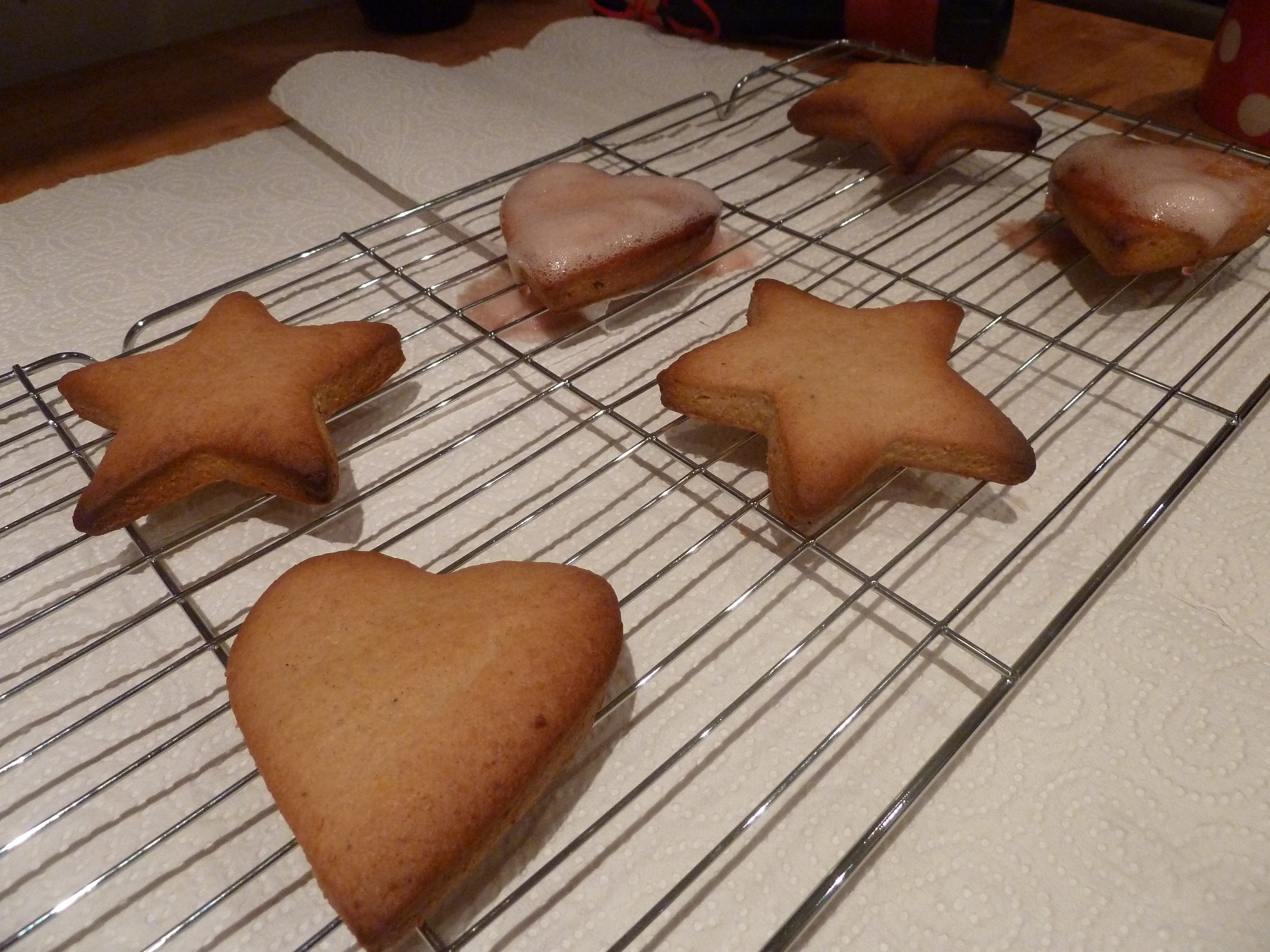
I drizzled it over the biscuits and let them drip dry onto kitchen roll. Once they hardened slightly they were ready for eating and the biscuit tin! They were lovely and chewy on the inside. They aren’t overwhelmingly spicy but rich and I enjoy the kick of the black pepper and cloves. I will be baking these every year from now on. I may even try some new variations. I’ve seen some with a much more crispy coating and with a little jam in the middle too to make them extra gooey!

Glazed

I did whip up the second batch in a baking emergency, during a Christmas baking marathon, so didn’t cut them into shapes but made a dough roll (using cling flm to roll it up of course)  and chopped it up… very quick and easy!

Dough roll (not to be mistaken for a sausage)

Lebkuchen Quick Chunks

Happy New Year and New Food Processor!

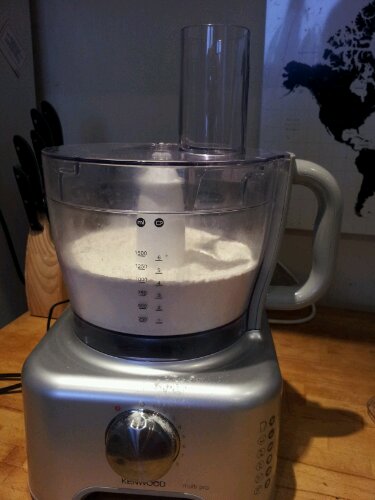
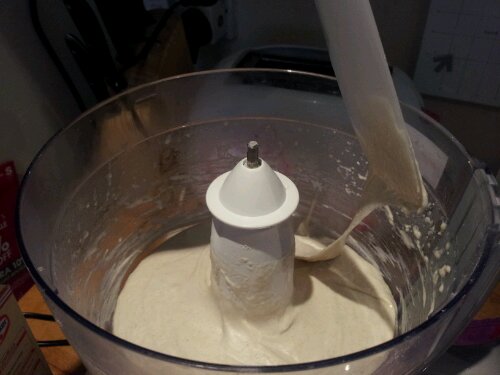
Apologies for lack of bloggage over the festive period. I have been a bit distracted with moutains of Christmas baking and subsequent eating so there’s rather a lot to catch up on. I’m not even sure where to start so here’s a selection of some of my most recent bakes. Not all of the food was officially international baking so I can’t  count it towards the around the world in eighty bakes nevertheless I thought you might like to see some of my experiments following my new acquisition, a wonderful food processor, for Christmas. My wonderful new baking toy that I’m attempting to learn how to use. (Thanks mam and dad!)

image

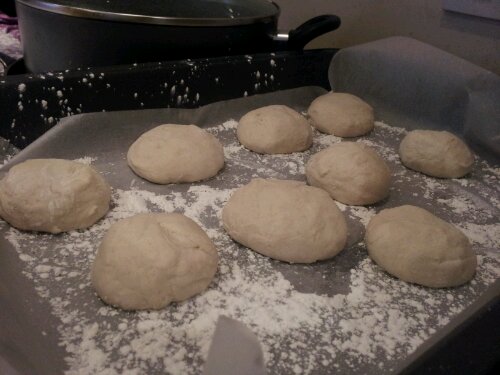
Dinner rolls for New Year

image

An invention what I can only term a plaited crown loaf

image

Rose cupcakes of the Hummingbird Bakery Variety

image

The new food professor!

image

Merry Christmas!

Super Hans (sorry I couldn’t resist)

image

Happy New Year! Hope you have a fantastic 2012 and thanks so much for reading! We’ve made it to 20 bakes so far, so hope you enjoy reading the next 60 bakes!