The Final Frontier – Decorating and Assembling my 5 Tier Wedding Cake

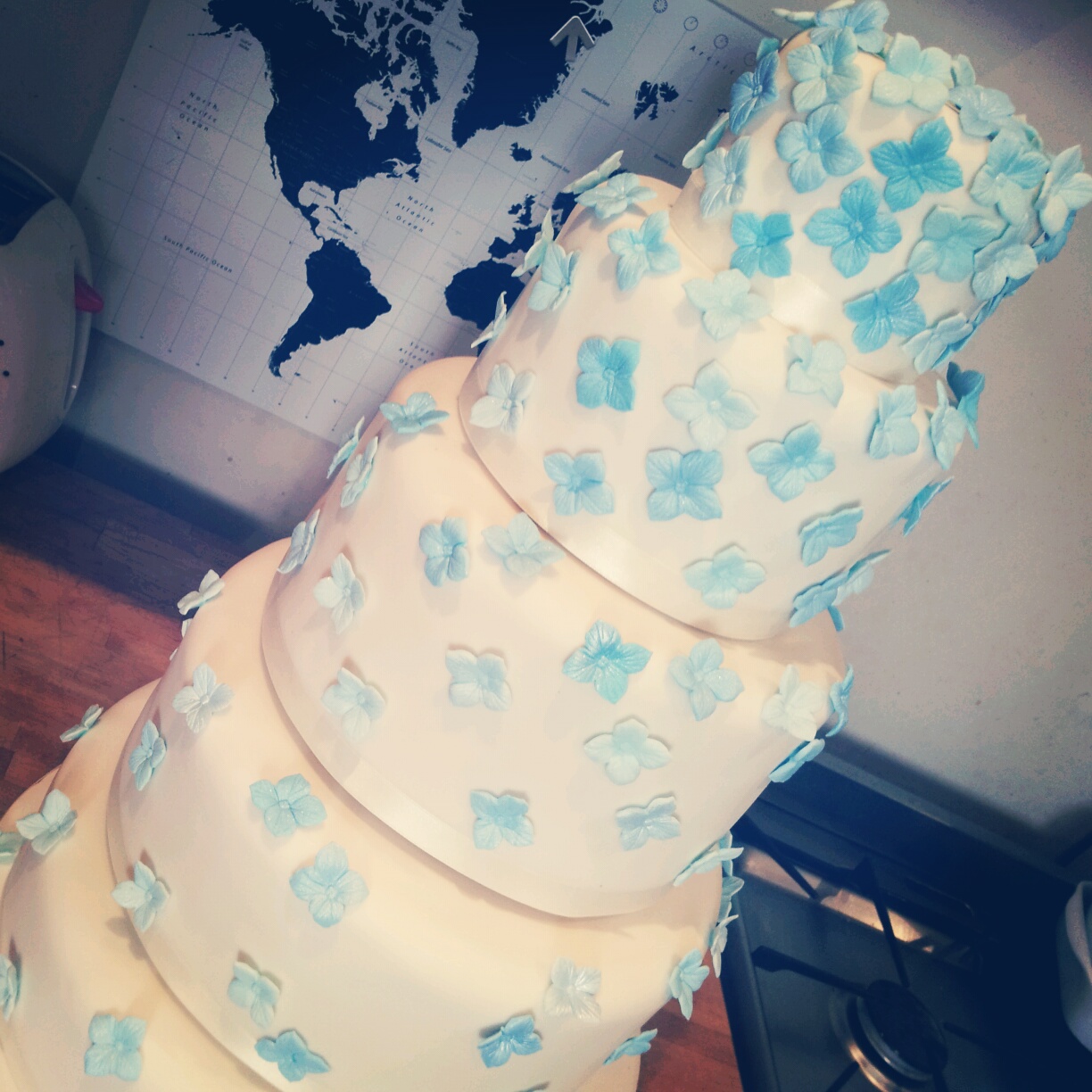
The decorated wedding cake in my kitchen

The decorated wedding cake in my kitchen

When I engaged in creating hundreds of Hydrangea blossoms to adorn the wedding cake with I didn’t really stop to think too hard about how I was going to get them on the cake… It can’t be that hard right? I purchased a pot of edible glue (amongst many other things from the lovely cake shop) and trotted off to carry on baking, pushing all thoughts to the back of mind about how edible glue works.
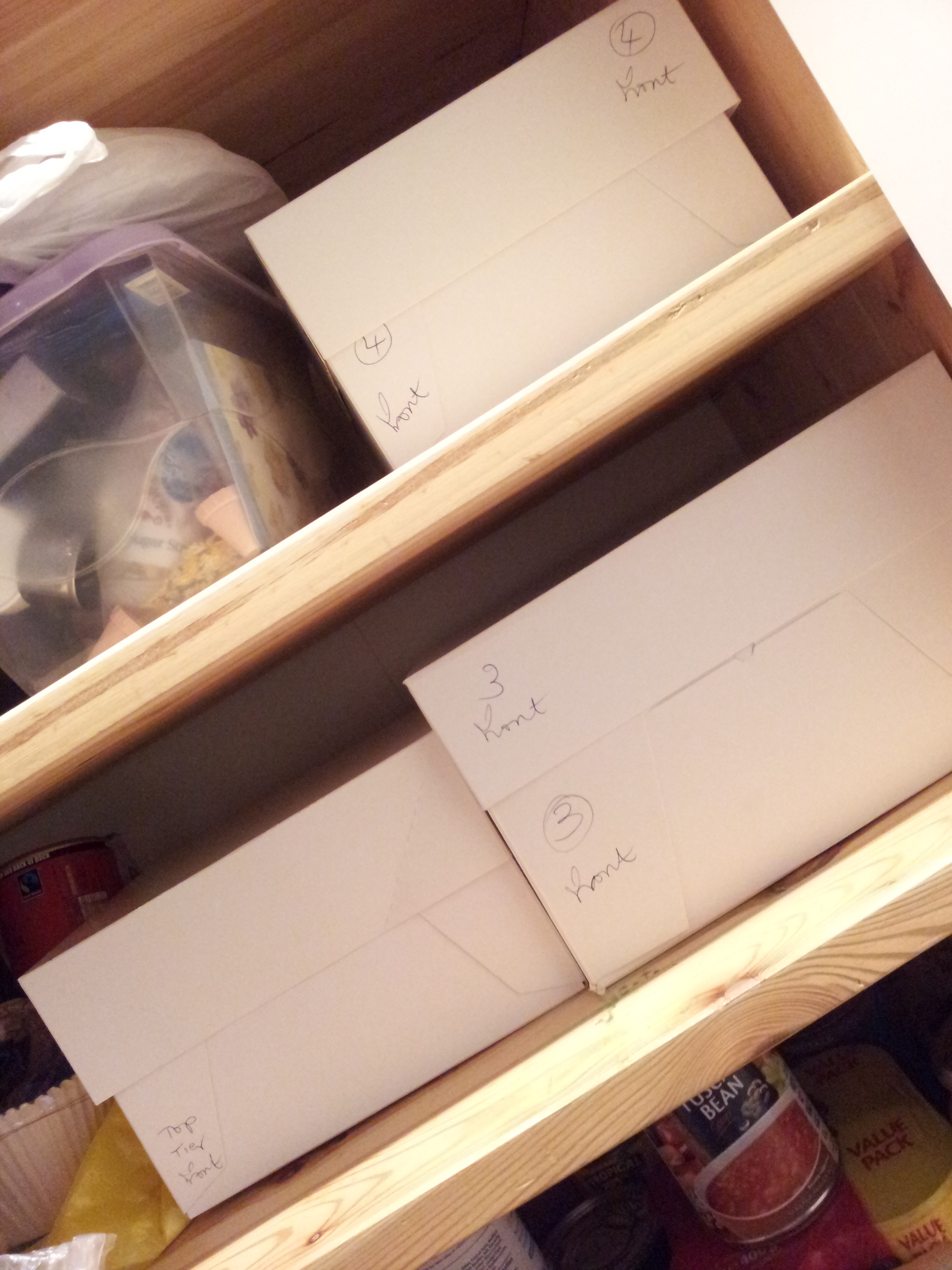
Some of the cakes resting nicely in my kitchen cupboards

Some of the cakes resting nicely in my kitchen cupboards

Fast forward 3 months to December 2012 and I have now 5 iced wedding cakes resting nicely in their cardboard cake boxes, up on some book shelves in our spare  room/wedding dumping ground. I have 1 extra iced cake just in case of any disasters and 2 naked fruit cakes leftover from the epic baking stage of this cake.

We were going to celebrate Christmas early this year, what with the wedding being on 30th December. So I started wrapping all of my presents very early. I was wrapping until 11 one night and popped everything under the tree only to look up and discover yellow stuff running down the walls, behind the tree. I showed Chris and he discovered that I had also placed all of my freshly wrapped presents into a quickly mounting pool of water gathering under the tree.

The wall was quickly turning into a water feature in our house. It also joins onto the spare room. A spot of investigating further revealed that the flood had started in the spare room, saturated the wall and then seeped into the living room and across the floor! Thank god my dress was at my parents house and thank god for Kate’s cake boxes! They were the perfect protection against any damp that was lingering in the air (there was a lot!). Luckily the shelves weren’t up against the soaked wall too and lucky that I had been wrapping presents to discover the leak as I wouldn’t have noticed it until we were swimming in our sitting room.

We're all having a dehumifier party

We’re all having a dehumidifier party

One emergency cake evacuation later and removal of everything out of my kitchen cupboards, the 8 cakes had a new dry home!  Our landlord delivered a dehumidifier to get rid of the damp and the stink and we were good to go. Although further calamities were awaiting me whilst Chris was away for his stag do and I had friends round for festive fizz, mulled cider and spare wedding cake tasters. The dehumidifier started to leak! I then flooded the toilet trying to mop it up and broke a handle off the door just before everyone arrived. I think it was best to get all the bad luck out of the way before the wedding.

Sticking a milliong sugar flowers in place

Sticking  millions of sugar flowers in place

To give myself plenty of time to glue the flowers on to the cakes I set aside a Saturday the week before Christmas to give them a chance to dry fully and me to repair any breakages/falling offs. This happened to coincide with the painter coming to repair our flooded flat. It made for an interesting 5 hours of glueing flowers whilst directing decorators to dust pans, brushes and keeping the cat at bay.

Edible glue takes a ridiculously long time to dry! In hindsight I think royal icing would have been a MUCH better idea… I used a cocktail stick to smear a little spot of glue onto the back of each flower (which had become really rigid and quite fragile so had to be handled extremely carefully). The moulded reverse of each flower results in grooves and ridges that the glue disappears into. It needs a bit more glue so that the it can actually touch the cake.

The glue should be tacky before attempting to apply it to the cake… If you try to stick it on while the glue is still runny you will have a happy game of chase the flowers as they fall off the cake leaving a trail of glue which has now taken on some of the blue food colouring all down the cake. Many of the flowers fell on the floor and smashed this way but I also realised that I have quick reflexes, almost a cake decorating ninja.

The painters were highly amused by my antics in the kitchen where I didn’t even stop for a cup of tea for 5 hours whilst contorting myself into all shapes to catch the falling flowers and hold 4 flowers in place with each hand until the glue dried enough to support their weight. Patience and flexibility were useful qualities to have a this stage in the cake decorating process. It’s a good job I do yoga.

Almost there but not quite yet...

Almost there but not quite yet… have a look at the varied blue hues in the hydrangea

Zoe Clark’s original design for this cake uses buttercream icing to cover all of the cakes. The sugar flowers can then simply just sit on the buttercream and be held in place. No glue required. The fondant icing that I used, had now hardened and had no give to it to help hold on to the flowers, so it really was the glue doing all of the hard work.

I realised after about an hour of catching and reapplying flowers that I needed to paint the flowers with glue, leave them for about 5 minutes and then the glue would be just about right to stick it onto the cake. Some flowers also had to be rejected as when they dried they hardened into such a curly shape that they lacked a flat area on the back where I could paint the glue on.

I wanted the flowers to appear as natural as possible cascading down the cake.  I chose a combination of hues of the blue hydrangea blooms and applied them randomly at different angles to the cake to give a more varied finish. Tapering off towards the bottom of the cake.

The decorated wedding cake in my kitchen

The decorated wedding cake in my kitchen

With most of the flowers stuck into place, reserving a gap down the back of the cake, so I had some space to pick each cake up and stack it back together later on. I retired for an essential lie down.

A couple of hours later the glue was really dry and the flowers were stable enough so the cakes could be returned to their boxes and shelf for safe keeping.

One Tier - complete with a full round of dowls - how to ice a wedding cake

Back in it’s box. One Boxed Tier – note the gap down the back – no flowers here yet so it can be handled without damaging the decoration.

I arranged to deposit and arrange the cake at Jesmond Dene House the day before the wedding. It was an exciting and cautious trip in the car trying to keep all the flowers on the cake and intact.

I hired a cake stand to add extra height to the cake and whipped up a batch of royal icing to glue the cakes together and popped it in a icing bag so pipe it easily into place in situ.

All together now in Jesmond Dene House. The day before the big day! (please excuse the lack of make up and scraped back hair it was a busy day! BUt the cake is almost as tall as me!)

All together now in Jesmond Dene House. The day before the big day! (please excuse the lack of make up and scraped back hair it was a busy day! But the cake is almost as tall as me!)

Each tier of the cake required a generous dose of royal icing to hold it in place but not too much so it oozes out the sides. When royal icing dries it’s rock solid. That cakes wasn’t going to be moving anywhere!

With all 5 tiers stacked and arranged with the floral cascade running down the front and the joins in the ribbons running down the back I could then add more flowers to fill in the gap that I left to pick the cake up down the back. Amazingly only 2 flowers fell off in the process! Royal icing was a perfect glue and each flower didn’t need to be held in place for hours!

The final result was everything that I had hoped for. The 5 tiers of fruit cake ontop of the cake stand made it almost as tall as me! Please excuse the lack of make up and scraped back hair.

Birds eye view of the cake in place in the great hall at Jesmond Dene House

Birds eye view of the cake in place in the great hall at Jesmond Dene House

I have no idea how the wonderful staff at Jesmond Dene House managed to manoeuvre the gargantuian cake upstairs. The 12 inch tier by itself was just about all I could carry!

The Final Result! The Wedding Cake

The Final Result! The Wedding Cake

When we arrived at JDH after the ceremony it was amazing to see everything all together. I loved it. The flowers, the cake, the vintage glass, the real fire, and the sweets and treats I’d made. It was a dream come true with all of my most favourite people in the world together in one room! It was the most perfect day.

Cutting the cake!

Cutting the cake!

And then we got to cut the cake and the dancing began. I didn’t sit down all night but I managed to squeeze in a sneaky slice of wedding cake and it was truly my best ever cake. Rich, extremely fruity and moist, with not too much of an alcoholic burn. The 3 months of maturing were a really good idea! I love the amaretto and cherries. I will definitely be using this recipe again in the future.

What an adventure. This is without doubt my most epic bake yet. Exciting and exhausting in equal measures. I daresn’t even think how much time and energy I spent on the whole cake process, in fact I’m not even going to consider it (or how much I spent on eveything along the way) as it would detract from the very happy memories. I’m so proud that I could make my own wedding cake. Who would have thought a year ago when I hadn’t even made pastry before that I’d be baking and icing a 5 tier wedding cake?  I’m very grateful for the help I’ve had along the way too. It was all the more special that I made it myself and that I could share with all of our family and friends. I even posted some to my Aunty Carol in Canada. Cutting the wedding cake is supposed to bring good luck to the marriage. I wonder if making it yourself gives you extra kudos in the luck stakes?

I’ve saved one naked cake for a special occasion and I still have enough cake left for one last slice. I’m saving that one for a rainy day. I’ll even get the wedding photos back out and relive it all just one more time…


This is part 4 of the 4 stages of wedding cake baking! You can read more about my epic wedding cake adventures here…

Part 1 – My 5 tiers of fruit wedding cake – My biggest booziest cake yet 

Part 2 – How many sugar flowers does it take to make a wedding cake?

Part 3 – Where to start icing a 5 tier wedding cake?

Part 4 -The Final Frontier – Decorating & assembling my 5 Tier wedding cake

5 Tiers of Fruit Wedding Cake – My biggest booziest cake ever

Five Tiers of Fruit Cake on our wedding day

Five Tiers of Fruit Cake on our wedding day

After Chris and I got engaged my first thoughts turned not to the arranging the wedding, or buying my dress, but to the wedding cake. I got my priorities right. My theory is sort out the cake first and everything else will fall in to place.  I actually bought the first wedding dress I tried on and my nephew who wasn’t quite 1 years old helped me choose it but that’s a completely different story. Let’s concentrate on the cake. We knew we wanted to get married as soon as possible, so the vast majority of the 6 months of our planning and preparation time I spent creating our wedding cake.

Fruit cake is very popular in my family as you can tell by my previous Caribbean Christmas Cakes and Jamaican Black Cake so I knew I needed to make something extra special, something a bit more challenging and flavour packed to feed about 120 of our family and friends. A few sleepless nights later of conjuring up flavour combinations in my head I had it planned. 5 tiers of fruit cake, each with it’s own booze and fruit combination.

12 inches worth of dried fruit soaking in their temporary storage box home

12 inches worth of dried fruit soaking in their temporary storage box home

I quickly realised that I needed much BIGGER kitchen equipment than I owned to create the largest 12″ tier. No bowl was big enough to house the enormous quantity of dried fruit to soak it in the flavoursome booze. A quick hunt round the house and I discovered a hard plastic storage box which I disinfected and decanted all the ingredients into. I like to soak my fruit for as long as possible, in a bit more booze than is recommended so then I don’t really need to feed the cooked cake on a regular basis. It matures nicely wrapped up in greaseproof paper and stays moist. I pour enough booze onto the fruit to give it a pungent glistening alcoholic coat, but not so much that it’s swimming in a pool of booze. If you stir it regularly you can make sure the fruit is absorbing the booze. There should be no liquid left after 2 weeks.

Soaking 3 tiers of boozy fruit - wedding cake fruit

Soaking 3 tiers of boozy fruit

Weighing out the fruit and measuring in the booze can be quite complicated as I found out, especially if you don’t mark on your pot which size cake the fruit is eventually intended for.  Note to self: You really won’t remember which fruit is which after 2 weeks of soaking in booze so don’t even pretend that you will. Your memory is good but it’s really not that good. Squashing an 8″ cake’s worth of fruit into a 6″ cake will not work and you won’t realise that this is the problem, even when you can’t fit it all into the cake tin and have to make extra cupcakes with the rest of the mixture. The cake will be extra moist and you will think it’s not cooked so you have to bake it for an extra 3 hours to convince yourself it’s definitely cooked. To compensate for the extra oven time you will then pour way too much booze on the hot cake when it comes out of the oven and drown it. You will never be happy with this cake so you will then have to start again. From scratch. (You will also have to make another 8″ cake as you decided to bake the two cakes simultaneously and made a right pigs ear of the whole thing. That was a really good Saturday well spent.)

one incinerated wedding cake - let's eat the middle with a spoon

One incinerated wedding cake – let’s eat the middle with a spoon

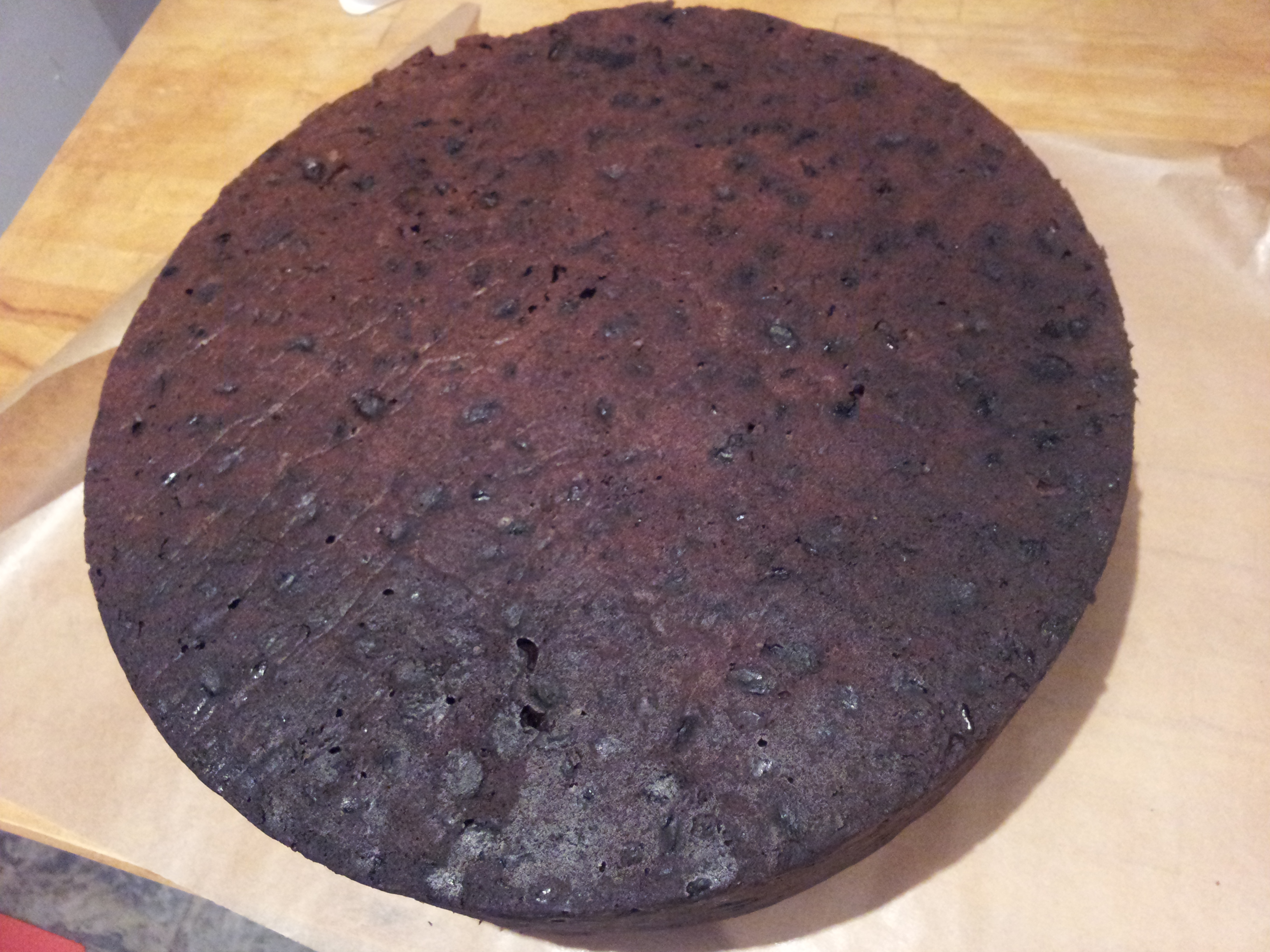
For my 5 tier wedding cake I ended up baking 8 actual cakes! Mainly due to my own stupidity and also because the oven broke. The 2 cakes which required an extra 3 hours of baking (when added onto their original 4 hours of baking is a lot of time in an oven!) made me realise that the oven wasn’t playing nicely. I invested in an oven thermometer to check the temperature throughout the wedding cake baking process and followed this precisely. Only to then incinerate one cake completely. It was a charcoal cake. Although once I chipped away the outer charcoal casing the centre of the cake was really rather nice. I was determined not to let the amaretto soaked cherries to go to waste. So I chopped up the inside of the cake and served it with ice cream. It was delicious!

The quick ice day late spare cake

The quick ice day late spare cake

The other ‘ruined’ cakes did not go to waste either. I decided to donate one of my reject cakes to the church bake sale and quickly iced it. However upon arrival we discovered we were a day late for the bake sale… Ah the brain fog of wedding preparations! So I shared it with friends instead when they came round for festive drinks. I must admit the extra booze and fruit in the cake made it tricky to cut but it was so tasty!! The final uniced extra boozy tier is still maturing nicely in the cupboard. I’m going to save that one for a special occasion. I’m sure it’s good to keep for at least a year or two.

I despaired slightly as I still had 3 cakes left to bake with a broken oven. Then I did a bit of googling and decided instead to dismantle the oven, clean it and put it back together.  Thankfully this seemed to do the trick! I also watched the other cakes like a hawk and turned them every hour to avoid any charring from the hot spots in the oven. The result? The final 3 tiers were the best cakes I’ve ever baked in my life. I’m sure that extra care and attention was the secret to their success. They were so level they didn’t need to be propped up when icing them to get an even top.

Creaming the butter and the eggs - wedding fruit cake

Creaming the butter, sugar and orange and lemon zests

The method for each sized cake is exactly the same and after baking 8 of them I was starting to know it off by heart. I think this Christmas I may make chocolate cakes! After soaking the fruit in booze for at least 24 hours (if not 2 weeks) you cream the butter, sugar and fruit zests together until light and fluffy.

Whisk in the eggs to the butter and sugar

Whisk in the eggs to the butter and sugar

Then to add the eggs, whisking them into the butter and sugar mix one at a time. I had to use the biggest bowl I own for this job as the eggs inflate like mad when whisked. The mixture can start to curdle or separate at this point, but it’s not the end of the world. You can whisk in a little flour to stop it separating but it’s still going to taste pretty amazing.

The whisked eggs are dangerously close to overflowing the bowl

The whisked eggs are dangerously close to overflowing the bowl

Then to prepare the dry ingredients. A separate bowl was definitely required to sift the mountain of flour and spices together. I love a spicy cake, so I’m always quite liberal with the cinnamon and nutmeg.

Mountains of flour and spices

Mountains of flour and spices

For the 12″ cake I didn’t have a bowl big enough to fit everything in so had to resort to stirring it all together in the plastic storage box! Who knew it was so difficult to stir things in a square box… I ended up with cake mix right up to my elbows and consequently my face and hair. But I did it!

Time to stir it all together! Wooden spoon at the ready

Time to stir it all together! Wooden spoon at the ready

You have to fold the wet and dry ingredients in a third at a time until it’s all incorporated. Then finally fold in the ground almonds, chopped nuts and treacle.

Almost fully combined just the treacle and almonds left to fold in

Almost fully combined just the treacle and almonds left to fold in

I hired the largest cake tins from my local cake shop. At 50p a day it was much cheaper than buying massive cake tins and I don’t have to worry about storing them in our already full to capacity flat. It’s really important to double line and grease the cake tins to help prevent the cake from burning as it needs to bake for a really long time at a low (ish) temperature (150 degrees Celsius).

I always tie an extra collar of greaseproof paper around the outside of the tin and use that to prop up a greaseproof paper lid to protect the top of the cake from burning too. As it doesn’t have any raising agent in it the fruit cake won’t really rise any higher than it sits in the tin uncooked. I wanted to try to get the most even finish that I could so I carefully layered the mixture into the tin, spreading and flattening it down with a spatula. No air pockets for me thanks and the smoothest top I’ve ever achieved.

An even spread - all of the 12" cake mixture in it's very large tin

An even spread – all of the 12″ cake mixture in it’s very large tin

The largest cake obviously takes the longest time to bake. In hindsight starting a massive cake at 6pm is probably not the best plan. It takes at least an hour to combine all of the ingredients together and prepare the tins. Then it needs 6 hours in the oven. This meant I was babysitting the cake until 3am. I accidentally fell asleep and awoke with a fright with the oven timer going off, in my own personal inferno with the oven and the heating on, whilst wearing fleecy pyjamas, a dressing gown and a furry blanket with the cat sat on top of me. I forgot to turn this cake whilst it was baking, due to me being asleep and all , so the cake had a nice diagonal shadow across it, but once it had an extra feeding of booze and it was iced no one noticed. And with a cake this big, using so many ingredients there was no way I was going to start again!

The biggest 12" fruit cake with a slight shadow... shhh no one will notice

The biggest 12″ fruit cake with a slight shadow… shhh no one will notice

The cake fruit and booze combinations I created were…

  • 4″ Cake – Amaretto Tier – Almond, Amaretto and cherry
  • 6″ Cake – Vanilla Tier – Vanilla Brandy, dates, peel and sultanas
  • 8″ Cake – Tropical Tier – Malibu, dried pineapple, coconut, papaya and mango
  • 10″ Cake – Traditional Tier – Brandy and mixed fruit
  • 12″ Cake – Orange Tier – Orange Brandy sultanas, cherries, peel
Putting things into slightly frazzled perspective. This cake was bigger than my head.

Putting things into slightly frazzled perspective. This cake was bigger than my head.

Each cake had a different baking time too although all were baked at 150 degrees

  • 4″ Cake – 2 and a half hours
  • 6″ Cake – 3 hours
  • 8″ Cake – 4 hours
  • 10″ Cake – 4 and 3 quarter hours
  • 12″ Cake – 6 hours
The 6 inch wedding cake. Quite the smooth level finish even if I do say so myself

The 6 inch wedding cake. Quite the smooth level finish even if I do say so myself

What I used to bake my wedding cake – Ingredients

4″ Cake – Almond, Amaretto and Cherries

  • 150g dried cherries
  • 100g sultanas
  • 40g candied peel
  • soaked in (at least) 2 tablespoons of amaretto
  • 100g butter
  • 100g brown sugar
  • zest of 1/4 of lemon
  • zest of 1/4 of orange
  • juice of 1/4 orange (add to the soaked fruit just before you combine the rest of the ingredients)
  • 2 eggs
  • 100g plain flour
  • 1 tsp cinnamon (or more…)
  • 1/2 tsp nutmeg
  • 1/2 tsp mixed spice
  • 1 tsp almond extract
  • 10g ground almonds
  • 10g flaked almonds
  • 1/2 tablespoon treacle

6″ Cake – Vanilla Brandy, dates, peel and sultanas

  • 70g glace cherries
  • 375g sultanas
  • 200g dried chopped dates
  • 45g candied mixed peel
  • soaked in (at least) 4 tablespoons of vanilla infused brandy (pop a vanilla pod in your bottle of brandy and leave a vanilla pod in with the fruit whilst soaking in brandy)
  • 175g butter
  • 175g brown sugar
  • zest of 3/4 of lemon
  • zest of 3/4 of orange
  • juice of 1/2 orange (add to the soaked fruit just before you combine the rest of the ingredients)
  • 3 eggs
  • 175g plain flour
  • 1 tsp cinnamon (or more…)
  • 1 tsp nutmeg
  • 1/2 tsp mixed spice
  • 1 tsp vanilla extract
  • 20g ground almonds
  • 20g flaked almonds
  • 1 tablespoon treacle

8″ Cake – Tropical Tier – Malibu, dried pineapple, coconut, papaya and mango

  • 125g glace cherries
  • 650g sultanas
  • 320g dried tropical fruits (pineapple, papaya and mango)
  • 100g candied mixed peel
  • soaked in (at least) 5 tablespoons of malibu (coconut flavour white rum)
  • 350g butter
  • 350g brown sugar
  • zest of 1 and half of lemons
  • zest of 1 and a half  oranges
  • juice of 3/4 orange (add to the soaked fruit just before you combine the rest of the ingredients)
  • 6 eggs
  • 350g plain flour
  • 2 tsp cinnamon (or more…)
  • 1 tsp nutmeg
  • 1/2 tsp mixed spice
  • 35g ground almonds
  • 35g desicated coconut
  • 1 and 1/2 tablespoons treacle

10″ Cake – Traditional Tier – Brandy and Mixed fruit

  • 180g glace cherries
  • 800g sultanas
  • 210g dried apricots
  • 250g dried chopped dates
  • 250g dried cherries
  • 110g candied mixed peel
  • soaked in (at least) 8 tablespoons of brandy
  • 450g butter
  • 450g brown sugar
  • zest of 2 of lemons
  • zest of 2 of oranges
  • juice of 1 orange (add to the soaked fruit just before you combine the rest of the ingredients)
  • 8 and half eggs
  • 450g plain flour
  • 3 tsp cinnamon (or more…)
  • 2 tsp nutmeg
  • 1/2 tsp mixed spice
  • 55g ground almonds
  • 55g flaked almonds
  • 2 tablespoons treacle

12″ Cake – Orange Brandy sultanas, cherries, peel

  • 250g glace cherries
  • 1460g sultanas
  • 400g dried apricots
  • 350g dried chopped dates
  • 250g dried cherries
  • 200g candied mixed peel
  • soaked in (at least) 10 tablespoons of orange brandy liqueur
  • 660g butter
  • 660g brown sugar
  • zest of 3 of lemons
  • zest of 3 of oranges
  • juice of 1 and 1/2 oranges (add to the soaked fruit just before you combine the rest of the ingredients)
  • 12 eggs
  • 660g plain flour
  • 4 tsp cinnamon (or more…)
  • 2 tsp nutmeg
  • 1/2 tsp mixed spice
  • 75g ground almonds
  • 75g flaked almonds
  • 3 tablespoons treacle
5 teetering tiers of fruit cake. Stacked and ready to mature

5 teetering tiers of fruit cake. Stacked and ready to mature

Once all 8 cakes were baked I had a job trying to find places to store them. A bit of strategic thinking and double wrapping in greaseproof paper and tin foil later 8 cakes were ready to mature for a month before being iced. I’ll tell you all about that adventure later on along with our house flooding 2 weeks before the wedding and making over 100 sugar flowers…

My bakers impression of the final 5 tier wedding cake

My bakers impression of the final 5 tier wedding cake

Love from the new Mrs Lauren Hoy x

Me

Me – more bridey than cakey

This is part 1 of the 4 stages of wedding cake baking! You can read more about my epic wedding cake adventures here…

Part 1 – My 5 tiers of fruit wedding cake – My biggest booziest cake yet 

Part 2 – How many sugar flowers does it take to make a wedding cake?

Part 3 – Where to start icing a 5 tier wedding cake?

Part 4 -The Final Frontier – Decorating & assembling my 5 Tier wedding cake

46. Say hello to my Brazilian Roll ~ Rocambole Cake

image

Brazil is yet another country on my still to visit list. However I do have a lovely Brazilian friend who was an exchange student at my sixth form. We became firm friends over A Level Media Studies and parties. Thinking of you Gabriella when baking my Brazilian Roll or as you may call it in Brazil a Rocambole.

image

This bake reminds me of Mary Berry’s Chocolate Roulade (one of my very first around the world in 80 bakes more technical challenges). Both are very similar to the wonderful Swiss Roll however the distinguishing factor of the Rocambole and the Roulade is that they use whisked egg whites to fluff up the sponge. This means it’s a fragile cake but very light. Where as the Swiss Roll is more like a sponge cake, less delicate and probably (in my opinion) a bit easier to bake and to handle.

Traditionally the filling in a Rocambole is a Doce de Leite. This is a Brazilian favourite. It’s a creamy milky toffee sauce made from slowly reduced condensed milk. (It’s quite similar to the Italian toffee sauce dolce de leche). It’s reduced down over a low heat until caramelised to produce a thick fudgey gooey paste. As the filing takes quite some time to prepare it’s best to start with this! You need to be really careful with this as if the pan is left to boil dry the can could explode and really hurt yourself (and your kitchen).

how to make doce de leit Simmer an unopened can of condensed in a pan of water for at least 2 and a half hours

Simmer an unopened can of condensed in a pan of water for at least 2 and a half hours

Take one unopened can of condensed milk (Most cans in the UK randomly contain a very precise amount of condensed milk of 395ml. Who knows why? But the process is the same regardless of the size of your tin). Place your unopened can of condensed milk in a pan of boiling water and simmer it for 2 and a half hours. Keep an eye on the pan and keep topping up the water so the water level remains.always around 2 thirds of the way up the can. Allow the can to cool for about 30 minutes before opening it.

Evaporated milk isn’t the same and unfortunately won’t work as a substitute, as evaporated milk doesn’t have as much sugar in it. Never to be defeated I have managed to make doce de leite with evaporated milk. If you’re up for an experiment and evaporated milk is all you’ve got, you could get away with adding sugar to evaporated milk and dissolving it slowly over a low heat to create your own toffee sauce. (I have free styled this recipe before and it gave a rather more liquid toffee sauce so it can be done! Just add enough sugar until you reach your desired level of toffee colour and taste.)

how to make doce de leite

The grand reveal! My doce de leite looks suspiciously like condensed milk. No hint of toffee here. Back in the pan you go

Unfortunately I failed to let the water bubble (being a little too cautious – very unlike me!) so when I opened my can it still looked like condensed milk, just a bit thicker. However undeterred I threw it all into the pan and heated it on the stove to make my doce de leite directly in the pan. It does require a bit more attention and elbow grease however…

The slightly reduce condensed milk straight from the can, the bottom revealed some thicker doce de leit

The slightly reduce condensed milk straight from the can, the bottom of the can revealed  the beginnings of some thicker doce de leit. It’s a bit lumpy so needs a good whisk

I’m a little impatient and wanted it to thicken up quickly so kept increasing the heat and whisking by hand until it bubbled, then removed the pan from the heat to allow the residual heat to continue to cook the condensed milk. You need strong arms to keep whisking continuously as the milk thickens! (My arms weren’t feeling the strongest after a full day of Yoga handstands the day before but I still managed)

Whisking the condensed milk over a low heat to make doce de leit

Whisking the condensed milk over a low heat to make doce de leite

My impatience led my doce de leite to become extremely thick and it pulled the head off my hand whisk! However a little cold milk reduced the heat of the sugar to calm the doce de leite down. It allowed me to get the sauce back to a slightly more spreadable state. To stop the cooking process I placed the hot pan into a sink of cold water. In my ‘wisdom’ I then dipped my finger into the doce de leite to test if it was cool enough to spread! It was most definitely NOT cool enough and welded to my finger. I managed to pull the molten lava doce de leite off my finger and ran it under the cold tap. Did you know a piece of frozen melon makes a wonderful cold compress to take the heat out of a burn? Clutching my melon I managed awkwardly to continue to whisk the sauce still undefeated by my blistering finger. I ended up clutching on to more frozen fruit whilst spreading the doce de leit and rolling up the cake.

After a good 5 minutes of whisking and heating it turns a golden brown colour and becomes quite thick! Add a bit of milk to loosen the mixture if it needs it.

After a good 5 minutes of whisking and heating it turns a golden brown colour and becomes quite thick! Add a bit of milk to loosen the mixture if it needs it.

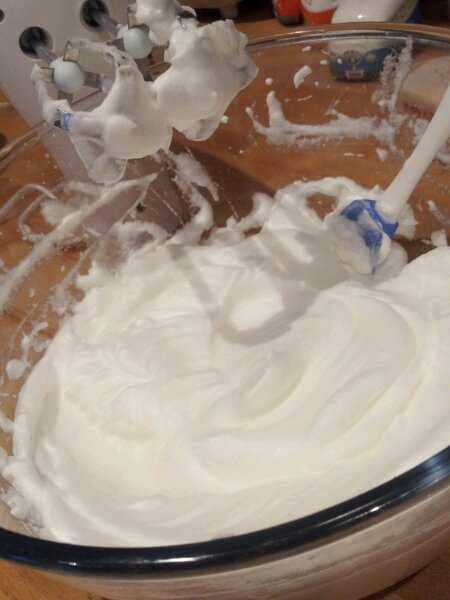
The cake itself takes hardly any time at all to prepare. The whisking is the most time consuming part of the Rocambole. Like a Roulade you have to whisk the ALL of the egg whites (there’s 5 eggs in this cake! That’s a lot of egg!) on a high speed setting. (If you have an electric whisk, if not prepare your arms for a bit of a work out!) until stiff and shiny. This takes about 5 to 7 minutes. The egg whites will double in size. I love this bit!

Whisking the egg whites to make Rocambole

Whisking the egg whites to make Rocambole

One slight difference between the Rocambole to a Roulade is that the egg yolks are then also whisked into the egg whites. (With a Roulade you whisk the yolks with the sugar and chocolate then fold it into the egg whites.) The Rocambole is a bit quicker banging it all together and whisking to your hearts content. You don’t want to knock any of the air out of the egg whites, so it’s best to beat the yolks lightly first so they are runny. You can then pour the egg yolks in as you whisk.

Adding egg yolks to whisked egg whites - rocambole

Whisking in the egg yolks to the egg whites – lovely creamy yellow colour and very fluffy!

Then to whisk in the sugar. The traditional Brazilian Rocambole recipe doesn’t include any flavourings or spices, it is a plain egg sponge. (A bit like my Chinese Egg Yolk Sponge favourite!)  Ever the experimenter I wanted to add a bit of flavour to this bake so I used vanilla sugar. I made this really simply by shoving a leftover vanilla pod, which I had scraped the seeds from for another bake, into a bag of sugar. I then left it to infuse it’s vanillary goodness for a couple of weeks. It smells lovely and gently flavours the sugar with a hint of vanilla. It’s a good way to get your moneys worth out of those more expensive ingredients as I hate to throw the pods away. I often pop a vanilla pod into any spirit that I have in my cupboard too. Vanilla Brandy or Vanilla Rum anyone?

Then to whisk in 5 tablespoons of water into the eggs and sugar - Rocambole

Then to whisk in 5 tablespoons of water into the eggs and sugar

The eggs should be seriously expanding and threatening to overflow the bowl by this point as they inflate rapidly. You need to continue to whisk the fluffy and shiny eggs whilst pouring in 5 tablespoons of water. This takes around 5 minutes of whisking.

Fold in the tiny amount of flour and baking powder

Fold in the tiny amount of flour and baking powder

In order to maximise the air in the cake and to avoid knocking the air out of the wonderfully fluffy eggs, sift in all 5 tablespoons of plain flour and half a teaspoon of baking powder. Then using your  best metal spoon fold in the dry ingredients gently. This is probably the smallest amount of flour that I’ve ever folded into a cake. It felt a bit odd as the flour just disappeared to the bottom of the bowl, but trust in the recipe, it definitely works!

Rocambole Carefully pour the mixture into a rectangular baking tin

Carefully pour the mixture into a rectangular baking tin

Line and grease a rectangular baking tin. I used a tin 37cm long by 22cm wide and 5cm high. Use a deep tin as it will rise in the oven.  This mixture is really delicate so to avoid knocking the air out of it, hold your bowl of mixture as close to your tin as possible and pour. It’s a very liquid mixture so try to pour it into all of the corners so you don’t have to move it around too much in the tin. Gently level the mixture with a spatula to avoid an uneven bake.

A fully cooked and curled Rocambole

A fully cooked and curled Rocambole

After baking it in a preheated oven (350 F/170 degrees Celsius) for 15-20 minutes, it will become golden brown and feel slightly firm and springy to the touch. I always check that a cake is cooked by using a cocktail stick, if it comes out clean from the sponge you know it’s done. Unfortunately I was trying my Mary Berry recommended foil backed parchment paper and it doesn’t always do what it’s told. In the heat of the oven it curled up and into the cake! Maybe a wider variety of paper is needed for this tin so that it reached the edges of the tin and can be scrumpled down over the lip of the tin to hold it in place?

Carefully lift your cake from the tin and prise any baking paper out of the sponge (if needed)

Carefully lift your cake from the tin and prise any baking paper out of the sponge (if needed)

Allow the cake to cool in the tin slightly so it holds it’s shape. Then carefully lift the cake out of the tin, by the baking paper. But don’t remove the baking paper.

Spread the Doce de Leite carefully onto the sponge - try not to take the cake with you

Spread the Doce de Leite carefully onto the sponge – try not to take the cake with you

Using a spatula and a palette knife , I tried to spread  a thin layer of doce de leite across the cake. This is easier said than done whilst holding a piece of frozen fruit on your burnt finger. The Doce de leite is very gooey and if it’s as thick as mine, it could pull holes in your cake (note the holes in my sponge above…) But who is going to check the inside of your cake? When it’s rolled up no one will notice  and it’s going to taste gorgeous anyway so throw it on as best as you can.

Carefully does it ... Roll Roll Roll your Rocambole

Carefully does it … Roll Roll Roll your Rocambole (excuse my slippers)

There is a bit of a knack to rolling up a Rocambole. I decided to neaten up my slightly rough edges, trimming the longest edge as straight as possible with my very best sharp knife. It’s not the easiest cake to trim as the sponge is very moist and delicate (so it sticks to the knife!). I only trimmed one edge in case I destroyed the other side. This cake was to accompany me to the Clandestine Cake Club and I didn’t have time to make another one (or anyone condensed milk!). Trimming the cake does have it’s benefits however, I could make sure it tasted good before serving it up to my friends! 


Ta da! One rolled up Rocambole!

Ta da! One rolled up Rocambole! (And one pan of soapy boiling water on the stove to dissolve all of the doce de leite)

Before I even attempted rolling the cake I made sure I had loosened all of the edges from the baking paper gently with my fingers to avoid tearing the sponge. It’s best to keep the sponge on the paper so you can use the paper to coax the cake over. I started the roll off by pressing a knife into the sponge about half an inch in from the shortest edge. I then folded this lip of sponge over to start the roll and give a really tight spiral. Then to let gravity do it’s job! Lifting the paper over,  letting the cake fall into place whilst coaxing it into a roll with your hands. Once you start it’s easy to get carried away! Hence my lack of photos of this process the Rocambole was all rolled up before Chris could get into the kitchen to take a photo for me!

Rocambole recipe Gently ease any slightly stuck bits  of cake off the paper using your finger tip...

Gently ease any slightly stuck bits of cake off the paper using your finger tip…

All of the pictures I could find of a Rocambole seemed to show a cake with a very long spiral with a very thin sponge so I chose to roll mine from the short edge to the short edge, to maximise my spiral. If you wanted to get more slices out of your Rocambole you could roll from long edge to long edge and get a much longer cake.

Just rolled Rocambole - trimmed edge to the front!

Just rolled Rocambole – trimmed edge to the front!

Once you’ve rolled up your Rocambole all it needs is a liberal dusting with icing sugar and you’re good to go! I recommend eating it quick as the doce de leite has a tendency to ooze out of the sides when left for a night. But if you like this effect then see if you can hang fire for a bit for an extra level of goo.  I can confirm that this a tasty cake. It’s definitely a winner if, like me, you have a sweet tooth as most of the flavour is derived from the sugar in the cake and the milky caramel doce de leite! It’s an extremely tender sponge that almost melts in your mouth. I’ve heard very good things from my Brazilian friend, who’s Grandma makes Rocambole. She covers the entire Rocambole in chocolate buttercream and adds some texture with a fork to create a chocolate log Rocambole! Now there’s a good idea for another Christmas bake to add to my list!

Clandestine Cake Club Newcastle at Pink Lane Coffee

Glorious Cake Collection at the Clandestine Cake Club Newcastle at Pink Lane Coffee

I took my little Rocambole along with me to the Clandestine Cake Club  at the lovely Pink Lane Coffee shop in Newcastle where we were baking around a ‘New’ theme. This could mean a new recipe, new baking tin, new ingredients. This was perfect for me as pretty much every recipe I bake is new to me and a bit of an experiment. There were some amazing cakes that night, my favourite being a chocolate and peanut butter layer cake (7 layers in total!). Check out Lisa’s blog for more gorgeous pictures of the beautiful cakes from all of the bakers who braved the January snow. When there’s cake nothing will get in my way. It was immense. I must admit I took an extra sneaky piece home for later too. I was so happy that all of my Rocambole got eaten.

So if that has whetted your appetite for a spot of Rocambole here’s what I used to make mine.

Ingredients

Doce de Leite Filling

1 unopened can of condensed milk (395 ml)

Alternative fillings…

If you don;t fancy simmering a can of condensed milk down in a pan I’m sure you could put a jar of nutella or jam or guava marmalade (another traditional Brazilian Rocambole filling) to good use here too.

Cake

  • 5 eggs
  • 5 tablespoons of vanilla infused  sugar (or just normal sugar will do)
  • 5 tablespoons of water
  • 5 tablespoons of plain flour
  • 1/2 teaspoon of baking powder

Experimental Chocolate Chip Polvorón – Spanish Christmas Cakes or Mexican Wedding Favours

image

I adore Polvorón and wanted to have a go at creating a nut free version. What other flavours could I incorporate into this delectable sweet treat and not diverge too far from the traditional ethos of the the Polvorón which mainly consists of nuts…? What else but chocolate and cinnamon!

image

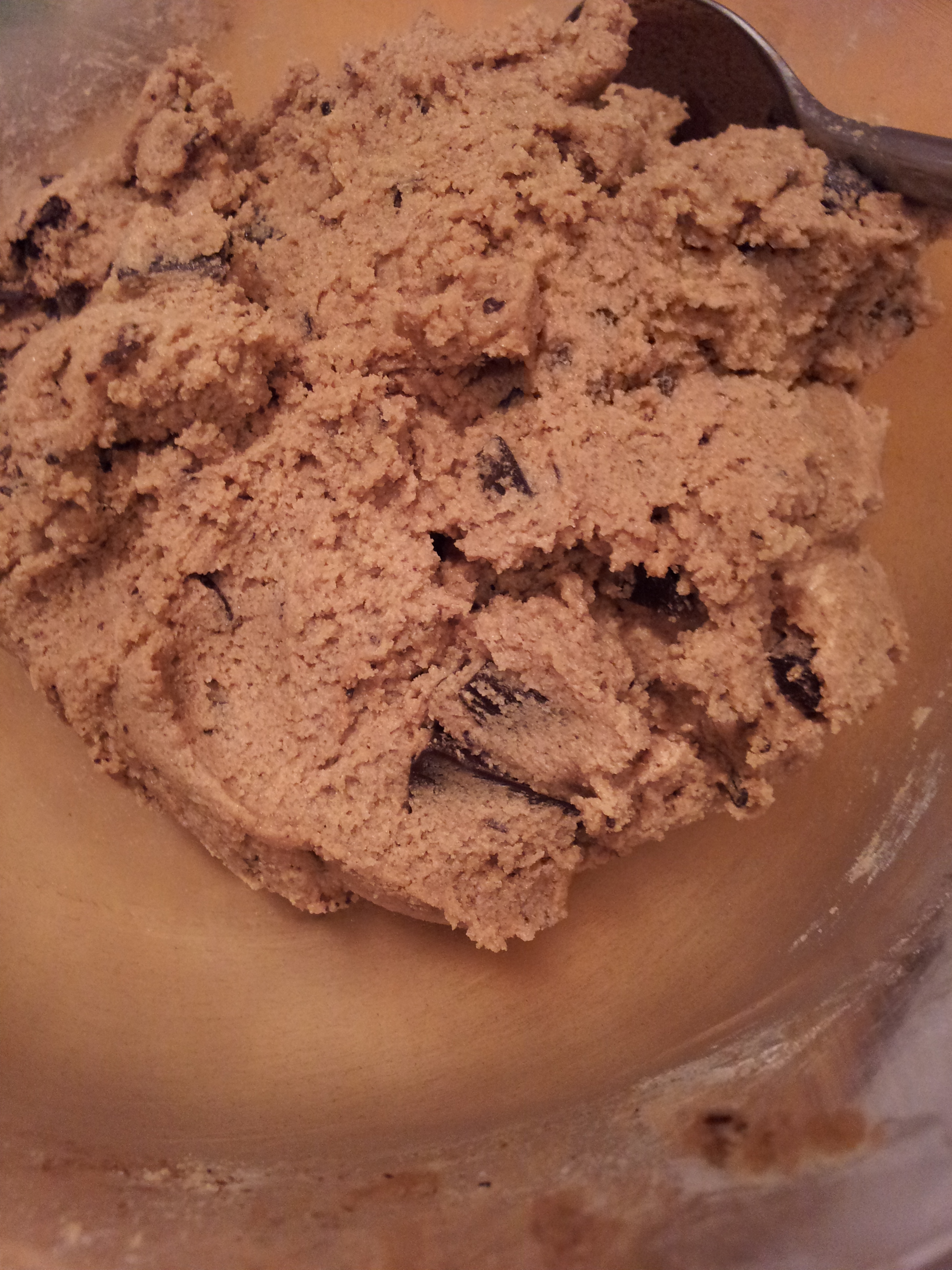
Using the same method as my original Polvorón attempt I replaced the nuts with dark chocolate and added a generous dose of cocoa powder.

And here we have it… a flatter chocolatey and chewier version of Polvorón!

image

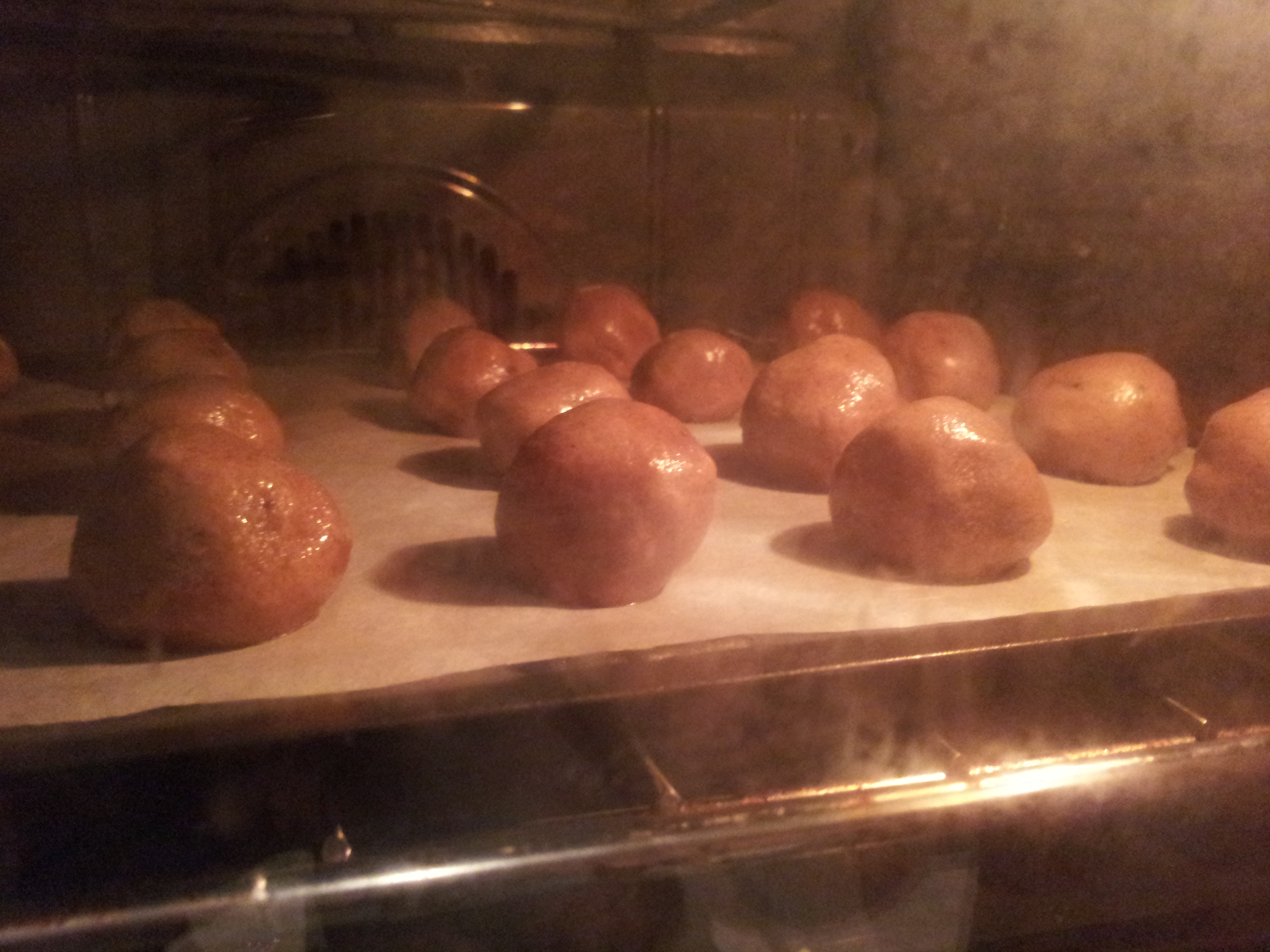
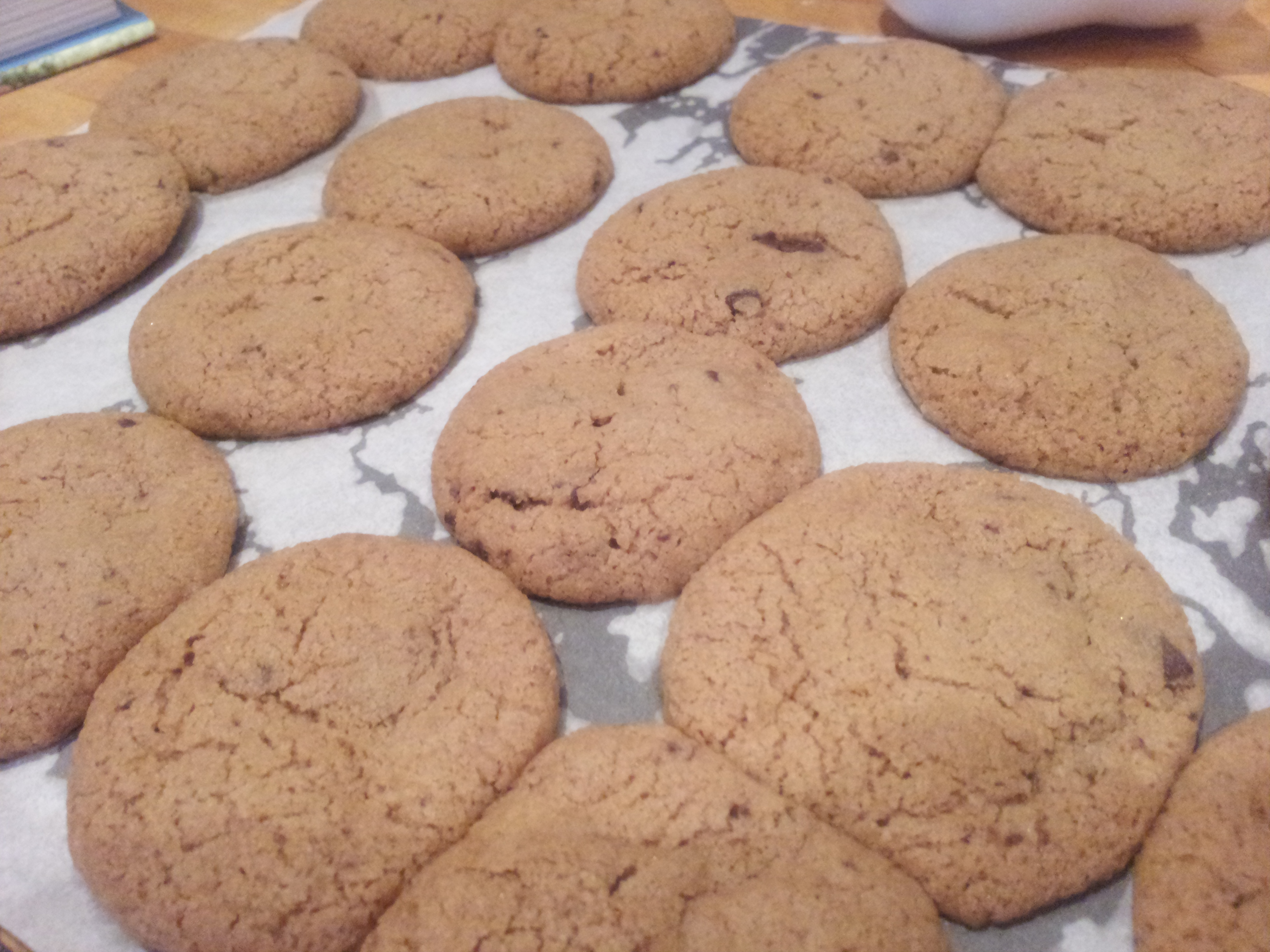
Perhaps because they lack the nuts to hold them together and chocolate (unlike nuts) makes when baked, the little chocolate balls spread into perfectly round chocolate chip cookies.

image

I chose to use caster sugar rather than icing sugar to enhance the crunchy texture. It also added a wonderful chewiness to the cookie, with the sugar and chocolate combining to create a toffee in the centre of the crumbly cookie! Yum! They have been very popular in my house!

image

With a light dusting of icing sugar they look very Festive. The hint of cinnamon conquers up Christmas.These are would make a perfect homemade present, or to be eaten by the handful with a large bucket if tea. I really rather enjoyed making this Spanish Christmas cakes/cookie recipe up!

image

I’m looking forward to my further Polvorón flavour experiments!

image

Things I used to make Chocolate Polvorón

Makes about 40 small biscuits

Preparation: 15 minutes

Chilling time: 30 minutes

Baking time: 18-20minutes at 170degrees c

  • 220g butter (1 cup or 2 sticks)  room temperature
  • 250g caster sugar (2 cups or 240 grams) – rather than icing sugar to add an extra crunch that the nuts would normally add
  • 2 teaspoons vanilla extract
  • 250g all purpose flour (2 cups or 240 grams)
  • 100 g (1 cup) dark chocolate coarsely ground/chopped
  • 1/4 teaspoon ground cinnamon
  • 30g cocoa powder
  • icing sugar to dust the biscuits with

image

I’m entering these experimental Spanish Polvores into Chris’s Cooking Around the World Spain Round up. Pop on over to his blog for a round up of some inspirational international cooking! Thanks for reading!

40. Chinese Rice Cakes – Half way aroundtheworldin80bakes!

Hasn’t time flown? One year in and we’re already half way Around the World in 80 bakes and what better destination to reach than China, one of my most favourite places in the world!

The Great Wall – look how far we walked

China has always been my ultimate must visit country. We visited just before the Beijing Olympics. Travelling around on over night trains from Shanghai to Beijing, climbing the Great Wall (sometimes on my hands and knees  – those steps are steep!) and sampling all of the delights of tasty chicken spine (!) and dried fish skin (yum).

Chinese Street Food – we didn’t eat the seahorses on sticks

Chinese Rice cakes have always intrigued me. I found the recipe in Marguerite Patten’s book and was surprised to discover how little rice flour they actually contain! However they do contain LARD! You may recall my love of lard from previous bakes such as Wiltshire Lardy Cake


These are such a quick little cake to bake and the results are impressive. Paul Hollywood would be proud of my equal sized rice cakes and even bake.

Chinese Rice Cakes – Paul Hollywood would be proud, look at the consistent size of the batch!

All you have to do is sift the dry ingredients together; plain, rice and corn flour, with baking powder, salt and sugar.

Ready to rub in the lard and rice flour

Rub the lard into the flour… My least favourite bit as I still shudder at the smell of lard. It’s definitely pungent.

Lardy times

Then bring together the mixture by stirring in a tablespoon of water, almond extract and half an egg. What a peculiarly precise measurement from Marguerite! I struggled to decide what half an egg was, so I cracked an egg into my cupped palm, over a bowl. I chopped the yolk in half with my finger and slid half (ish) of the egg into the mix. Keeping the other half for glazing the cakes later on.

Sticky dough ready for shaping

Once the mixture is quite sticky it’s ready to be divided and rolled into equal sized balls and plopped onto a greased and lined baking sheet. It’s easier to use your hands to roll them into smooth balls.

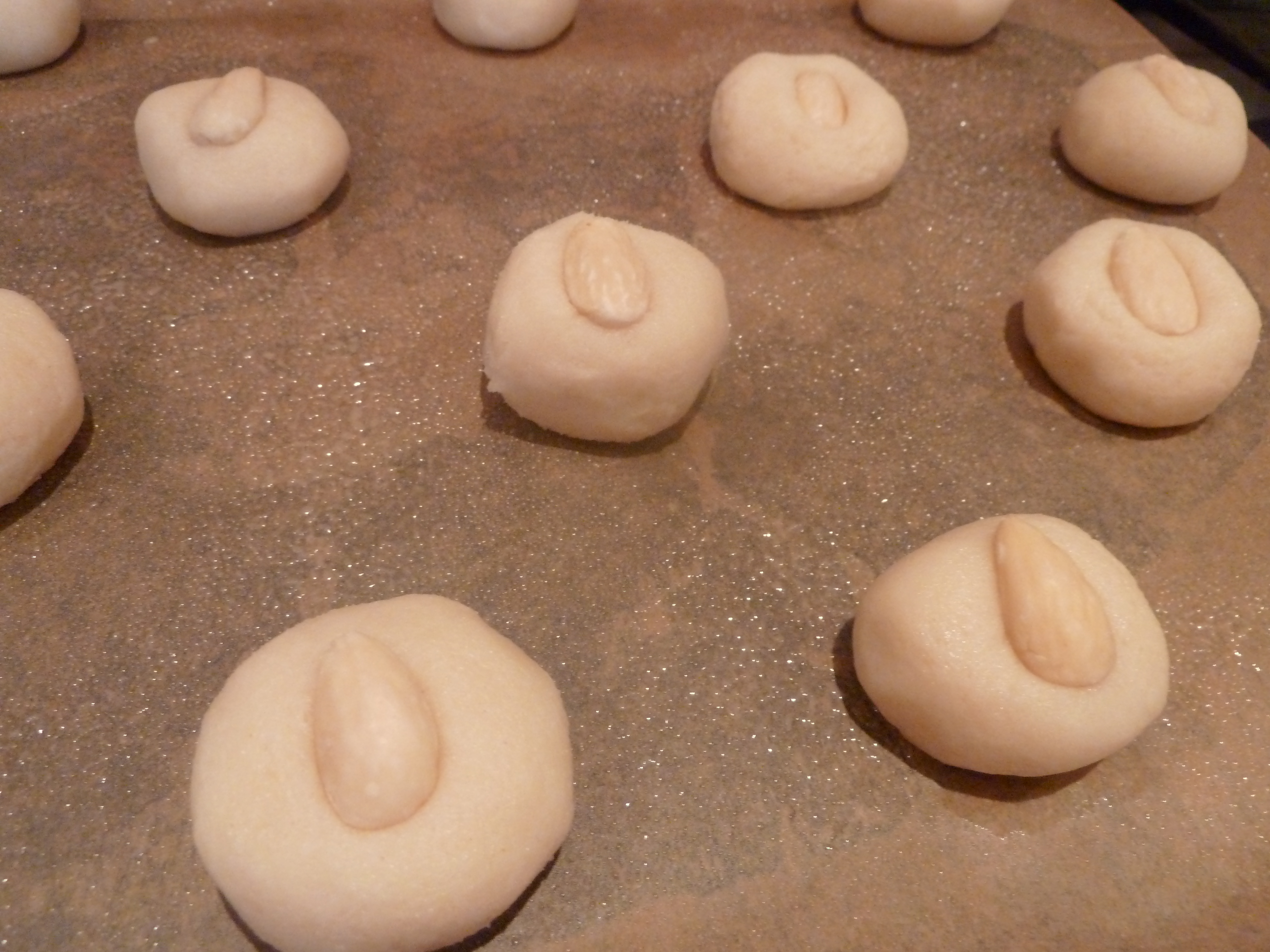
Lined up and ready for my close up – Chinese Rice Cakes

Once they’re on the sheet and spaced out nicely press a blanched almond into the centre and give them a quick egg wash with the other half of the egg. This means they will flatten a little onto the sheet and the almond will stick to the dough as it bakes. You will also get a wonderful golden crust on your cakes.

Perfectly spaced and oven ready Chinese Rice Cakes

Into the oven for for 15 -20 minutes at 205 degrees celsius and…

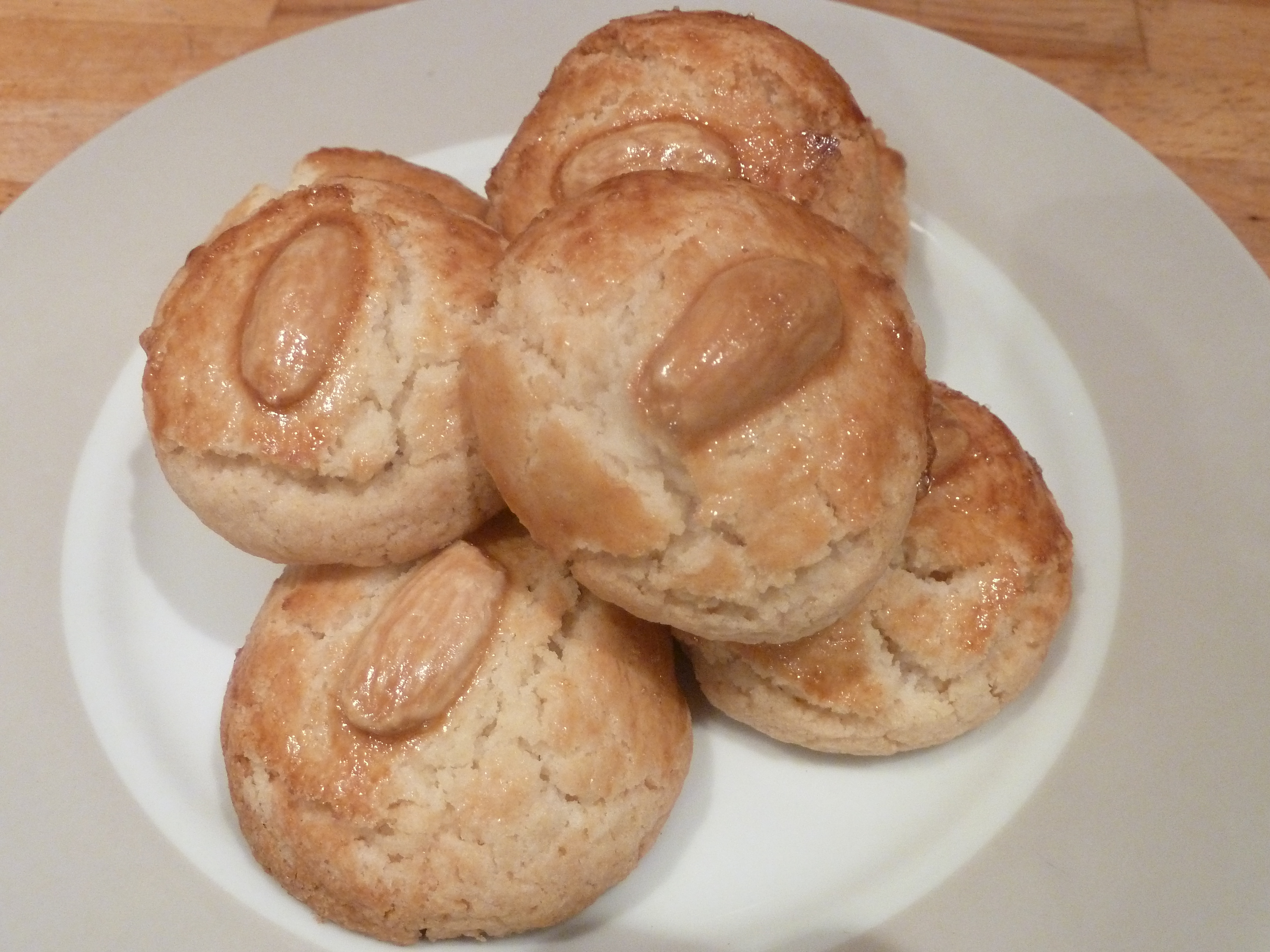
Just baked Chinese Rice Cakes

Ni Hao Chinese Rice Cakes ah hoy!

The Final Bake – Chinese Rice Cake

What a tasty little cake! The almond extract really comes though although if I were to make it again I probably would add more almond extract and some ground almonds too for more of an extravagant bake and richer flavour. Marguerite Patten’s recipes tend to be a bit more on the economical side, using minimum amounts of ingredients as she was baking during the war and making do with rations and tight budgets. I often double the quantities to make a larger batch and feed my hungry friends and family. The lard adds the extra moisture needed to give a crumbly yet light texture when baking with gluten free flours such as corn and rice which can be a bit dry side for my liking. They keep for quite a while in an airtight container and freeze really well too. Then easy to defrost as and when needed for a rice cake fix.

All in all a very quick, efficient and consistent bake. I would definitely bake these again and know that I won’t be able to resist experimenting with the ingredients.

Things that I used to make Chinese Rice Cakes

Margeurite Patten’s Recipe

This makes approximately 15 cakes

Preparation time: 10 minutes! (My kind of preparation!)

Cooking time: 15 -20 minutes

  • 4 oz (118g)  plain flour
  • 1 oz (30g) ground rice (rice flour)
  • 1/2 oz (15g) Cornflour
  • 3 oz (88g) sugar
  • 2/3 tsp baking powder
  • 3 oz (88g) lard
  • 1/2 an egg (quite difficult to measure!)
  • 1 tablespoon water
  • 1/2 tsp almond essence (I used extract as it’s stronger)
  • pinch of salt
  • blanched almonds to decorate
  • 15-20 minutes at 205 degrees Celsius

38. South Korean Sweet Potato Cake with Creamy Coconut Custard Frosting

This recipe was inspired by what I had left in my fridge. One lonely sweet potato. Upon returning from holiday to Amsterdam I needed a quick and exotic bake for my sister’s birthday. I wasn’t entirely sure that everyone would enjoy a South Korean sweet potato cake but hey, this is what you get when your little sister sets up an international baking blog challenge!

This was actually quite quick to make, the most time being spent peeling and dicing the sweet potato so it could be boiled and mashed into a gloriously orange mush.

Mushed Sweet Potato

I love sweet potatoes and have been eating them a LOT in my preparation for the Great North Run which is (gulp!!) next Sunday!! They promise many vitamins (A, C and B6), antioxidants AND they have anti inflammatory properties! Perfect for soothing those aching joints and muscles post running! ..So this cake is (almost) practically healthy!

Creamy butter and sugar

I started by creaming the butter and two types of sugar together with my handheld electric whisk for about 5 minutes until it became lighter and fluffy.

Then add one egg at a time and vanilla and keep on whisking

Then add the vanilla and eggs, one at a time,vanilla and keep on whisking until they’re incorporated completely. It take about 5 minutes to whisk the mixture up until it’s very light and fluffy.

Lots of fluffy eggs, sugar and butter

Then onto the dry stuff. In a separate bowl I mixed together the flour, baking powder, and salt.

Dry stuff, flour, baking powder and salt

Then to stir in the milk to the sweet potato along with the syrup (as I don’t keep maple syrup in my cupboard I substituted it for golden syrup 🙂

IN with the syrup!

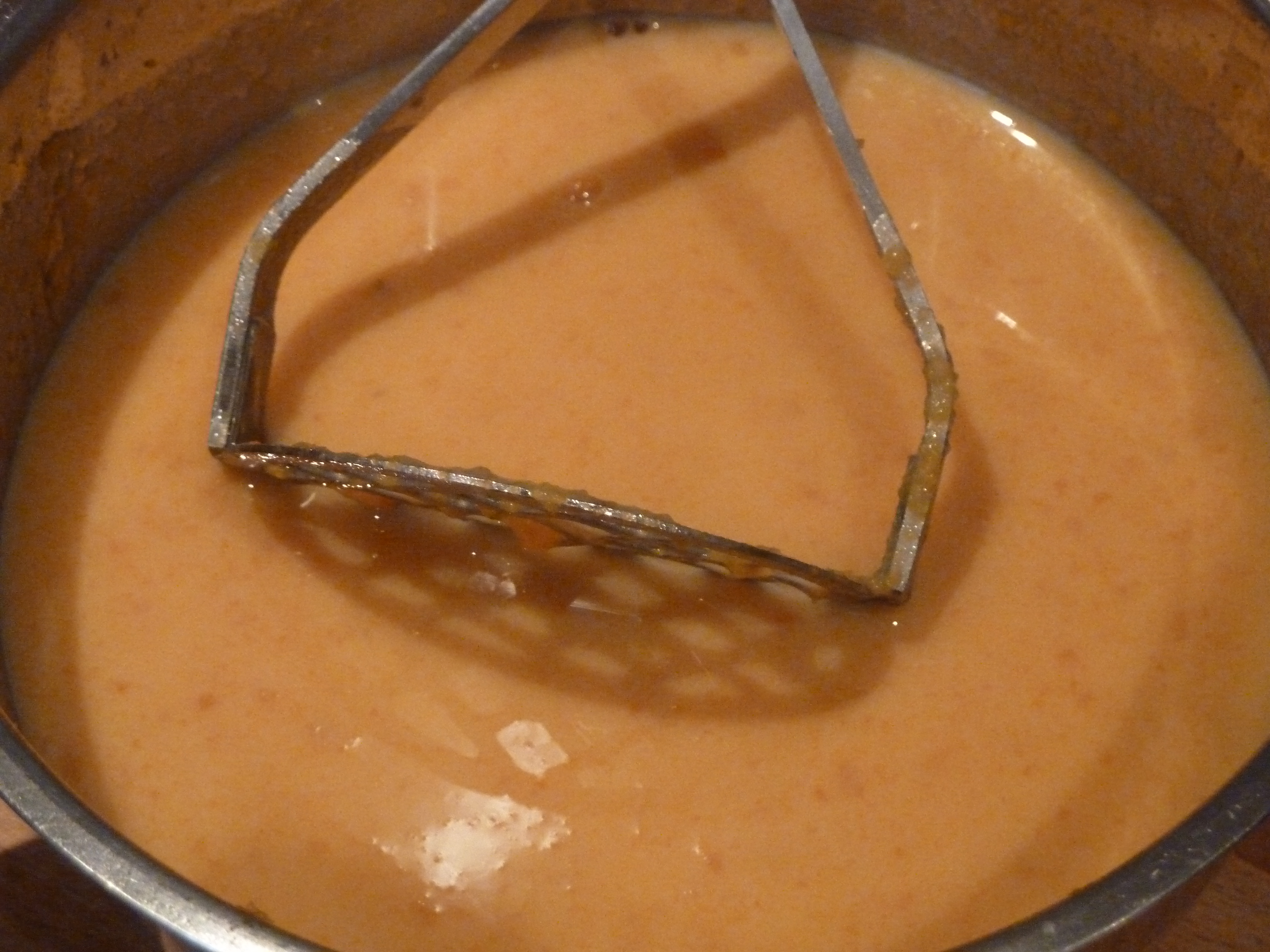
Stir it all together until it’s a milky sweet potato soup

Sweet potato soup

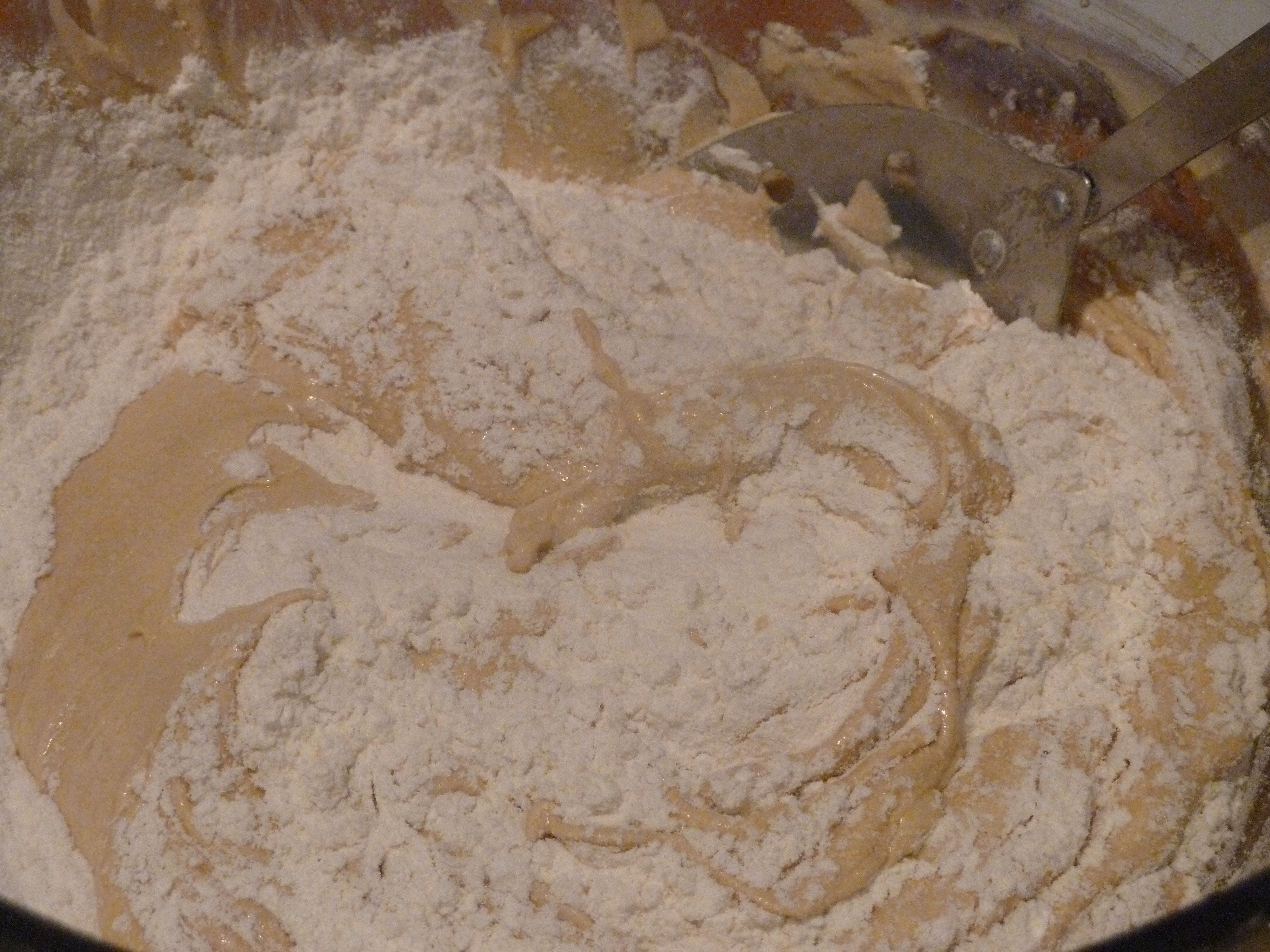
Then to gently fold in a third of the flour to the fluffy eggs and butter mixture

Folding in the flour

And then fold in a third of the sweet potato soup

Folding in the sweet potato soup

And alternate folding in a third of the flour and a third of the soup until all the ingredients are incorporated creating an orange flecked liquid batter.

All in!

The original recipe was to make two 9 inch round cakes. But I wanted one big cake and I love my lazy cake pan (PushPan) and use it at every opportunity I get! It really speeds up the process as it’s really non stick and leak proof! AND my favourite bit! No lining required! No wasted paper and effort. Just a quick spritz with cake release et voila! One quick cake! I wish I could afford more of them.

Just baked. Look at that deep brown!

I used one 9 inch tin to cake all of the batter in a 180 degrees C (or 350 degree F)  oven for 40 to 50 minutes. Until it’s baked evenly, with a golden top. This cake shrank back beautifully from the sides of the tin too to tell me it was ready for eating. I made sure it was done by sticking a cocktail stick in it and it came out clean on my check.

I always leave a cake to cool in it’s pan for at least 15 minutes before turning it out to cool fully on the wire rack. I learnt this the hard way as I once took my Christmas cake out of the tin straight away and it fell into 3 massive chunks in my hands. I did shed a tear at this after waiting patiently for it by the oven for 5 hours. They definitely need a bit of cooling to hold their shape! (Luckily I managed to stick my cake back together with jam and a bit of marzipan to cover the cracks and no one knew the difference!)

Tester sweet potato cupcakes

I was worried that this cake might be a bit odd on our English palettes so I made some tester cupcakes alongside my large cake. I needn’t have worried! It was delicious! I has only meant to try the corner of one cupcake and 2 minutes later the whole thing has disappeared into my tummy. It’s quite a sweet and slightly savoury sponge. A bit like carrot cake but without the grated carrot texture. It’s also a lot more moist than carrot cake.
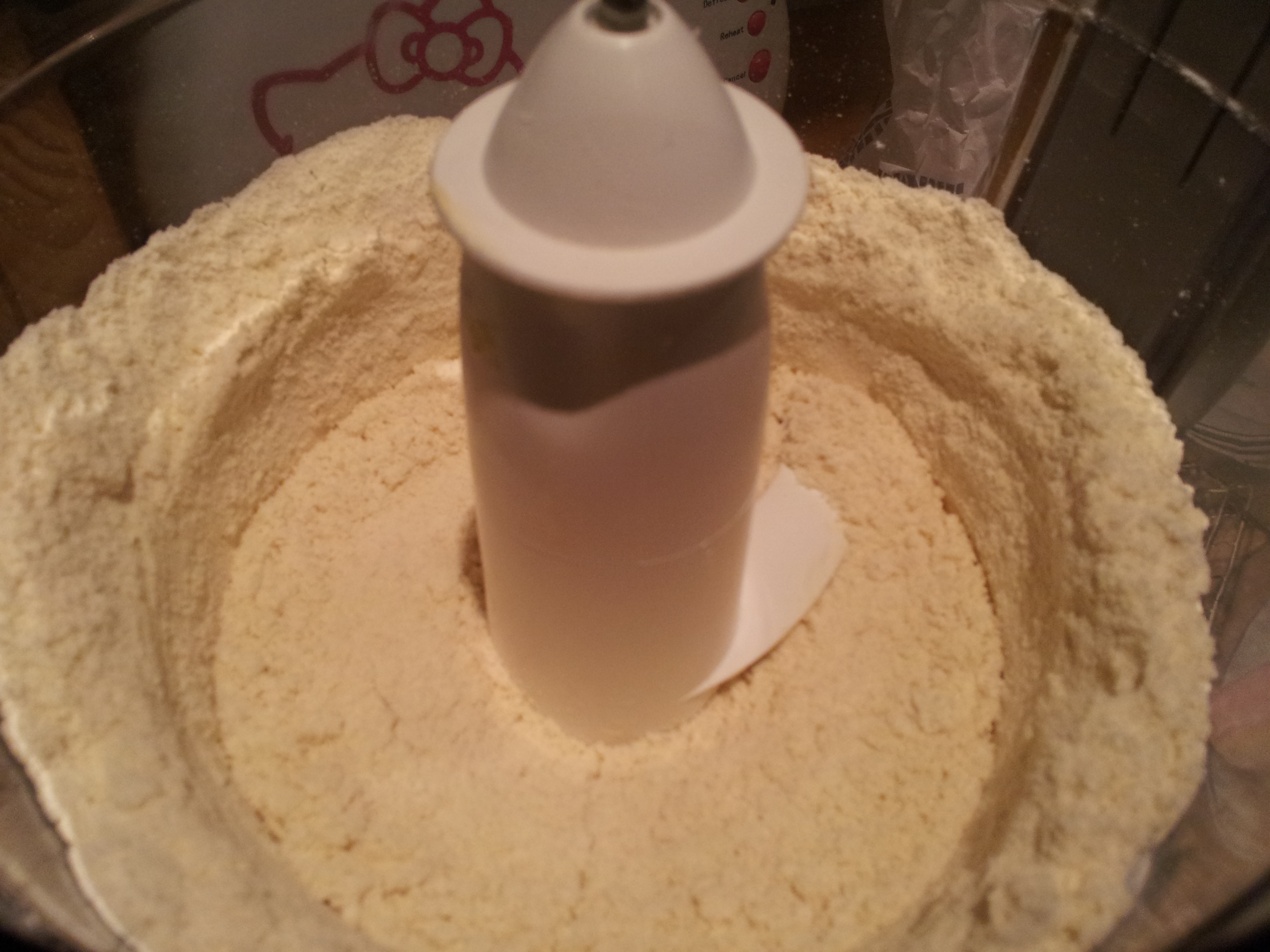
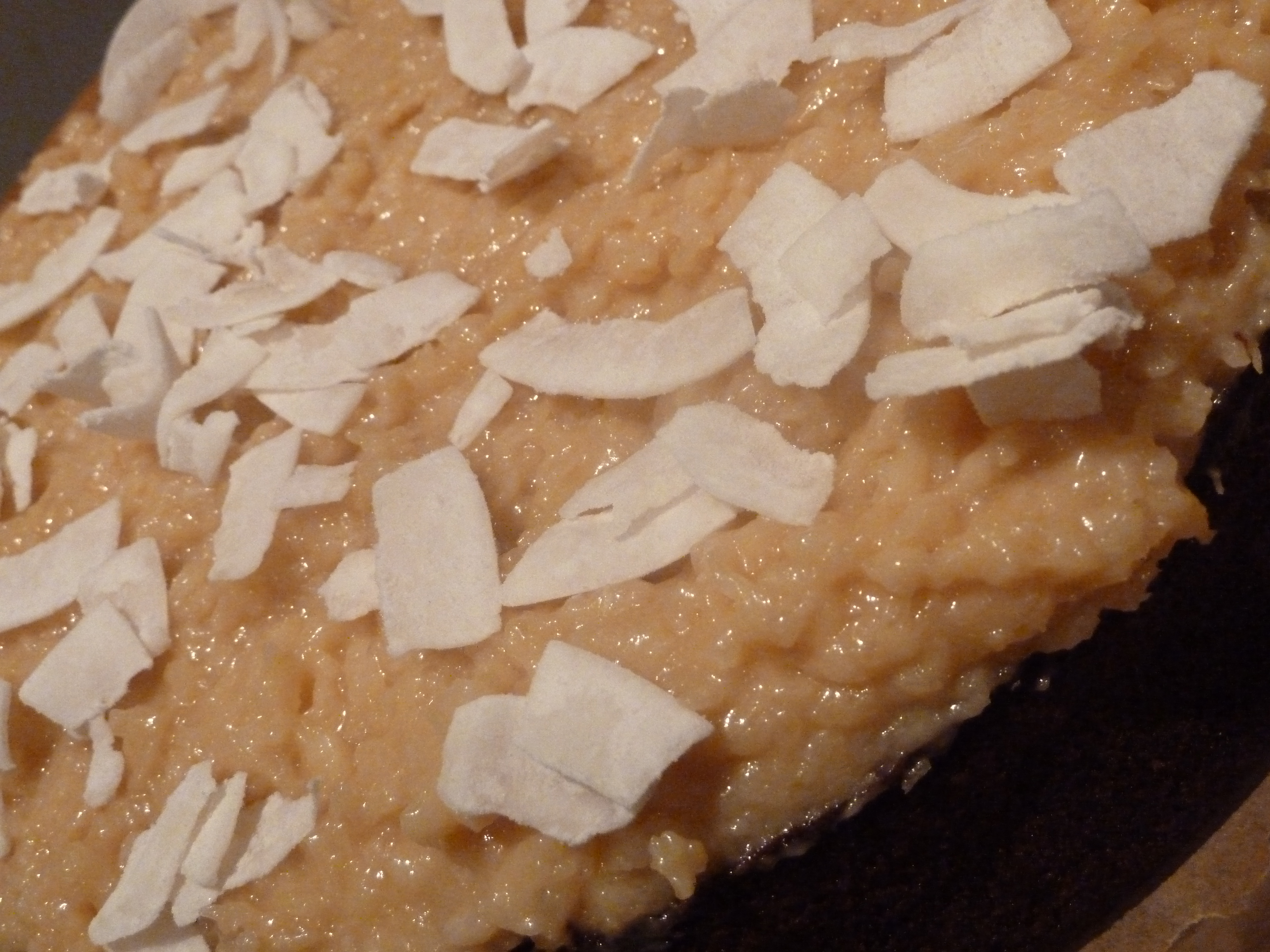
You could stop here as the recipe didn’t give any sort of filing or frosting and the cake is sweet enough to eat as a sponge in it’s own right. HOWEVER if like me you want to take things a step further I found an amazing recipe for Creamy Coconut Custard Frosting, which is very reminiscent of rice pudding with a whole can of evapourated milk but with dessicated coconut instead of rice. Delicious! And what I love even more about this recipe is it takes 15 minutes with no trace of icing sugar to be swept up from every corner of your kitchen afterwards! This is a great alternative to buttercream which my family aren’t a huge fan of.

Throw into a pan egg yolks,  evapourated milk, sugar and vanilla

Choosing my heaviest sauce pan I added the sugar, egg yolks and milk to it along with the vanilla and stirred it all together

Continue to stir over a medium heat for 12 minutes until it thickens

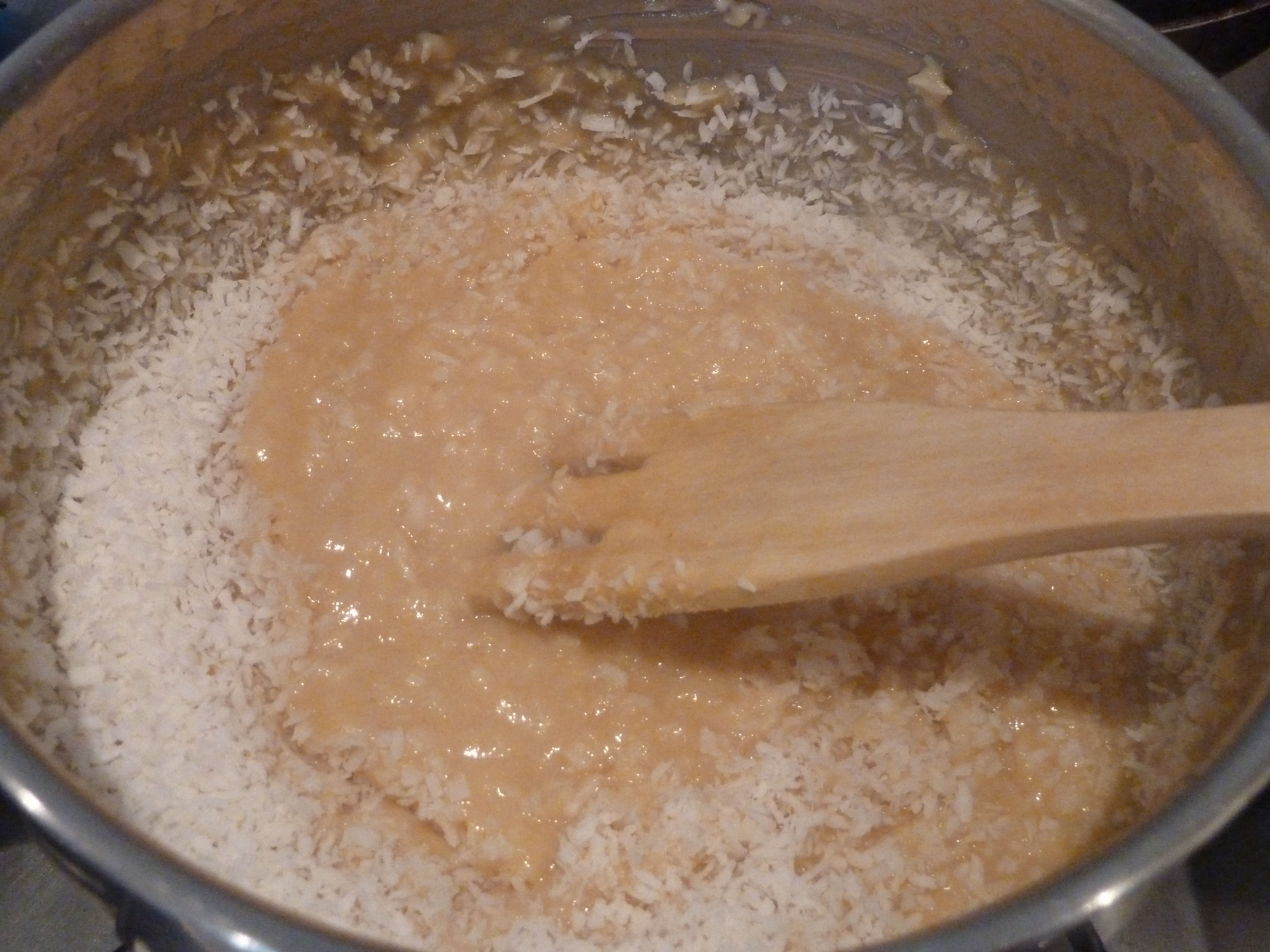
Once it reaches the ‘pudding’ stage (it’s as thick as pudding) take the pan off the heat, throw in the dessicated coconut and Bob’s your uncle you’ve made coconut custard!

Then it needs to be cooled completely before spreading it over your cake.

Creamy Coconut Custard Frosting

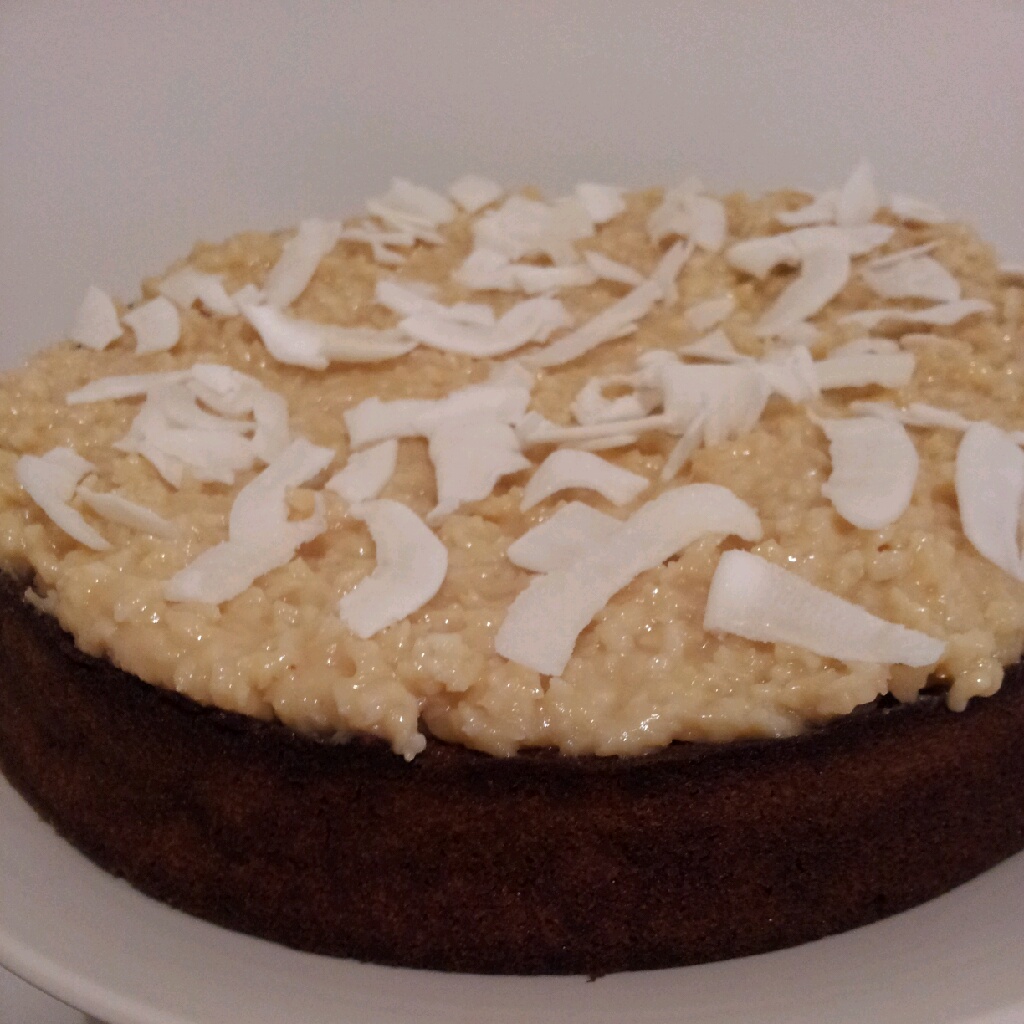
As Mary Berry ‘s sage advice is to include a little of what’s in your cake on your cake so I lovingly adorned the cake with slices of coconut too.

South Korean Sweet Potato Cake and Coconut Custard Frosting

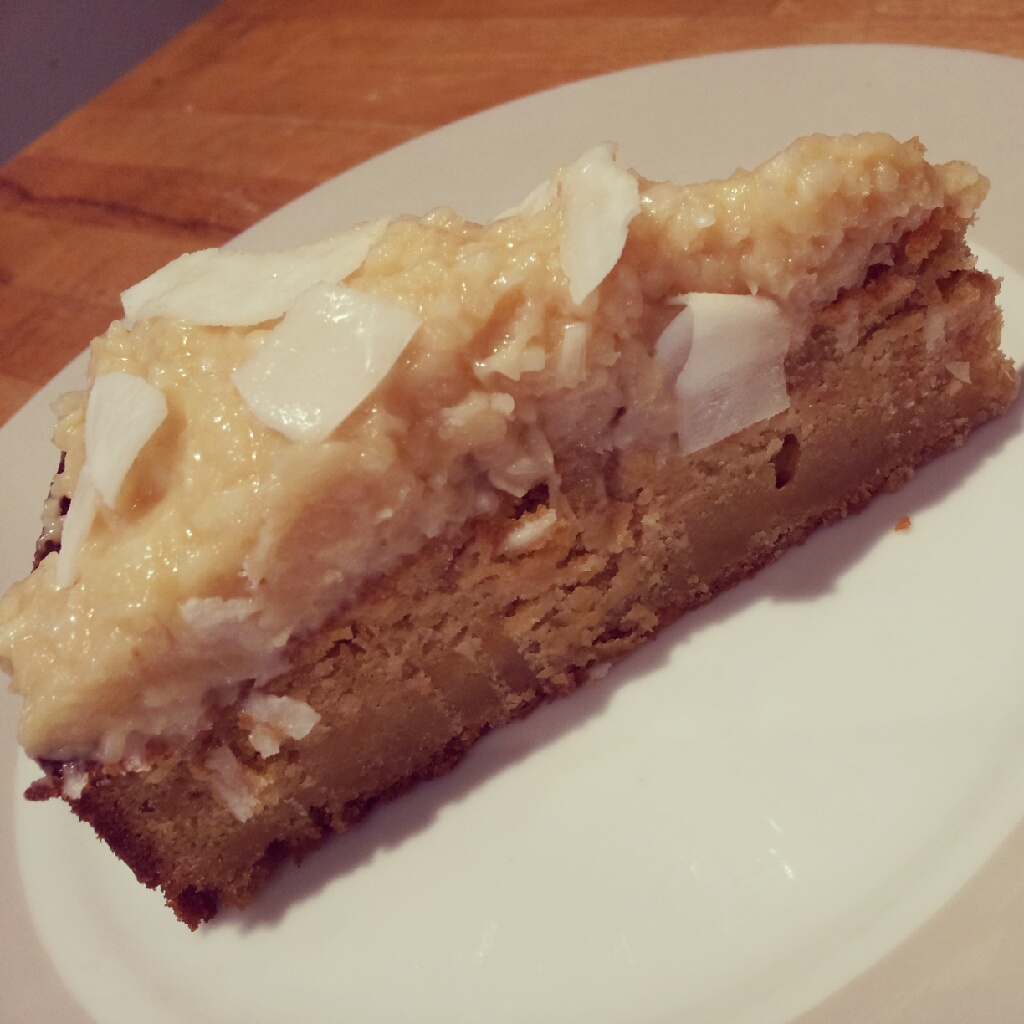
I was very pleasantly surprised by this cake and the combination of coconut custard. This was my very first ever attempt at making custard too and given the opportunity (and a spoon) I could merrily eat the whole pan of it by itself. That would definitely warm you up on a winter’s night! It was so sweet and comforting. You probably couldn’t eat more than one slice as it is quite a dense cake but I’m always up for a challenge. Now I’m thinking about it again I wish I had another huge chunk to tuck into! I’m happy to report that my sister enjoyed it too!

Sweet Potato Cake and Coconut frosting a sideways glance

Things I used to make South Korean Sweet Potato Cake

  • 1 cup of soft butter
  • 2/3 cup white sugar
  • 2/3 cup brown sugar
  • 3 eggs
  • 1 teaspoon vanilla extract
  • 2 cups all-purpose flour
  • 1 cup cake flour
  • 1 tablespoon baking powder
  • 1 teaspoon kosher salt
  • 1 1/3 cups milk
  • 1 medium sweet potato, peeled, cubed, boiled, and mashed
  • 1/3 cup maple syrup (golden syrup)

15 min  Creamy Coconut Custard Frosting

Things I used to make Creamy Coconut Custard Frosting

  • 1 (13-ounce) can evaporated milk
  • 1 cup sugar
  • 1/2 cup butter or margarine
  • 3 egg yolks
  • 1 teaspoon vanilla extract
  • 1 1/2 cups flaked coconut

37. Moroccan Basboosa (Semolina Slice)

Basboosa Baby

Lauren of Arabia

J’adore Morocco, the heat, the people, the beauty, the adventures into the Sahara and camping out under the stars. The food and desserts are amazing. I ate many a tagine and honey soaked sweets when we visited Marrakesh.

into the desert we go

Food Heaven

Having purchased the worlds largest bag of semolina I needed a recipe to put it to good use. I have vaguely horrific memories of semolina pudding every day for as part of of our school dinners and me disliking it so much I pretended to sneeze into my bowl so I could have it removed. But the dinner nannies soon wised up to my rouse and refused to let me get away with refusing semolina.

Thankfully my taste palette has refined somewhat since I was 6years old. I now even eat peas and broccoli!

Basboosa all lined up and ready to go

Basboosa is a middle Eastern dessert and seems to be from Morocco and Egypt too. It reminds me of Baklava which I love and you may remember me attempting to make from scratch…

Thankfully Basboosa doesn’t involve the shelling of hundreds of pistachios or the creation of millions of layers of paper thin filo pastry! This is one quick bake the I will be definitely repeating in the future!

Sugar and water to bubble into a syrup

I began with the syrup. Unfortunately I didn’t have an orange flower water so I ad libbed and utilised the lemon and orange extracts I have in my cupboard. I think rose water would work just as well too.

The key to this bake is sugar. And LOTS of it. The syrup requires a lot of simmering to reduce it to about 2 cups worth but it still seemed very watery to me. I put faith in my Marks and Spencer recipe and hoped for the best.

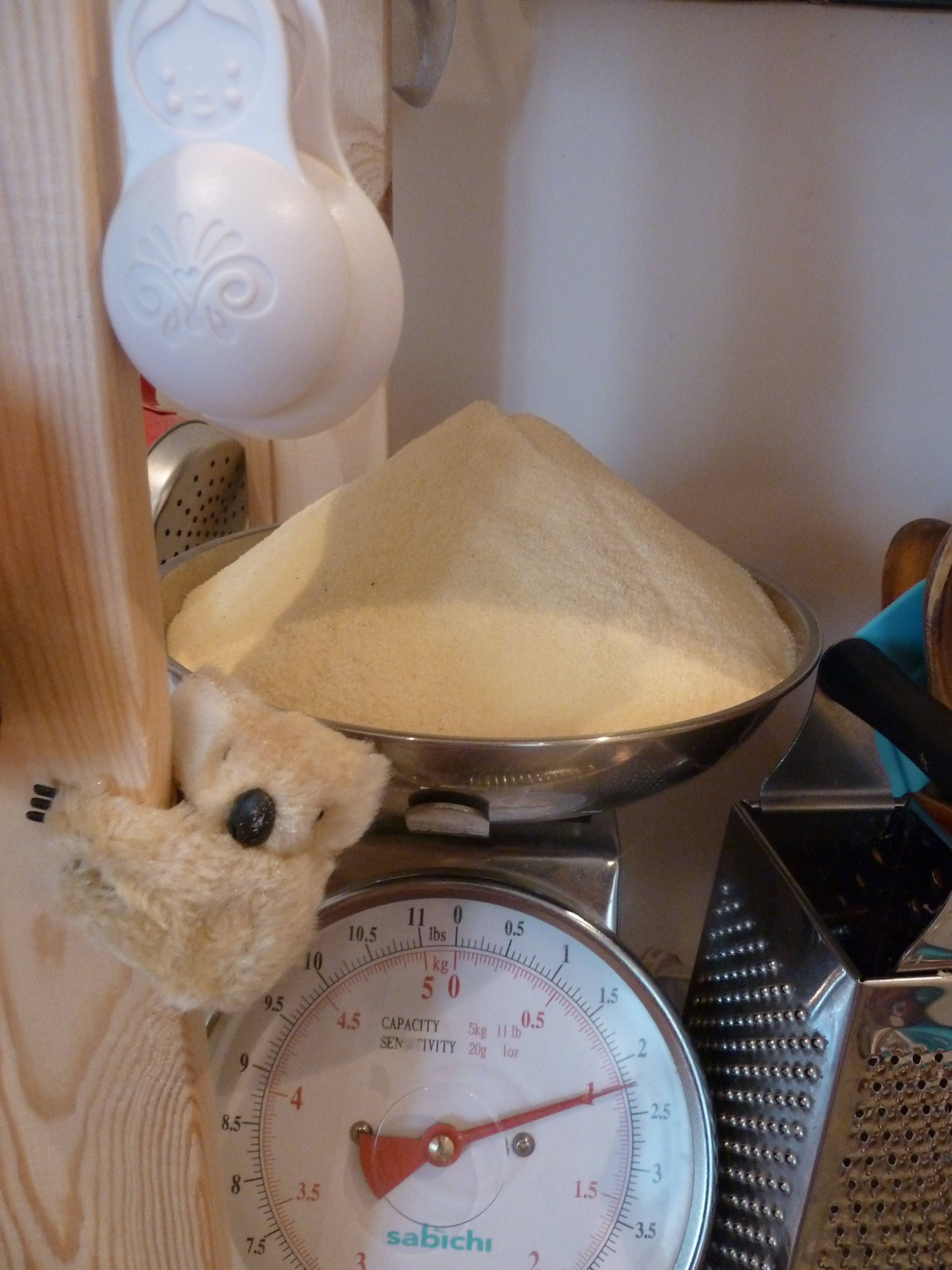
1 KG of semolina!!!

While the pan bubbled merrily on the stove I measured out 1kilogram (yes 1 KG!) of ground semolina! (I checked about 4 times that I had read this right as it seems like a massive amount and just about fitted into my biggest mixing bowl!

Precariously full bowl of sandy semolina

Adding in the sugar the mixing bowl was precariously full and could only be mixed with my bare hands, a spoon would just have tipped things over the edge completely!

Butter and milk on the stove

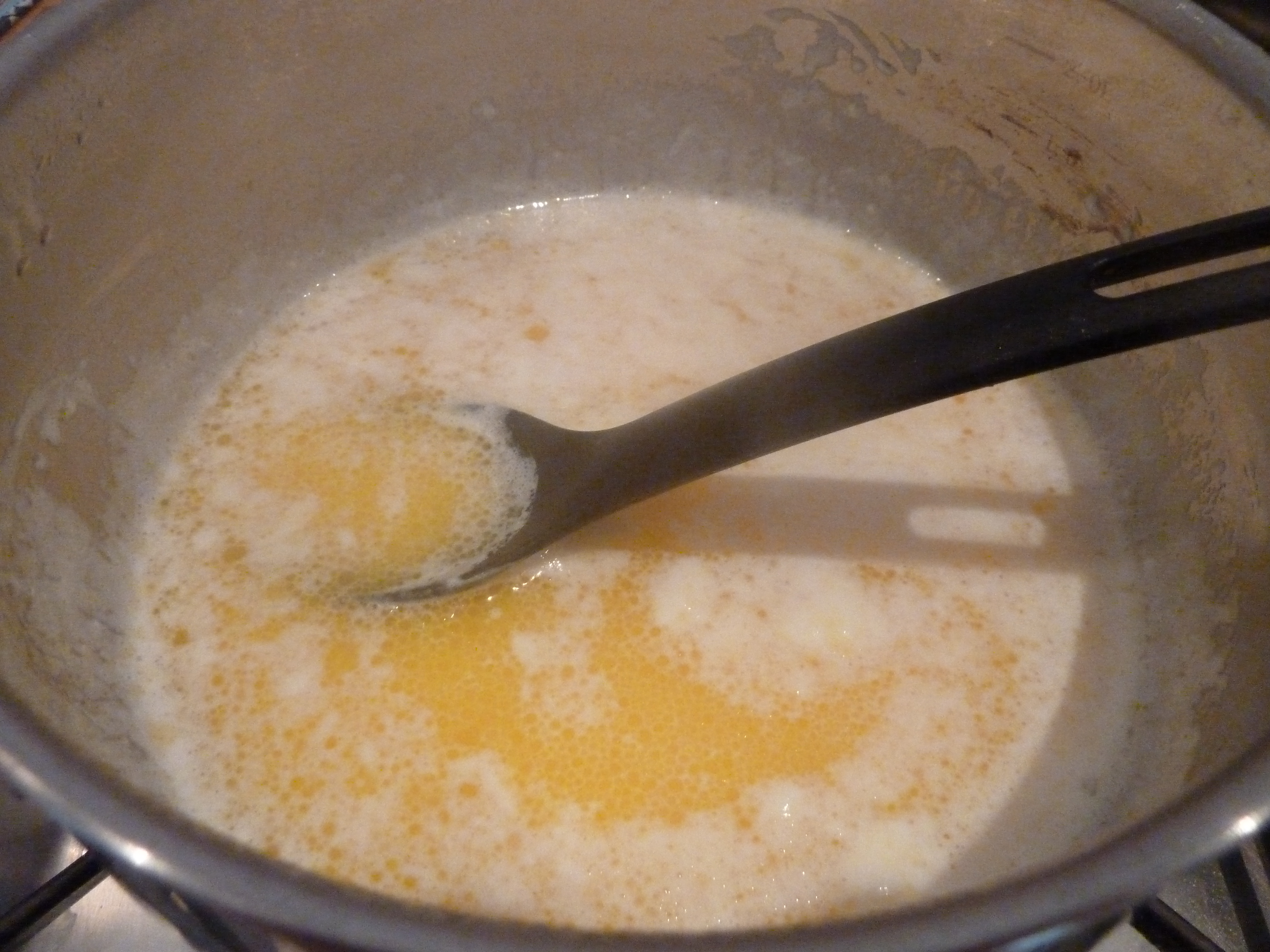
Then to gently warm the milk and butter on the stove until the butter melts completely.

Thoroughly melted butter and milk

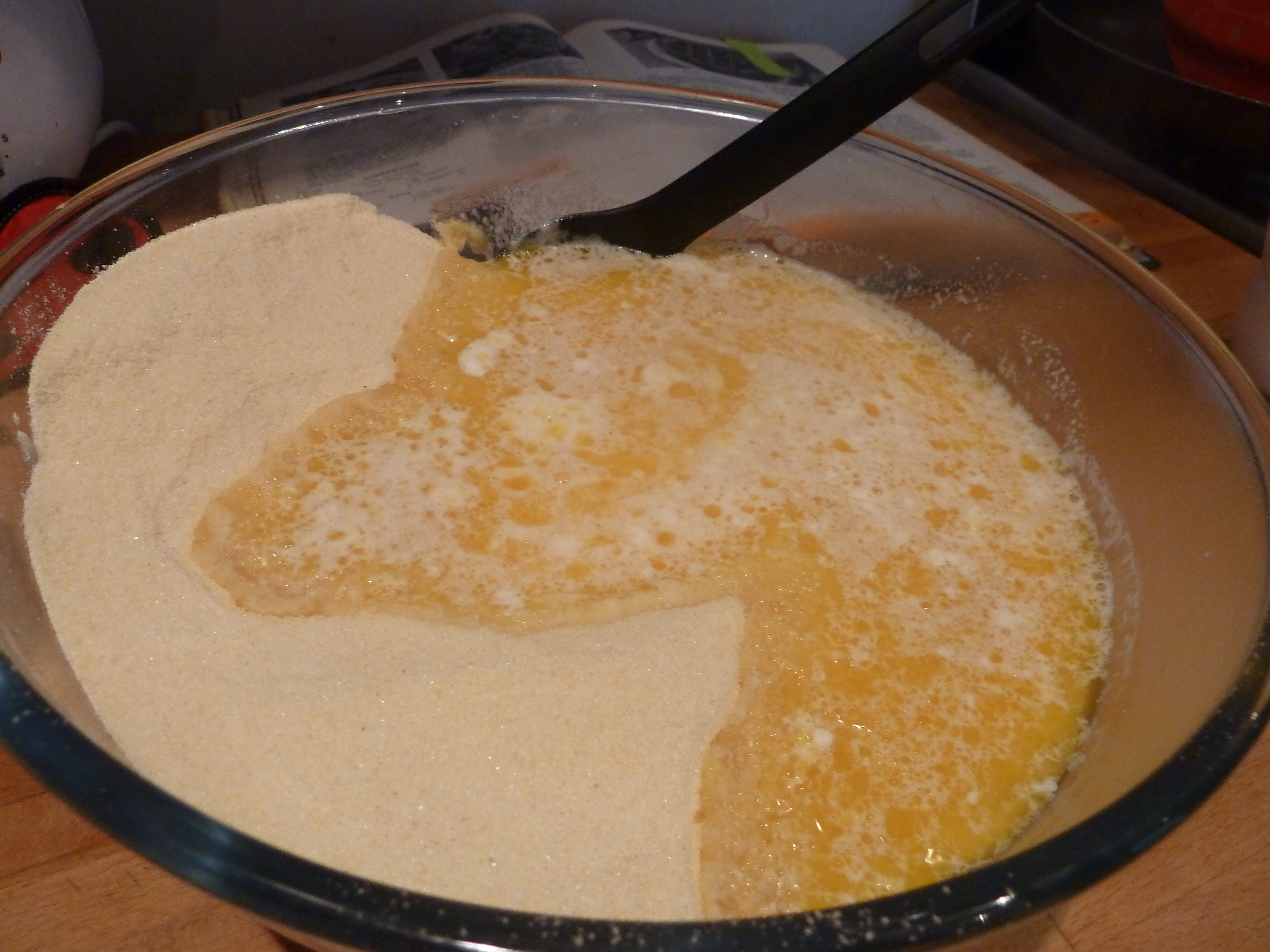
Once it’s thoroughly melted (and hopefully a little less frothy than mine) it’s  ready to add to the semolina. This was a delicate process. There didn’t seem to be enough liquid to bring the dry semolina and sugar together into a paste at all.

Bind us together – oh butter sugar and semolina

Nevertheless I perservered and gingerly (the milk was a bit hot) took to mixing it by hand again until lo and behold I had a semolina paste!

Pastey Semolina

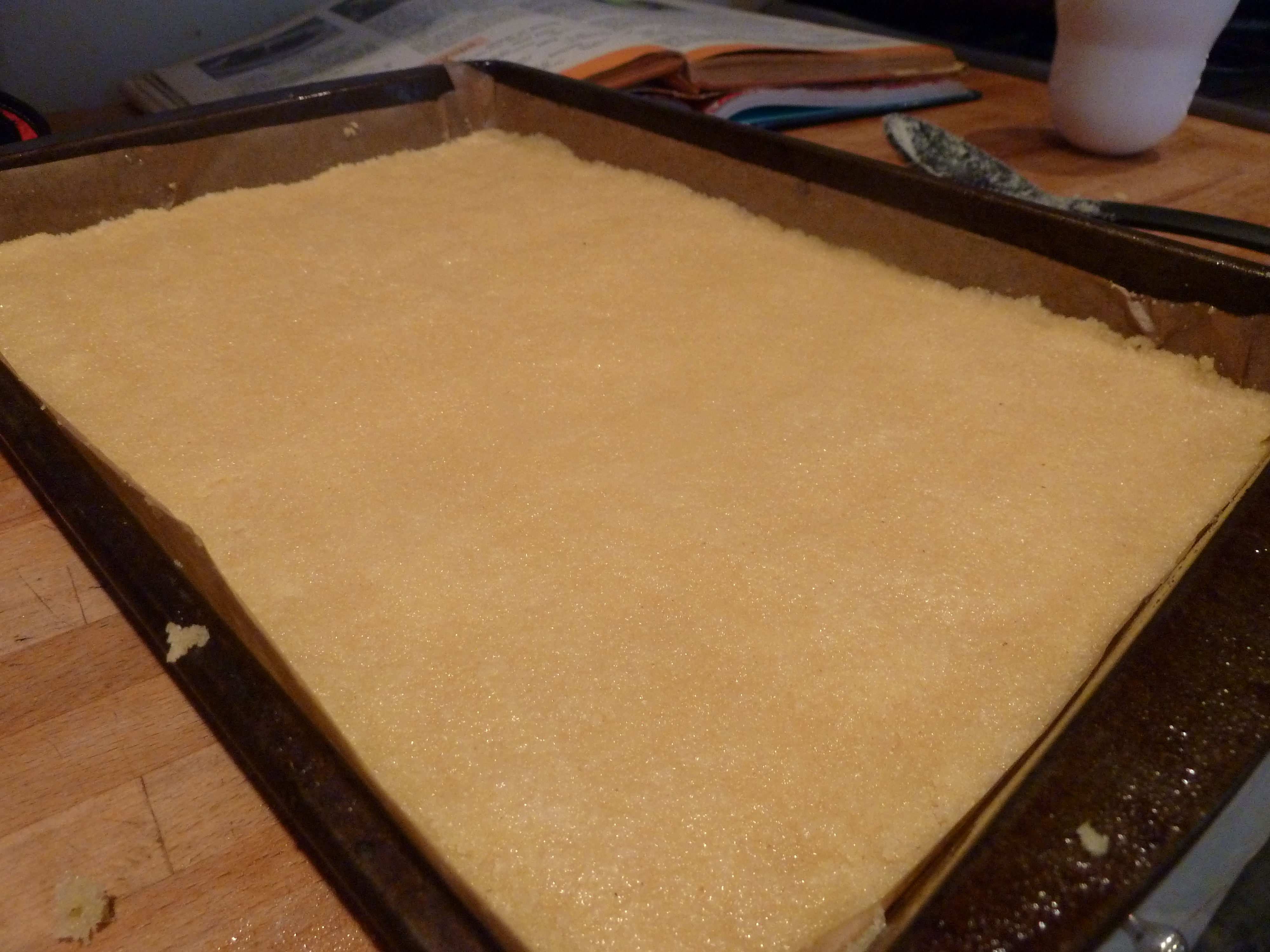
Tipping the bowl upside down into my greased and lined deep baking dish the semolina required a little coaxing to flatten it out completely into all the corners.

bowl shaped semolina paste – into the tray you go

Once it was relatively flat I smoothed the surface with a wet hand and squashed it down into the tin to avoid any bubbles or gaps in the bake.

Flattened and smoothed semolina

Taking the syrup off the stove  (I added a dash more orange extract as I realised I had added it too early and it may have mostly evaporated…) popped it into the fridge to chill it, ready for it’s next job.

Syrupy and ready for a good chilling

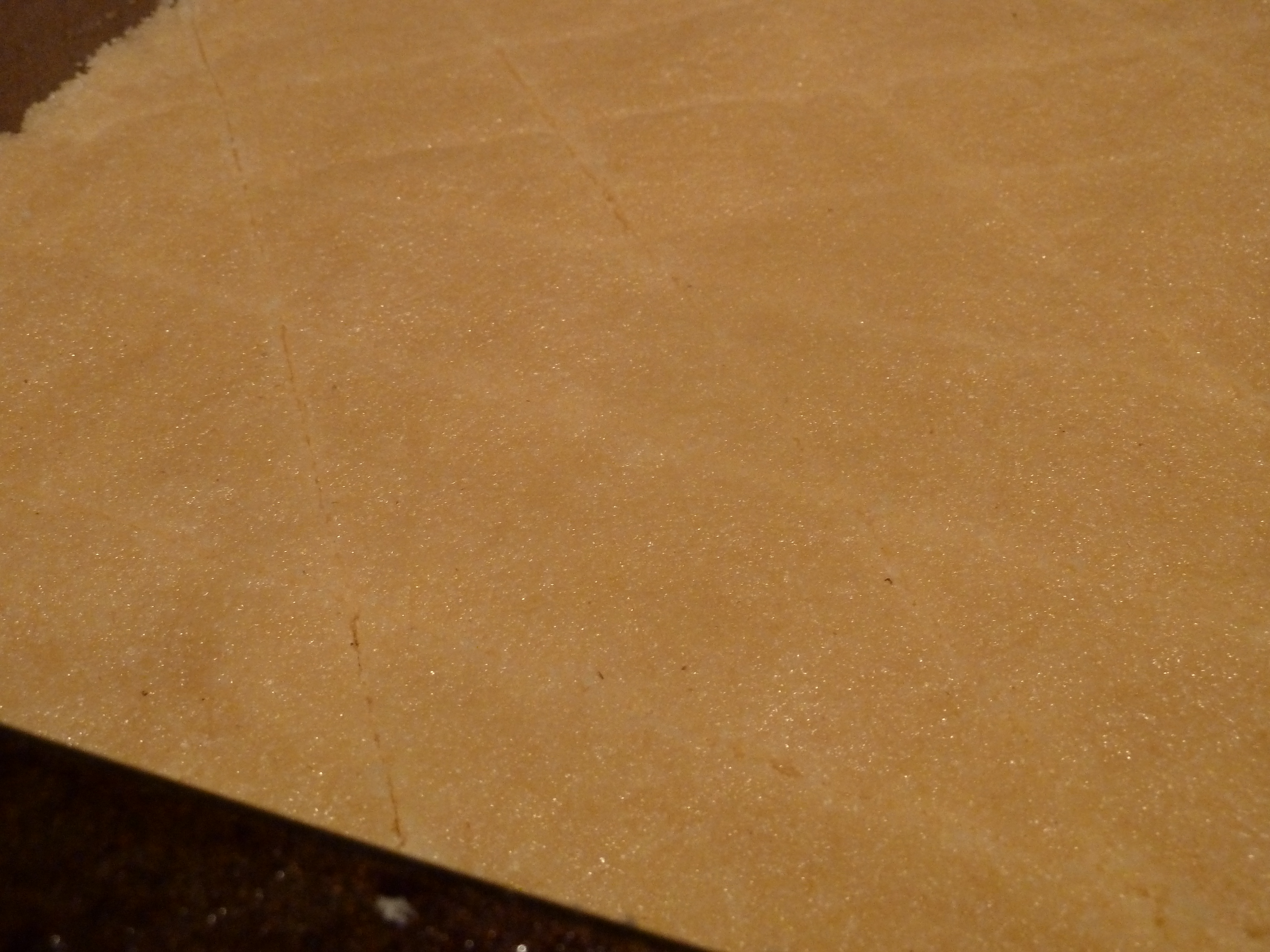
With a sharp unserated knife I attempted to score the semolina into equally sized diamond shapes (this befuddled my brain somewhat so I ended up with all sorts of shapes and sizes).

Zig zags in the semolina (supposedly diamond shaped)

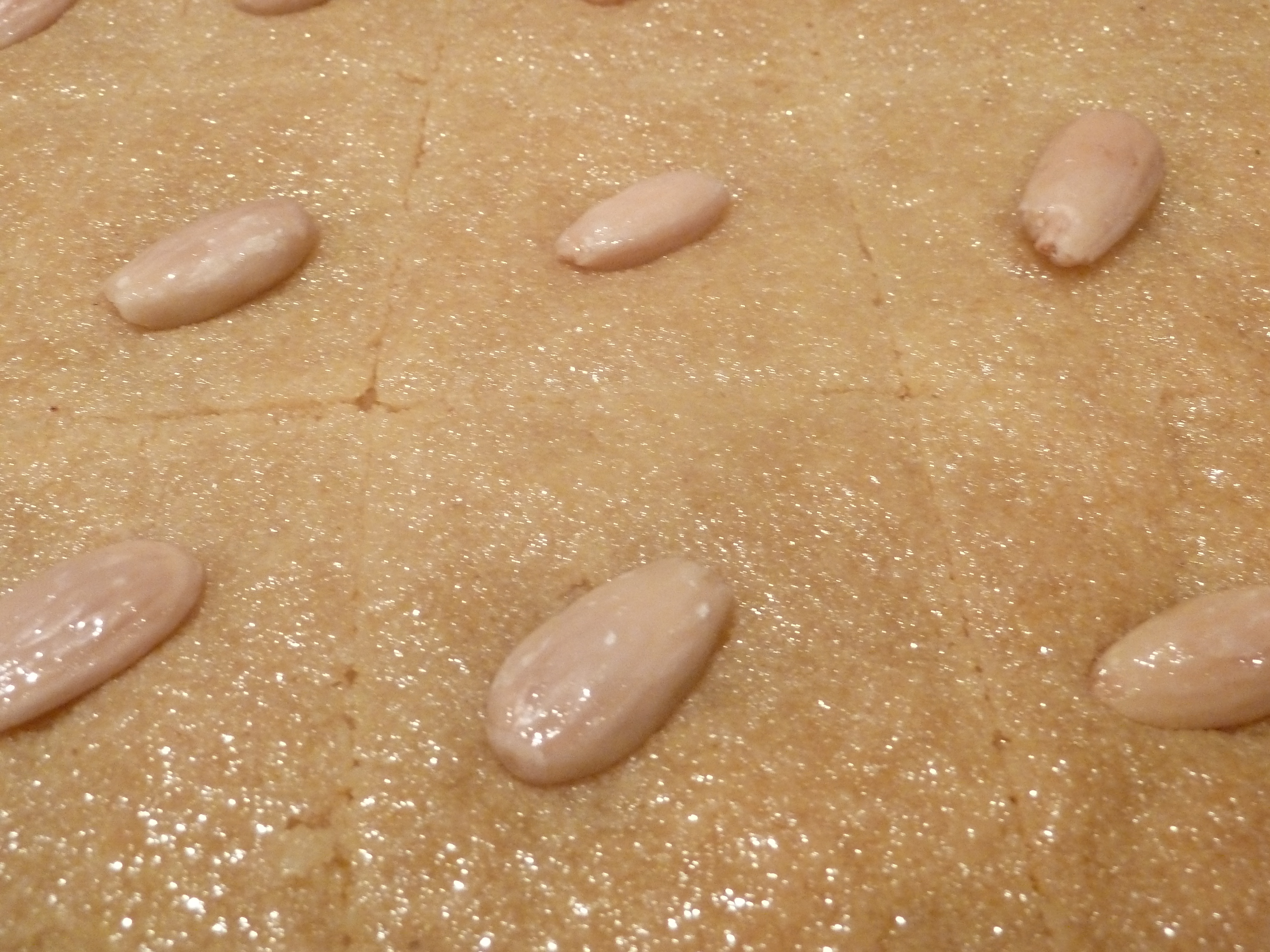
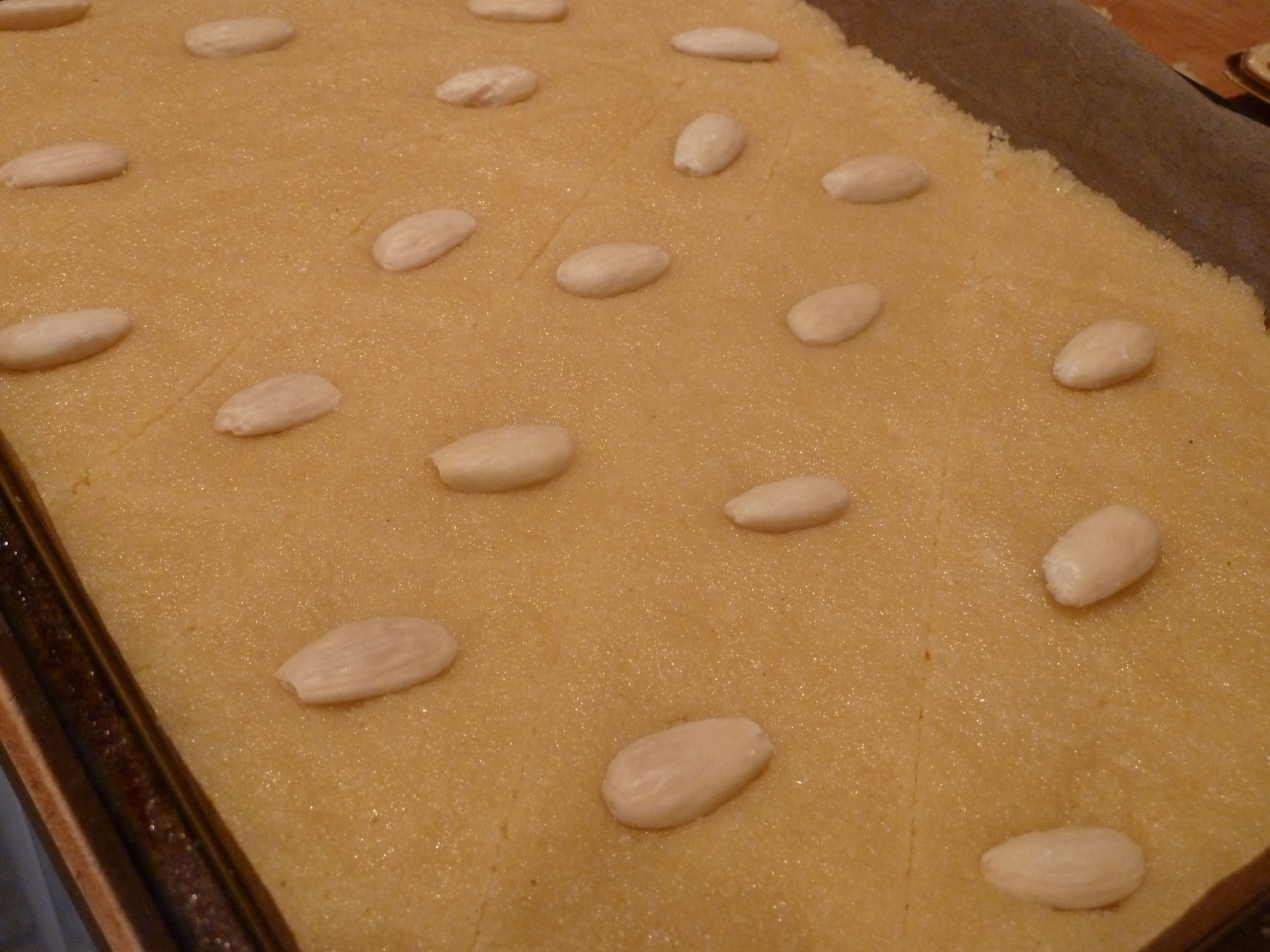
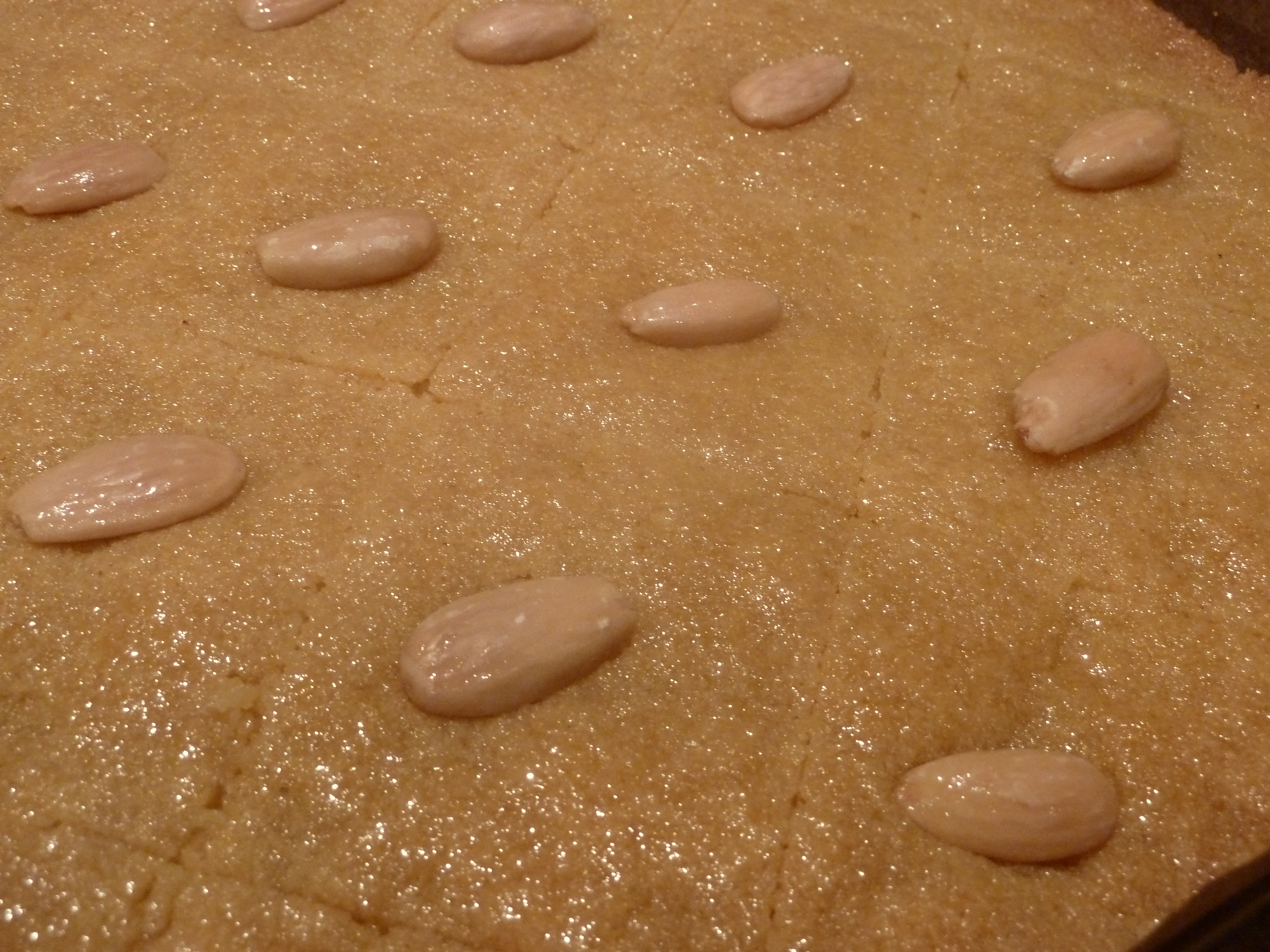
I popped the tray in the oven then quickly realised I forgot to pop the almonds onto each diamond! Quick as a flash I studded each piece with a blanched almond and threw it back in the oven.

Studded Semolina – check out those blanched almonds (better late than never)

Then a cup of tea and a spot of Mary Poppins is all you need to do whilst the bakes for an hour and a half! (Mary Poppins is optional but it was choice du jour)

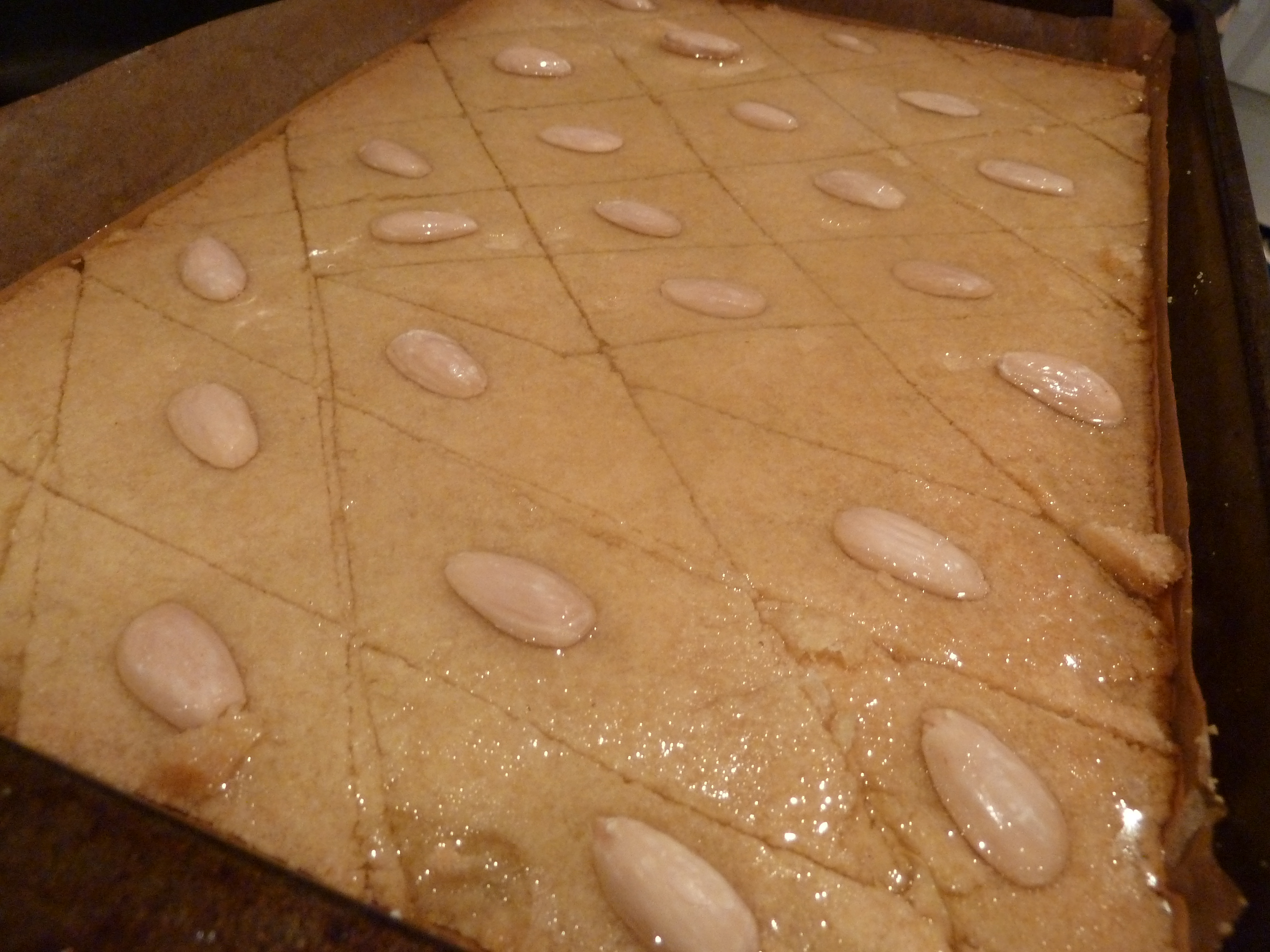
Soaked in Syrup

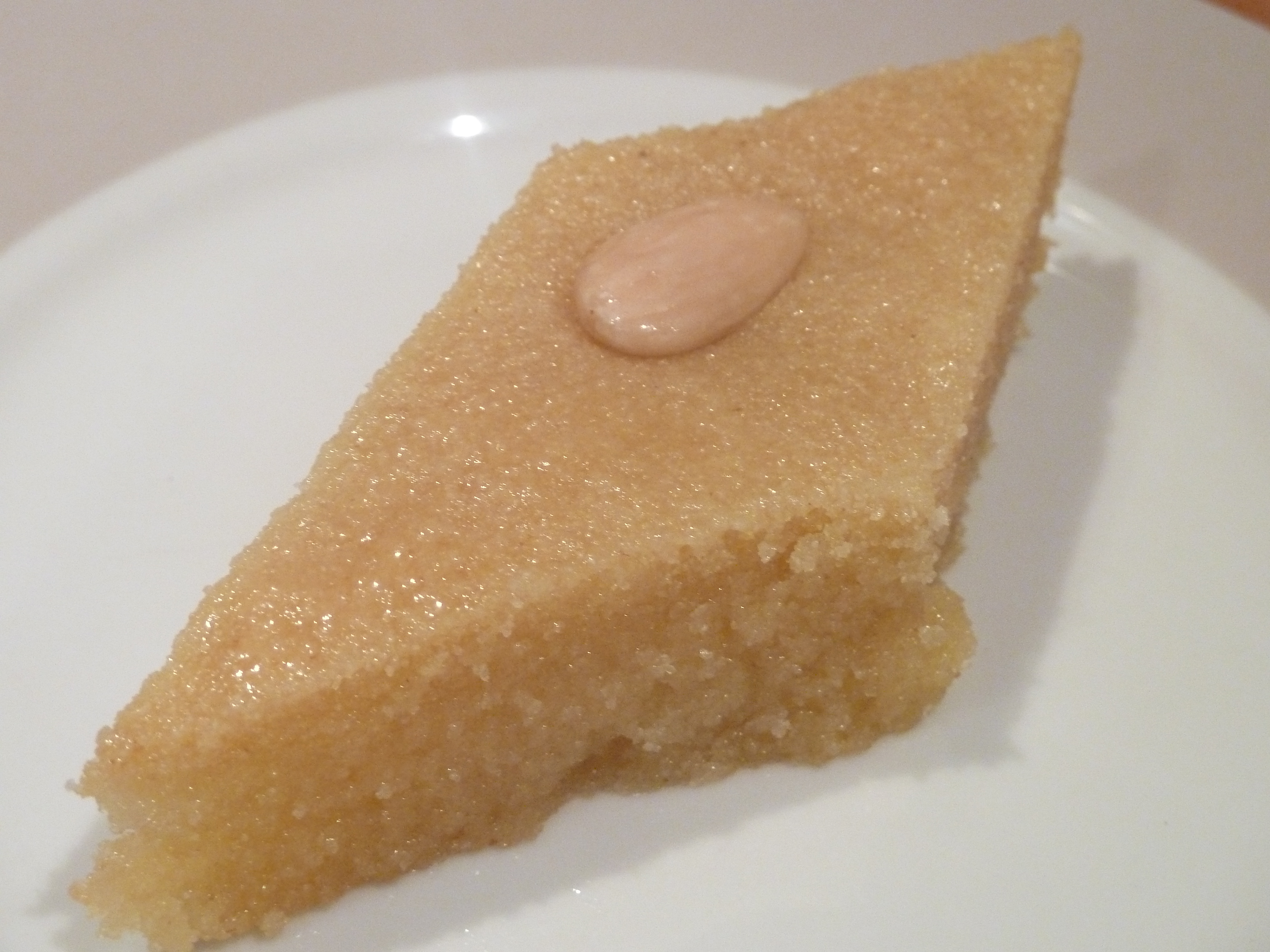
Once the semolina is golden brown and firm to touch it’s ready for a final slice with sharp knife and a good drowning in chilled orange syrup. I poured half of the very liquid syrup over the baked semolina and worried that it was a bit too much! It definitely required a break for absorption! Half an hour later I poured the rest of the syrup over and let the Basboosa relax and take it’s time to drink up the sweet orange flavour.

Totally soaked basboosa

Once it’s all absorbed it’s ready for eating! I REALLY loved this bake. It’s baklava-esque and shortbread-ey. Just the perfect accompaniment to a cup of tea. It has quite a distinctive crumbly texture which some may not enjoy, I suppose it could be a bit dry if you didn’t pour all of the syrup over it too.

But as it’s a wheat derivative it has CARBS and is full of SUGAR so this is a perfect pre run treat. (I’m now running what I had always considered to be beyond my wildest dreams… 10 miles! Who’da thunk it? Admittedly this was by accident as I got hopelessly lost one afternoon/evening but I now know that I can do it! And I now have a freezer stocked full of this sugary pick me up.)

Basboosa Baby

This recipe makes a LOT of Basboosa, about 23 pieces – or more if you cut it into smaller pieces. It is very sweet so you probably don’t need a huge slice but it also keeps really well. Once the syrup crystalises it has a lovely glittery sugary crunchy top too. 🙂

I hope you like it as much as me!

Things I used to make Basboosa…

  • 1 kg ground semolina
  • 2 1/2 cups of sugar (550g)
  • 1 cup milk (250ml)
  • 125g butter
  • 1/4 cup blanched almonds (40g)

Syrup

  • 3 cups water (750ml)
  • 2 teaspoons lemon juice
  • 1 and 1/2 cups sugar ((330g)
  • 2 teaspoons of orange extract  (or Orange blossom water/rose water)
  • 2 teaspoons of lemon extract

Equipment

  • one 20cm x 30cm x 5cm baking tray
  • oven at 140 degrees c (fan assisted oven) 160degrees C normal oven


36. Wiltshire Lardy Cake – Let Them Eat Lard! – 18th Century Clandestine Cake Club – EAT Festival

Wiltshire Lardy Cake at the Clandestine Cake Club

Lard in a cake? Sounds vile doesn’t it? I’ve always been perplexed by this notion of animal fat in food. Long gone are the days when we made Yorkshire Pudding with blisteringly hot fat and yet we still use butter and such like in all our cakes which I guess is a tad more appealing than pork blubber.

Wiltshire Lardy Cake

I purchased a pack of lard to bake some Chinese cakes but never found the right occasion to bake the Lardy beauties. I was greatly amused in my favourite Chinese Bakery to see little signs in front of some of the buns proclaiming “I contain lard”. Like they were sharing a guilty secret with us. This was another case of serendipity,  me having the perfect random ingredients required to bake something unusual for a very special EAT Festival Clandestine Cake Club.

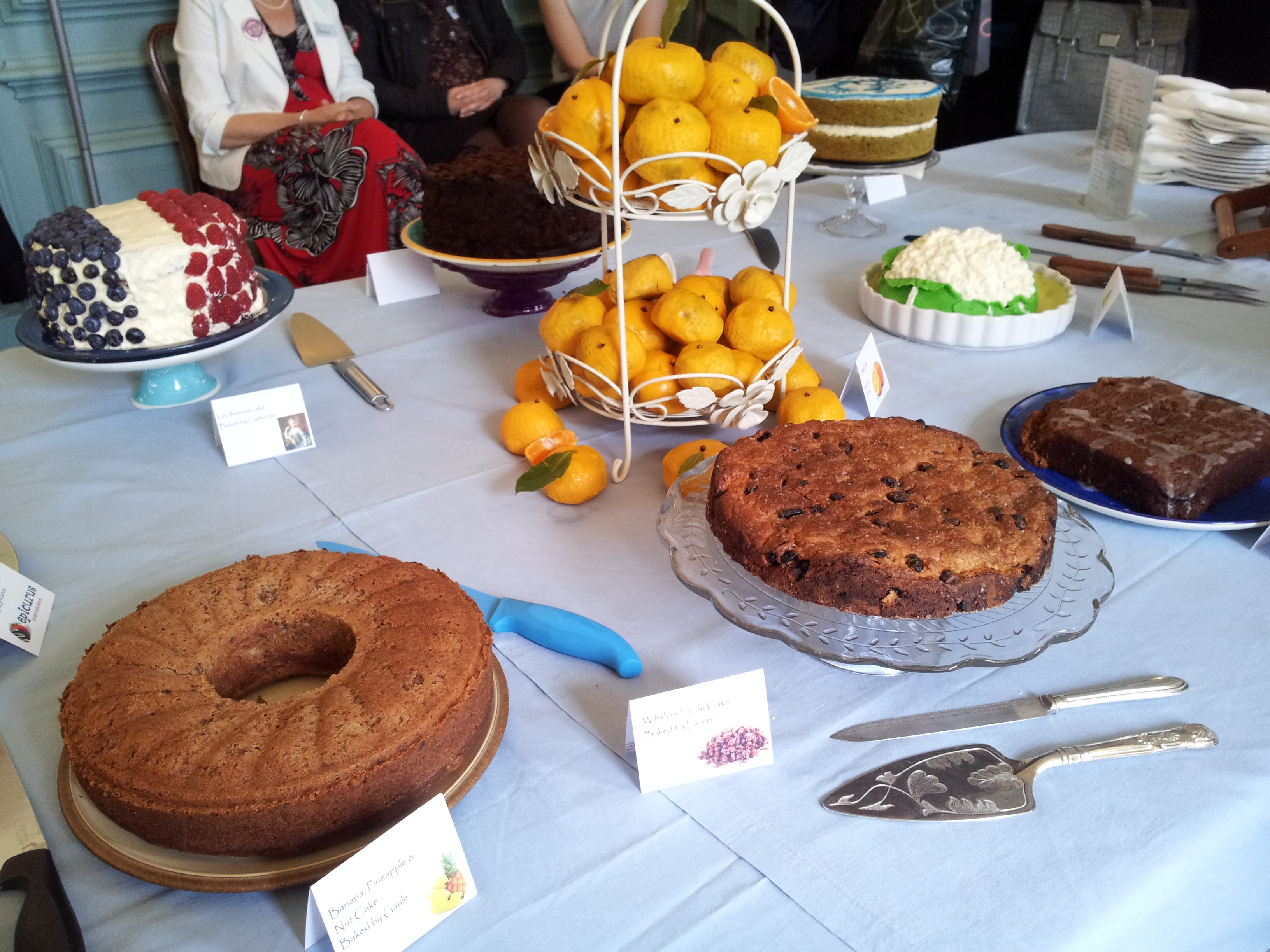
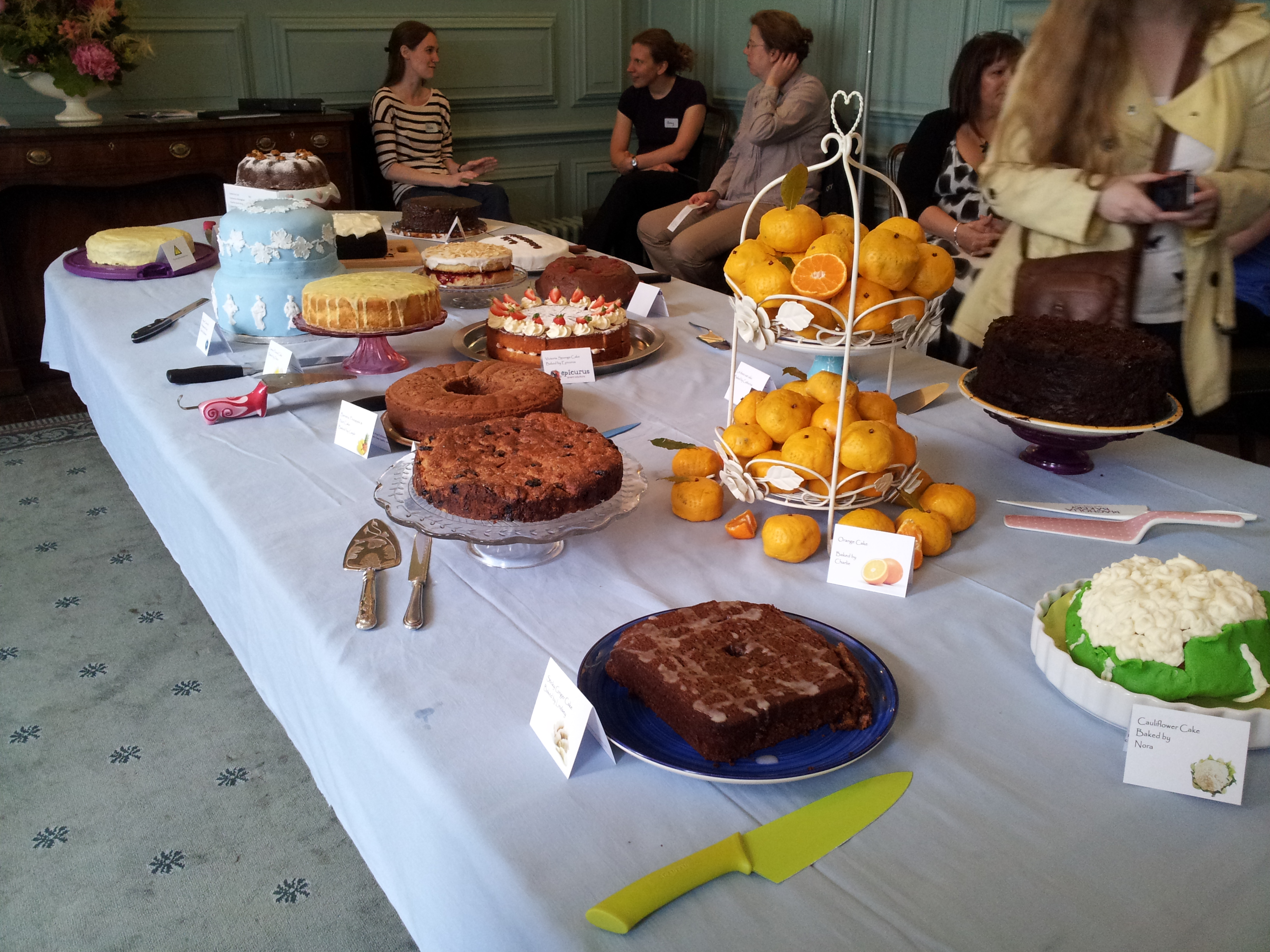
Clandestine Cake Club – 18th Century Cakes – note the oranges and cauliflour!

The theme was 18th century cakes. (It’s harder than you would think to find a genuine 18th century recipe online.) A bit of research/googling later I realised in the 18th cake was spicy (the spice trade was blooming) and mainly contained readily available ingredients such as Lard and yeast!

I reverted back to good old Marguerite Patten and found Wiltshire Lardy cake. A very traditional English recipe. (I realise I’ve baked A LOT already from England but I promise to be more exotic again soon.)

Marguerite instructed me on making a basic yeast dough. I could tell how authentic (and genuinely old this recipe is as it uses the measurement ‘gill’ I have never heard of this before and it took a bit of deciphering!)

Now attempting to follow a recipe and instructions located in 3 different sections of a book is sure fire way to get me to make mistakes. I did not fail. Was it the late night baking efforts or my recipe coordination skills that are lacking?! Probably a bit of both!

The Food Processor did a wonderful job of distributing the yeast and rubbing the butter into the flour. Saved me a job!

The recipe instructed me to make a yeast paste. I ignored this as I know dried instant yeast doesn’t need to be mixed with liquid first. If I was using fresh yeast (which is a bit more difficult to find these days and more tricky to encourage) I would have followed the recipe to the letter, using blood temperature water and whatnot. With the instant yeast all you need to do is chuck it in with the flour and give it a stir to distribute it throughout. Simple.

Proving Time

After creating the basic yeast dough and leaving it to prove I fully embraced the lard. The technique required is very pastry like and it requires a little planning and preparation.

I set out my;

– glass work surface protector on top of a damp tea towel to hold it in place
– rolling pin
– flour for dusting
– lard
– spices, sugar and dried fruit

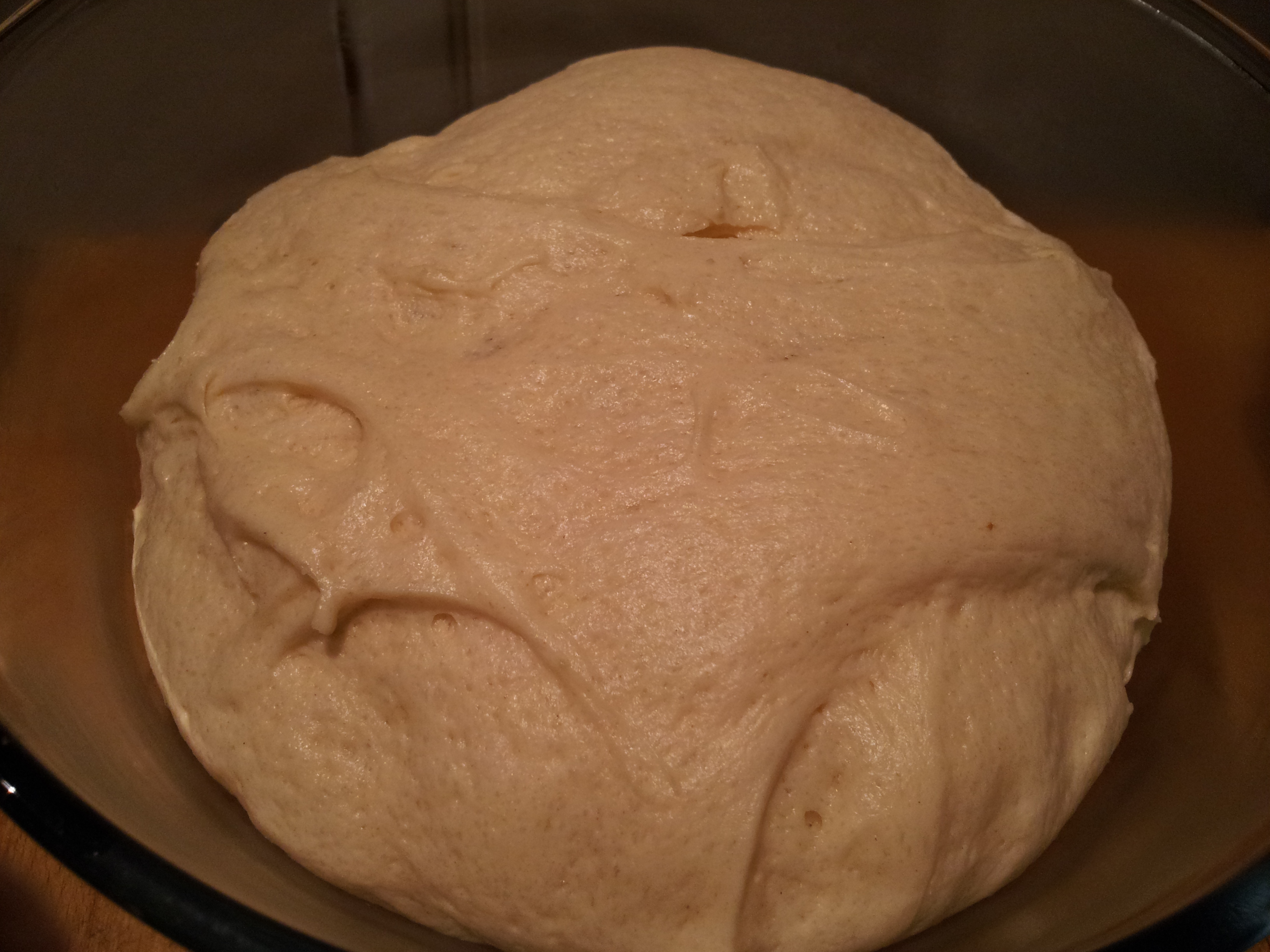
Proven Dough

Pastry is not my strong point I’m unashamed to admit. I’ve only tried to make flaky pastry once and I shed a few tears over the sheer effort and complicated origami folding required. It was distinctly lacking in flakes too after all the hard work!!

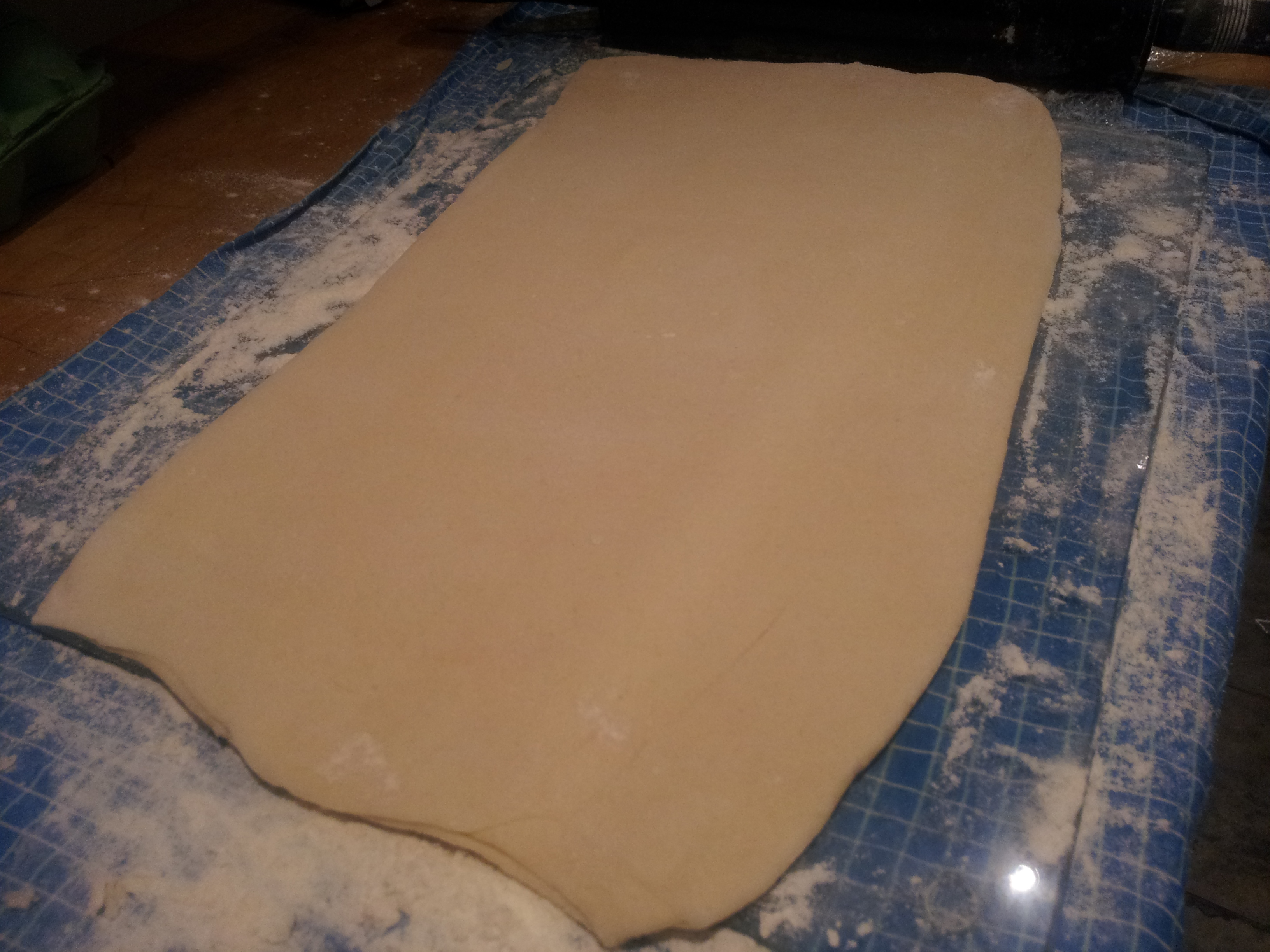
To start with the dough needs to be knocked back and kneaded gently to distribute the yeast and warmth again. Then on a floured board it needs a good flattening with the rolling pin. Roll it into a rectangle.

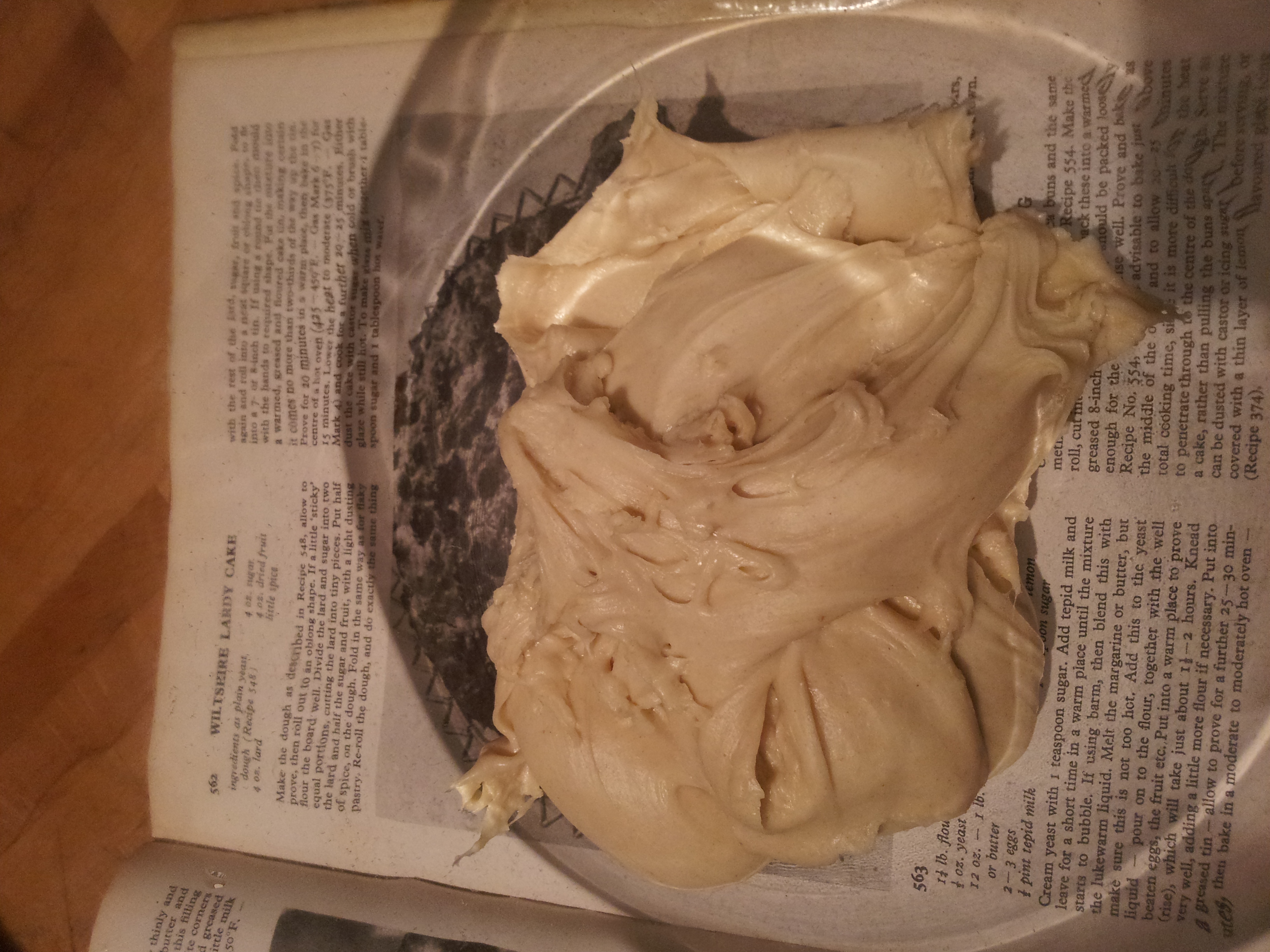
Rectangular Rolling and dotting of LARD

Then to dot dollops of lard all over, (but leaving the final third empty)! I was in the throes on smearing the distinctly stinky lard in dots onto my flattened dough and crazily folding it into envelope shapes when Super Hans (the cat) joined me wailing for a bit of lard.

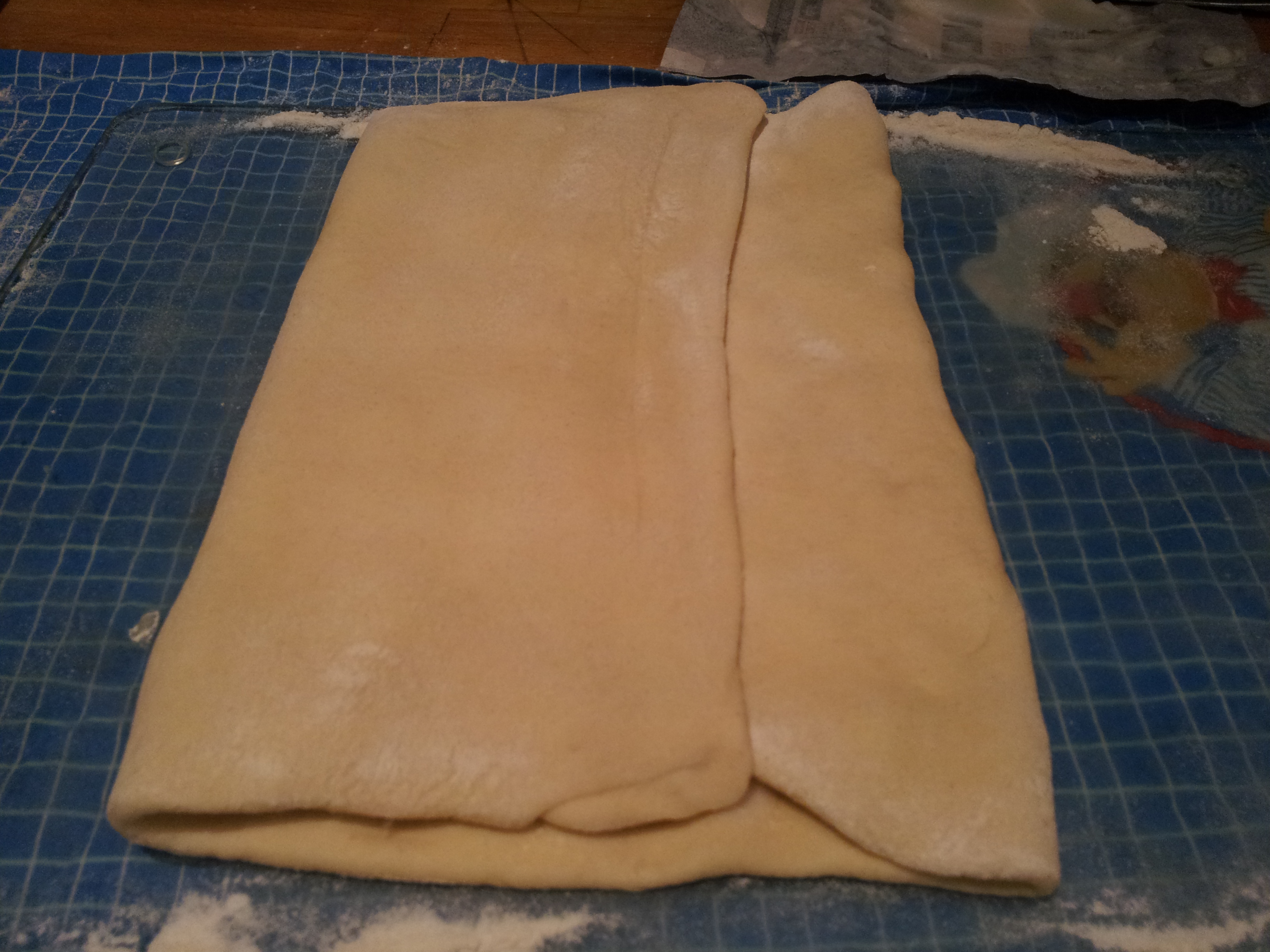
One Fold

Two Folds

Seal the edges with the rolling pin

Roll it out and repeat!

Turn clockwise and roll into rectangle

The animal fat smell most surely lured Super Hans into the kitchen. Is this a good sign?! I guess if it’s good enough for the cat to eat it’s good enough for me. Lard most certainly passes the Super Hans taste test. However a wailing cat is not conducive to pleasant baking experience…

Super Hans the noisy Cat. He enjoys a nice bit of lard.

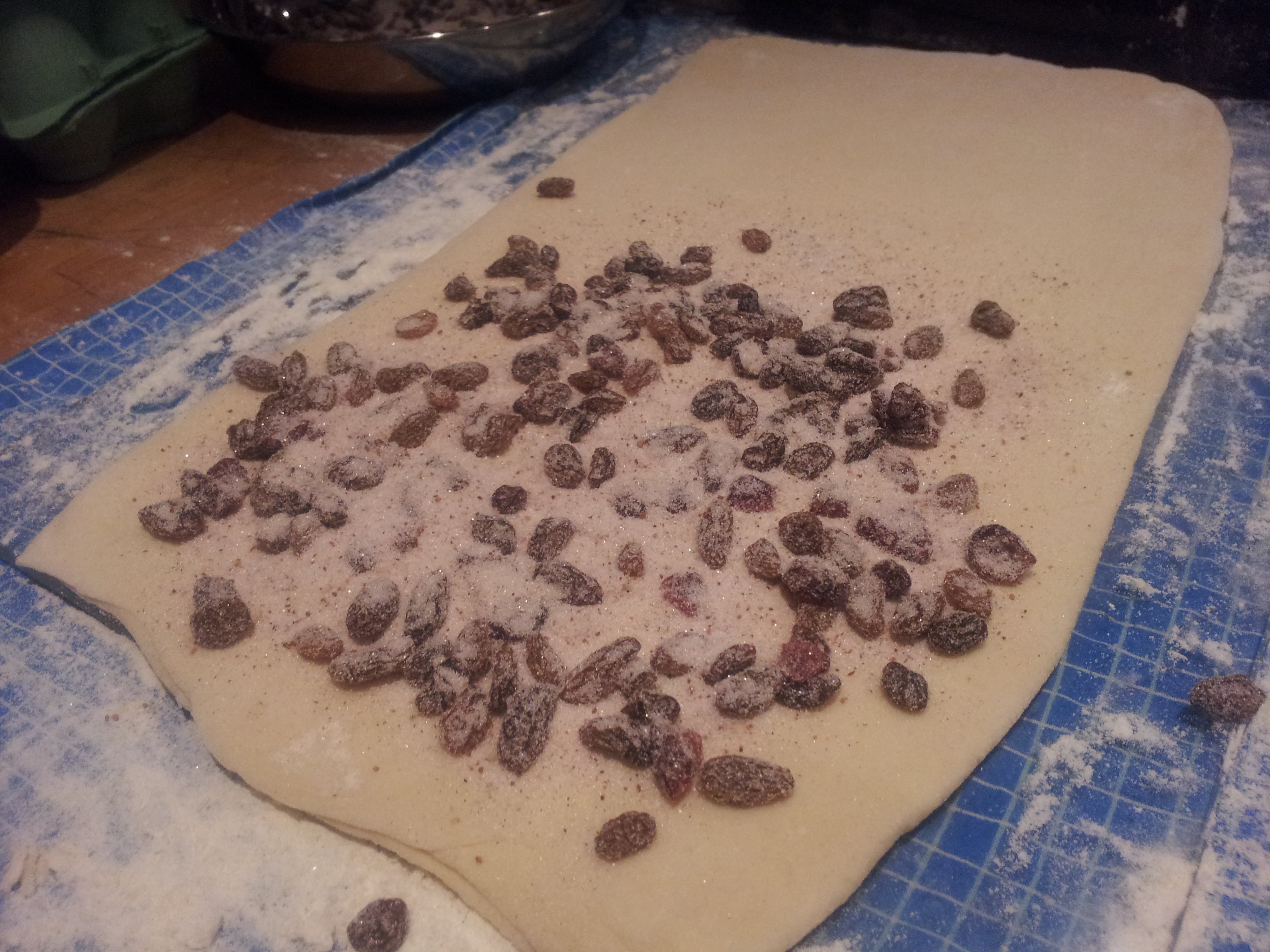
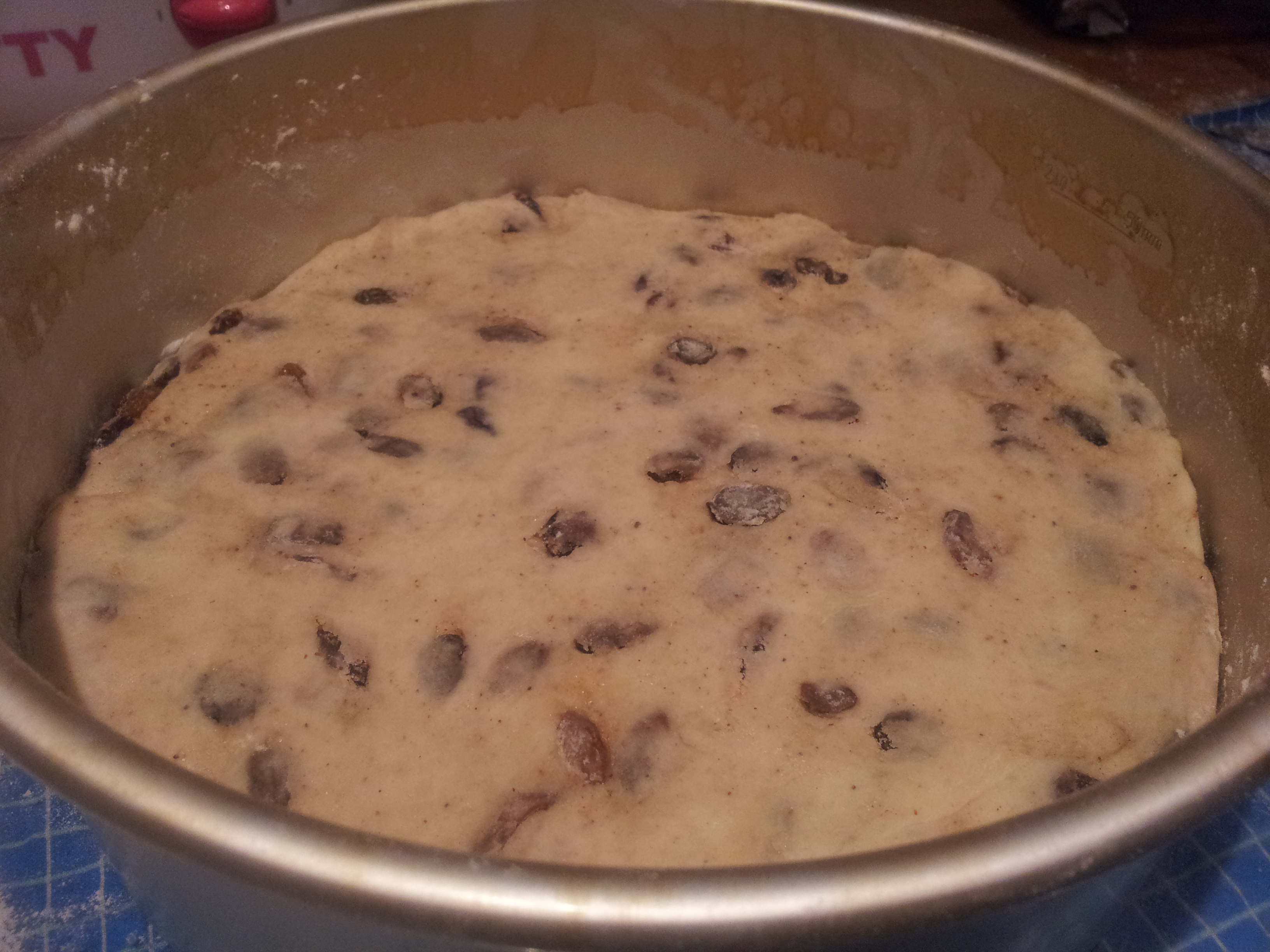
I merrily proceeded to fold the dough up as required and smeared all the lard into it, then returned to the Lardy Cake recipe to discover I was supposed to have folded the fruit and spices into the dough along with the lard! Damn. Back to the rolling pin and floured board for me to fold in the remaining ingredients. My Lardy dough had a very through folding and rolling! It is a bit more difficult to roll dough when it has dried fruit sandwiched in it, but don’t despair if a few raisins pop through. I think it gives it character.

Folding (again) this time WITH the sugar, fruit and spices!

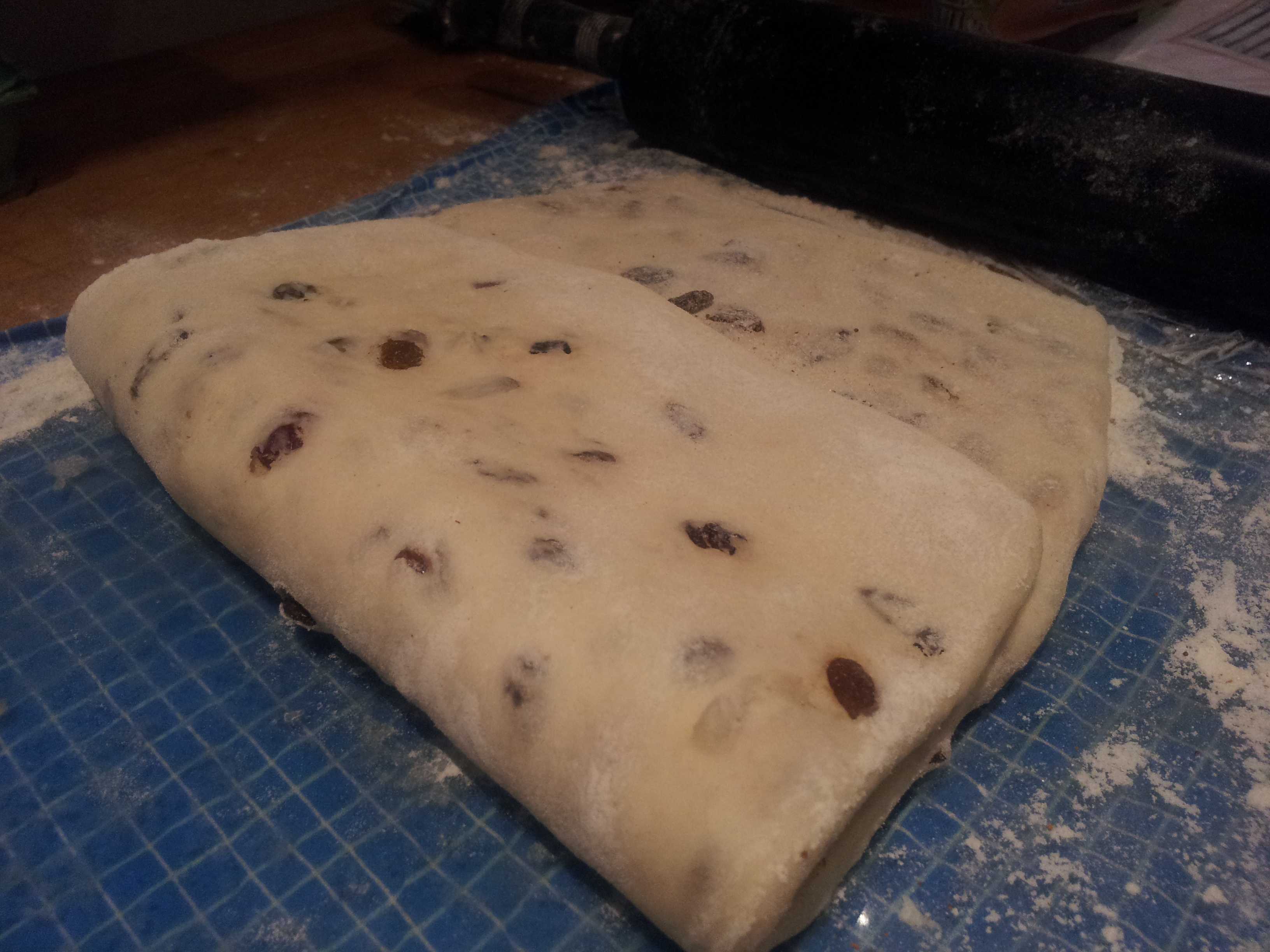
Folded and ready to be rolled with fruit, sugar and spices

Rolled out and ready to be folded again

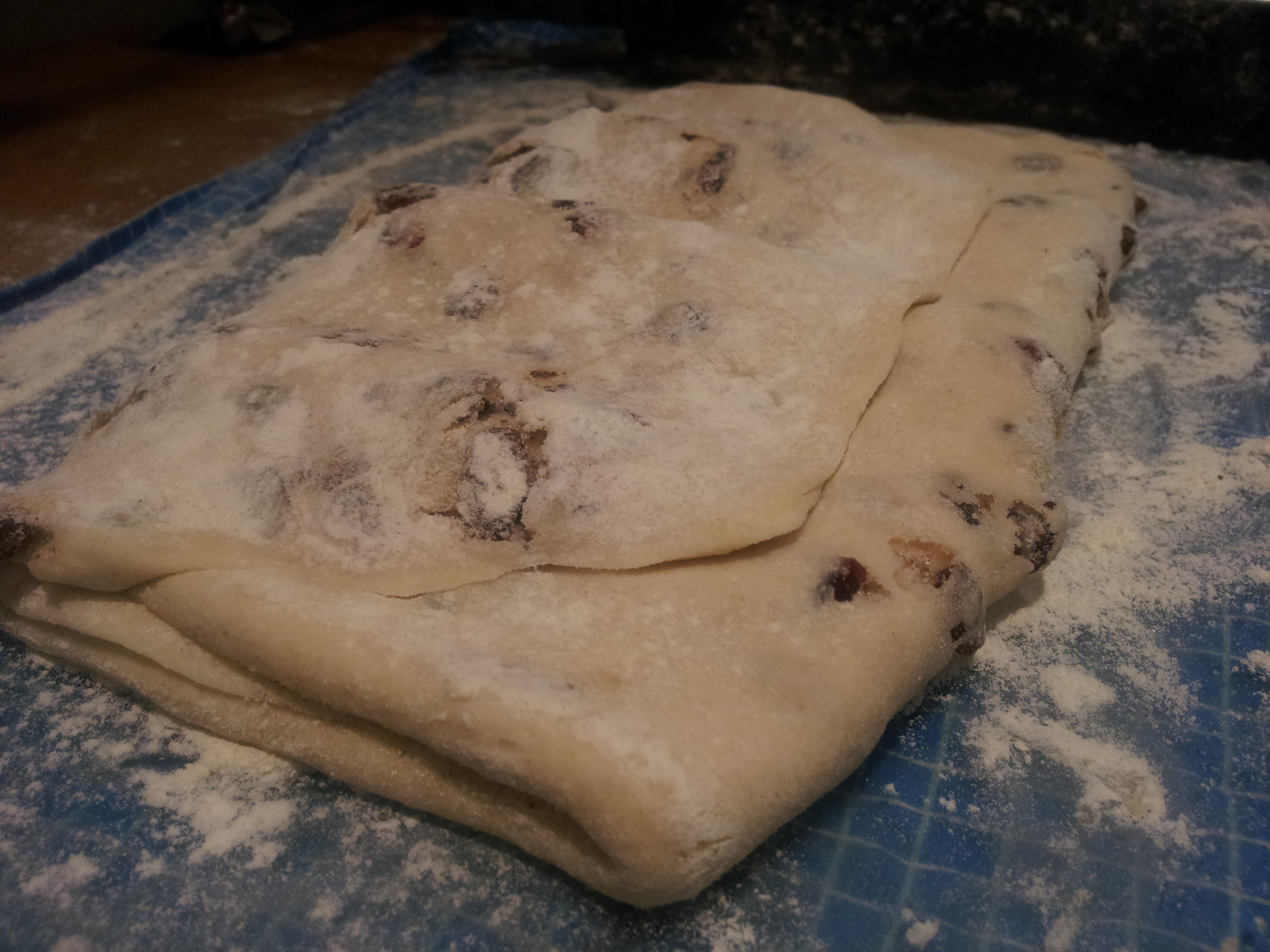
Second half of the fruit and sugar and yet more folding!

Another fold (don’t worry the fruit is going to peek out in places!)

This Lardy cake definitely has ‘character!’

I was very lucky that my friends Jill and Jonny brought me back some amazing spices from their Indian Honeymoon including some cinnamon bark, which I whizzed up in my spice mill on my food processor. It smells AMAZING, much fresher then my normal ground cinnamon. I added rather a lot of my Indian spices to the sugar mix.

Hand Shaped chunky lardy cake

Once I had folded everything into the dough, it needed to be shaped and coaxed by hand into a chunky square. I plonked the square dough into a round, greased and floured cake tin. Then to squash the dough into a round, ensuring there are no gaps along the edges or on the base of the dough to avoid any holes in the cake. It needed a bit more time to prove and then into the oven!

Squashed-into-a-cake-tin Lardy Cake

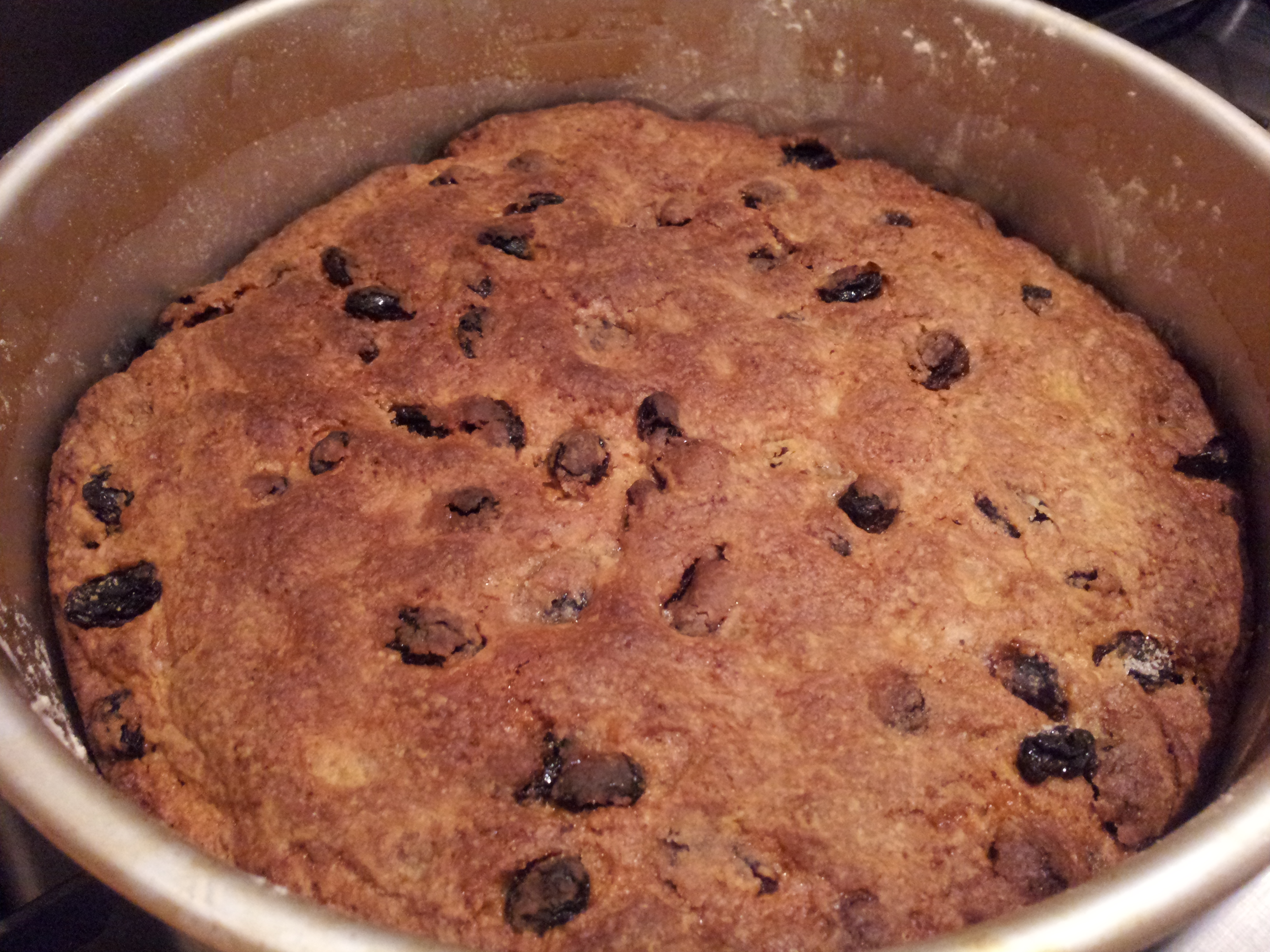
While it was baking away I prepared my glaze to pour over the cake as soon as it came out of the oven.

Just Baked – Wiltshire Lardy Cake

I was very nervous taking this cake along to the Clandestine Cake Club as it wasn’t as pretty as the other 18c cakes, which included a Wedgewood Iced Pepper Cake (beautiful!!), a basket of oranges! (marzipan encased chocolate and ganache cakes! So very realistic!) and I brought along LARD!? I made sure I sampled my cake first in case it was horrid and I needed to remove it from the table. But I was very pleasantly surprised.

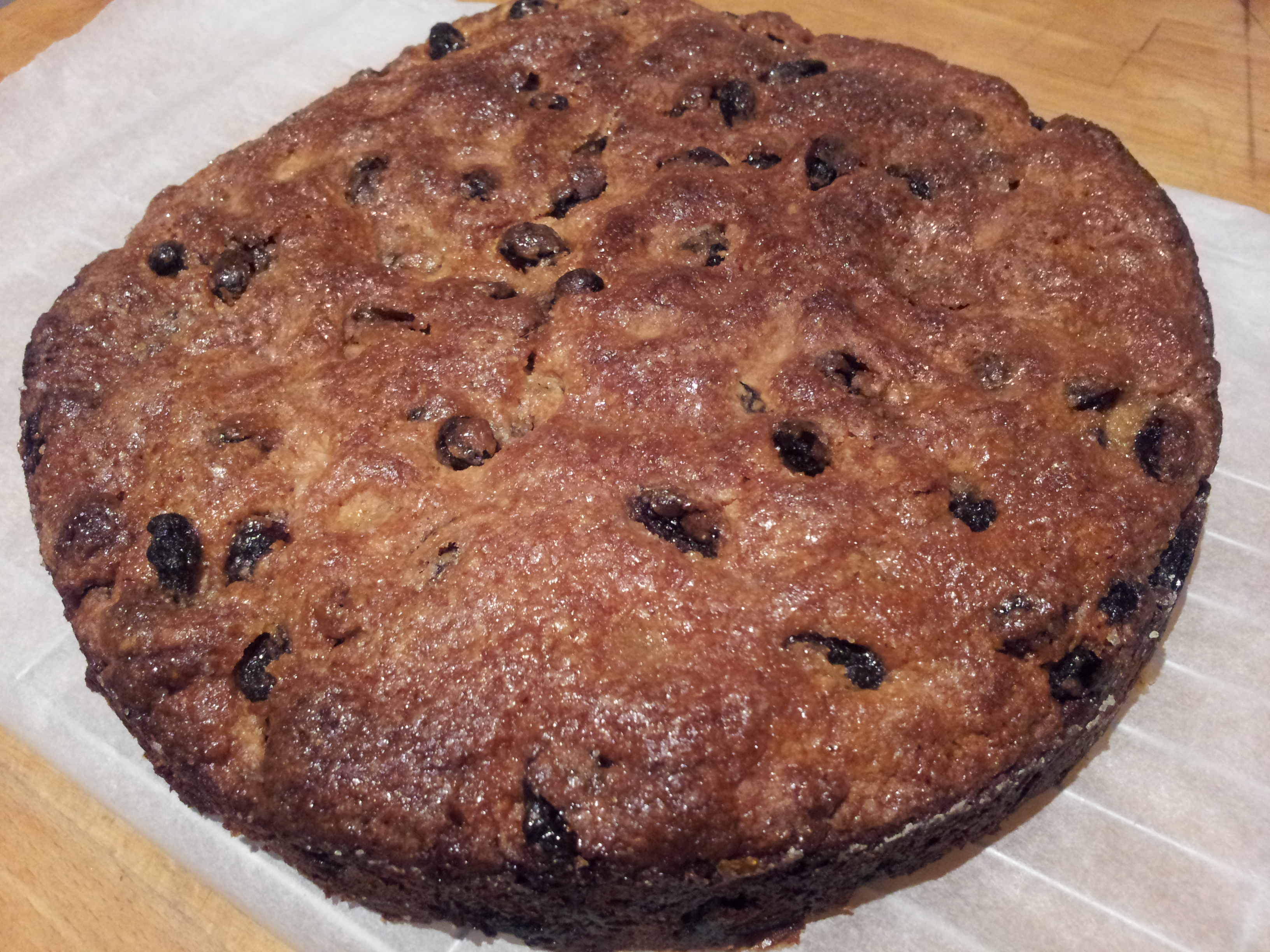
Post Glaze – Just Chilling – Wiltshire Lardy Cake

It actually tastes rather nice. It’s a distinctly brown cake. The sugar glaze adds a nice crunchy texture and the lard (dare I say it) gives the cake a slightly savoury feel, a little bit like the Herman the German Cake. I couldn’t see any layers despite all the meticulous folding but perhaps I messed that up with my accidental double folding and rolling. I’m not entirely sure it’s supposed to result in layers either! Marguerite doesn’t really go into that much detail.

A sideways glance of Wiltshire Lardy Cake – No layers in sight but plenty of fruit and spice

But as you may realise by now I am a sucker for a fruit cake and this ticks all my boxes, fruity, spicy, sugary. It’s always the way isn’t it? The things that are the least healthy, taste the best!

A fine selection of 18th Century Cakes

The Clandestine Cake Club was held in the Alderman’s House, which is absolutely beautiful. I’ve walked past so many times and it is only open on special occasions. It was perfect for our 18th century cake feast. As it was part of the EAT Festival we had additional guests to entertain with our cakes. It was a fabulous atmosphere with lots of tea flowing, cake demonstrations and sugar craft too. I’m looking forward to our next meeting in August.


Alderman’s House – Clandestine Cake Club

More Clandestine 18th Century Cakes


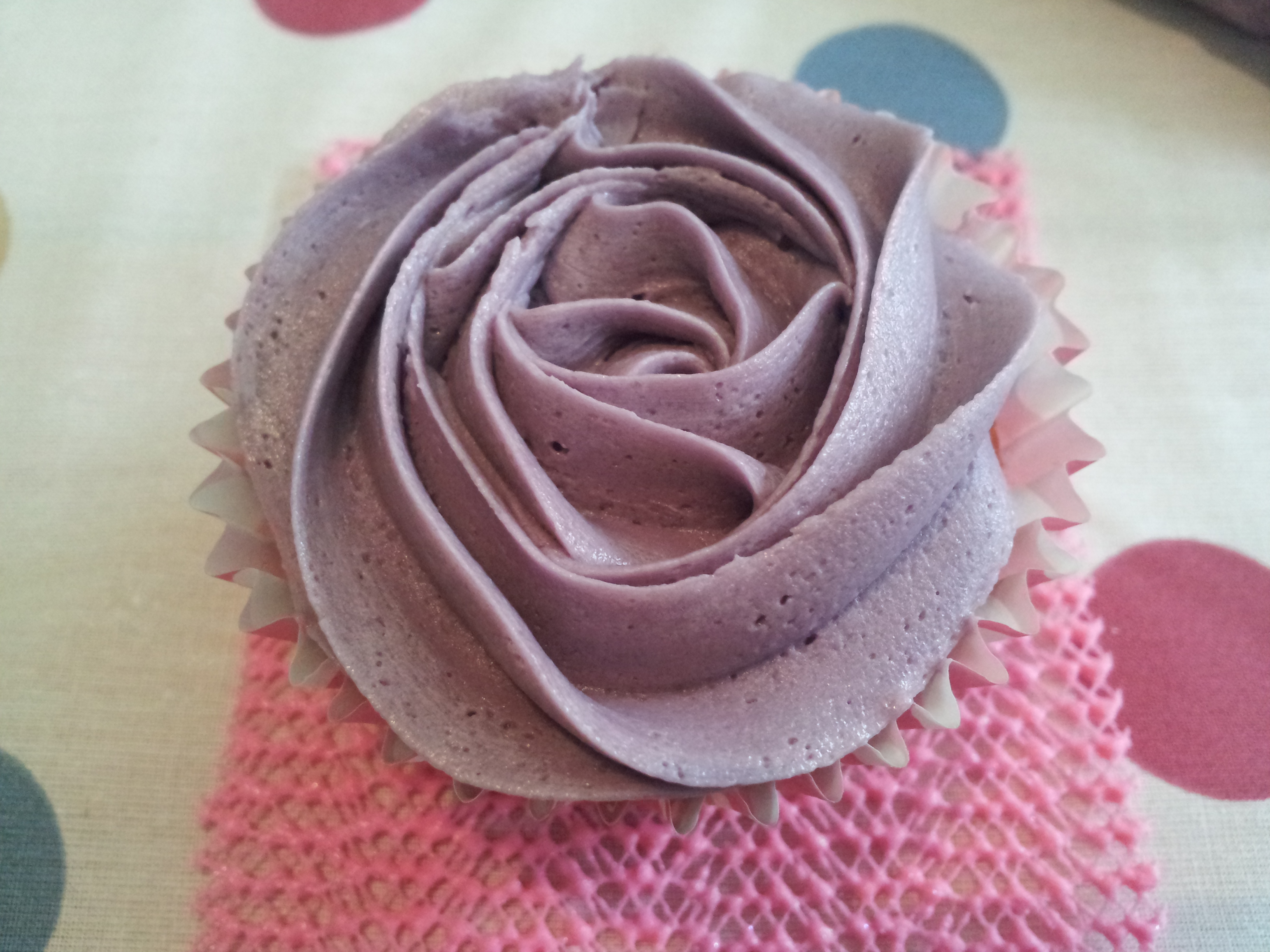
Rose cupcake decorating – look what I learnt!

Wiltshire Lardy Cake

Ingredients

Plain Yeast Dough

  • 12oz Plain flour
  • Pinch of salt
  • 1oz margarine
  • 1-2oz sugar
  • 1/2oz fresh yeast or 14grams instant dried yeast
  • Approx 1and ½ ‘gills’ tepid water, milk & water or milk (7.5 imperial fluid ounces or 213ml)

If using fresh yeast…

  1. Cream the (fresh yeast) yeast with a tsp of sugar
  2. Add tepid liquid and a sprinkling of flour
  3. Put into a warm place until sponge ‘breaks’ through

If using dried yeast ignore these 3 steps above and add instant dried yeast directly to the flour at this point

  1. Sieve flour and salt into a warm bowl
  2. Rub in margarine and add sugar
  3. When ready work in the yeast liquid and knead thoroughly
  4. Put into a warm place to prove for about 1 hr until it doubles in size
  5. Knock back and knead again until smooth


Lardy Cake

  • 4 oz Lard
  • 4oz Sugar
  • 4oz dried fruit
  • Little spice (mixed spices, cinnamon, ginger, cardamom,)
  1. Roll our the plain yeast dough into an oblong shape
  2. If it’s a bit sticky flour the board well
  3. Divide the lard and sugar into 2 equal portions, cutting the lard into tiny pieces
  4. Dot  half the lard onto the all over the dough and half the sugar and fruit, with a light dusting of spice on to the dough
  5. Fold in the same way as for flaky pastry
  6. Fold the dough over one third at a time, closing it like an envelope.
  7. Seal the edges by pressing it with the rolling pin
  8. ‘Rib’ the dough with the rolling pin. (Press the rolling pin into the dough lengthways to create ridges equally spaced across the dough)
  9. Turn the dough clockwise and roll out flat to a oblong shape
  10. Add flour as required to prevent the dough sticking to the board
  11. Re-roll the dough and repeat with the remaining lard, sugar, fruit and spice
  12. Fold again and roll into a neat square or oblong shape
  13. To fit into a 7 or 9 inch tin
  14. If using a round tin mould the dough with hands to the required space
  15. Put the mixture into a warmed, greased and floured cake tin, making sure it comes no more than two thirds of the way up the tin.
  16. Prove for 20 mins in a warm place
  17. Bake in the centre of a hot oven (425-450F or Gas Mark 6-7) for 15 mins
  18. Lower heat to 375F/Gas Mark 4 for 20-25 mins
  19. Either dust the cake with caster sugar when cold or brush with glaze when hot (1 tablespoon sugar and 1 tablespoon water)
  20. Enjoy with a big cup of tea and revel in the lardy glow

30. Beautiful Bara Brith! Welsh Tea Loaf

image

Bara Brith!

My friend Dicky who I met on Twitter asked me if I was planning any Welsh bakes recently. I’ve been thinking about baking Welsh cakes for a little while and asked Dicky for his favourite Welsh baking recipes. He very kindly shared with me his Bara Brith recipe. This is a wonderful fruity tea loaf that’s feels so healthy I don’t feel any guilt in eating a slice or three… I absolutely loved this bake!

I was worried that I wouldn’t be able to find self-raising wholemeal flour as I’ve never noticed it before in the local shops, but lo and behold I found it in the first place I looked. The stars had most definitely aligned to help me create this Welsh classic.

Tea soaked fruit

image

I soaked my fruit in hot strong black tea overnight. I must admit I had to improvise with the dried fruit that I had in the cupboard. I used a combination of sultanas and dried pear. (And threw in a little extra for luck!)

Unfortunately my measuring jug doesn’t have a vast amount of detail on it so I also guessed a little as to how much 2 thirds of a pint of tea is. I did add a little more freshly brewed tea to the final loaf mix later on as the fruit absorbed most of it to get it to the right ‘dropping consistency’.

For an added oomph I splashed in a little lemon juice to the tea and fruit also. I was worried that I might forget to buy a lemon to add it’s zest to the batter. (However I did remember and think the lemon zest really helps to lift the flavour of the loaf.)

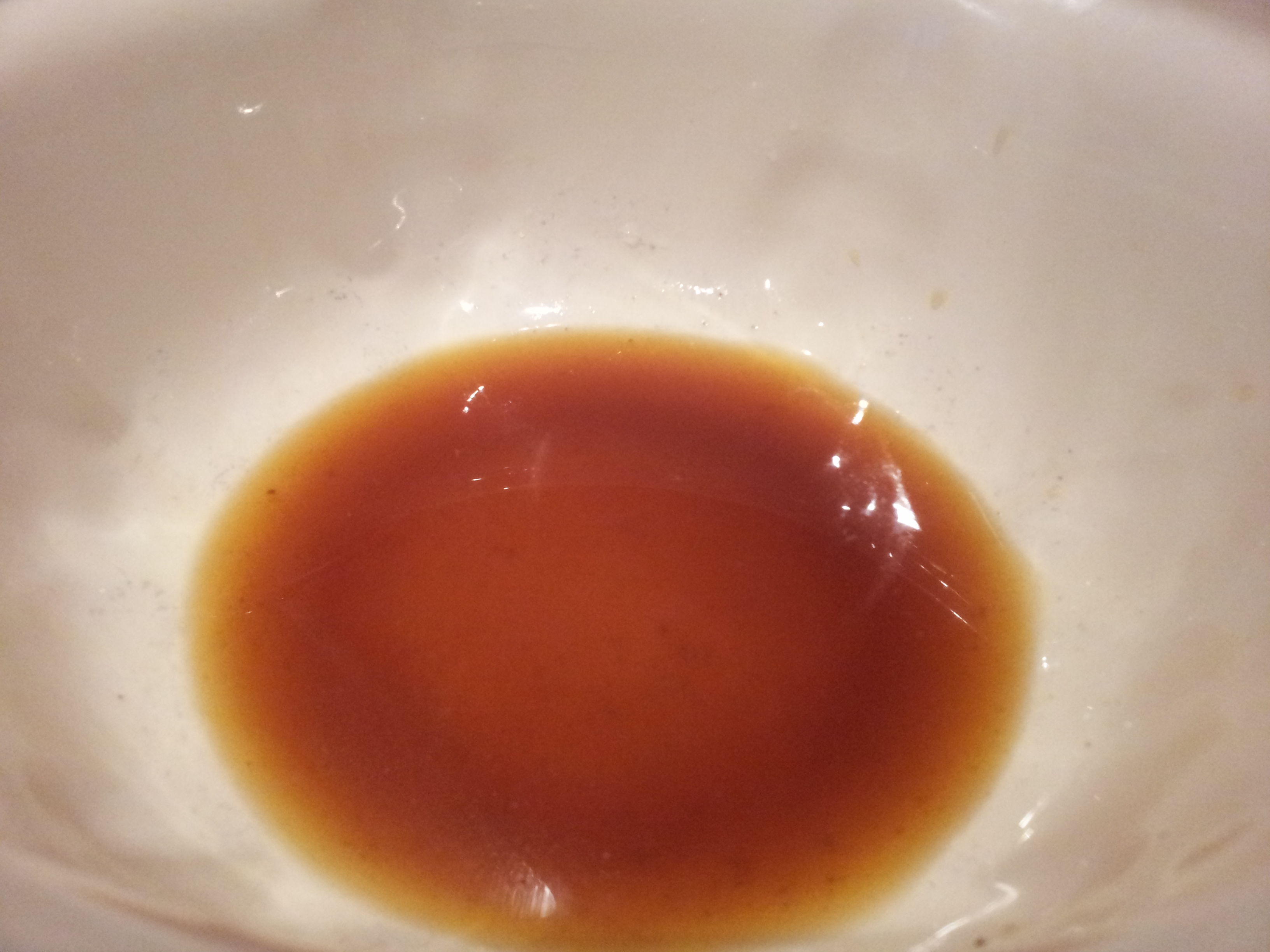
The remaining tea

image

After soaking the fruit in tea I strained the fruit and kept the remaining tea for future use.

Mixing in all the flour, spices, sugar and zest

image

I added the flour, spices, sugar, and egg to the fruit and mixed it all up along with the zest of one lemon.

The perfect dropping consistency

image

Then I gradually added the tea to the mix until it became a smooth and shiny fruit studded paste that drops slowly, but surely from the bowl when poured into the tin. Also known as the right dropping consistency.

I had prepared a loaf tin by thoroughly greasing and lining it with greaseproof paper.

Pre oven Bara Brith

image

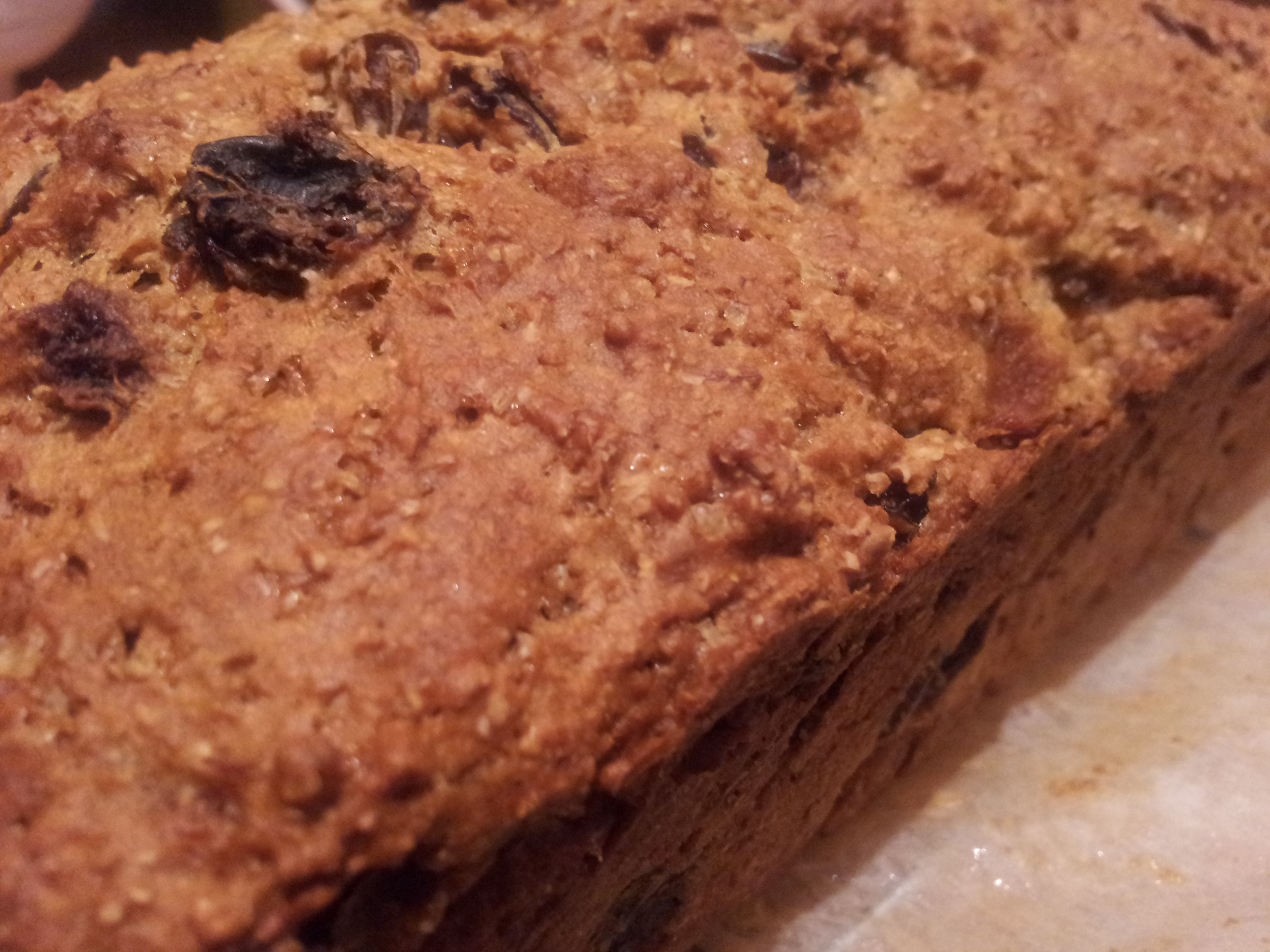
Then all it required was some 45-55 minutes in the oven at 170 degrees C. When it is risen nicely and has turned a lovely golden brown colour, it will be firm to the touch. Then ta da! A perfect Bara Brith is born!!

Fresh from the oven Bara Brith

image

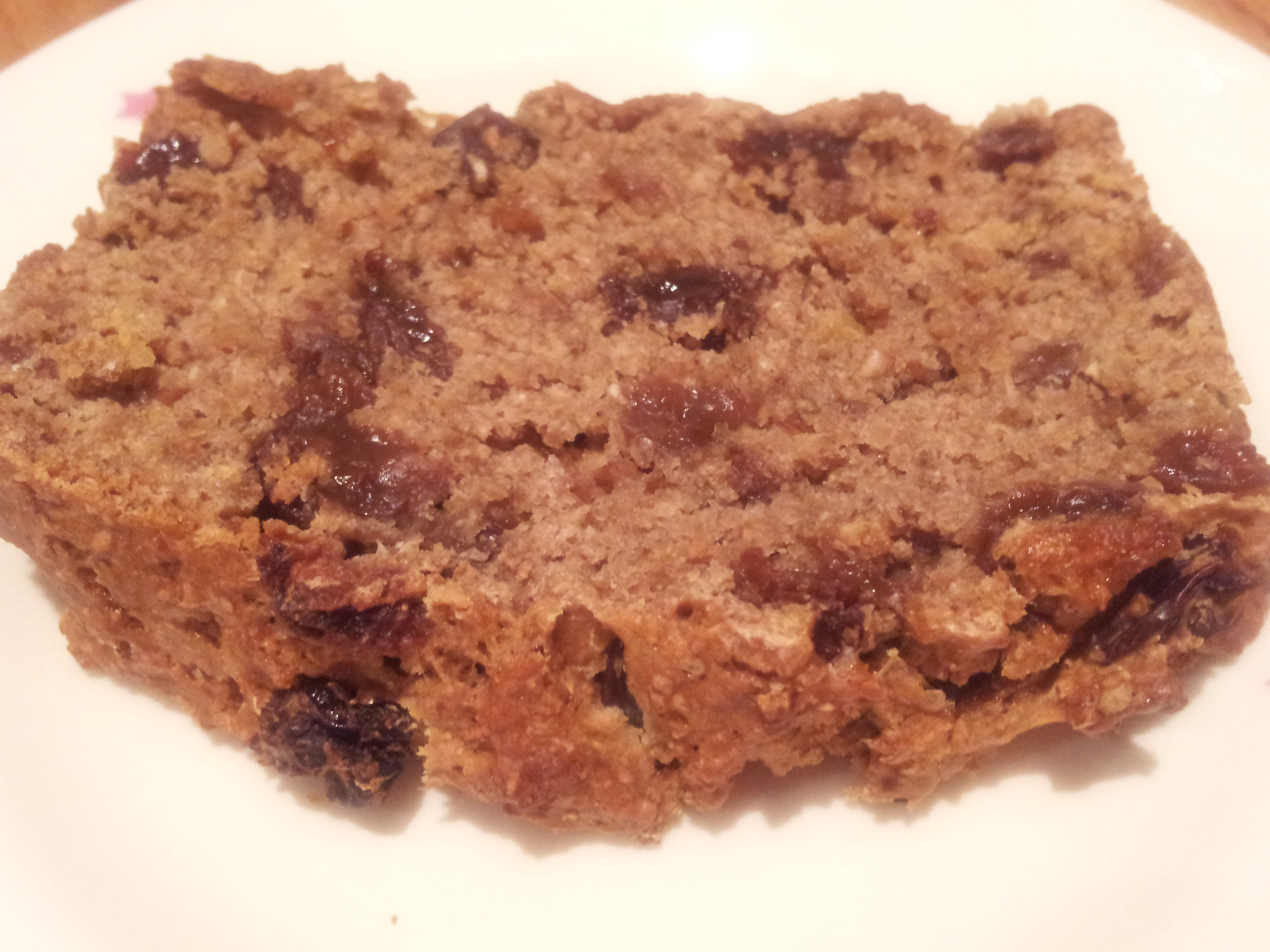
Dicky recommended eating it, once it has cooled, with lashings of butter and it is wonderful with a proper cup of tea. It’s a gently spicy sponge with plump and juicy tea soaked fruit. The wholemeal flour gives it a great texture too. What more could you need!

Bara Brith dressed in butter

image

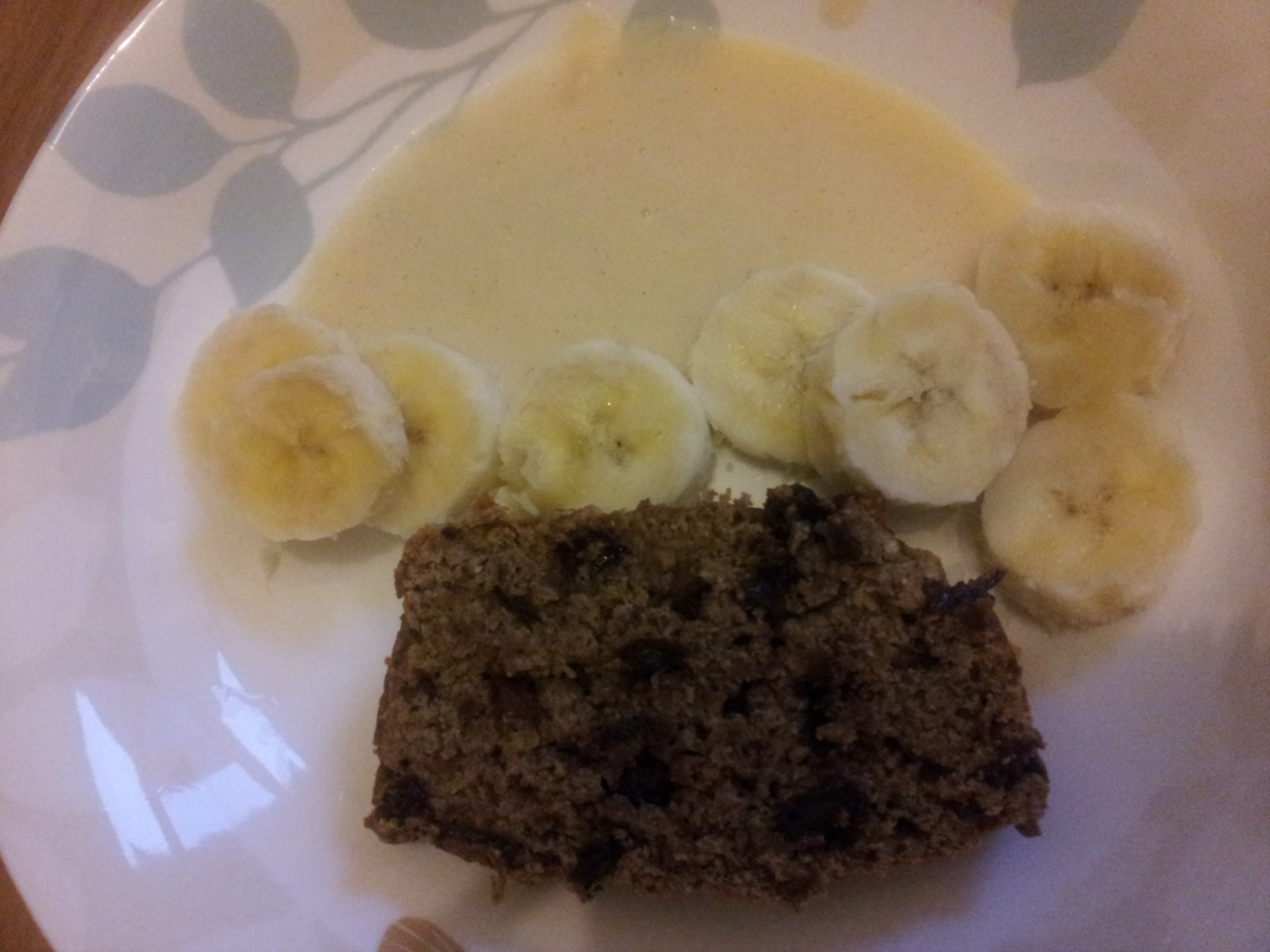
I enjoyed it for breakfast but it would be wonderful at any time of day. I must confess we also ate it with custard and bananas for pudding one night too. 🙂 Delicious!!!

Naked Bara Brith

image

Thank you so much for sharing your recipe Dicky. This will definitely be one of my staple home bakes in the future. I think I might even bake some and freeze them for future use! Also if you would like to follow Dicky on twitter I recommend that you do, he’s a lovely guy, training to be a chef and always baking something amazing. You can find his profile here.

If you have an international recipe that you would like to suggest or send my way, please let me know. You can leave me a comment below if you like. Thanks you so much for reading and all your comments are gratefully received.

Naughty Bara Brith dressed in custard and bananas

image

Things that I used

One 2lb loaf tin

Preheated oven at 170 degrees C,  350F or Mark 4

  • 10 oz (or 285g)  mixed dried fruit (I added a bit more than this for luck probably around 12oz/300g)
  • 2/3 pint hot tea (no milk)
  • 3 oz (or 85g) soft brown sugar
  • grated rind of 1 lemon
  • 12 oz (or 340g) self raising wholemeal flour
  • 1 teaspoon mixed spice ( I am always rather on the generous side with spices so used 1tsp ginger, 1tsp cinnamon 1tsp allspice)
  • 1 large egg ( I used a medium egg as it was all that I had in and it worked well)