56. Lost in Translation – Latvian Golden Coffee Cake – Kliņģeris

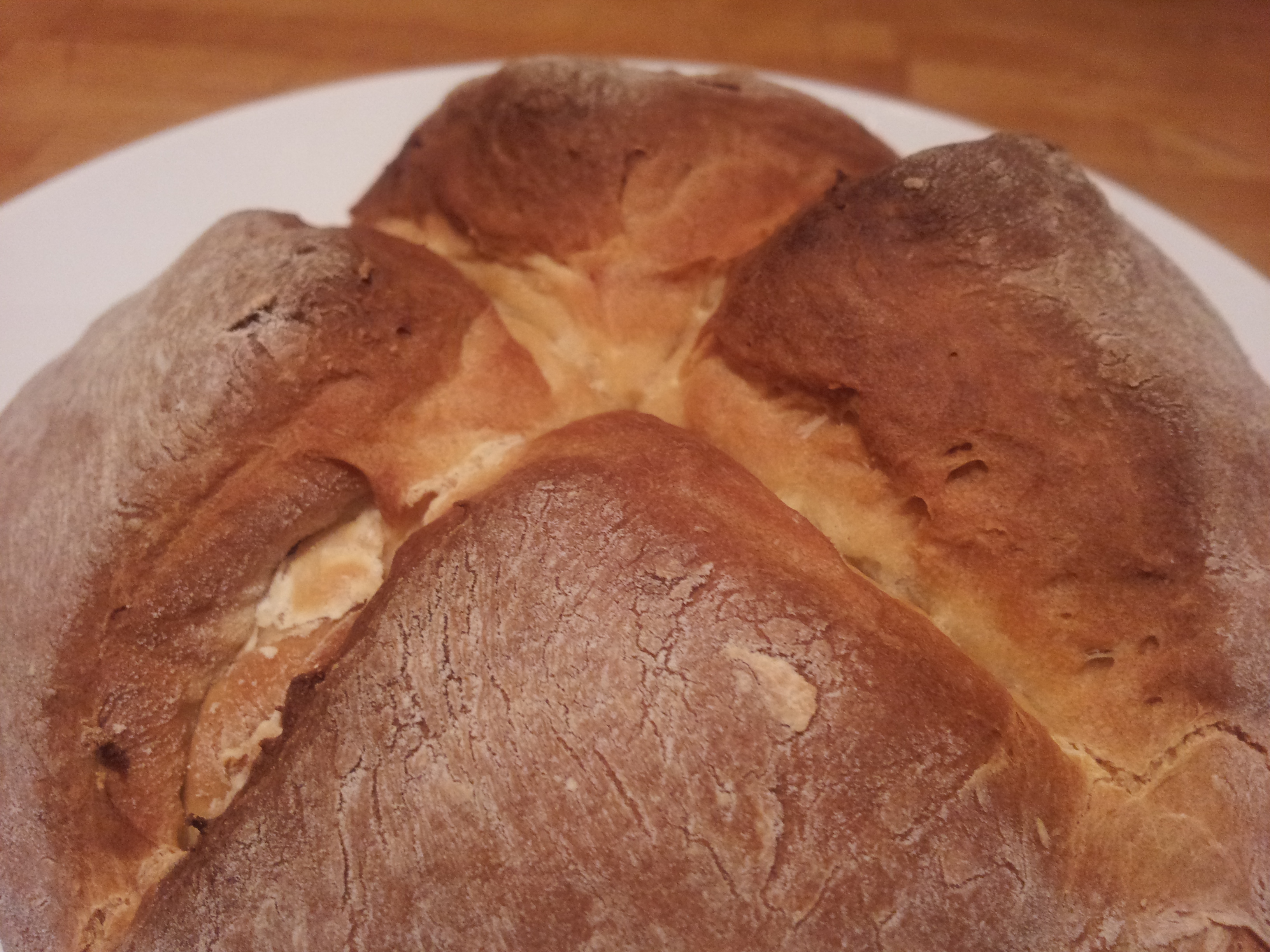
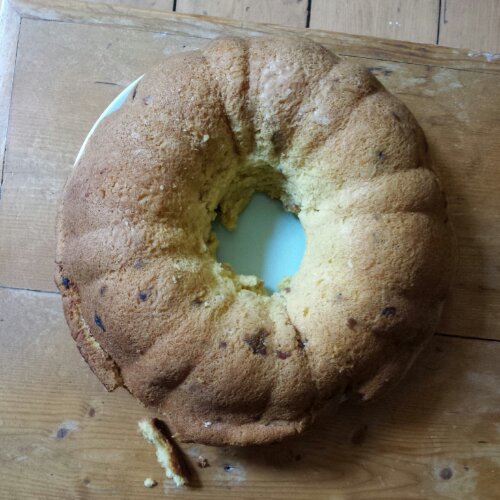
A slightly dishevelled Latvian Golden Coffee Cake

My slightly dishevelled Latvian Golden Coffee Cake

You can be excused for assuming this cake contains coffee. That’s the first of many surprises that this rather unusual cake bestows. It contains NO coffee but incorporates saffron, cake and a yeasted dough. It’s part cake part bread and mainly liquid!? Golden Coffee cake has intrigued me for months, with it’s promise of a saffron scented pretzel shaped traditional Latvian birthday cake. (I do love a good pretzel) I have been saving this recipe for a special occasion and didn’t realise until I began, just how unusual and complicated it really is.
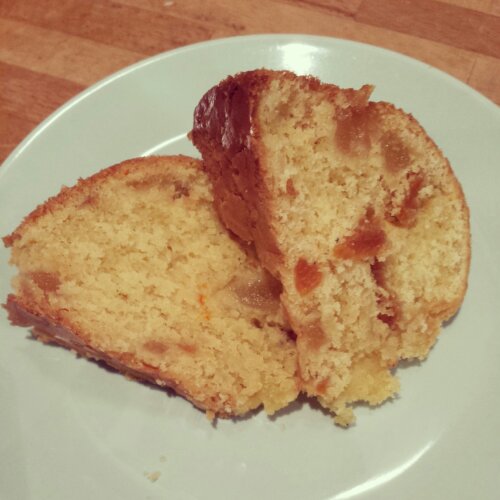
Golden slices

Golden slices

Not many recipes measure flour in litres or require you to combine an enriched dough with creamed butter and sugar. It was a test of my baking skill and intuition as every part of my brain questioned each step of the recipe. I fear I made a right mess of the recipe and something definitely got lost in the translation. Nevertheless I carried on regardless and produced one very interesting cake…

Is this how it's supposed to look?

Is this how it’s supposed to look?

The Latvian Golden Coffee Cake begins life as more of a bread dough than a cake. Kneading together flour, yeast and milk together to create a supple and springy dough.

A supple dough

A supple dough

Whilst your busy kneading the dough together steep the saffron threads in a little boiling water to infuse the liquid with the lovely golden hue and save it to one side for later on.

Steeping saffron strands

Steeping saffron strands

Then to cream together butter and sugar until light and fluffy, whilst the dough rests and proves. Once the butter and sugar are fluffy you then beat the egg yolks in gradually one at a time. I did wonder if I had misread the recipe here as a whole block of butter seems like rather a lot to try to fit into one bread/cake…
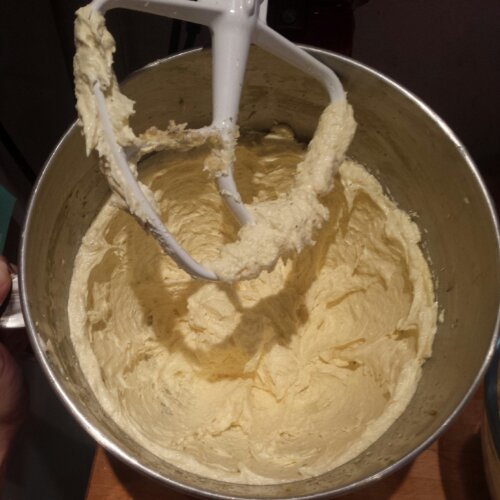
Creamed butter and sugar

Creamed butter and sugar

This is where I think it all started to fall apart. In an attempt to save on washing up and effort I used my Kitchenaid to knead the dough and creamed butter together. I also forgot to buy cream so substituted it for milk, which is far more liquid than cream. I adjusted the recipe slightly hoping to compensate for this substitution, but I’m not convinced I did! It took a long time to knead the butter into the dough. They just didn’t want to combine! After a good 10 minutes of kneading the gloopy mess smoothed out into a very fluid (!) and smooth bread/cake dough.
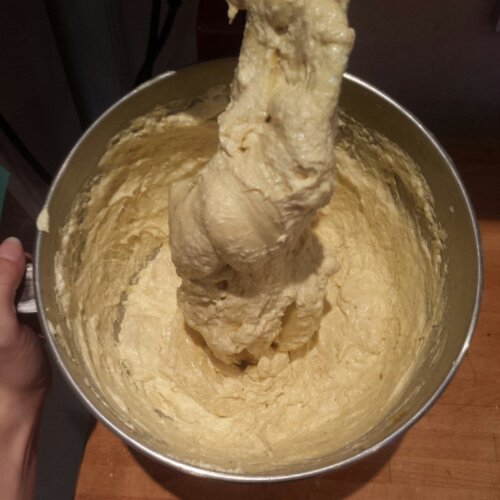
Gloopy mess of dough and butter

Gloopy mess of dough and butter

It took a good 10 minutes of mixing to get the dough to smooth out and look more appealing. And just when it was all going so well the recipe called for the the juice of 1 lemon and (I guessed as it wasn’t mentioned) the saffron and infused water. All this liquid along with the ground cardamom and zests of 1 orange and 1 lemon made for an even wetter dough…

The proven dough

The proven dough

Leaving the liquid dough to prove in the bowl for a couple of hours, it quickly increased in size and almost overflowed the bowl! The yeast was definitely working. The next tricky stage was to attempt to knead the chopped golden cherries (I didn’t have golden raisins but had randomly picked up some golden cherries on a whim, which were a good alternative) and apricots (the only other golden-ish dried fruit that I had in my cupboard).

Chopped dried golden fruits

Chopped dried golden fruits

I could clearly see that this dough was destined to never blossom into a beautiful pretzel shape despite the instruction to knead it on a floured board. There was not enough flour in my house to get this into a malleable dough state. Yet I found myself pouring it onto my worksurface and racing to catch it before it ran onto the floor. It was more like kneading treacle than bread dough. I resorted to stirring the chopped fruit in on the worksurface and scooping the mixture into a well greased bundt tin instead.
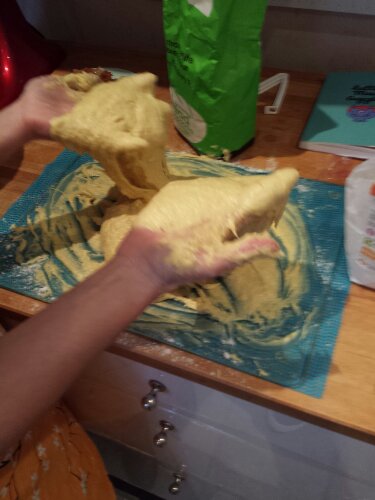
What do I do with this?

What do I do with this?

Covering the budnt tin with greased cling film I left the dough to prove for a full hour to allow the yeast to do it’s magic. Then into the oven for a good bake 35-45 minutes at 180 degrees c.

resorting to a budnt tin to encase the Latvian Golden Coffee Cake instead...

resorting to a budnt tin to encase the Latvian Golden Coffee Cake instead…

The bundt tin worked surprisingly well to bake the Golden Coffee Cake in. I think having the hole in the middle helps to ensure a cake is cooked all the way through. It expanded so much during baking, you could hardly see the hole in the middle any more! It sure is a yeasty cake.
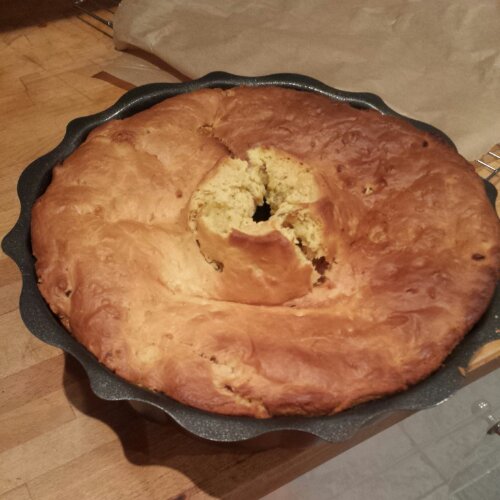
The ever expanding Golden Coffee Cake

The ever expanding Golden Coffee Cake

I still managed to make a hash of it however, tipping the cake out too soon, whilst it was still hot. I panicked as it sank further into the tin as it cooled. In my haste to turn it out the cake collapsed even further and bits broke off… I did check that the cake was cooked thoroughly by using a cocktail stick. The dough seemed to be evenly baked as the skewer came out clean, but I felt the cake was still a little too moist to hold it’s own weight. Perhaps 5 more minutes in the oven and 10 more minutes cooling in the tin afterwards would have given it the extra strength to hold it’s own shape a little better.

Tipped out too soon...

Tipped out too soon…

My Golden Coffee Cake has a slightly rugged edge to it which isn’t necessarily a bad thing. As the cake had expanded enormously there were bits of overhang, that had to break off to get it out of the tin. This means that you get to sample the cake before everyone else! Super Hans and I shared the scraps. He thoroughly enjoyed it which is always a good sign,
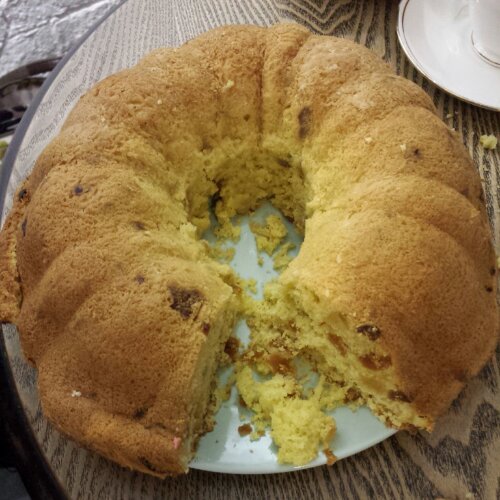
The opened cake

The opened cake

I was a bit nervous about presenting this cake to my friends at the Clandestine Cake Club. It really hadn’t gone to plan, despite the many hours of planning and preparation that had gone into this cake. Saffron tends to also be an acquired taste especially when combined with the strong yeast, it’s quite the unusual flavour combination.

The beautiful collection of cakes at The Clandestine Cake Club

The beautiful collection of cakes at The Clandestine Cake Club – my emergency blackberry heart is on the right

The original recipe called for icing too, which frankly I couldn’t be bothered to make as I decided to bake an emergency alternative blackberry and almond cake to take to cake club instead. I didn’t want to waste my Golden Coffee Cake, I still took it along repeatedly apologising for it’s dishevelled appearance.

The Golden Coffee Cake

The Golden Coffee Cake

The verdict? Golden Coffee Cake reminds me of a stronger flavoured Hot Cross Bun. A spicy and fruity bread rather than a traditional sponge cake. It’s similar to an Italian Panetonne, so would be a lovely Christmas bake. The taste definitely improves with age so it’s best baked in advance to allow the flavours to develop and mellow. On the third day, it tasted pretty good! The wet enriched yeast dough gave the cake the moisture it required to create a light aerated texture, with an even crumb I’m sure Paul Hollywood would be proud of.

Golden and fruit filled

Golden and fruit filled

It was a rather moist cake, so a slightly longer baking time wouldn’t do it any harm. It may have been even better if I had got round to icing the cake too! The feedback from my cake club friends was very positive too. Perhaps I had been too hasty in my judgement of this cake, dismissing it as a failure.

Golden Coffee Cake

Golden Coffee Cake

The Latvian Golden Coffee Cake is an exotic cake that I’m very pleased I got to experiment with. I love the defined bundt shape of this bake. The dough really holds the grooves of the bundt well and once you slice into the cake it’s beautiful golden saffron interior is revealed. You get a lovely waft of cardamom from the cake too with every slice, bringing it’s own festive cheer to the table.  The sharpness of the citrus fruits cuts through the yeast and spice and gives the cake a light tang. This cake isn’t a cheap to make, once you’ve purchased your precious saffron, cardamom, butter and eggs so I can see why the Latvians save it for special occasions. I fear I may never learn my lesson and continue to substitute ingredients on a whim, so I take the blame for my own additions to this recipe! Don’t add too much liquid if you do try this at home and you may actually get to shape it into a pretzel!

Things that I used to make my Latvian Golden Coffee Cake

  • 1/2 tsp Spanish saffron – steeped in
  • 1/4 cup boiling water

Knead together

  • 570g strong white flour
  • 20g instant dried yeast
  • 400ml warm milk ( I would use much less! maybe 300ml if using milk or 400ml of double cream)
  • 1 tsp sugar
  • 1 tsp salt
  • The water infused with saffron and the strands

Cream together in a separate bowl

  • 250g butter
  • 3/4 cup sugar

Then beat in

  • 3 egg yolks
  • zest of 1 orange
  • zest of 1 lemon
  • 1/2  tsp ground cardamom

Knead the butter mixture together and dough

Prove dough for 1 hour

Knead in

  • 300g of dried chopped fruit (golden cherries/raisins/apricots)

(Shape like a pretzel if you can! and bake on a greased sheet.)

Pour into a greased bundt cover and prove for 1 hour

Bake for 35-45 minutes at 180 degrees C

Allow to cool in the tin for around 30 minutes

Ice with a sugar glaze if you like! (Mix icing sugar and water together until gloopy and pour over your cake) or leave plain if you prefer.

Golden slices

Golden slices

Enjoy a slice with a nice strong coffee, hence the name Golden Coffee Cake!

This recipe was adapted from the www.latvianstuff.com/Kringel.html. Thank you for the inspiration and my apologies if I’ve ruined your recipe! Any tips on how to improve my technique would be very welcome.
How to churn your own Butter and make Buttermilk – Back to Basics

image

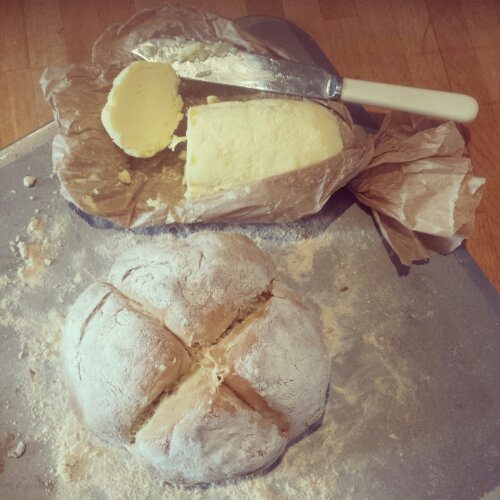
Homemade soda bread and butter at the ready!

Homemade Butter

Homemade Butter

Not wanting to let any food go to waste I realised I had a pot of double cream sitting in the fridge almost ready to be thrown away. So what to do with left over cream?? Why not teach myself how to churn butter at home?

Bread and butter. The perfect combination

Bread and butter. The perfect combination

Having a kitchenaid stand mixer makes this so easy, however I know you can make your own butter by sloshing cream around in a jar too. One guy attached a sealed jar of cream to his very active toddlers back and as the child frolicked he churned butter as he went. Now that’s multi tasking.

image

I didn’t employ any small children in the making of this butter. Rather I set my kitchenaid to work for less than 20 minutes and produced a patty of butter and a bowl of buttermilk. Magic.

There’s 6 clear stages in the butter development which is quite exciting to watch.  Starting with 350ml of double (or heavy) cream just whack it in your mixer with the beater attachment and let it go.

Double cream at the ready

Double cream at the ready

As it’s quite liquid to start with I gradually increased the speed working my way up to high and left it running whilst I made myself a cup of tea and treat Super Hans to a dollop of leftover cream. I could then marvel at the wonder of butter making, stopping only to sip my tea and take photos.

If you start off too high the liquid will escape from the bowl and not end up in your butter. I want to maximise my butter intake so slow and steady it goes. The cream will thicken as it fluffs up with air.

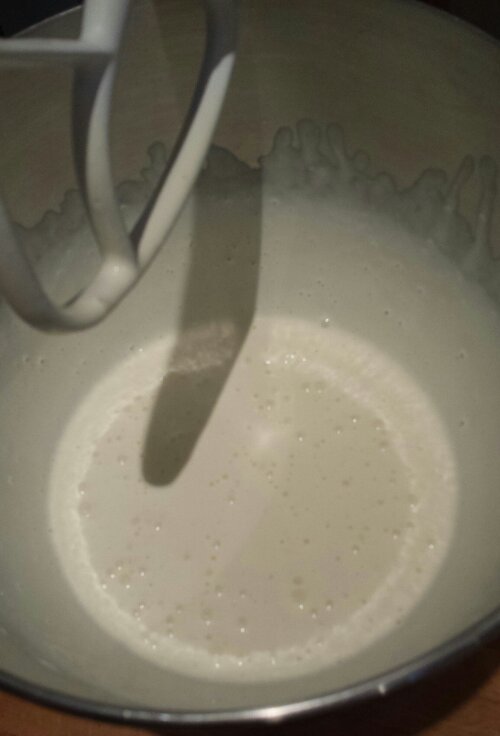
Stage 1: Bubbly Cream

Stage 1: Bubbly Cream

Stage 1. White bubbly cream.

Whipped cream! Keep going

Whipped cream! Keep going

Stage 2. Thick whipped cream. Delicious on scones but not what we’re looking for.

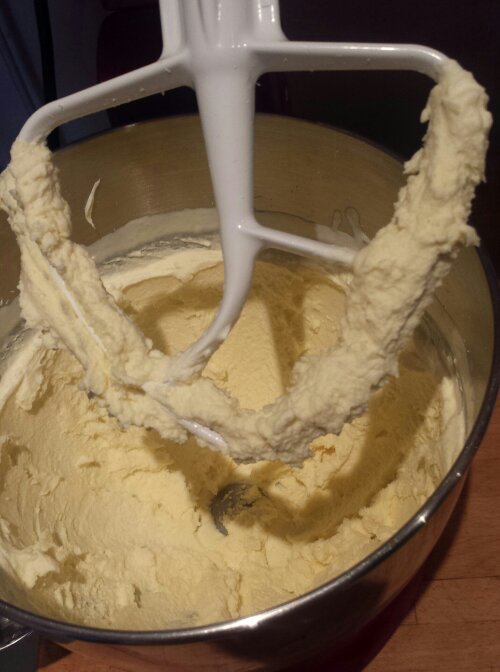
Not quite ready... starting to become yellow and thick

Not quite ready… starting to become yellow and thick

Stage 3. It’s getting exciting. The cream takes on a yellow hue and is very thick.

Starting to separate into butter and milk

Starting to separate into butter and milk

Stage 4. It starts to look a bit scrambled as the cream begins to separate into butter and milk. Don’t worry it’s meant to look a bit grainy!

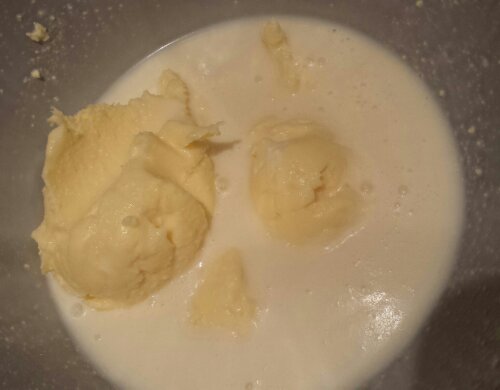
Ready!

Ready! We have Butter!

Stage 5. WE HAVE BUTTER! And a beautiful buttermilk by product.  It separates fully into a lump of butter sloshing around the bowl with buttermilk. Take it easy at this stage as you’ll lose the precious buttermilk if you beat the butter too vigorously.  Once the butter comes together in a patty it’s ready to drain.

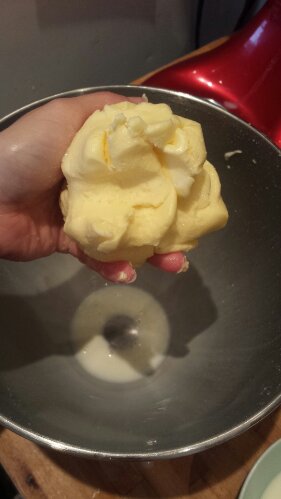
Squish out the excess buttermilk

Squish out the excess buttermilk

Stage 6. Drain the buttermilk out of the bowl and save it for later. (This is a triumph. I’ve not been able to find real buttermilk in the shops so now I have genuine buttermilk to work with and make proper Soda Bread!) Squish the butter by hand to remove the excess milk and hey presto your butter is ready. You can also leave it drain in a sieve over a bowl.

And as if by magic we have Butter and Buttermilk

And as if by magic we have Butter and Buttermilk

Stage 7. Roll into a nice patty shape inside some greaseproof paper and pop it in the fridge to set. You could add flavourings at this stage too if you fancy, herbs, garlic, salt. As I’m going to use this in a pie crust I’m keeping mine pure and simple.

Butter me up

Butter me up

Before even starting the washing up I calculated the ratio of flour needed for the amount of buttermilk I had made (162ml of buttermilk to be exact) to whip up a quick soda bread!

Butter patty at the ready with Soda Bread for the oven

Butter patty at the ready with Soda Bread for the oven

I just threw all the flour back into the mixing bowl and made a half size loaf. I guessed just under half the amount of flour was needed. Now we have a full on snack from one pot of cream that was just going to be thrown in the bin. Using every single bit of the ingredient so nothing goes to waste. Economical and environmentally friendly baking. Now that’s my kind of cooking.

Homemade butter and soda bread!

Homemade butter and soda bread!

Things I used to make my butter

  • 350ml double or heavy cream (any amount would do, but the more cream you have the greater the amount of butter you will make with better value for your time and electricity bill…)
  • Kitchenaid (or you could shake it up in a jar or use a hand whisk if you’re feeling energetic)
  • You coud add herbs, garlic or salt to flavour your butter)

After 20 minutes of beating I made

50. Authentic Danish Rye Bread – Rugbrød

Danish Rye Bread

Danish Rye Bread

My wonderful friends Josh and Mark shared their genuine Danish Rye Bread recipe with me months ago and I’ve been dying to try it! I was going to visit them in Manchester and thought it the perfect occasion to take them some freshly baked Rye bread too to say thank you for letting me stay!

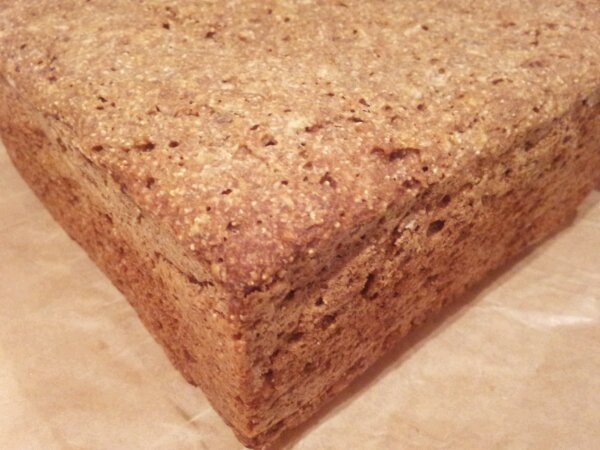
A cross section of Danish Rye Bread

A cross section of Danish Rye Bread

The recipe arrived in 3 photos of hand written sheets so I knew it was going to be good and truly authentic. It requires rather a lot of flour as it is enough for 3 loaves. My brain couldn’t calculate the maths to scale this recipe down so 3 loaves it is!

The Rye Bread Sourdough Starter

The Rye Bread Sourdough Starter – porridgey

The recipe calls for a homemade sourdough base. I have attempted to make my own sourdough starter from scratch before following the Fabulous Baker Brothers method of capturing the yeast from the air in flour and water and letting it ferment. Perhaps my house is not particularly yeasty, I’m not sure but for whatever reason I couldn’t get it to bubble. Having made a successful Herman the German Sourdough starter and cake before I know that adding instant yeast is a sure fire success. Therefore, I admit it, I deviated from the rules immediately, before I even began baking pouring in a little cheating instant yeast to get the sourdough started.

Starting the Rye Bread in my massive cake tin

Starting the Rye Bread in my massive cake tin

I don’t own a bowl big enough to stir this vast amount of flour in so wielding my largest cake tin I set to work… and consequently ruined said cake tin, bending it out of shape with the cement like dough!

If you were making your own sourdough starter, you could keep some back and carry on feeding it so you can make many more beautiful loves in the future. I was making just enough for this recipe, but may attempt to make my own sourdough rye starter again.

There's a lot of flour in this Rye Bread

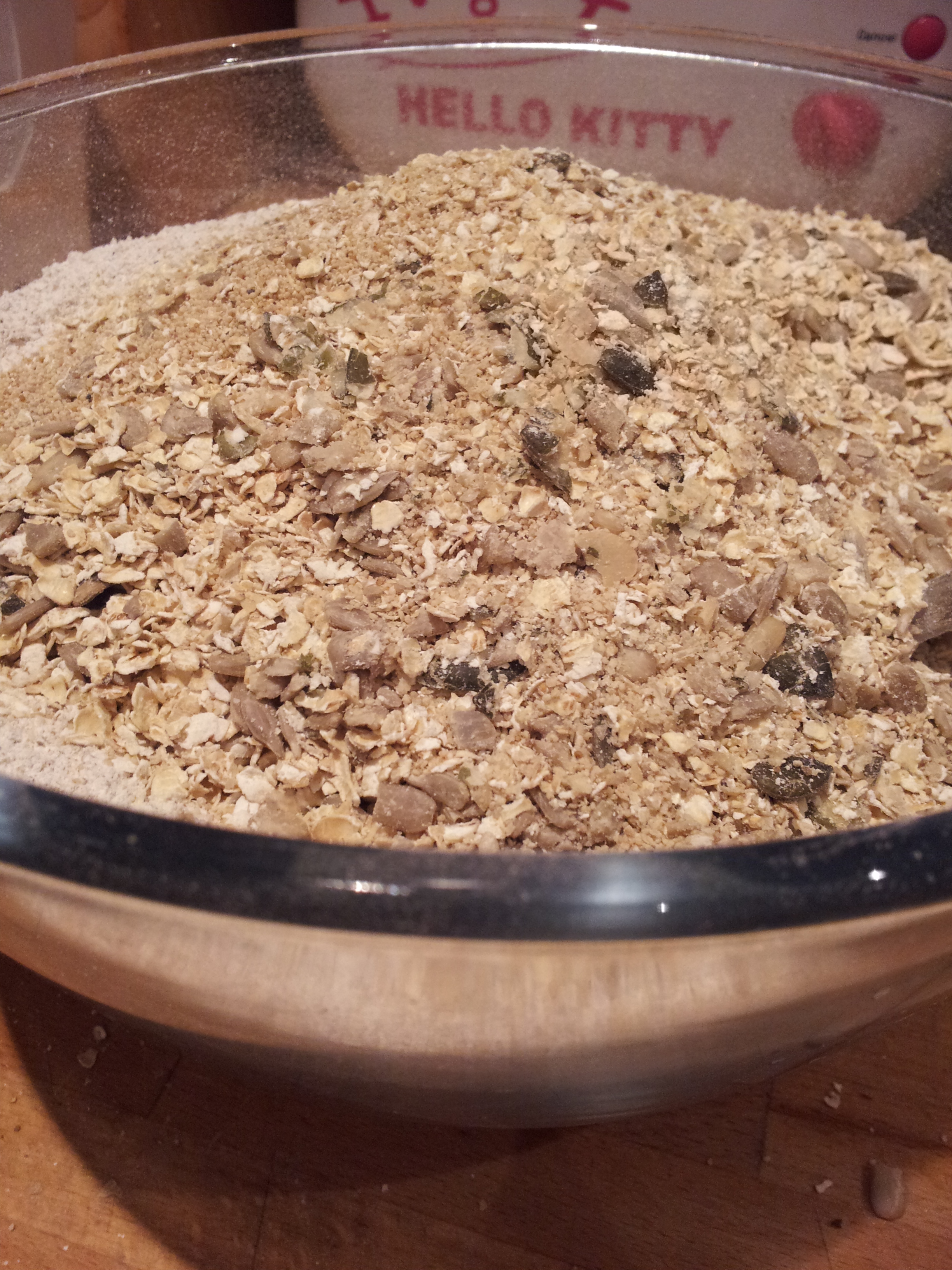
There’s a whole lot of flour, seeds and grains in this Rye Bread

Rye is quite the healthy flour, full of wholesome goodness, as opposed to refined white flour. This means that it has quite a distinct flavour and it is much heavier than white flour. It creates a rather dense loaf. Mixing rye flour with white flour lifts the texture and colour of the bread slightly. The addition of seeds, nuts and grains give it extra texture and nutritious value!  This bread is perfect for applying lashings of cream cheese and smoked salmon to. I love the traditional Smørrebrød, or Danish open sandwiches. Rye bread is an essential part of proper Danish sandwich making.

If you plan this in advance you will have plenty of time to allow the starter to ferment. I however did not. You should mix the flour and water together, stirring it into a smooth, thick paste and leave for at least 12 hours to let it bubble. I made my starter but needed it to be ready to go asap so I cheekily added 7g of instant yeast to make sure it rose fully.

Adding the flour and seeds to the sourdough start mix

Adding the flour and seeds to the sourdough start mix

Once your starter is ready you can save a cup back for future sourdough creations or, whack it all in to the mix like me. The beauty of rye bread is that it doesn’t require kneading! However you do need strong arms for the mixing. My weapon of choice was a wooden spoon to battle the heavy dough with. Combining the sourdough starter with the rest of the rye bread mixture, alternating between the dry ingredients and the water is hard work but you must keep on stirring until everything is combined, including the seeds and grains. Prepare yourself for a good 10 minutes of elbow grease.

How to fit all of this in one bowl... water, flour, seeds and sourdough starter
How to fit all of this in one bowl… water, flour, seeds and sourdough starter

Unfortunately there were a few ingredients that I didn’t have to hand so improvising to my hearts content, I chose sunflower and sesame seeds to add to the dough. I haven’t been able to find malt powder so I just left it out of the mix, but I bet you can get it in healthfood shops. Rye/barley/wheat grains don’t really feature in my cupboards (other than broth mix and I’m pretty sure dried barley and split lentil is not what we’re looking for here) but oats were an excellent emergency substitute!

Thick and porridgey just how the best Rye breads should be

Thick and porridgey just how the best Rye breads should be

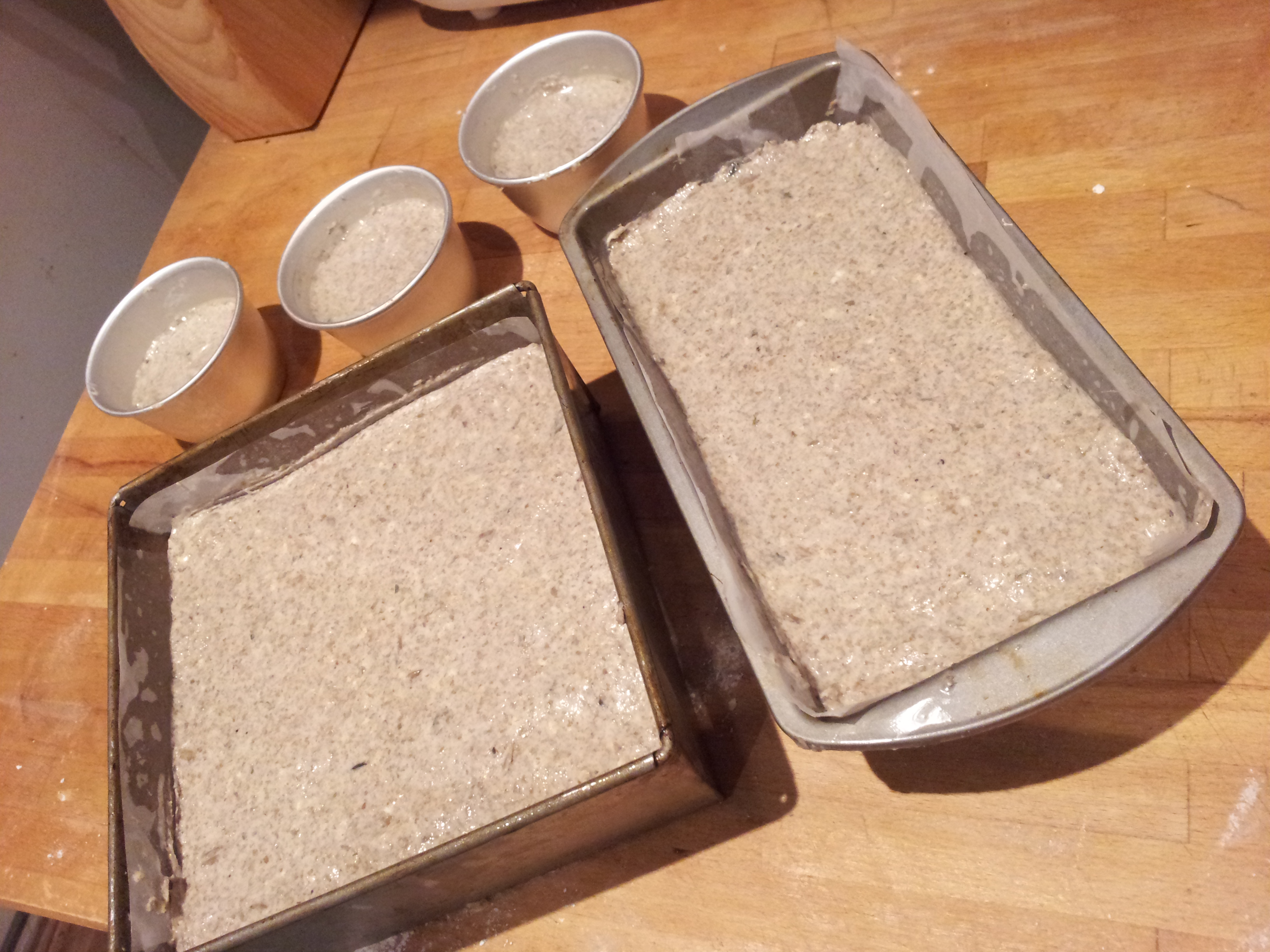
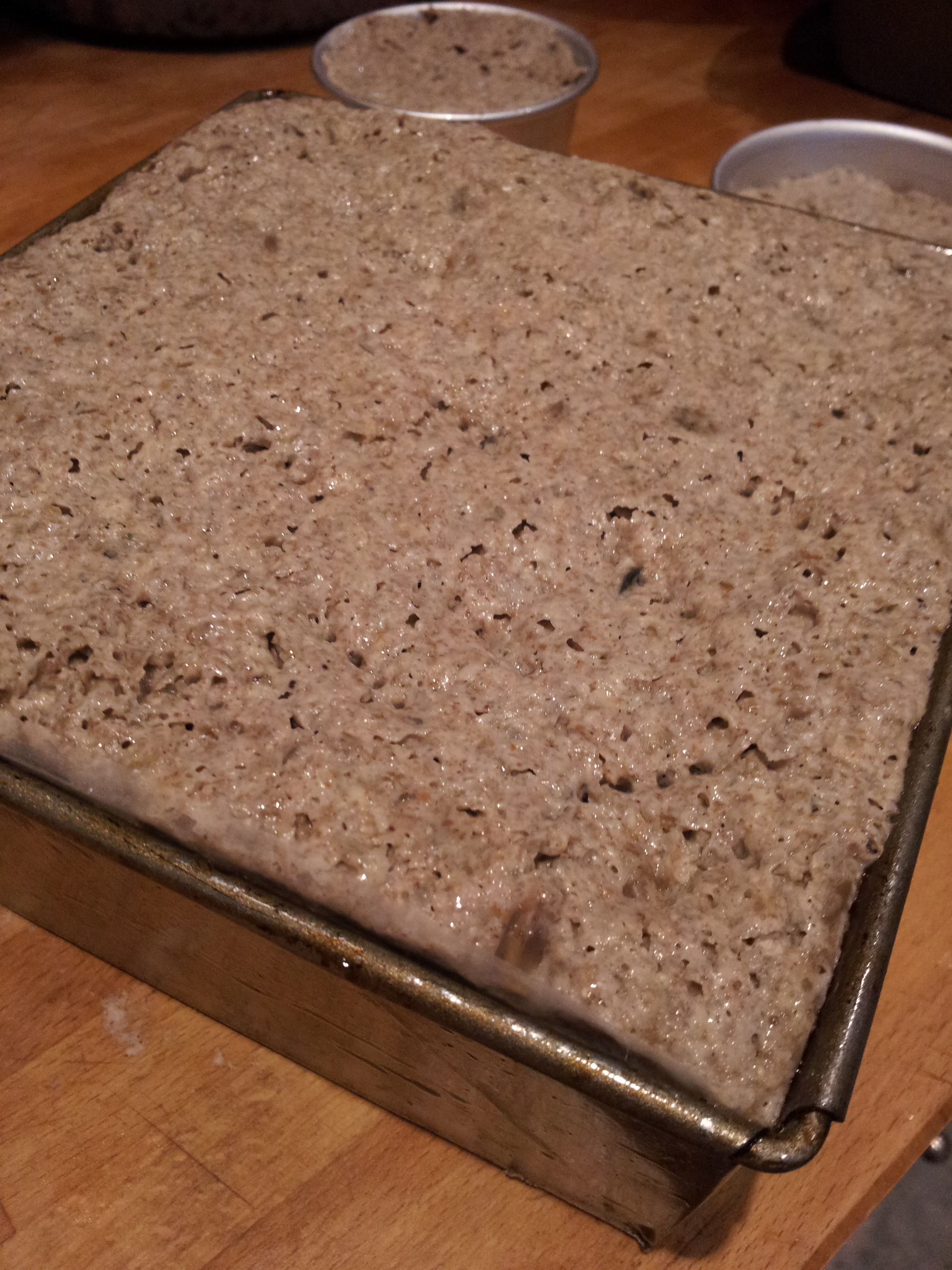
Once the dough is the consistency of thick porridge (lumpy in a good way) it’s ready to pour/scoop into your greased and floured loaf tins. It is quite a stiff liquid so your have to encourage the dough as you pour it into the corners of the tins. Pour in enough dough fill two thirds of the tin, so there’s still space for the dough to expand without overflowing the tin. I had to resort to baking one loaf in a square cake tin (the same size as 2 normal loaf tins) and some mini pudding tins as I only have the one small (500g) loaf  tin!  Coat each loaf with a nice wash of oil and sprinkle a few oats/seeds on the top. Cover the loaves with greased cling film and leave to prove/mature for 8-12 hours. This time allows the sourdough to mature further and add a deeper tangy flavour to the bread.

Pour your rye bread dough into all of your loaf tins (and every other container you can find...)

Pour your rye bread dough into all of your loaf tins (and every other container you can find…)

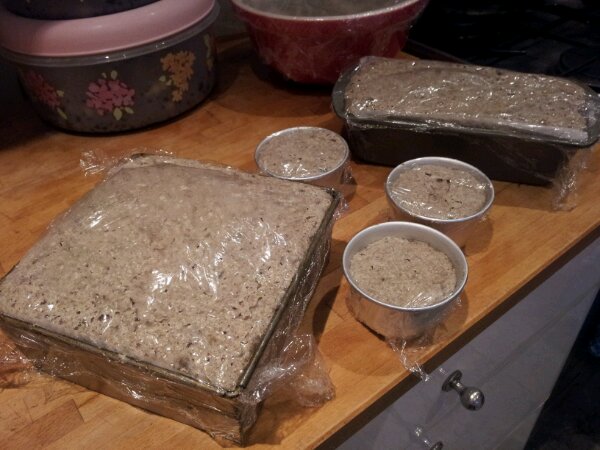
When proved the dough will not double in size like other breads but it will increase in volume and should reach the top of your loaf tins. Prick the tops of the proven loaves all over with a fork, this will help keep your crust intact as it may fall off if left un perforated. It also prevents the loaves from rising and cracking in the oven, maintaining that distinctly symmetrical Danish Rye bread oblong shape.

The cling film covered and proving loaves

The cling film covered and proving loaves

Pre heat your oven to 220 degrees C. Bake the loaves at 220 degrees for 10 minutes. This initial blast of heat helps to force the bread to rise and the crust to develop. Lower the temperature to 175 degrees C and bake for a further 75  minutes.

Sometimes pegs come in handy to keep the cling film in place...

Sometimes pegs come in handy to keep the cling film in place…

If your loaves can be removed easily from the tins at this point do so. if not, leave for another 5-10minutes until they can be removed. Bake the bread for a further 5-10 minutes without the tin directly on the oven shelf to allow the crust to become extra crunchy.

The forked loaf ready for the oven

The forked loaf ready for the oven

Once they’ve cooled they’re ready to eat! You should be able to keep them at room temperature for 1-2 weeks or they freeze really well too.

Danish Rye Bread fresh from the oven

Danish Rye Bread fresh from the oven

I always know when I’ve baked something especially tasty as Super Hans will go out of his way to steal it from me. He was desperate for a bit of my Danish Rye Bread. I love the depth of the flavour in this bread. It radiates health and wellbeing. It’s also rather filling, so thin slices are a must. The sourdough tang cuts through the fantastic texture of the seeds and nuts. Now that I have the Kitchenaid I can dispense with the cake tin mixing method, so I will be purchasing more rye flour very soon and having another go. I would also love to try other dark breads. I can see me attempting many more in the future. Thank you Josh and Mark for sharing your fantastic recipe with me!

Extreme close up of the crunchy crust

Extreme close up of the crunchy crust

Things that I used to make Danish Rye Bread

Sourdough Starter

  • 300ml luke warm water
  • 250ml rye flour
  • 7g of instant yeast (if you’re in a hurry)

Mix together to a thick smooth paste and leave to ferment until bubbly (12-24 hours) or if you’re impatient add 7g of instant yeast to your starter…

Rye Dough

  • 1 litre of warm water
  • (if you can find it add 1 tablespoon of ground malt -I didn’t)
  • 200g sunflower seeds
  • 200g sesame seeds
  • 400g oats (or whole rye, barley/wheat grains)
  • 2 tablespoons salt
  • 1 tablespoon honey
  • 300g strong white flour
  • 900g rye flour
A slice of rye

A slice of rye

My pair of rye loaves

My pair of rye loaves

49. German Pretzel Playtime

Pretzels, Pretzels, Pretzels!

Pretzels, Pretzels, Pretzels!

I discovered that I have a slight obsession with Pretzels on our recent visit to Berlin, where I bought many delicious chewy pretzels the size of my head. I really rather enjoyed Berlin, my first venture into German cusine! Traditionally Preztels are a savoury German snack, dipped in a rather caustic solution of lye to achieve the dark brown coating with the distinctive chewy texture.

In amongst the Curry Wursts, Strudels and Pork Knuckle I filled my self up on pretzels as often as I could. We explored the historic sites and the bohemian avenues in the post Christmas and wedding drizzle. Berlin was a very welcome change of scenery, with pickled herring and salmon for breakfast. I went all in with the Germanic food. My instagram feed became awash with a vast array of wonderful and interesting food. Nothing went undocumented!

Dough ready for some good kneading

Dough ready for some good kneading

Upon returning home I wanted to recreate some pretzel perfection, preferably without the hazardous solutions. No chemical burns for me please! Pretzels are made from a basic soft white bread dough recipe. The flour, yeast, oil and water should be mixed together in a big bowl until it can then be kneaded on a oiled board for 10 minutes. Once the dough is smooth and bounces back when pressed your kneading is done.

Kneaded dough ready to prove

Kneaded dough ready to prove

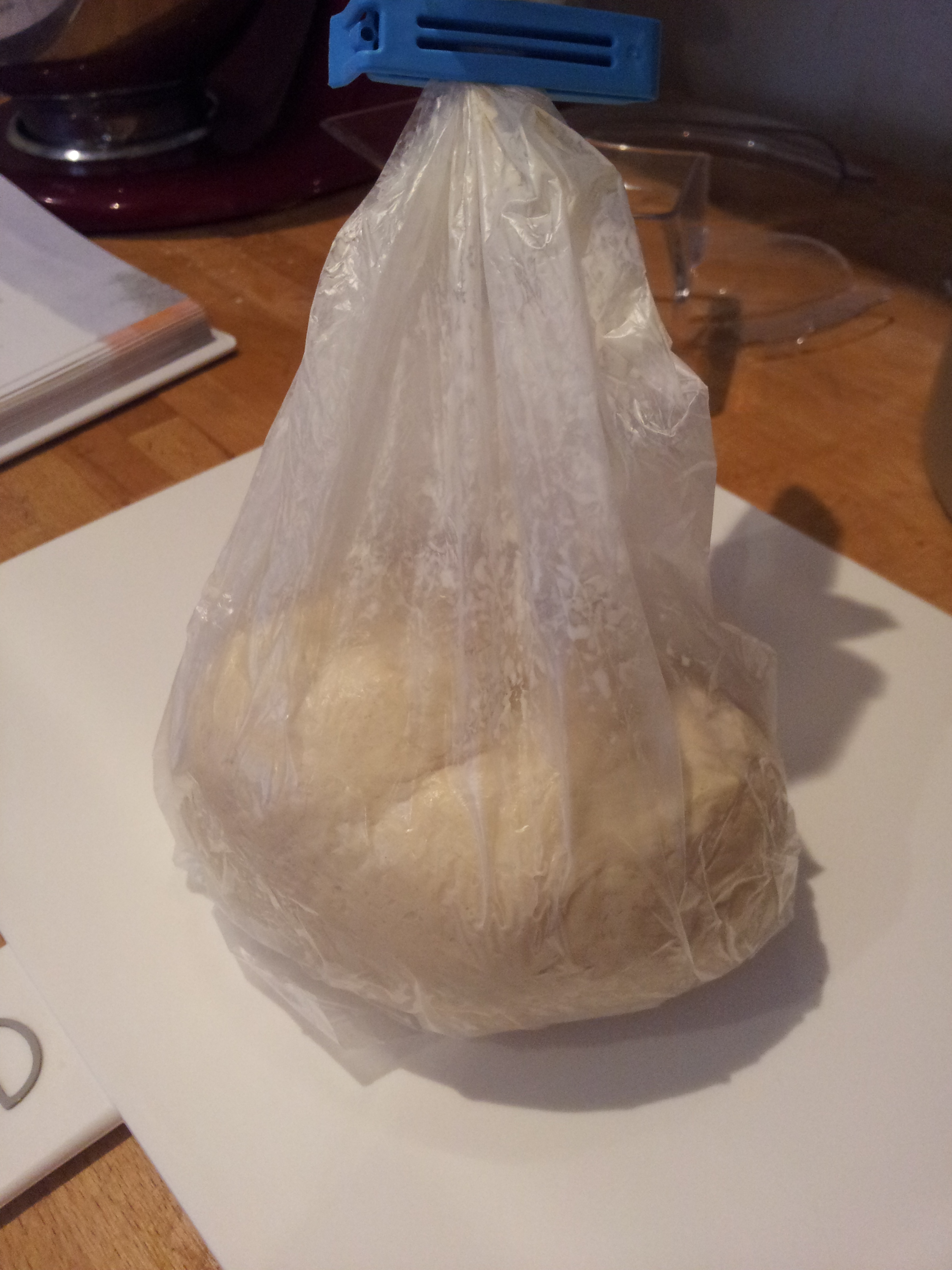
The dough can then be left to prove in a warm place in a greased plastic bag, for about an hour or two.

The proven preztzel dough

The proven pretzel dough

When the dough has doubled in size it’s ready to shape. This is probably the most complicated and time consuming bit of the entire pretzel making process. But it’s not as difficult as it may seem! I shall demonstrate in 10 easy steps…

Stage 1. Roll your dough to a sausage shape and cut into 12 equal pieces

Stage 1. Roll your dough to a sausage shape and cut into 12 equal pieces

Stage 1: Roll your dough to a sausage shape and cut into 12 equal pieces

Stage 2. Roll your 12 pieces into balls (check that they're all roughly the same size)

Stage 2. Roll your 12 pieces into balls (check that they’re all roughly the same size)

Stage 2: Roll your 12 pieces into balls (check that they’re all roughly the same size). Redistribute the dough to make sure you have equal sized dough balls here if needed.

Stage 3. Take one dough ball and leave the others covered with cling film in a greased bowl to stop them drying out. Roll your dough into the longest thinnest sausage you can make

Stage 3. Roll one dough ball into the longest thinnest sausage you can make

Stage 3: Take one dough ball at a time leaving the others covered with cling film in a greased bowl to stop them drying out. Roll your dough into the longest thinnest sausage you can make. Give the dough a good slap if you spot any air bubbles along the way. You need to pop any air bubbles to get a good even bake and to maintain your lovely pretzel shape.

Stage 4. Start shaping you sausage. Curl the dough into a circle but don't close the ends.

Stage 4. Start shaping you sausage. Curl the dough into a semi circle but don’t close the ends.

Stage 4: Start shaping your sausage. Curl the dough into a semi circle but don’t close the ends. You need those loose ends to finish your pretzel shape.

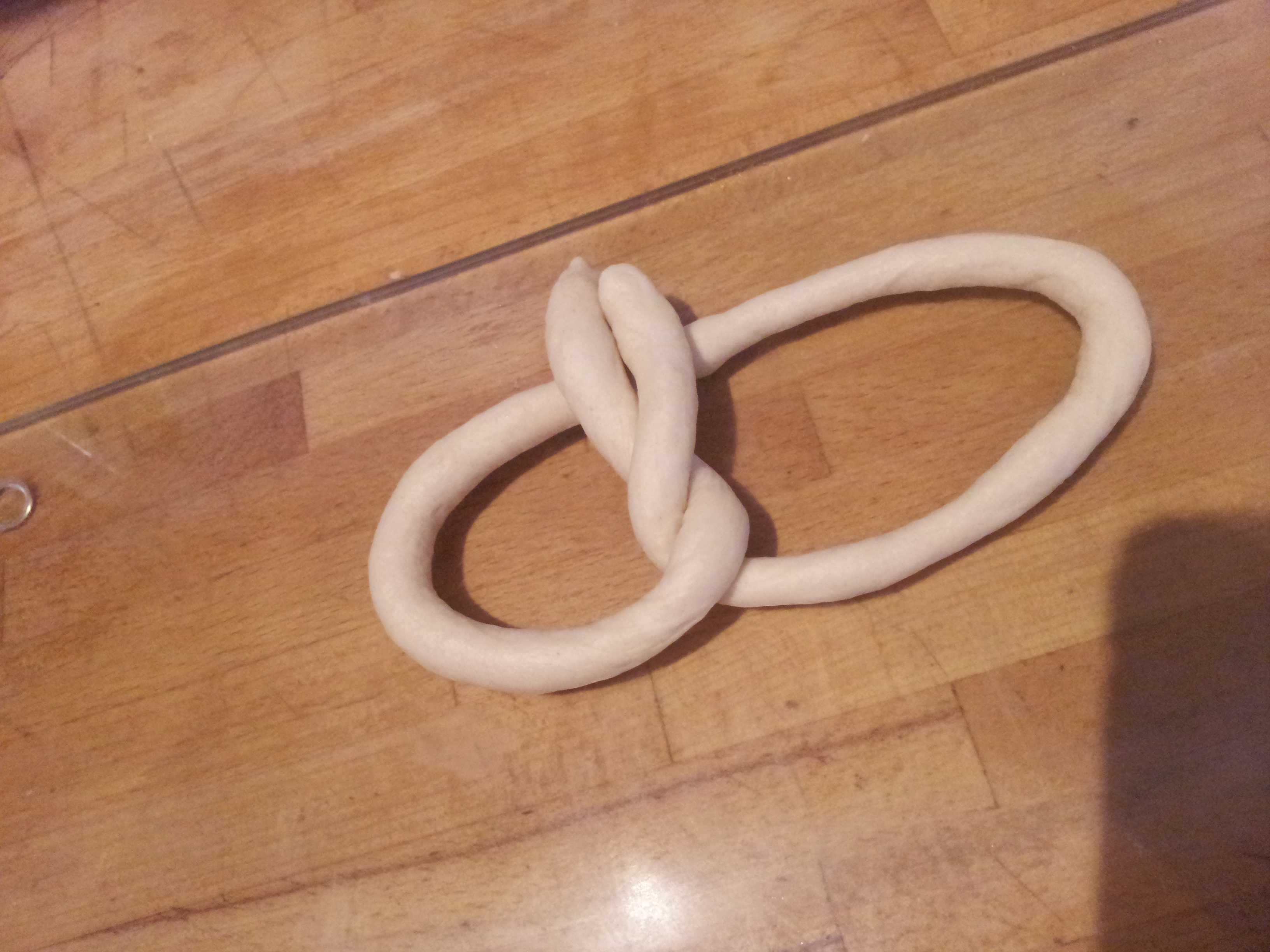
Stage 5. Bring the loose ends of the dough together and twist them up the centre of the circle

Stage 5. Bring the loose ends of the dough together and twist them up the centre of the circle

Stage 5: Take the loose ends of the dough and twist the strands together, one under the other up the centre of the pretzel circle.

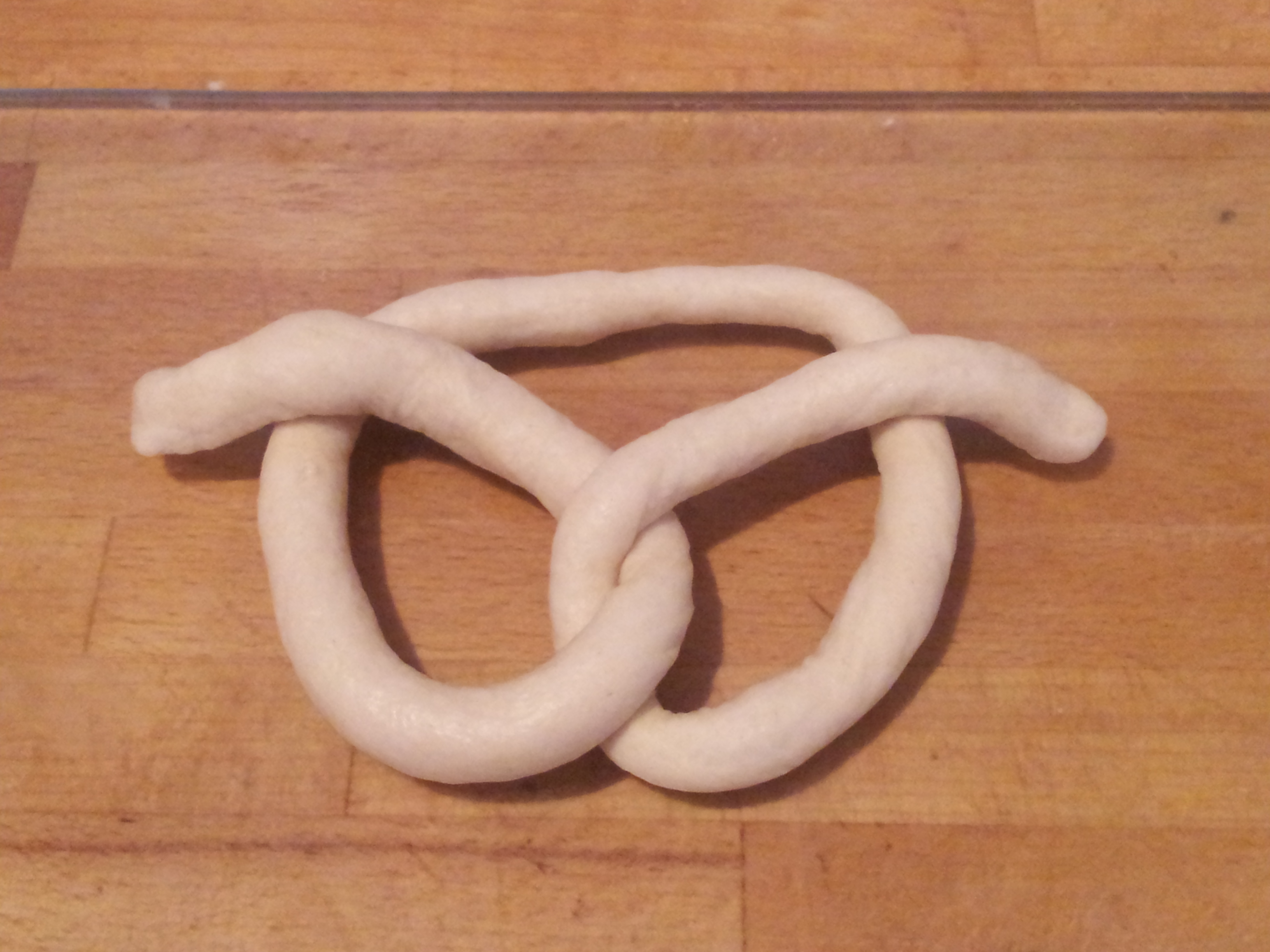
Stage 6. Bring the loose ends two thirds of the way up the sides of the pretzel like arms

Stage 6. Bring the loose ends two thirds of the way up the sides of the pretzel like arms

Stage 6: Bring the loose ends two thirds of the way up the sides of the pretzel like arms. Reshape the circle of the pretzel as you go to keep the even shape.

Stage 7: Gently press the 'arms' of the pretzel into the dough to fix it in place.

Stage 7: Gently press the ‘arms’ of the pretzel into the dough to fix it in place.

Stage 7: Gently wrap the ‘arms’ of the pretzel around the pretzel. Gently press the arms into the dough to fix them in place.

Stage 8. Carefully line up your pretzels on a greased and lined baking tray

Stage 8. Carefully line up your pretzels on a greased and lined baking tray

Stage 8: Carefully line up your pretzels on a greased and lined baking tray. Cover them with greased cling film and leave them to prove again for another hour.

Stage 9: Give each pretzel a good coat of egg wash and water and sprinkle with rock salt before baking

Stage 9: Give each pretzel a good coat of egg wash and water and sprinkle with rock salt before baking

Stage 9: Give each pretzel a good coat of egg wash and water and sprinkle with rock salt before baking. In hindsight I went a bit mad with the rock salt. It kind of burns the tongue when you put that much on! I might in the future smash up the rock salt with a pestle and mortar to get smaller chunks and sprinkle a much smaller amount on!

The baked pretzels

The baked pretzels

Stage 10: Give the pretzels a good baking in the oven for 15 -20 minutes at 200 degrees C. These are snack sized rather than the extra large pretzels that I was eating in Berlin, which could probably constitute a main meal. So if you wanted to make yours larger you could divide your dough into 6 lumps rather than 12 and shape them to your hearts content.

The golden pretzel

The golden pretzel

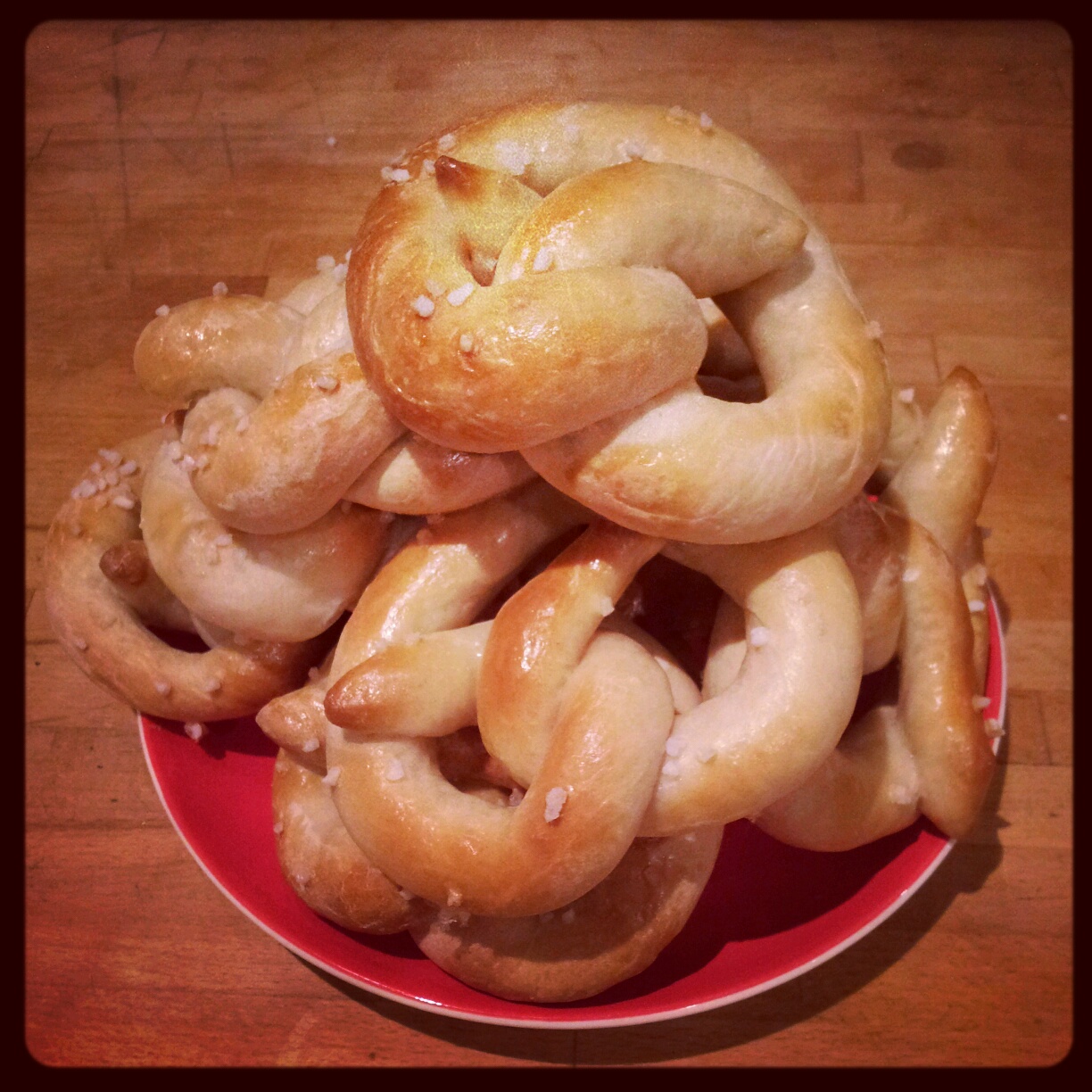
After a quick bake in the oven these mini pretzels beauties are ready to be devoured! The most complicated bit of the entire process is the shaping and after a couple of goes you soon get used to the technique. I’m sure you will end up developing your own pretzel twisting style too. I adore these pretty bread shapes and will most definitely be making them again. They look impressive, so you can wow your friends with your technical know how and let them imagine you’ve spent countless hours in the kitchen preparing treats for them.

Piles of Pretzels

Piles of Pretzels

They also taste amazing with their glistening golden crust. White bread can sometimes be a bit plain, but as the pretzel is thin it takes on the depth of flavour from the egg yolk and salt. Combined with the chewy texture, they are like a plaited bit of bread heaven.  You could even make sweet pretzels if you prefer, with cinnamon and sugar coatings, or add sesame seeds or poppy seeds for a bit of variation. Then you can enjoy them for breakfast lunch and dinner! I may attempt some wholemeal pretzels too to inject some health into my bread products. I will also be attempting extra large pretzels with the distinctive slash as soon as possible! Things I used to create Mini Pretzels Pretzel Dough Recipe

  • 350g strong white flour
  • 1 tsp instant dried yeast
  • 1 tsp salt
  • 1/2 tsp sugar
  • 215ml of luke warmwater
  • 10ml olive oil

Egg Wash Topping

  • 1 egg yolk mixed with a tbsp of water
  • A sprinkling of rock salt to decorate
  • (Or you could dust them in cinnamon sugar, poppy seeds, or sesame seeds if you wish!)

Bake for 15-20mins until golden brown at 200 degrees C

45. Rosca De Reyes – Spanish Three Kings Cake

Rosca de Reyes - 3 Kings Cake

Rosca de Reyes – 3 Kings Cake

I’m so excited! I’ve been invited to join an online bake off with 4 amazing bloggers, including the wonderful Yasmin Lambert from the Great  British Bake Off! We’re all baking the Spanish festive bake, Rosca de reyes and the baker with the most votes will win £500 worth of holiday holiday vouchers! (which would come in very handy for our honeymoon which are still yet to arrange following our wedding in less than 3 weeks…) I’m so happy to also be able to offer you the chance to win  £50 of vouchers to spend on the very.co.uk Christmas Shop, perfect for finding those last minute Christmas gifts! My first ever competition on aroundtheworldin80bakes! 

If you would like to enter this competition all you need to do is vote for my Rosca de Reyes (aroundtheworldin80bakes) on the Cosmos Holidays website by leaving a comment at the bottom of the article and a 5 star rating. This would be very gratefully appreciated! You can see the full Rosca de Reyes in all it’s glory over on the Cosmos holiday website. The closing date is Wednesday 19th December. Then please let me know that you have voted by leaving me a comment on (any or all!)

This means I can then contact you if you are the lucky winner. I will choose one winner at random from all of those who vote for me. You could tweet something like “I’ve voted for @laurenprince #roscadereyes  to win£50very.co.uk vouchers http://aroundtheworldin80bakes.com #bakeoff #competition Vote to enter”

Now for the bake itself! I hope you like it!

Rosca de reyes  (Kings’ Cake) is a traditional Spanish  cake with an amazing story. It’s eaten on 6th January, the day that the 3 Kings (or wise men) reached the stable to visit Jesus.  This is also known as the religious holiday the Epiphany, a day where Christians celebrate the Son of God taking on human form as baby Jesus. In some countries this is the day that children open their presents rather than Christmas Day so this day definitely needs a special cake to celebrate!  A little figurine or a bean is usually hidden inside the cake to represent baby Jesus fleeing from King Herod who was trying to kill Jesus. Whoever finds the baby bean/figurine is blessed  as ‘King’ or ‘Queen’ of the banquet and should take the figurine to church with them on February 2nd. In Mexican cultures this person also has to throw the Epiphany banquet party for their families and friends the following year!

I’ve never eaten a Rosca de reyes despite all of our family holidays in Spain as a child. We always visited Spain in the Summer holidays where we contented ourselves eating ice cream and custard filled donuts whilst basking in the sun on the beaches instead. Some of our best family holidays were in Spain, so this recipe intrigued me. I’ve never attempted to hide things inside my cakes before and was unable to find a figurine in my house small enough, or that wouldn’t poison us all so I decided to make one out of sugar paste instead and hope that it doesn’t melt in the oven!

My marzipan interpretation of the baby Jesus...

My marzipan interpretation of the baby Jesus…

Looking for a suitable recipe I discovered there are quite a few variables. The Rosca de reyes is usually a ring shape or it could also be an oval (depending on how many people you’re baking for!). The festive dried fruits usually include wonderful reds, greens and oranges so you could use cherries, apricots, figs, cranberries, or mixed candied peel. The choices are endless.

This is essentially an enriched dough, shaped into a bejewelled festive wreath. It’s a bit of a cake/bread/pastry hybrid and stuffed with beautiful dried fruits.

Whizz up the flour and yeast

Whizz up the flour and yeast

If you’re using instant dried yeast you can throw it straight into your flour and mix it evenly through the flour. Using my Russian Doll measuring cups makes life a bit easier than weighing things out on the scales.

As it’s almost Christmas (we’re celebrating on 15th December this year as our wedding is just around the corner…) I wanted to make light work of this recipe. I struggle to knead dough for a long time, I’m simply not tall enough to put enough weight into it! So I whacked it all into my food processor to ease the process. If you don’t have a food processor you can mix it together by hand instead.

Grind up a star anise

Grind up a star anise

I whizzed the yeast and the flour together first to make sure the yeast is evenly distributed throughout the flour. Then while the food processor was running I added the dry ingredients first, the sugar, salt, cinnamon and ground star anise.  The spices really enhance the colour of the dough giving it a wonderful brown hue.

Rub in the butter

Rub in the butter

Once this is combined I popped the butter in and rubbed/blended it into the flour.

Rub in the butter until it looks sandy

Rub in the butter until it looks sandy

Followed quickly by the  beaten eggs, vanilla pod seeds and water. In the future I probably wouldn’t add any water as this made an extremely wet and sticky dough which meant my food processor went into over drive and actually caught fire! The poor food processor didn’t make it but the dough was thoroughly kneaded!


Beat in the eggs

Beat in the eggs


The food processor may screech a bit in protest but it can (usually!) knead the dough (using the dough hook) for a good 3 minutes before it starts to rock out of control and dance off the work top.

I had to add a little more flour in order to knead the dough by hand as it was more of a paste at this stage.

It was rather a sticky dough...


Once it becomes a firm dough it’s ready for a final knead on the work surface for 5 minutes or so until it bounces back when pressed lightly with a finger.

I had to bring out the cavalry to sort out this sticky mess - dough scraper!


Then to rest the dough for 2 hours in a greased and covered bowl in a warm place until it’s doubled in size. Or if like me you like to do things in stages feel free to let it rise slowly over night in the fridge and shape it at your leisure the next day.

A nice firm brown dough


When the dough has risen, punch it down and knead it thoroughly before starting to shape it into a ring or wreath. This really reminds me of my Swedish Tea Ring attempt. Roll it into a rectangle  about 30cm by 20cm. I oiled the board to stop the dough from sticking rather than dusting it with flour.

Roll it out to an even rectangle about 5mm thick

Roll it out to an even rectangle about 5mm thick

Spread the melted butter all over and give a generous coating to the outside edge of the dough.

Spread a generous coating of melted butter all over


I found I had an extra bit of dough which I trimmed off to make my rectangle extra straight. I used this to make another plaited version of Rosca De Reyes later on.

My second plaited Rosca de Reyes


Line the dough with an even covering of candied fruits, cinnamon and sugar.

Coat with sugar and spice and all things nice


Take your figurine/bean (or in my case a hand crafted marzipan baby Jesus) and hide him amongst the fruit.

Hide your figurine inside the fruit


Then roll it up into one long sausage, from the longest edge to the longest edge.

Roll roll roll your dough


Once you have you sausage shape you can add a smattering of melted butter to one end and coax the 2 edges together to form a ring. Feel free to pop a small greased pudding dish in the centre of the ring to ensure the ring has a hole in the middle as the dough rises.

The final sausage shape


A final egg wash and decoration with your chosen candied fruits, I used glace cherries and mixed peel, and it’s ready for the final proving.

Using lazy egg wash in a can (!) and dotting with cherries


Cover your ring with greased cling film to prevent it sticking and leave it for an hour to double in size on a baking tray greased and lined with greaseproof paper.

Bejewelled and ready to prove itself


After 40 minutes in the oven at 170 degrees C the Rosca De Reyes will have taken on a golden tinge and be firm to the touch. You can check it’s cooked through by tapping the bottom, of the ring, it should sound hollow.

Straight from the oven


Once it’s cooled completely I carried on decorating my Three Kings Cake. I’ve been saving my gold lustre spray for a special occasion and this seemed to be the perfect time to use it! I thought the gold would add a regal touch to the ring and additional symbolism as one of the 3 Kings brought gold as a present for baby Jesus. So I’m presenting a very gold Rosca de Reyes to you!

Then it seemed a bit too gold… so I added a sprinkling of marzipan stars with a dab of brandy on the back of each star to hold it in place. The original plan was to add just the one star, as the 3 Kings followed the star to Bethlehem to find baby Jesus in the stable, however I got a bit carried away with my cutters and made an entire starry night of marzipan instead. Resulting in a very decadent Rosca De Reyes!

A very decadent Rosca de Reyes - 3 King's Cake


With my left over dough I created a plaited Rosca De Reyes and smeared cinnamon, butter and sugar in between the plaits and dotted a few more glace cherries on the top. I hid one whole cherry underneath and tucked it into the dough.

A golden plaited Rosca de Reyes


Once it was baked I also gave it a liberal coating of edible gold lustre.

This bake feels so festive and is a wonderful cake to share with friends and family. It’s a bit like hiding a silver sixpence inside your Christmas pudding, waiting in anticipation to see who finds the baby Jesus inside their piece of bread. I loved this bake and think it may become a regular festive creation in my house. The egg wash gives the outside a fantastic bite to it. I love warming spices and this definitely packs a punch, with the cinnamon and star anise spices in the dough, carried through to the spicy sugary fruit inside. It is also rather reminiscent of a sticky Chelsea bun but even more festive and sparkly!

Cinnamon swirls - a slice of Rosca de Reyes


Marzipan is not traditionally found inside Rosca de reyes, but I adore it and try to fit it into everything that I possibly can. The addition of marzipan made the rosca de reyes slightly stollen-esque and what’s not to love about stollen? (It’s another of my favourite festive bakes – as if I don’t have enough already?!)  I try not to waste any ingredients  and wanted to put my left over marzipan to good use from icing my Wedding and Christmas cakes. You can adapt this recipe to suit your own favourite ingredients and play around with the shape too. Have fun and hope you enjoy it as much as me!


Things I used to make Rosca De Reyes:

Bake for approximately 45 minutes at 350 degrees F or 170 degrees C

  • 1/3 cup warm water (only add as much as you need)
  • 1 packet of yeast (7g dried instant yeast)
  • 4 cups flour
  • 1 cup sugar
  • 4 large eggs, beaten
  • 3/4 cup butter, room temperature
  • 1/4 teaspoon salt
  • 1 1/2 teaspoons cinnamon
  • 1/2 teaspoon ground star anise
  • 4 teaspoons vanilla extract

Filling

  • 2 tablespoons unsalted butter, melted
  • 1/2 cup sugar
  • 2 teaspoon cinnamon/mixed spice
  • A marzipan baby Jesus (or you can use a small figurine or toy or a bean)
  • Dried/candied fruit (about 2 cups of assorted fruit cut into small pieces  such as sultanas, orange/lemon peel, mango or cherries)

Decoration

  • Large dried fruits (so they don’t burn in the oven) such as glace cherries
  • Beaten egg (to wash over the whole ring)
  • Edible gold lustre spray (or glitter) if you wish!
  • Marzipan and star cutters

39. Bagels Bagels Bagels! Polish Bakery

Bagels! Bagels! Bagels!

Bagels have been on my to bake list FOREVER! Inspired by a recent episode of The Great British Bake Off (new series and I’m guessing everyone else is totally addicted to it like me too?) I uncovered my wonderful (signed) copy of  Thoughtful Bread  ‘Bread Revolution’ for a recipe I could begin late one night. (I’ve even tweeted @thoughtfulbread to let them know I was baking from their book and got some lovely late night baking encouragement.)

We were treated to a short history lesson on bagels by the Great British Bake Off. Although they are more recently considered to be an American bread, they were originally brought from Poland to England and then on to America. They are typically Jewish Food with a wonderfully chewy crust from the poaching of the dough before the bake. (My favourite bit!)

Mixing up all the flour, salt, honey and yeast

A spot of late night preparation was in order to get this dough on the road. I mixed together the flour, dried yeast and a little salt to0. I ran out of strong white flour so made up the difference with brown strong flour, so these bagels were almost healthy too.

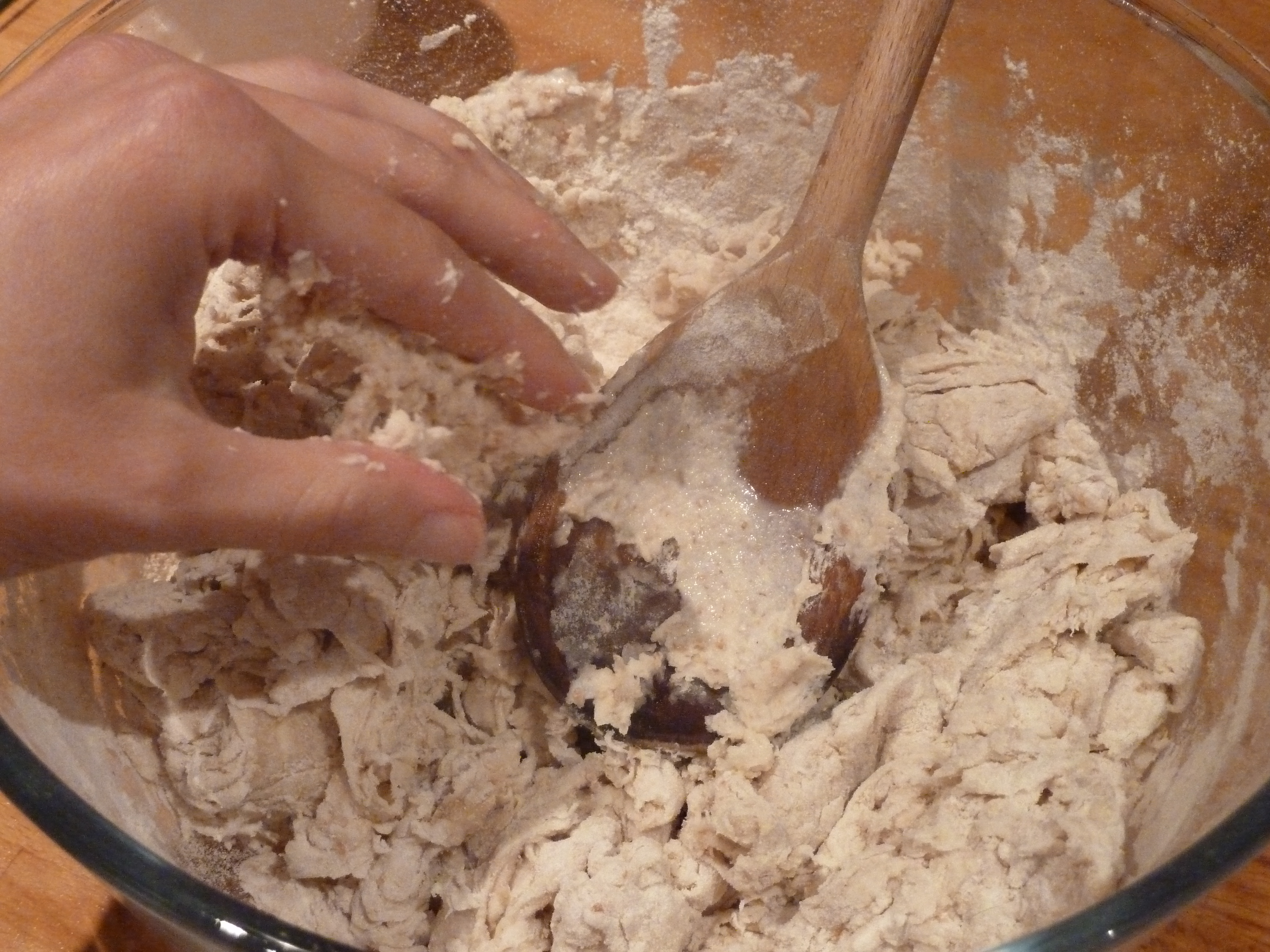
Add the water to get a sticky dough and stir!

Then to add the water. I had to add a little more water as I worked with the dough, probably due to the slightly drier brown flour I used.

Ready for some good kneading

When I started kneading the dough I was determined to reach the elusive ‘window pane’ stage where the gluten in the flour has become all stringy and elastic  and stretches out when pulled to create a transparent window when held up to the light in the dough. Alas after the allotted 10 minutes of kneading the rather tough dough by hand I was still windowless. A further 10 minutes of kneading (tracked by my faithful hamburger timer) and I was STILL windowless… I asked Chris to have a go with his brute strength and STILL no window. So I gave up comforted slightly that the dough had been kneaded at least twice as long as it was supposed to be and it did bounce back when prodded with my finger.

Me kneading on tip toes

I think I need lower work surfaces for bread making as I always have to resort to balancing on my tip toes to get the full impact of the kneading…

proving time

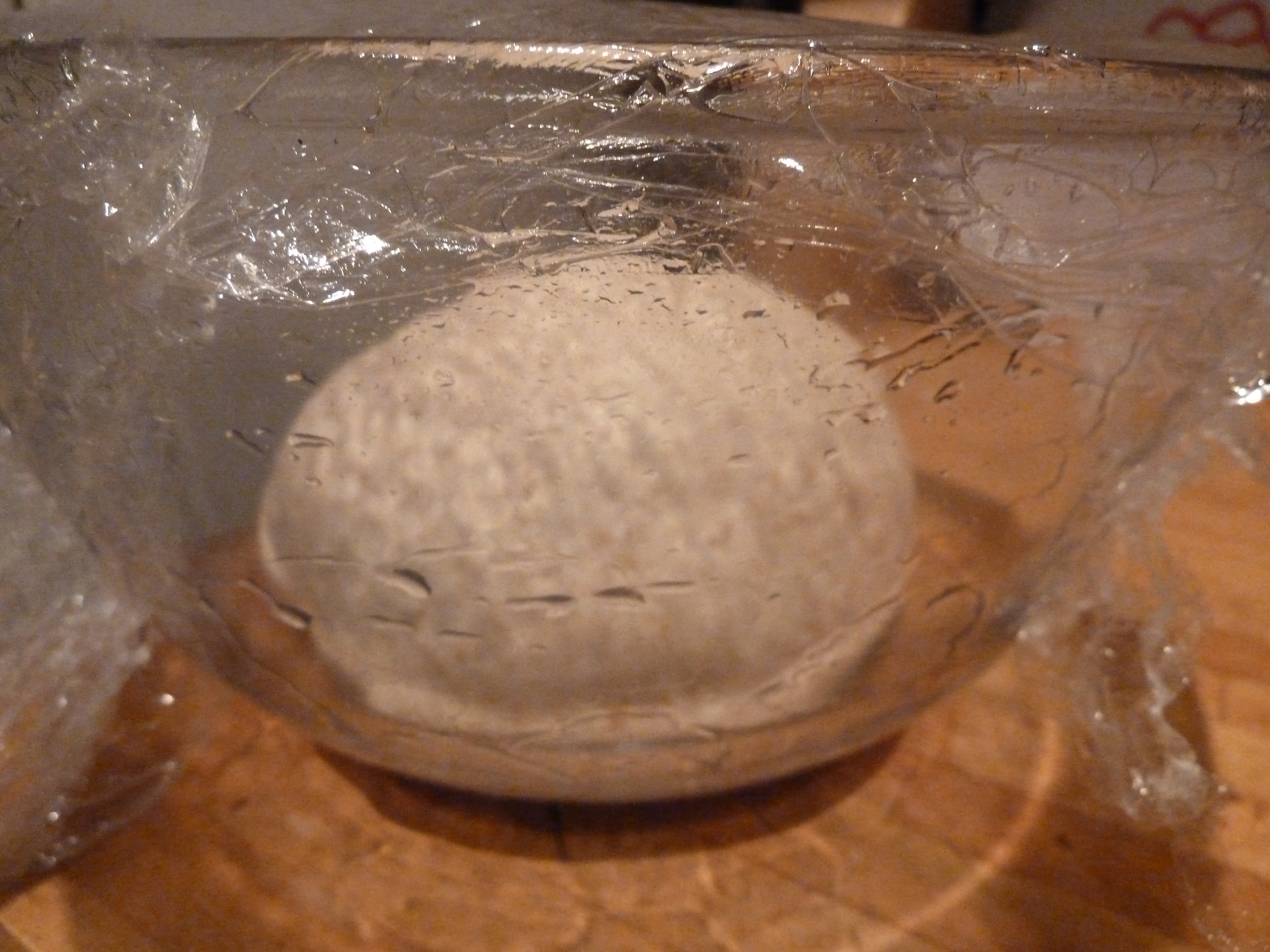
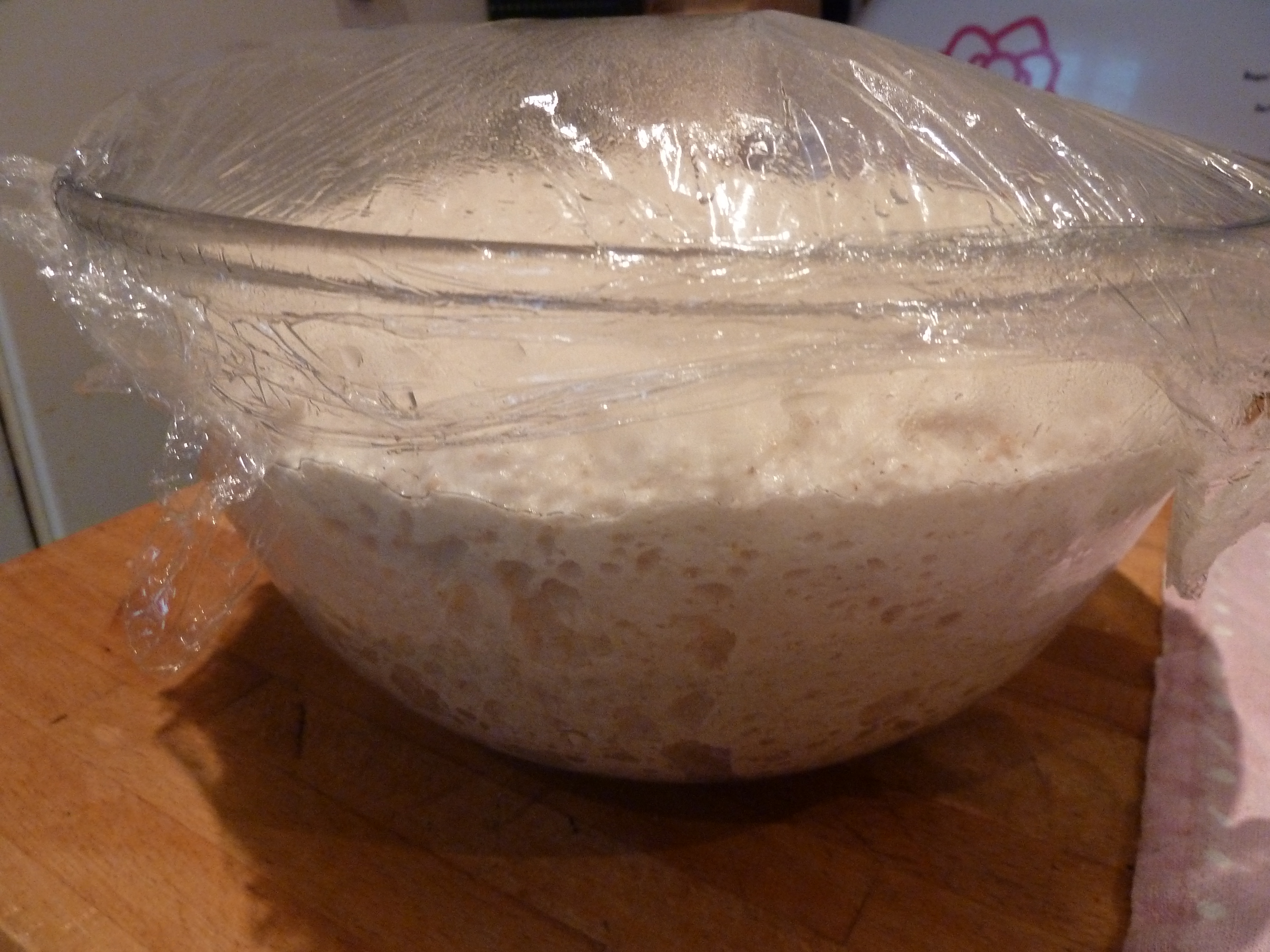
I left the ball of dough to prove and double in size over night in a greased bowl covered with greased cling film. Et voila! The next morning I awoke to beautifully risen dough.

Beautifully risen dough

Punching it back I kneaded it thoroughly again (it’s a good job I do yoga press ups!) dividing the dough into 12 (equal-ish) portions I left it to rest for 5 minutes whilst I arranged the next stage. Water bath!

12 chunks of dough

Taking my largest soup pan I filled it about half way with water from the kettle.

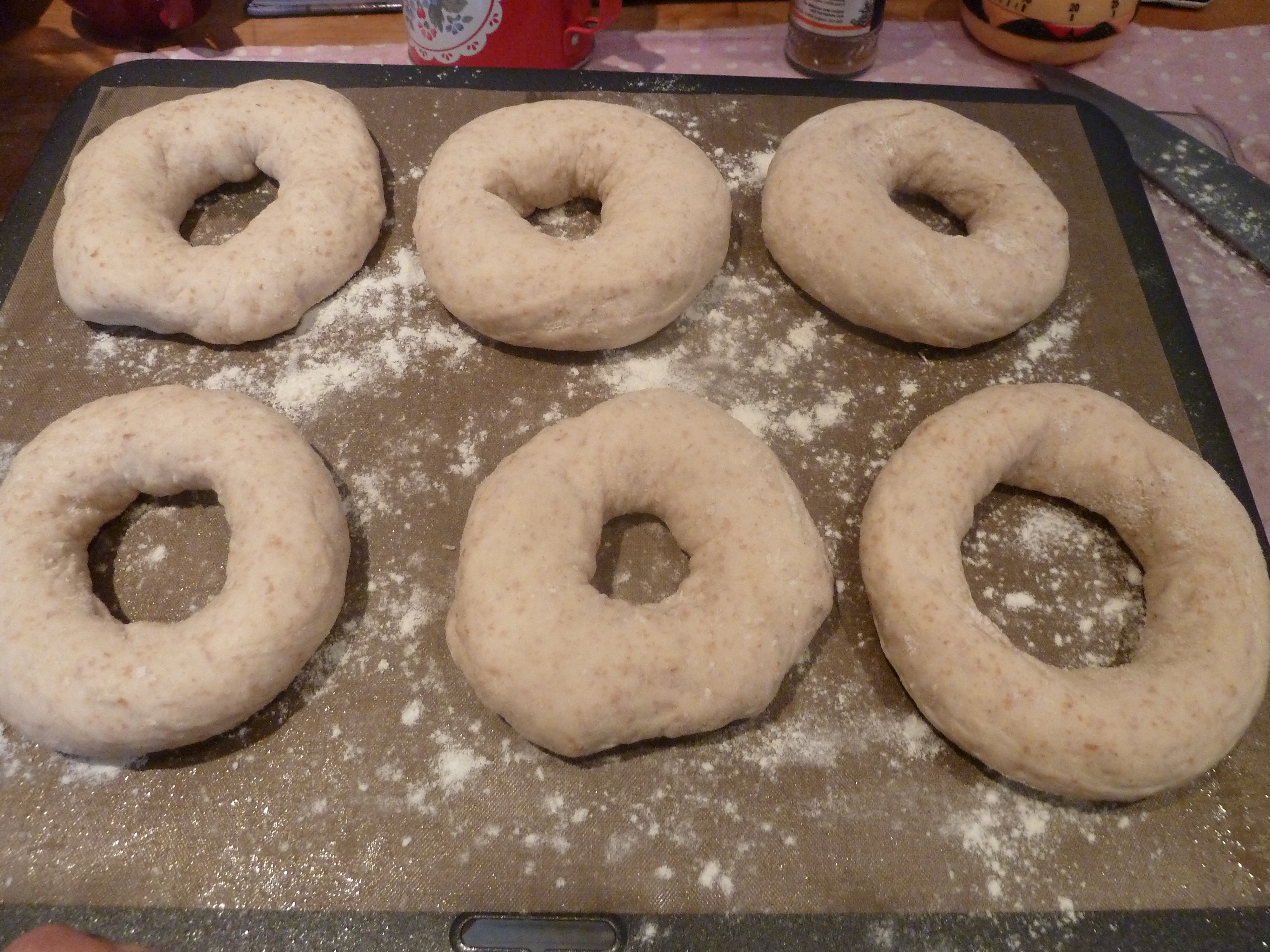
Stage 1: The dough sausage

Then to shape the bagels. I tried a few different methods to see which worked best and I think I prefer the traditional method. Roll a long sausage about 20 cms long) of dough and shape it into a circle.

Stage 2: shape into a circle

Fold the loose ends together and squash them together.

Stage 3: Fold the loose ends together

Then put your hand through the ‘hole’ in the centre and roll the join together until the two ends are firmly merged. Then if required roll the rest of the dough ring in the same way to even up the dough and shape it into a bagel.

Stage 4: Squash the loose ends together

The other method is more modern and maybe slightly quicker. Where you shape the dough into a ball, flatten it, poke your thumb through the centre and then whilst holding the dough in your palm squeeze around the dough to widen the hole and shape the dough into a bagel.

I used for each bagel? Poor dough ring on the right is a bit more of a bagel bracelet

Once shaped the bagels need to prove for about 30 minutes under a damp tea towel or greased cling film at which point you can start to warm up the oven and water so it’s simmering nicely.

If you want to add flavouring to your bagels you can add toppings like sesame or poppy seeds after the poaching stage, but if you like your bagels fruity on the inside (like me) then you will have to add your chosen flavour before you shape the bagels. I chose to make half savoury and half sweet.

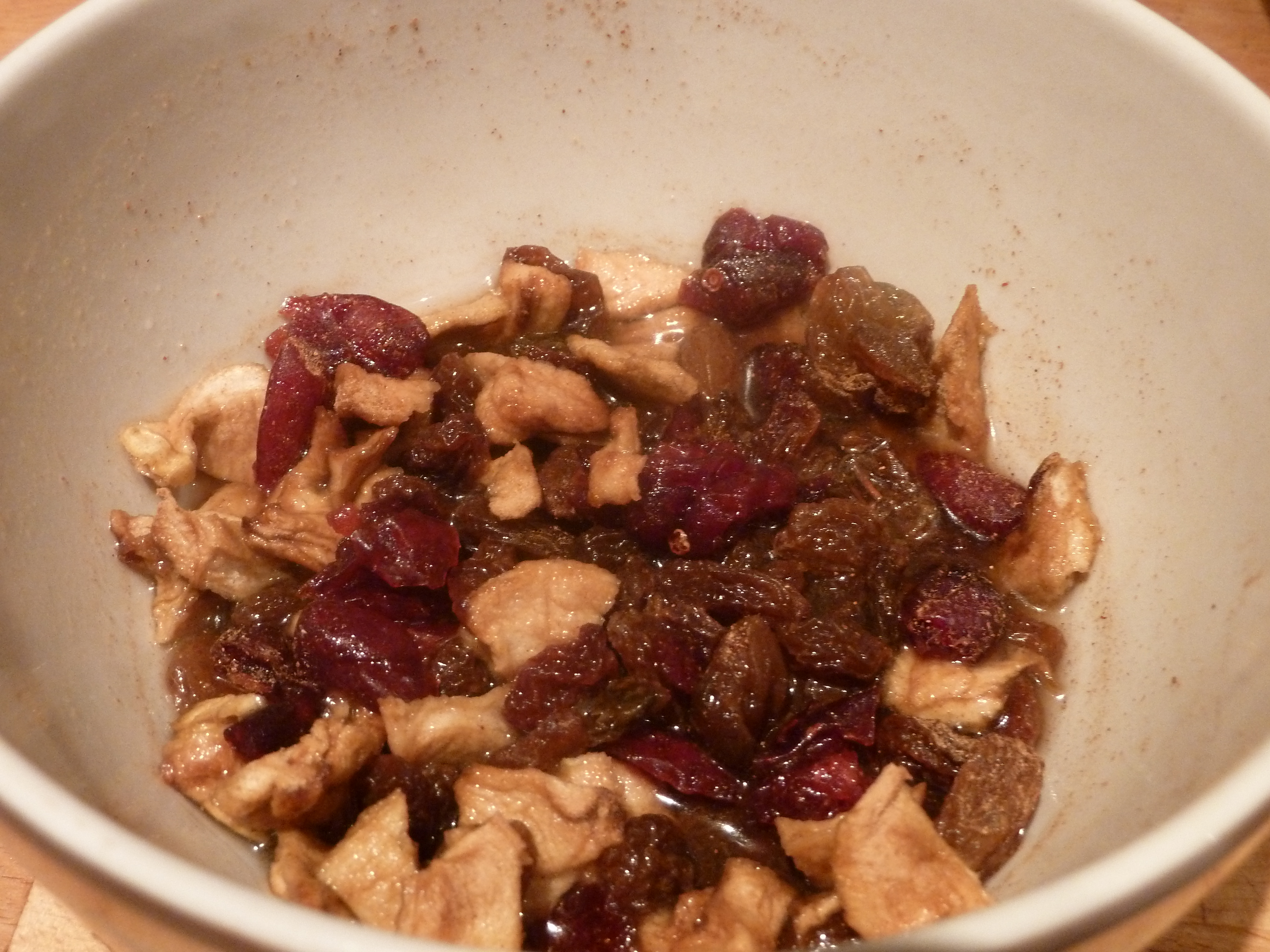
pre soaked dried fruit, apple, cranberries and raisins

I pre soaked some dried fruit, raisins, apple and cranberries overnight in a little boiling water with a dash of cinnamon. Drained off the excess water and folded in a teaspoon (or 2) of the fruit along with an extra sprinkle of cinnamon into the dough before shaping it.

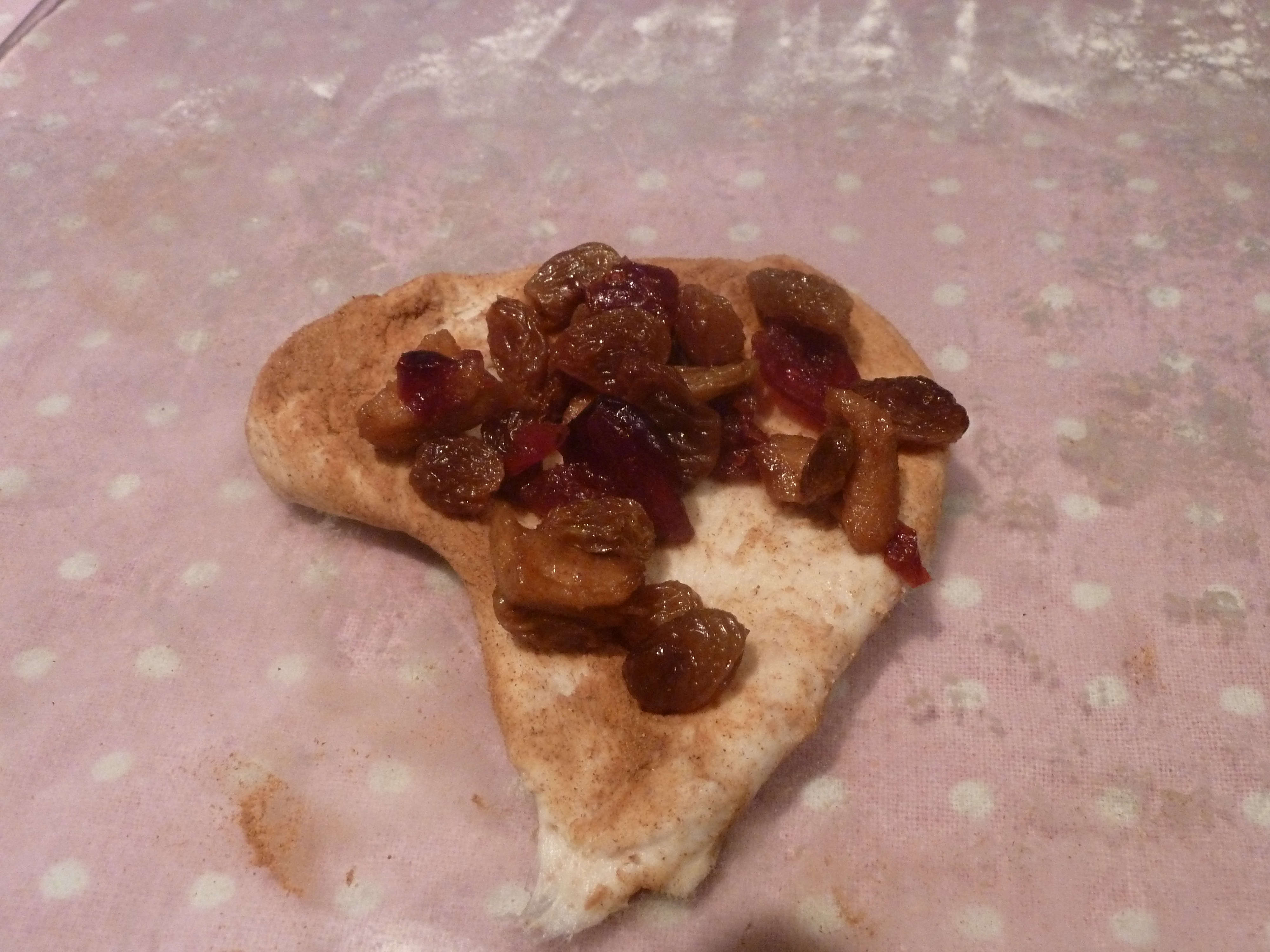
Step 1: Filling the bagel

It makes the bagel a bit unpredictable with spots of fruit poking out all over the place but I found if I sealed the fruit into the dough and then shaped it, it was a little easier.

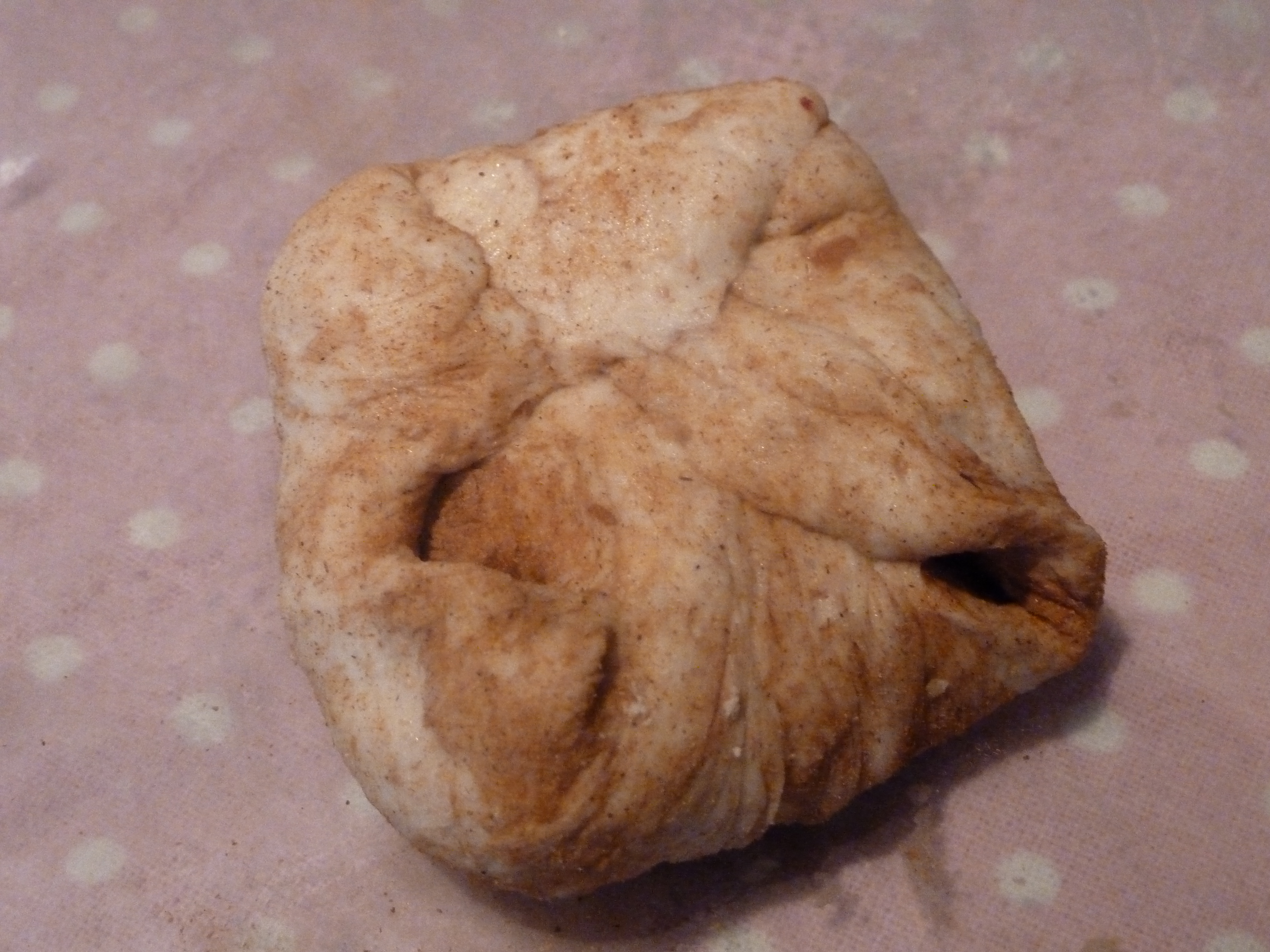
Step 2: folding in the edges to make a fruit pouch. Sealing the edges together

Step 3: roll into a dough sausage and follow the stages above to shape the bagel

Then all you have to do is plonk the bagels into your pan of simmering water for 2 minutes (turning them over half way through for an even poach).

Bagels in for a swim

The bagels do expand slightly so don’t over fill your pan, do them in batches so they have room to breathe.

Ever increasing circles

Then out of the pan an into the oven! I used my Nana’s slotted spoon to scoop the bagels out and drain off the water. Then gently pop then onto a lined baking tray (sprinkle on your choice of topping while the bagel is wet) and into the oven they go.

Ready for the oven

This means you can have a continuous run of bagel poaching and baking until all of your bagels are baked. However this meant I was waiting for my breakfast for almost 2 hours. I ended up devouring 2 hot bagels and butter straight from the oven and they did not disappoint! Hot and buttery they were just what I needed.

Fruity Bagels in for a swim

They are definitely easier to split down the middle when they’ve cooled a bit though. The plain bagels were easier to eat and even better toasted too to give an even crisp coating and chewy soft centre. I LOVED this bake. You know you’re making something special when it takes a bit more effort and skill.

Bagels! Hot from the oven

The fruity bagels were a little more moist in the middle, but this is what I had expected. You can’t put fruit into a bagel without adding a bit of moisture.

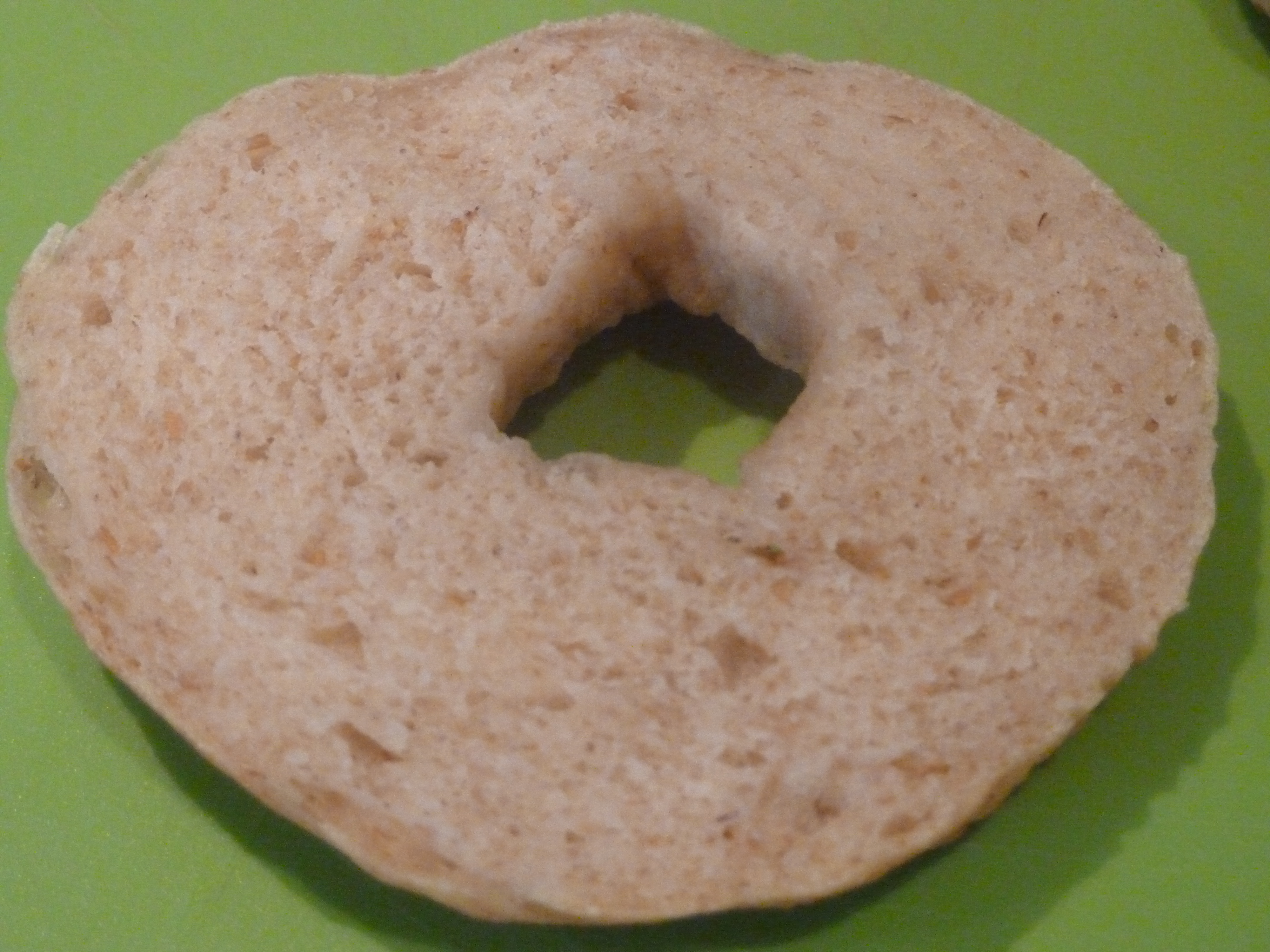
bagel splitting

Perhaps in the future when I think they’re baked I might also turn them over and return them to the oven for a few more minutes just to ensure the bagels are baked evenly. As I did find that the bagels were quite wet when they went in the oven so they were slightly soggy when they came out of the oven, but a lot of this moisture dried as they cooled (and I guess adds to their chewiness.)

Bagel goodness

I would also add more cinnamon to the bagels as they weren’t quite cinnamony enough for me. All in all a very good bake and I’m adding this to my baking repertoire now!

Bagel sandwiches

Things I used to make this recipe:

Lovingly adapted  from Bread Revolution by the Thoughtful Bread Company

  • 375g strong brown flour
  • 375g strong white flour
  • 3 tsp fine sea salt
  • 2 tsp dried yeast
  • 375ml warm water
  • 7 tsp honey
  • additional strong white flour for dusting the board

Fruit filling

  • A bowl full of dried fruit (cranberries, raisins, dried apple)
  • cinnamon

Optional Toppings

  • I used sesame seeds and just sprinkled enough to coat the bagels on each one
  • You could use anything such as poppy seeds, sunflower seeds,

Cath Kidston Flour Sifter – so handy when you’re covered in sticky dough

The Hamburger Timer – so handy for timing all those batches of bagels

27. Paul Hollywood’s Peshwari Naan Bread – India

Paul Hollywood’s Naan Bread

Rolling on to India and bake number 26! (All this baking is taking its toll! I’m now increading my exercise to 15 miles of walking a week, Ashtanga yoga and the occasional spin class/torture session.) But I love food and I love naan bread, particularly Peshwari Naan but then again who doesn’t love a good Naan? And not just any Naan bread but Paul Hollywood’s, the King of bread bakers, Naan bread?

Looking for the perfect accompaniment to my home made dahl and pilau rice I stumbled across the Paul Hollywood recipe I’ve been saving for a special occasion. Any excuse to whip out my trusty food processor too! I combined the flour, yeast, salt and oil and mixed it all up using the dough hook attachment, adding water until it became a good sticky dough.

The food processor alone was not enough to knead the dough properly and the food processor was about to leap off the worksurface with the sheer effort of spinning the dough. I had to admit defeat and resort to my own hands.

Shiny Happy People – Kneady Stuff

I kneaded the dough for about 10 minutes on an oiled surface, to stop it sticking, which is so much easier than a floured surface. Until it was smooth and shiny and bounced back when pressed lightly. It’s times like these that I wish I was 2 inches taller so I didn’t have to knead the dough whilst teetering about on my tip toes to get the right force required!

Time to Prove

Whilst the dough proved under it’s oiled cling film covering I set to work on arranging my naan flavours. Paul Hollywood’s recipe called for caraway seeds and coriander. Unable to follow any recipe without substituting something or ad libbing somewhere, I decided to attempt a Peshwari Naan, guessing that I could throw some crushed garlic, spices (coriander, cumin and cardamom seeds), raisins and coconut into the mix and it would produce Peshwari Naan. Upon opening the cupboard I found dried fruit store severely depleted! My normal store cupboard staple, raisins, were nowhere to be found! (I forgot earlier in the week I bought an extra double amount to feed an entire litre of rum to for a very special future bake! All of my dried fruit is currently sitting patiently soaking up lashings of rum. All will be revealed soon!)

Naan Flavourings: Coconut, Garlic, Coriander, Cardamom Seeds and Cumin

Slightly disappointed I ploughed on with a combination of coconut, half a bulb of crushed garlic, dried coriander and cumin instead. Noting I must buy more dried fruit as soon as possible.

Risen to perfection

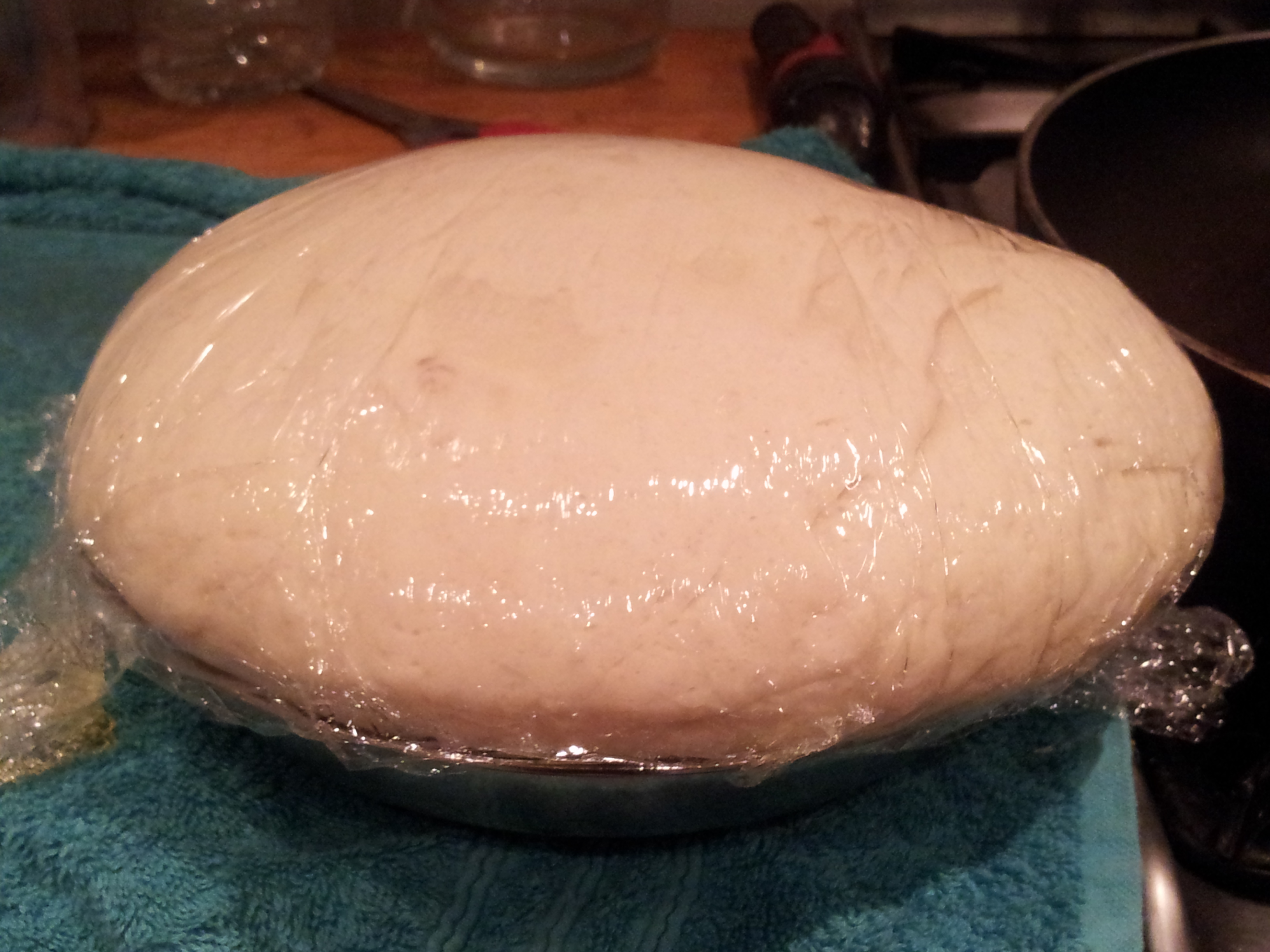
After about an hour of rising, (near the hot hob on the stove while I was cooking a chicken and vegetable dahl to encourage the dough to prove) the dough had doubled in size and was ready to be flavoured! I added the flavours a third at a time and kneaded them thoroughly through the dough.

Flavoured and divided

Once all the coconutty goodness was distributed evenly throughout the dough I rolled it into a fat sausage to chop it into quarters. Each quarter of dough should then be cut in half and flattened. Paul Hollywood is obviously a bit more of a perfectionist than me as he insists that a rolling pin is required to flatten the dough portions out. I can’t believe that people in India whip out a rolling pin at this point and so I decided to do all this flattening with my bare hands. Which did mean that my first attempt was more like a paperback novel than a fluffy, naan bread.

Stacks of semi flattened naan bread dough – must be flatter than this before hitting the pan!

I re-read the recipe and realised that the dough should be stretched into circles about 25cm in diameter, probably twice as big as my inital attempt! This explains the chunky naan brick that I produced.

Chunky Naan

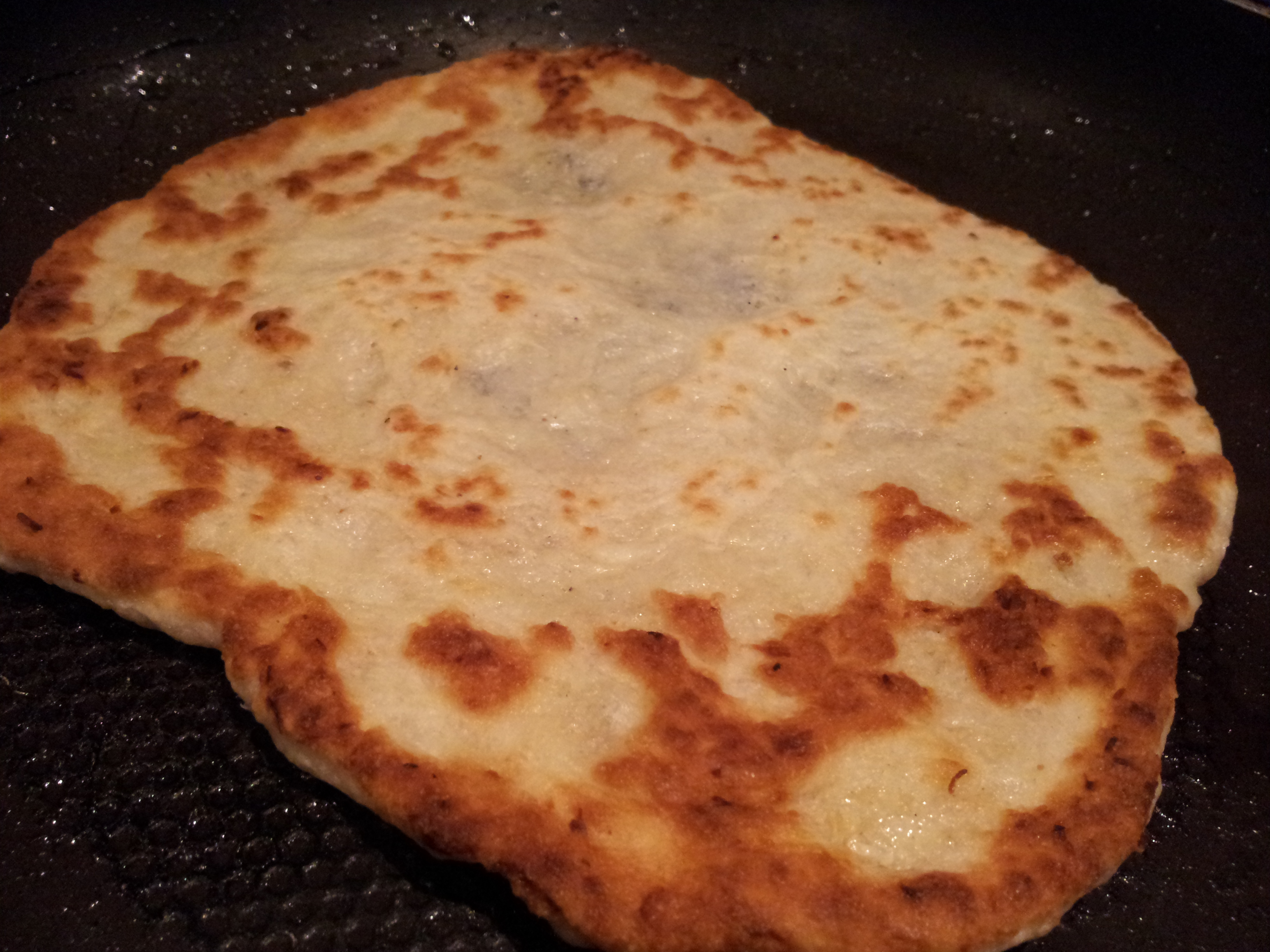
Once flattened the dough has to be rested again for 5 minutes before plopping them (individually) into a hot pan with a splash of oil. I quite enjoyed the sizzle of the naan in the oil as the naan immediately puffed up and bubbled away happily in the pan. Then a quick flip over to sizzle it on the other side too. I was worried the coconut would all fall off as I got a bit bored whilst frying up the naans and decided to press some more coconut and coriander into the awaiting naan breads. I’m not sure if Paul Hollywood would approve of my inconsistent making-it-up-as-I-go-along approach but hey they were looking golden and lovely in the pan, so why worry about presentation and consistency now?!

Naan -ish and Golden (look at those bubbly edges!)

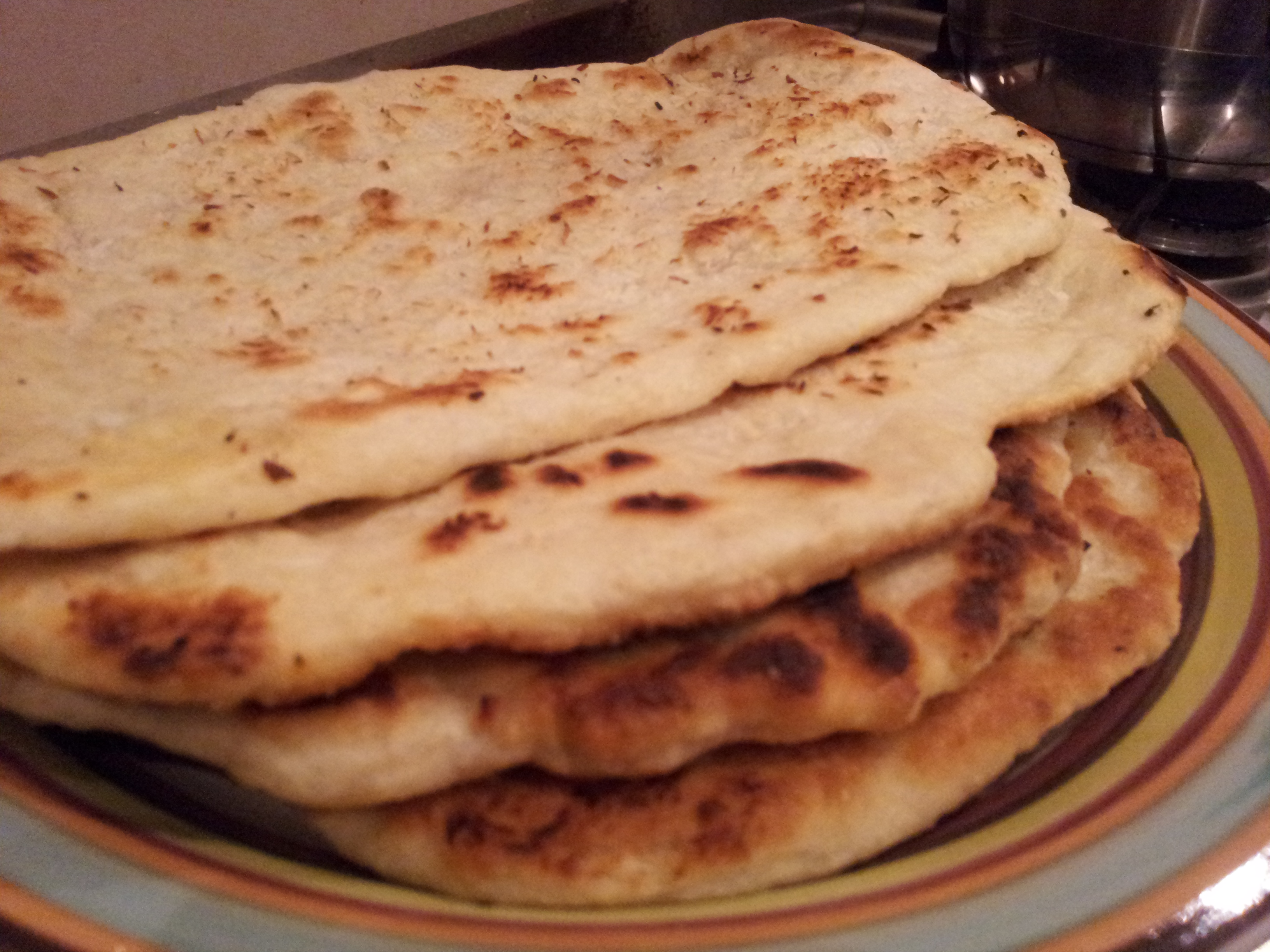
Once the naan is golden brown on both sides, it’s ready to hop out of the pan on onto a plate. I continued pan frying all 8 of the naans, piling them high on a plate ready to be devoured with daahl.

Stacks of Naan

Tea time! It smelt amazing, although a tad smokey in my kitchen as I definitely had the heat up too high on the pan. The windows had to be opened to get rid of the haze in order to see at one point. But other than my carelessness when it comes to fire safety, this recipe was a resounding success. I did slightly chargrill (burnt) one naan and created a naan brick, but I still had 6 more naans to get the technique right with. When I eventually got it right, I really got it right!

Chargrilled Naan

The bread was fluffy and light around the edges with thinner crispier bits towards the middle, where I had possibly been a bit over enthusiastic with my thinning process. I quite liked the texture and it was a good call to add an extra layer of coconut before frying the bread as it toasted on the top. Lovely! I’ve frozen the rest of the batch after we had eaten our share, to be defrosted in naan bread emergencies, of which I’m sure I will have many.

Tea Time! (The naan was so massive I couldn’t fit it all on the plate or in the photo…)

The recipe, just in case you would like to try it is…

    • 500g/1lb 2oz strong white flour
    • 10g/¼oz salt
    • 15g/½oz fresh yeast
    • 30ml/1fl oz olive oil
    • water, to mix
    • 1 tsp cumin seeds (I substituted this for – the crushed seeds of 4 cardamom pods)
    • 1 tsp caraway seeds (I used a generous 1 tsp of dried coriander and 1 tsp cumin)
    • I then added further to Paul’s recipe with 1/2 a cereal bowl of coconut (sorry its a very rough guestimate, my usual measurement unit)

You can also find the full Paul Hollywood Naan Bread recipe on the BBC Food website.

Paul Hollywood’s Naan Bread Recipe

26. The 10 Minute Irish Soda Bread Challenge – Ireland

Soda Bread

I’ve heard pretty good things about soda bread but never have I attempted to make it myself. I discovered a recipe from Ballymaloe House in Ireland, in my food processor cookbook that appeared to be very straight forward. Promising to only require 10 minutes preparation and 40 minutes cooking! I took on the 10 minute soda bread challenge and set to work.

This was actually very quick and dare I say it… Easy to bake! With very little kneading or washing up required. Hurrah!!

I literally whacked everything in the food processor…

  • 450g of plain flour (not bread or strong flour)
  • 500g of plain live (active/cultured) yoghurt (or alternatively you can use 350-425ml of buttermilk)
  • 1tsp Bicarbonate of Soda
  • 1tsp salt
  • 1tsp sugar
  • A glug of double cream (just because I needed to use it up)

… and set it to high for a couple of minutes using the dough hook attachment. You could use a bowl and a spoon or even just your hands to combine it all together into a runny, floury mixture.

Once it all comes together the challenge is to remove the sticky mess from the bowl in one swoop and not get coated in runny flour mess. I failed on this count and had to deploy a spatula to encourage the mix out of the bowl.

I tipped it out onto a lightly floured surface (also known as my glass worktop protector thing). Adding more plain flour to the board until I could bring the dough together without it adhering to my hands.

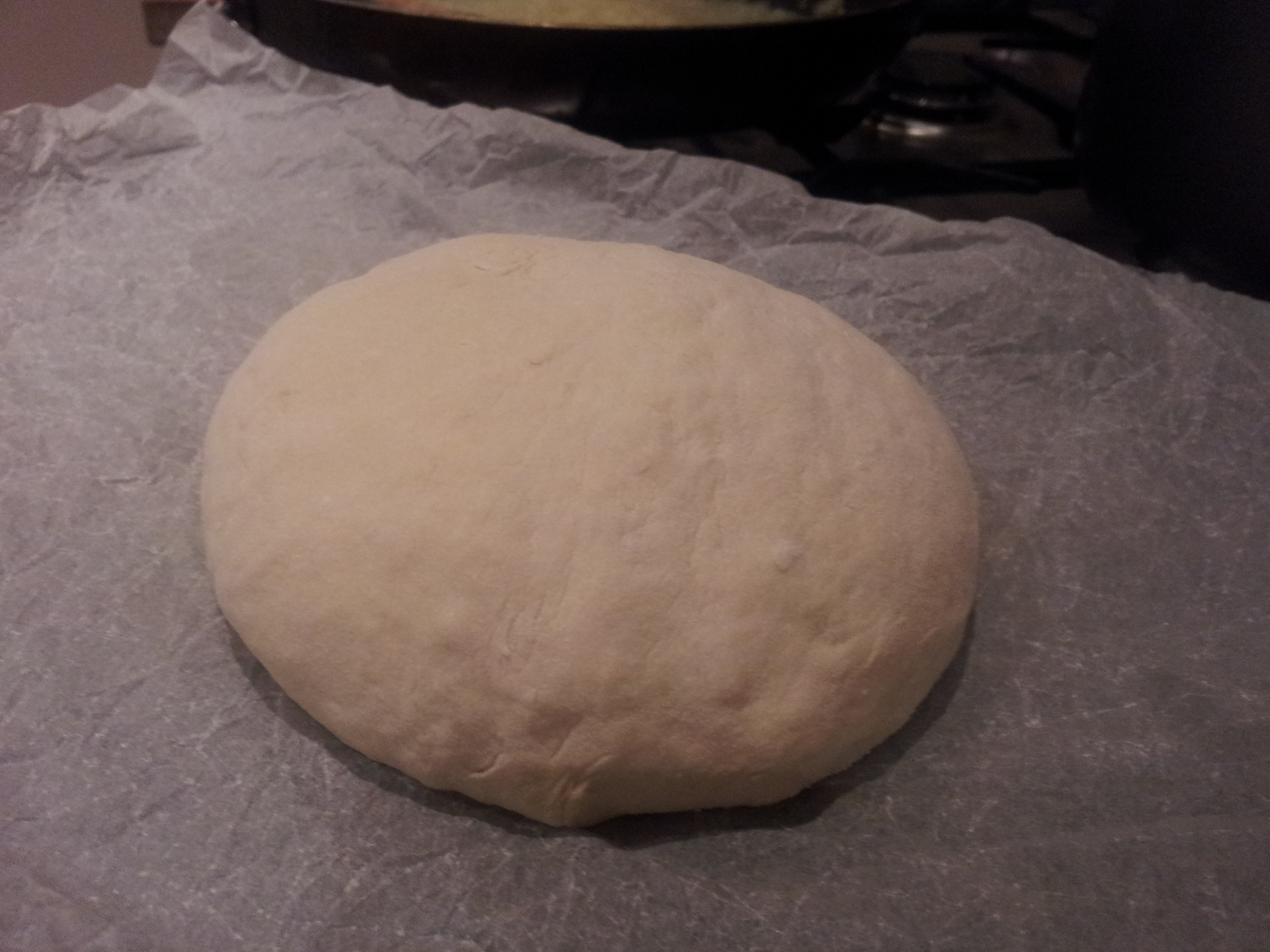
Once it starts to take shape all it needs is some encouragement, folding and lightly kneading the edges into the middle to form a round dough shape about 4 cm deep.

Flattened circle

I greased and floured a flat baking sheet and plopped the smooth circle of dough (folded edge down) onto the sheet.

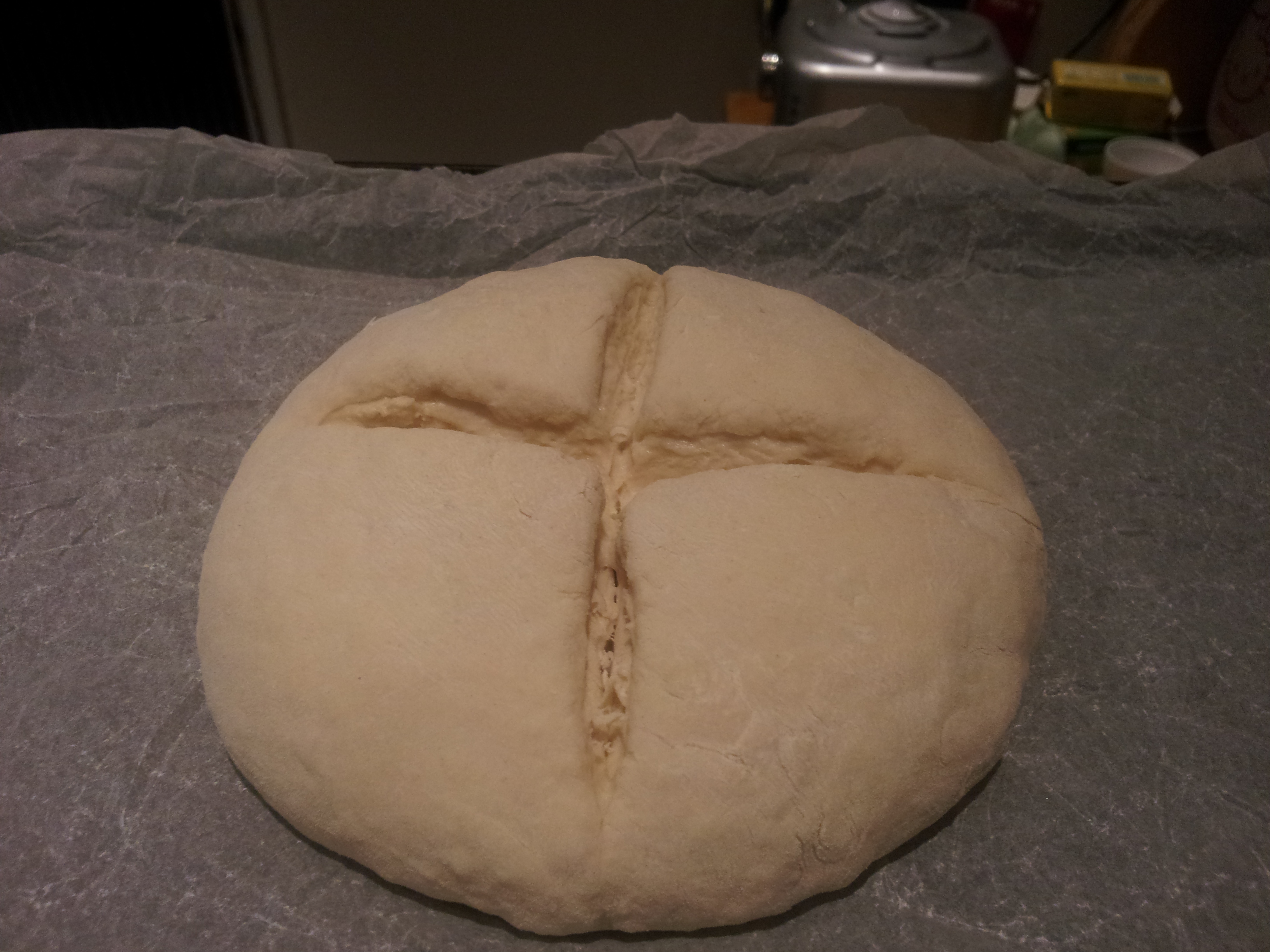
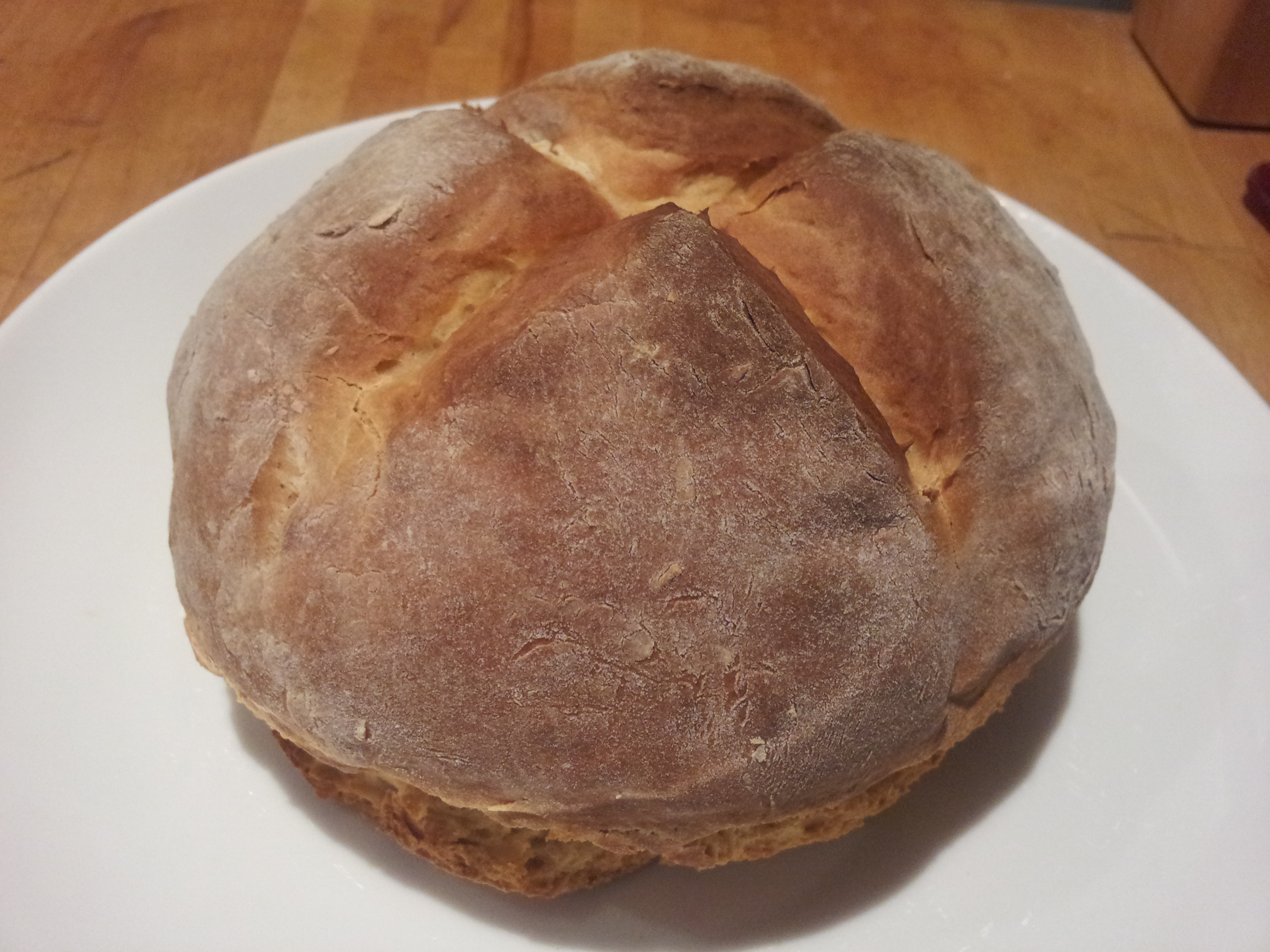
Challenge complete in less than 10 minutes!! Taking my sharpest knife I cut a shallow cross into the top of the loaf and teased the edges out slightly so the cross was more defined. The cross helps the heat penetrate the loaf and cook evenly throughout. Irish folklore also says that that the cross lets the evil spirits out. Good to know.

Criss Cross

Into the oven it went for 10 minutes at 230 degrees c. (gas mark 8). While the oven was heating up I popped a roasting pan in the bottom to get really hot. Then just before shutting the oven door I threw a cup of cold water into the pan to create some steam and a soft crust on the bread. Perfect! (I love this tip – thank you Holly Bell)

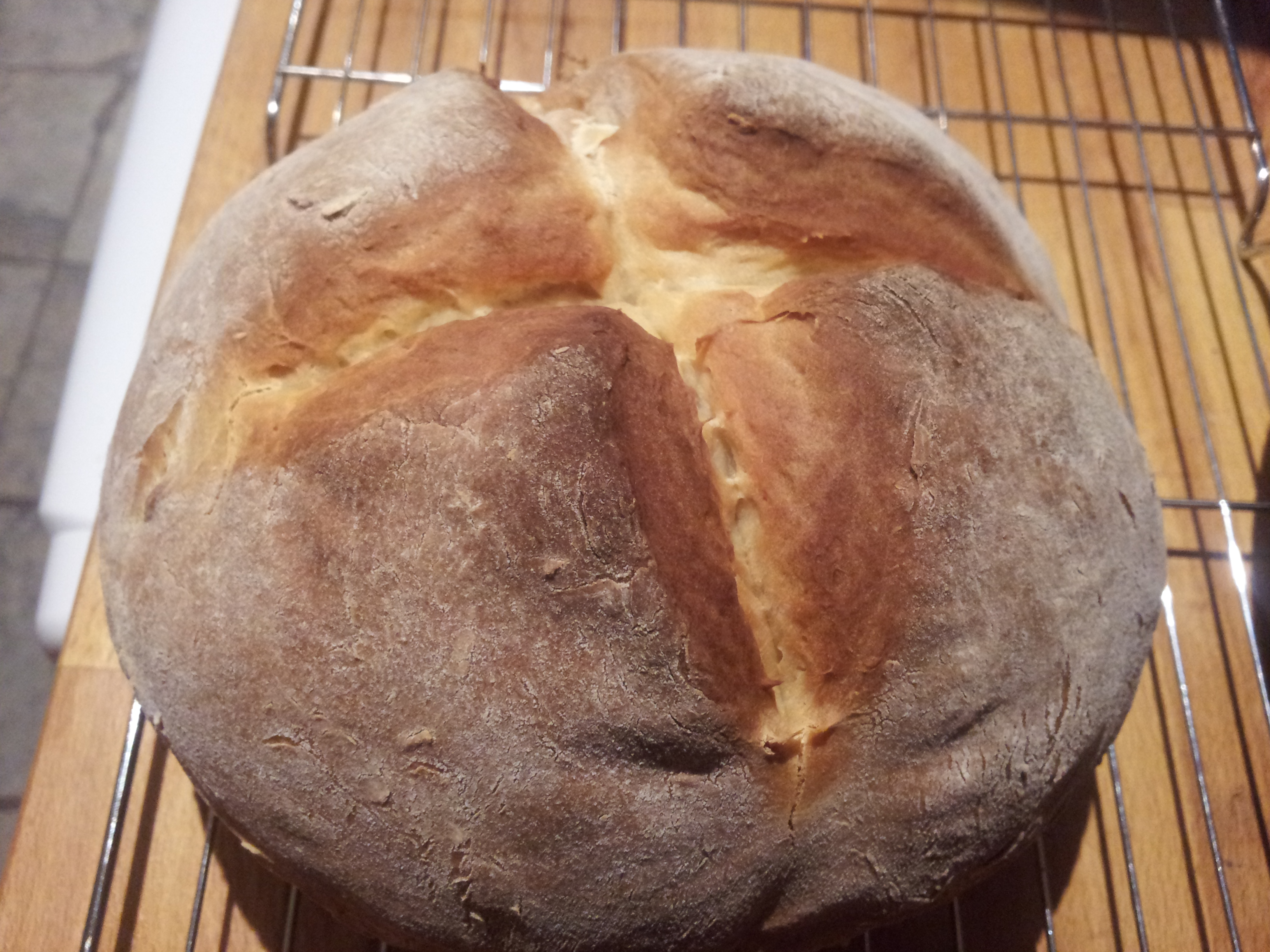
After 10 minutes I turned the oven down to 200degrees C (gas mark6) and baked for 30 more minutes until the crust was golden brown and the loaf sounded hollow when tapped on the bottom.

Risen

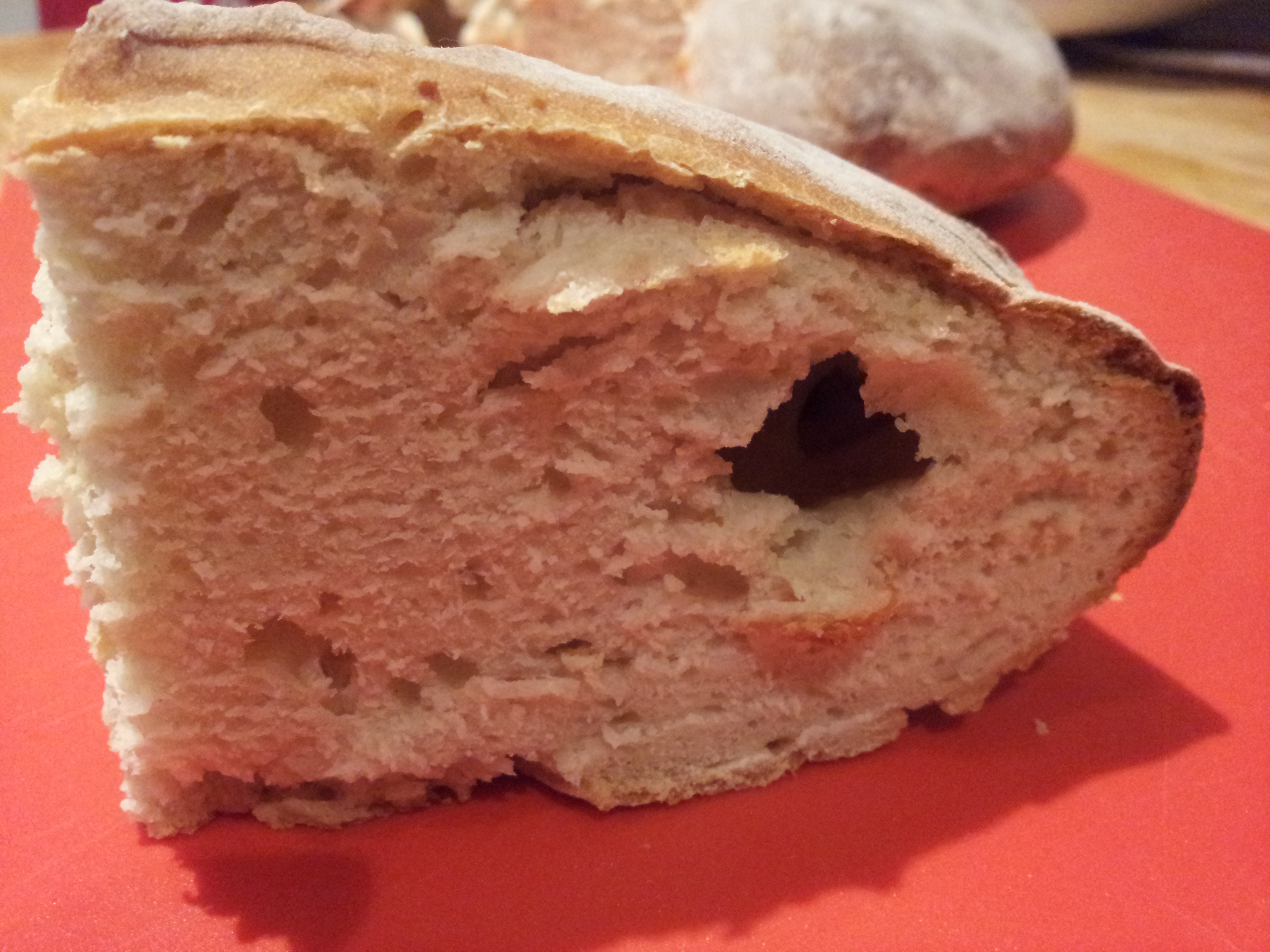
What a result!! I was astounded that a yeast free bread rose so much! It doubled in size and didn’t need any proving or strenuous kneading either! Amazing result for so little effort. It smelt amazing and tasted a bit like a cake too. What could be better than a bread/cake hybrid?!

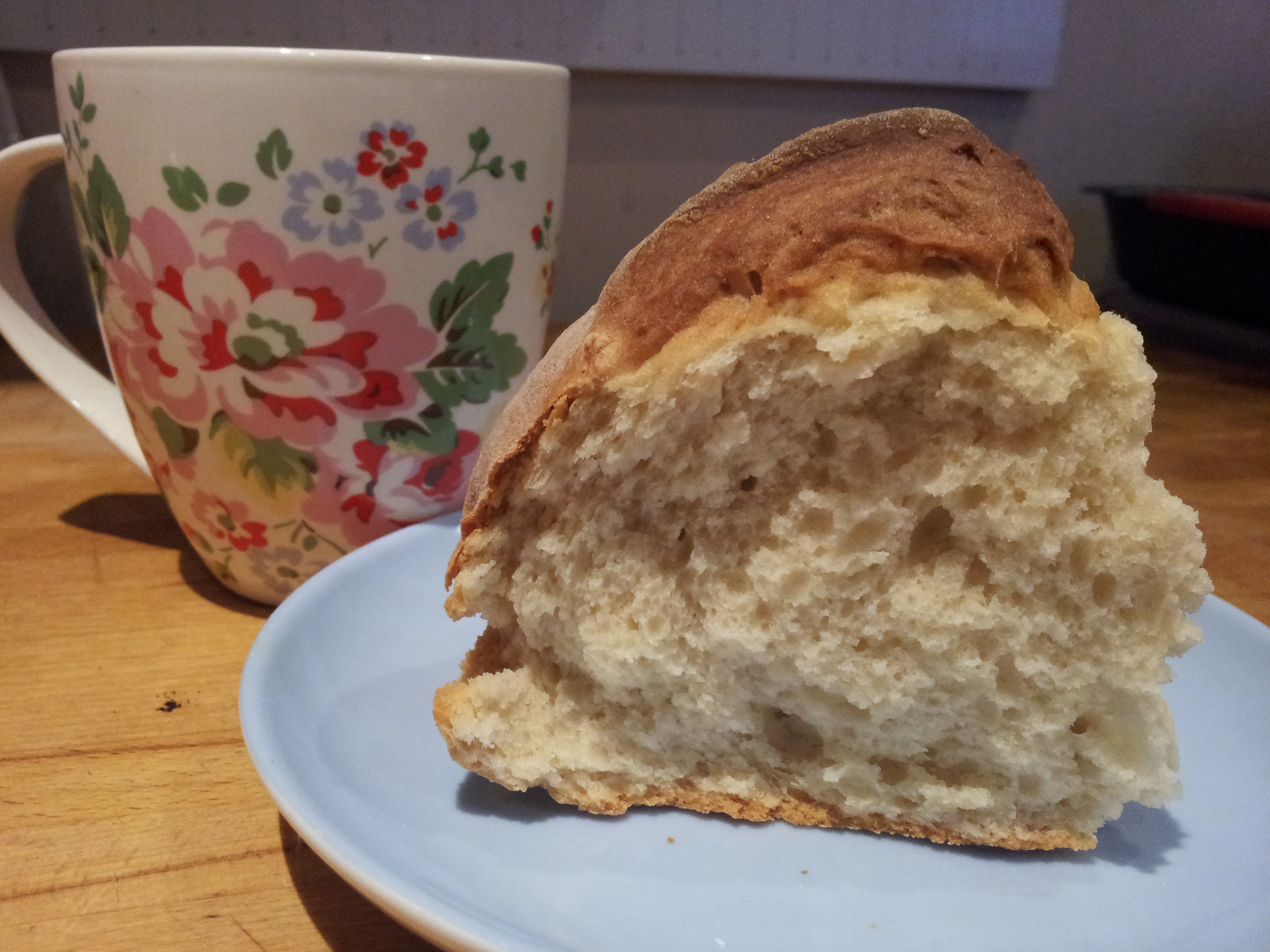
One hunk of Soda Bread

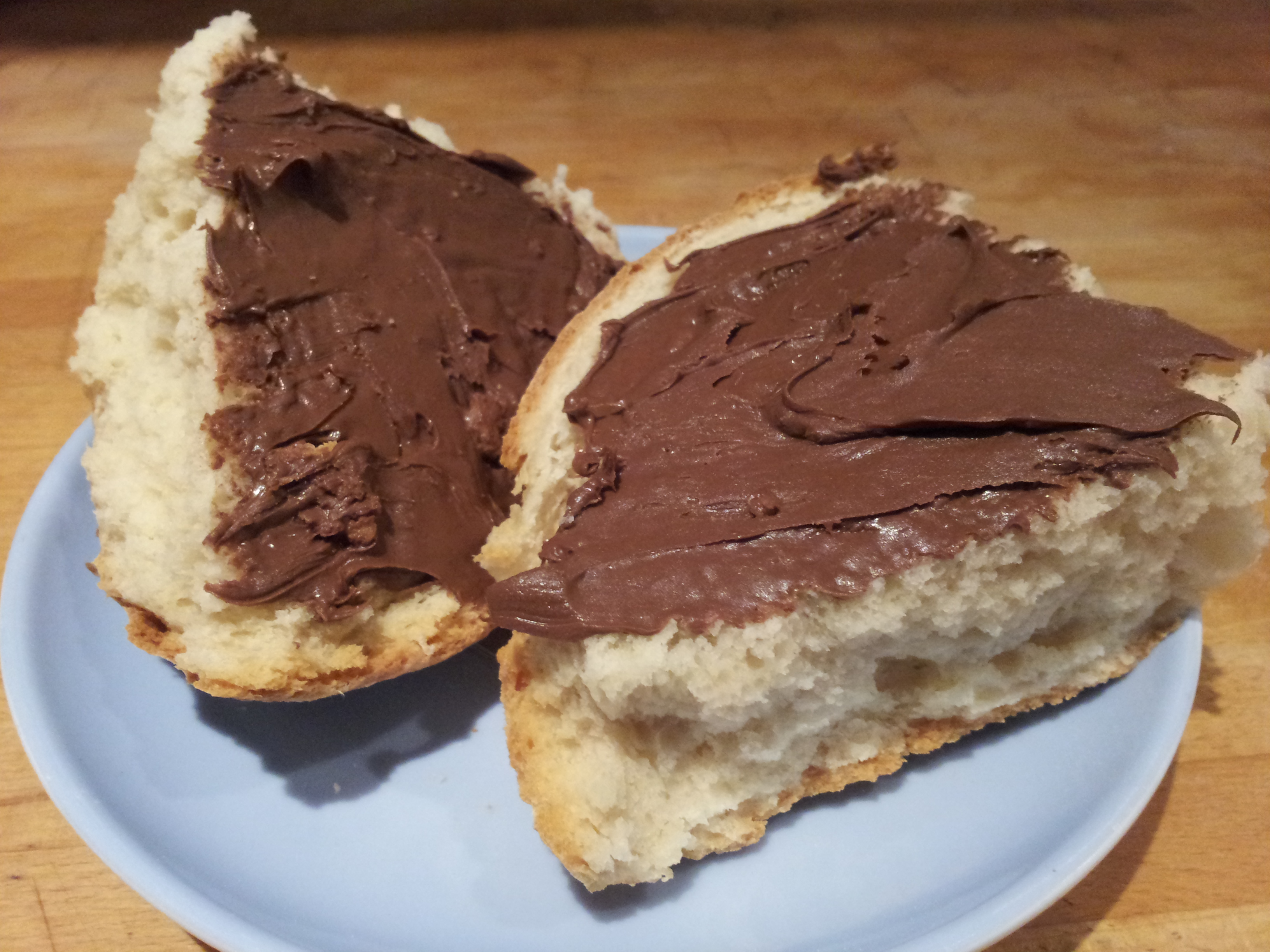
We ate this for breakfast one weekend and I loved it. I could happily eat it without any butter as it’s so moist, but I did put nutella on it (it was Saturday after all). This loaf should serve 4 and is best eaten fresh which is a good thing as I devoured a quarter of the loaf chunk in one sitting.

with lashings of Nutella?

I loved it so much I made it again however I was obviously a bit complacent after my initial success. I used plain yoghurt which wasn’t active but a little past it’s best, assuming this would mean it had grown some cultures. I guessed wrong as this time it didn’t expand as impressively and I was a little disappointed by its lack of height. I will be baking it again but following the recipe properly next time! If you haven’t baked it before I really recommend it! And please let me know how you get on!

The slightly deflated second attempt…

*Recipe taken from Kenwood Creative Food Processor Cooking Book, by Becky Johnson. Thanks!

Irish Soda Bread

<!– Include ONCE for ALL buttons in the page –>

(function() {     window.PinIt = window.PinIt || { loaded:false };     if (window.PinIt.loaded) return;     window.PinIt.loaded = true;     function async_load(){         var s = document.createElement(“script”);         s.type = “text/javascript”;         s.async = true;         if (window.location.protocol == “https:”)             s.src = “https://assets.pinterest.com/js/pinit.js“;         else             s.src = “http://assets.pinterest.com/js/pinit.js“;         var x = document.getElementsByTagName(“script”)[0];         x.parentNode.insertBefore(s, x);     }     if (window.attachEvent)         window.attachEvent(“onload”, async_load);     else         window.addEventListener(“load”, async_load, false); })();

<!– Customize and include for EACH button in the page –> <a href=”http://pinterest.com/pin/create/button/?url=http%3A%2F%2Fprinceproductions.wordpress.com&amp;description=Around%20the%20World%20in%20Eighty%20Bakes%20“>Pin It</a>

Happy New Year and New Food Processor!

Apologies for lack of bloggage over the festive period. I have been a bit distracted with moutains of Christmas baking and subsequent eating so there’s rather a lot to catch up on. I’m not even sure where to start so here’s a selection of some of my most recent bakes. Not all of the food was officially international baking so I can’t  count it towards the around the world in eighty bakes nevertheless I thought you might like to see some of my experiments following my new acquisition, a wonderful food processor, for Christmas. My wonderful new baking toy that I’m attempting to learn how to use. (Thanks mam and dad!)

image

Dinner rolls for New Year

image

An invention what I can only term a plaited crown loaf

image

Rose cupcakes of the Hummingbird Bakery Variety

image

The new food professor!

image

Merry Christmas!

Super Hans (sorry I couldn’t resist)

image

Happy New Year! Hope you have a fantastic 2012 and thanks so much for reading! We’ve made it to 20 bakes so far, so hope you enjoy reading the next 60 bakes!

9. Black Olive and Cheese Rolls – Italy – Mary Berry

I ordered a proper  Mary Berry – At Home cookbook. It is amazing. It has everything that you could ever need like which things you can freeze and how to reheat things. Clever Mary. I really want to bake everything in it and also recreate in my kitchen the fabulous 70’s photos of Mary smiling while popping a tray of something lovely in the oven. I’ve post-it noted all of my things to bake and the first out of the hat was…

Italian Black Olive and Parmesan Rolls

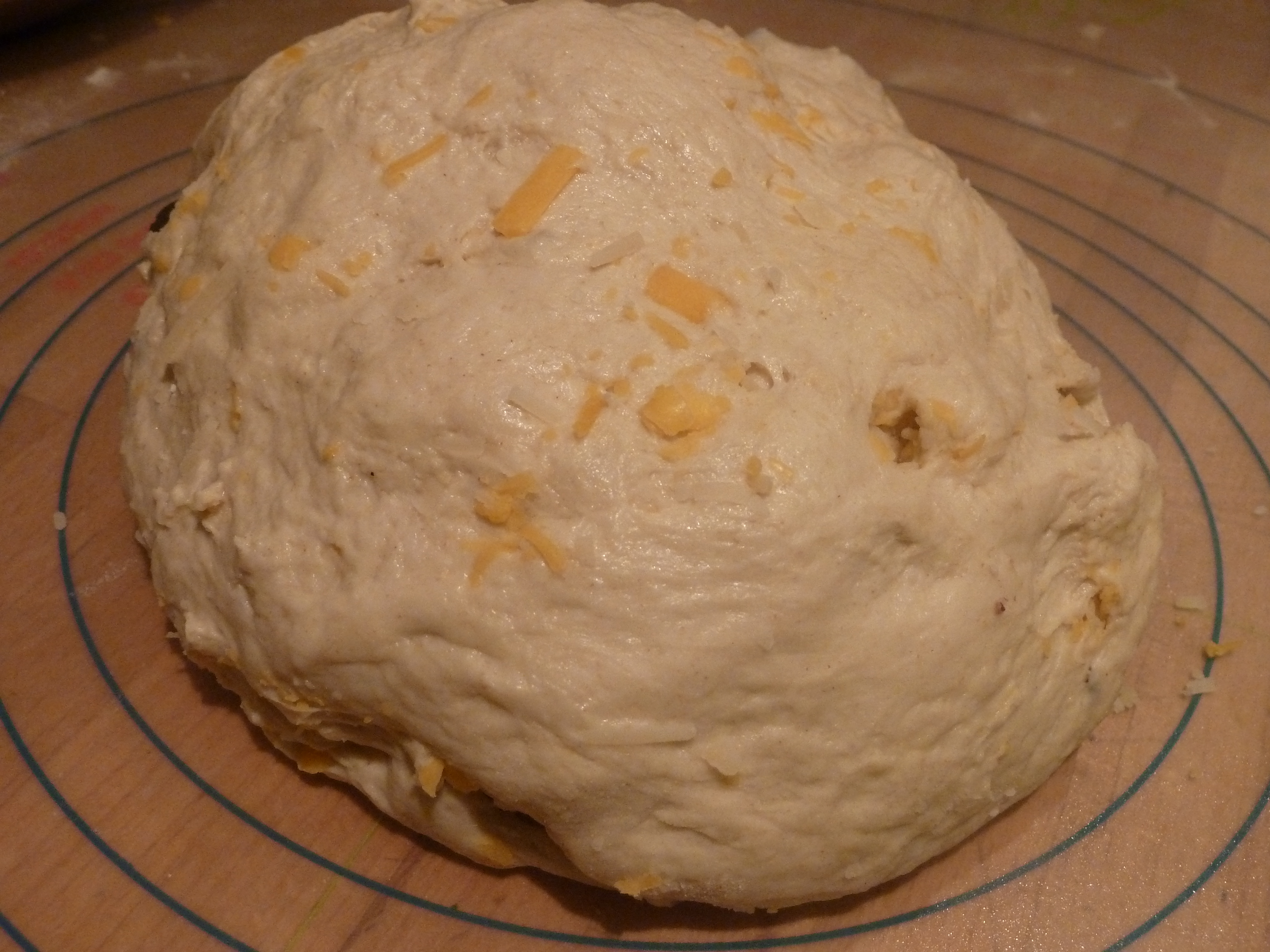
Italian Black Olive and Cheese Rolls. I wanted to bake something special (and savoury) to complement the Chocolate Roulade for my Book Group friends, I was definitely channelling Mary that night! I even purchased proper bread flour and parmesan for the occasion, rather than making do with plain flour and Red Leceister Cheese, which wouldn’t be very Italian.

I have been to Italy briefly and it was great. A long weekend in Milan, venturing up to the top of the Duomo, gorging myself on coconut gelato and wandering round Gucci and Prada gazing longingly at everything that I could never afford in a million years.

Up on the roof - Duomo - Milan

I followed this recipe almost exactly, but added double the amount of yeast…(that just means it will be extra fluffy, right?) and left it to prove as prescribed. I pre chopped all the olives and grated the cheese. I even bought myself an early Christmas present, a big kneading board, with measurements on for cutting dough, this will force me to become more exact in my measurements, eventually.

The new kneading board. Look at those concentric circles!

I thoroughly enjoyed throwing the dough about and kneading the ingredients in. I have almost perfected a one handed kneading/throwing teachnique which means I can multi task to the extreme. I fear that my neighbours may complain about the noise from my over zealous kneading however.

Ready for the second knead

The rolls, once sprinkled with parmesan and shaped, had to prove once more. I fashioned a rudimentary tent from cling film (as always) and a grater, as nothing else was big enough to hold the tray full of ever expanding dough.

Rudimentary Cling Film Tent

Pre Oven and Pre Proved

A very quick 30  minutes in the oven and the kitchen smelt gorgeous! So much so, that at 10pm I was tucking into a fresh baked, still warm, golden rolls. My mouth is watering just writing about these buns. I LOVE them. Mary has done me proud yet again.

The Final Bun

I even took them for my lunch all week as they are like a pre prepared sandwich. I definitely recommend warming them up again in the microwave so the cheese melts slightly inside. Beautiful!

Crammed with Olives - my lunch