50. Authentic Danish Rye Bread – Rugbrød

Danish Rye Bread

Danish Rye Bread

My wonderful friends Josh and Mark shared their genuine Danish Rye Bread recipe with me months ago and I’ve been dying to try it! I was going to visit them in Manchester and thought it the perfect occasion to take them some freshly baked Rye bread too to say thank you for letting me stay!

A cross section of Danish Rye Bread

A cross section of Danish Rye Bread

The recipe arrived in 3 photos of hand written sheets so I knew it was going to be good and truly authentic. It requires rather a lot of flour as it is enough for 3 loaves. My brain couldn’t calculate the maths to scale this recipe down so 3 loaves it is!

The Rye Bread Sourdough Starter

The Rye Bread Sourdough Starter – porridgey

The recipe calls for a homemade sourdough base. I have attempted to make my own sourdough starter from scratch before following the Fabulous Baker Brothers method of capturing the yeast from the air in flour and water and letting it ferment. Perhaps my house is not particularly yeasty, I’m not sure but for whatever reason I couldn’t get it to bubble. Having made a successful Herman the German Sourdough starter and cake before I know that adding instant yeast is a sure fire success. Therefore, I admit it, I deviated from the rules immediately, before I even began baking pouring in a little cheating instant yeast to get the sourdough started.

Starting the Rye Bread in my massive cake tin

Starting the Rye Bread in my massive cake tin

I don’t own a bowl big enough to stir this vast amount of flour in so wielding my largest cake tin I set to work… and consequently ruined said cake tin, bending it out of shape with the cement like dough!

If you were making your own sourdough starter, you could keep some back and carry on feeding it so you can make many more beautiful loves in the future. I was making just enough for this recipe, but may attempt to make my own sourdough rye starter again.
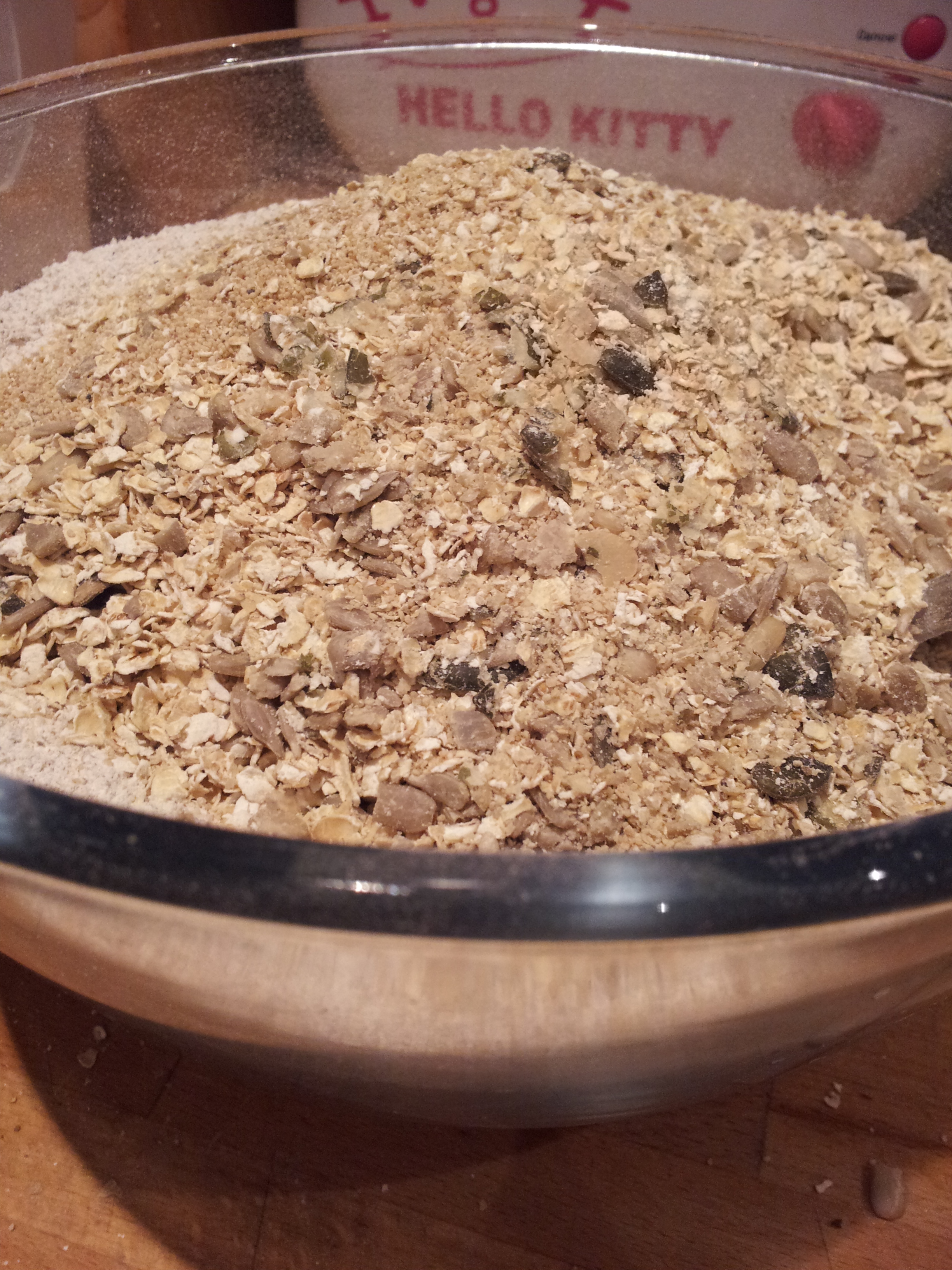
There's a lot of flour in this Rye Bread

There’s a whole lot of flour, seeds and grains in this Rye Bread

Rye is quite the healthy flour, full of wholesome goodness, as opposed to refined white flour. This means that it has quite a distinct flavour and it is much heavier than white flour. It creates a rather dense loaf. Mixing rye flour with white flour lifts the texture and colour of the bread slightly. The addition of seeds, nuts and grains give it extra texture and nutritious value!  This bread is perfect for applying lashings of cream cheese and smoked salmon to. I love the traditional Smørrebrød, or Danish open sandwiches. Rye bread is an essential part of proper Danish sandwich making.

If you plan this in advance you will have plenty of time to allow the starter to ferment. I however did not. You should mix the flour and water together, stirring it into a smooth, thick paste and leave for at least 12 hours to let it bubble. I made my starter but needed it to be ready to go asap so I cheekily added 7g of instant yeast to make sure it rose fully.

Adding the flour and seeds to the sourdough start mix

Adding the flour and seeds to the sourdough start mix

Once your starter is ready you can save a cup back for future sourdough creations or, whack it all in to the mix like me. The beauty of rye bread is that it doesn’t require kneading! However you do need strong arms for the mixing. My weapon of choice was a wooden spoon to battle the heavy dough with. Combining the sourdough starter with the rest of the rye bread mixture, alternating between the dry ingredients and the water is hard work but you must keep on stirring until everything is combined, including the seeds and grains. Prepare yourself for a good 10 minutes of elbow grease.

How to fit all of this in one bowl... water, flour, seeds and sourdough starter

How to fit all of this in one bowl… water, flour, seeds and sourdough starter

Unfortunately there were a few ingredients that I didn’t have to hand so improvising to my hearts content, I chose sunflower and sesame seeds to add to the dough. I haven’t been able to find malt powder so I just left it out of the mix, but I bet you can get it in healthfood shops. Rye/barley/wheat grains don’t really feature in my cupboards (other than broth mix and I’m pretty sure dried barley and split lentil is not what we’re looking for here) but oats were an excellent emergency substitute!

Thick and porridgey just how the best Rye breads should be

Thick and porridgey just how the best Rye breads should be

Once the dough is the consistency of thick porridge (lumpy in a good way) it’s ready to pour/scoop into your greased and floured loaf tins. It is quite a stiff liquid so your have to encourage the dough as you pour it into the corners of the tins. Pour in enough dough fill two thirds of the tin, so there’s still space for the dough to expand without overflowing the tin. I had to resort to baking one loaf in a square cake tin (the same size as 2 normal loaf tins) and some mini pudding tins as I only have the one small (500g) loaf  tin!  Coat each loaf with a nice wash of oil and sprinkle a few oats/seeds on the top. Cover the loaves with greased cling film and leave to prove/mature for 8-12 hours. This time allows the sourdough to mature further and add a deeper tangy flavour to the bread.
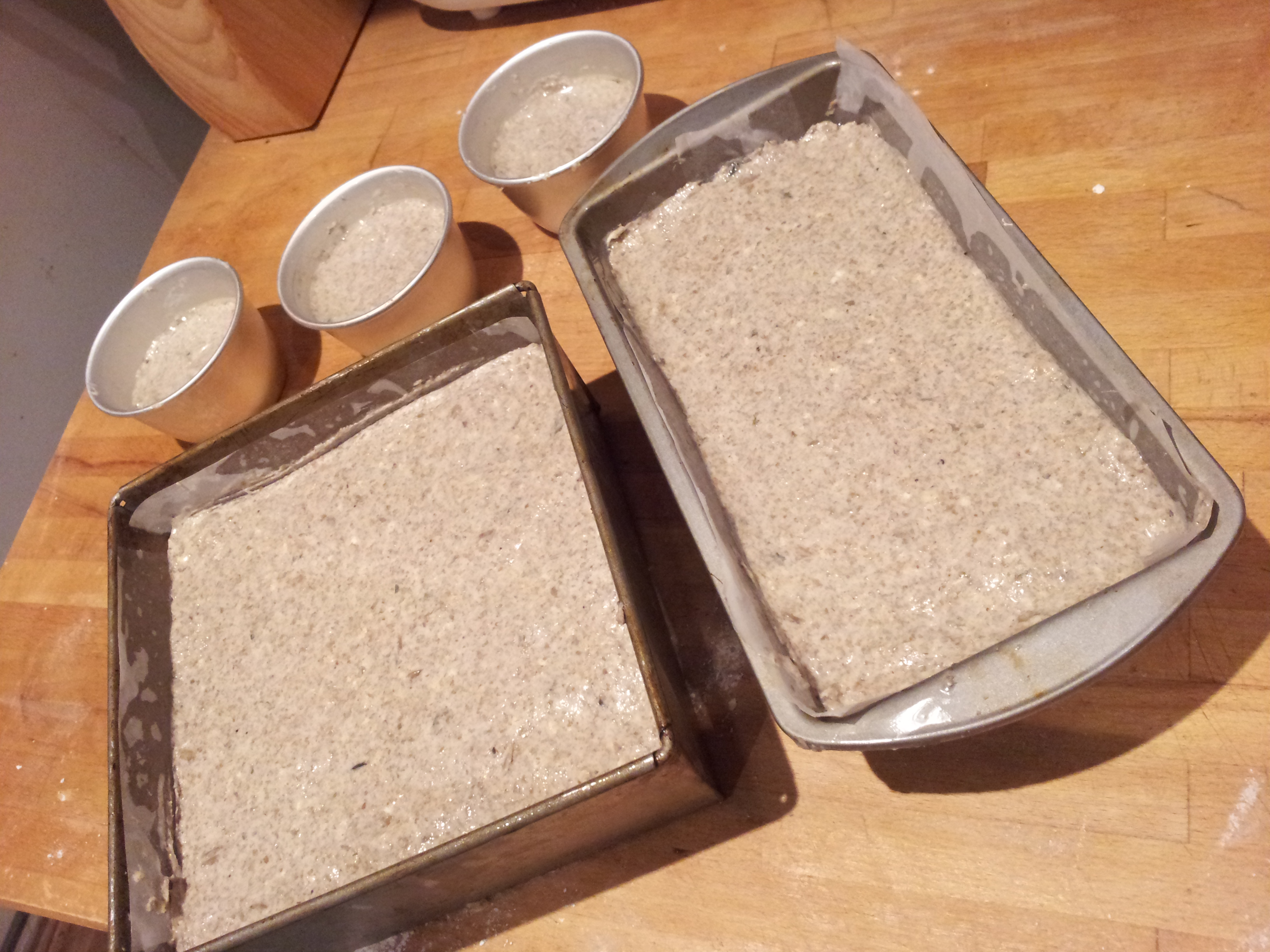
Pour your rye bread dough into all of your loaf tins (and every other container you can find...)

Pour your rye bread dough into all of your loaf tins (and every other container you can find…)

When proved the dough will not double in size like other breads but it will increase in volume and should reach the top of your loaf tins. Prick the tops of the proven loaves all over with a fork, this will help keep your crust intact as it may fall off if left un perforated. It also prevents the loaves from rising and cracking in the oven, maintaining that distinctly symmetrical Danish Rye bread oblong shape.
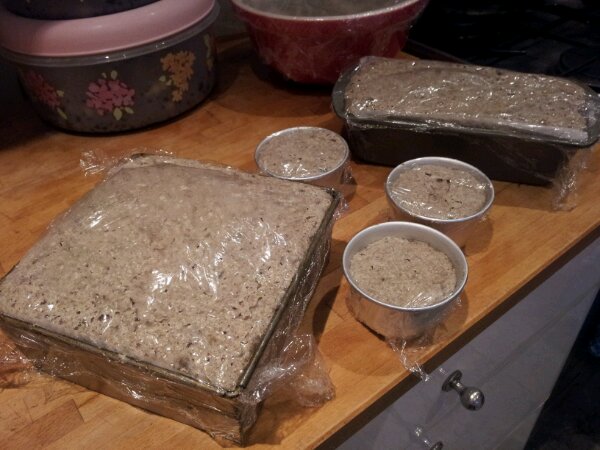
The cling film covered and proving loaves

The cling film covered and proving loaves

Pre heat your oven to 220 degrees C. Bake the loaves at 220 degrees for 10 minutes. This initial blast of heat helps to force the bread to rise and the crust to develop. Lower the temperature to 175 degrees C and bake for a further 75  minutes.

Sometimes pegs come in handy to keep the cling film in place...

Sometimes pegs come in handy to keep the cling film in place…

If your loaves can be removed easily from the tins at this point do so. if not, leave for another 5-10minutes until they can be removed. Bake the bread for a further 5-10 minutes without the tin directly on the oven shelf to allow the crust to become extra crunchy.
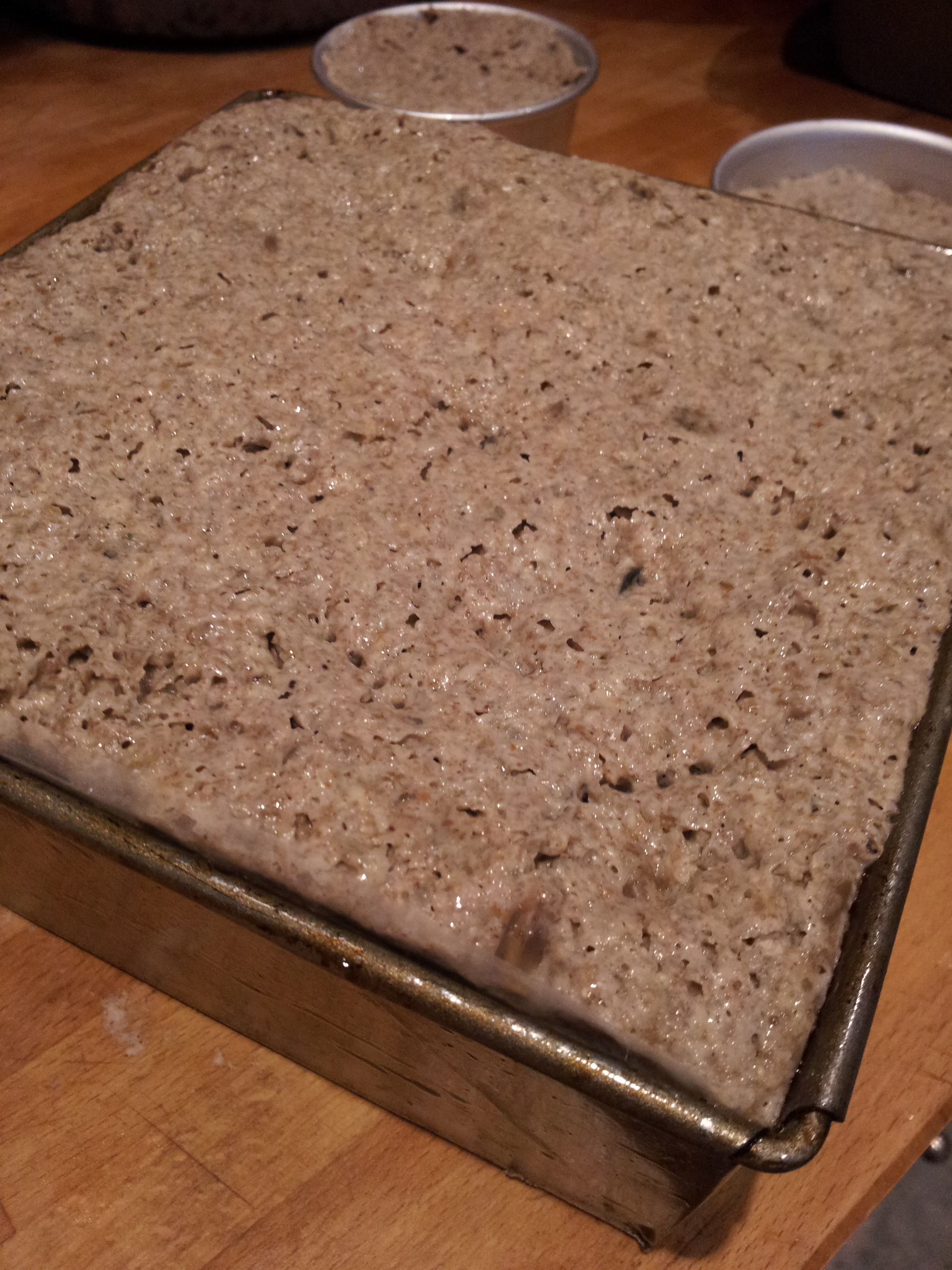
The forked loaf ready for the oven

The forked loaf ready for the oven

Once they’ve cooled they’re ready to eat! You should be able to keep them at room temperature for 1-2 weeks or they freeze really well too.

Danish Rye Bread fresh from the oven

Danish Rye Bread fresh from the oven

I always know when I’ve baked something especially tasty as Super Hans will go out of his way to steal it from me. He was desperate for a bit of my Danish Rye Bread. I love the depth of the flavour in this bread. It radiates health and wellbeing. It’s also rather filling, so thin slices are a must. The sourdough tang cuts through the fantastic texture of the seeds and nuts. Now that I have the Kitchenaid I can dispense with the cake tin mixing method, so I will be purchasing more rye flour very soon and having another go. I would also love to try other dark breads. I can see me attempting many more in the future. Thank you Josh and Mark for sharing your fantastic recipe with me!

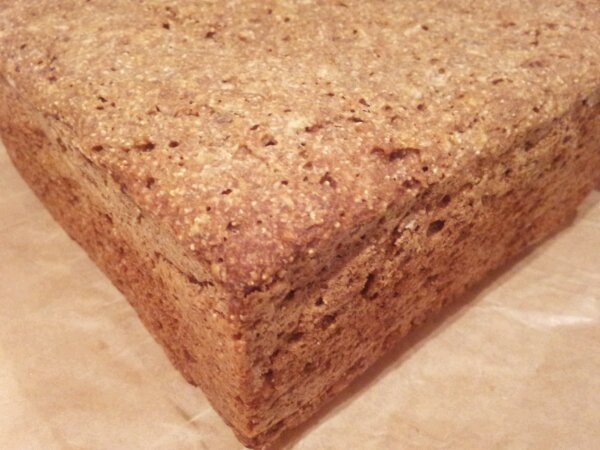
Extreme close up of the crunchy crust

Extreme close up of the crunchy crust

Things that I used to make Danish Rye Bread

Sourdough Starter

  • 300ml luke warm water
  • 250ml rye flour
  • 7g of instant yeast (if you’re in a hurry)

Mix together to a thick smooth paste and leave to ferment until bubbly (12-24 hours) or if you’re impatient add 7g of instant yeast to your starter…

Rye Dough

  • 1 litre of warm water
  • (if you can find it add 1 tablespoon of ground malt -I didn’t)
  • 200g sunflower seeds
  • 200g sesame seeds
  • 400g oats (or whole rye, barley/wheat grains)
  • 2 tablespoons salt
  • 1 tablespoon honey
  • 300g strong white flour
  • 900g rye flour
A slice of rye

A slice of rye

My pair of rye loaves

My pair of rye loaves
49. German Pretzel Playtime

Pretzels, Pretzels, Pretzels!

Pretzels, Pretzels, Pretzels!

I discovered that I have a slight obsession with Pretzels on our recent visit to Berlin, where I bought many delicious chewy pretzels the size of my head. I really rather enjoyed Berlin, my first venture into German cusine! Traditionally Preztels are a savoury German snack, dipped in a rather caustic solution of lye to achieve the dark brown coating with the distinctive chewy texture.

In amongst the Curry Wursts, Strudels and Pork Knuckle I filled my self up on pretzels as often as I could. We explored the historic sites and the bohemian avenues in the post Christmas and wedding drizzle. Berlin was a very welcome change of scenery, with pickled herring and salmon for breakfast. I went all in with the Germanic food. My instagram feed became awash with a vast array of wonderful and interesting food. Nothing went undocumented!

Dough ready for some good kneading

Dough ready for some good kneading

Upon returning home I wanted to recreate some pretzel perfection, preferably without the hazardous solutions. No chemical burns for me please! Pretzels are made from a basic soft white bread dough recipe. The flour, yeast, oil and water should be mixed together in a big bowl until it can then be kneaded on a oiled board for 10 minutes. Once the dough is smooth and bounces back when pressed your kneading is done.

Kneaded dough ready to prove

Kneaded dough ready to prove

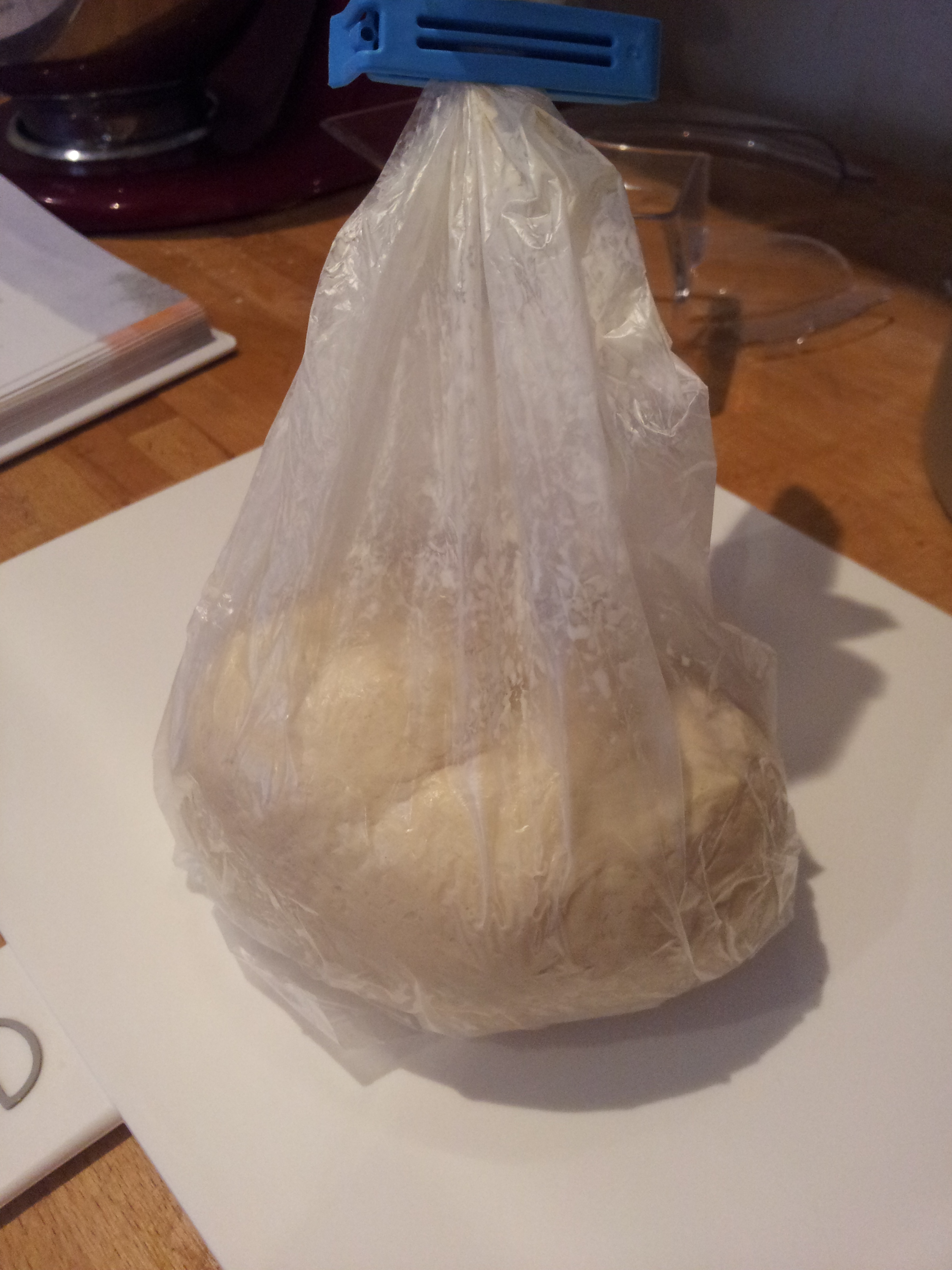
The dough can then be left to prove in a warm place in a greased plastic bag, for about an hour or two.

The proven preztzel dough

The proven pretzel dough

When the dough has doubled in size it’s ready to shape. This is probably the most complicated and time consuming bit of the entire pretzel making process. But it’s not as difficult as it may seem! I shall demonstrate in 10 easy steps…

Stage 1. Roll your dough to a sausage shape and cut into 12 equal pieces

Stage 1. Roll your dough to a sausage shape and cut into 12 equal pieces

Stage 1: Roll your dough to a sausage shape and cut into 12 equal pieces

Stage 2. Roll your 12 pieces into balls (check that they're all roughly the same size)

Stage 2. Roll your 12 pieces into balls (check that they’re all roughly the same size)

Stage 2: Roll your 12 pieces into balls (check that they’re all roughly the same size). Redistribute the dough to make sure you have equal sized dough balls here if needed.

Stage 3. Take one dough ball and leave the others covered with cling film in a greased bowl to stop them drying out. Roll your dough into the longest thinnest sausage you can make

Stage 3. Roll one dough ball into the longest thinnest sausage you can make

Stage 3: Take one dough ball at a time leaving the others covered with cling film in a greased bowl to stop them drying out. Roll your dough into the longest thinnest sausage you can make. Give the dough a good slap if you spot any air bubbles along the way. You need to pop any air bubbles to get a good even bake and to maintain your lovely pretzel shape.

Stage 4. Start shaping you sausage. Curl the dough into a circle but don't close the ends.

Stage 4. Start shaping you sausage. Curl the dough into a semi circle but don’t close the ends.

Stage 4: Start shaping your sausage. Curl the dough into a semi circle but don’t close the ends. You need those loose ends to finish your pretzel shape.

Stage 5. Bring the loose ends of the dough together and twist them up the centre of the circle

Stage 5. Bring the loose ends of the dough together and twist them up the centre of the circle

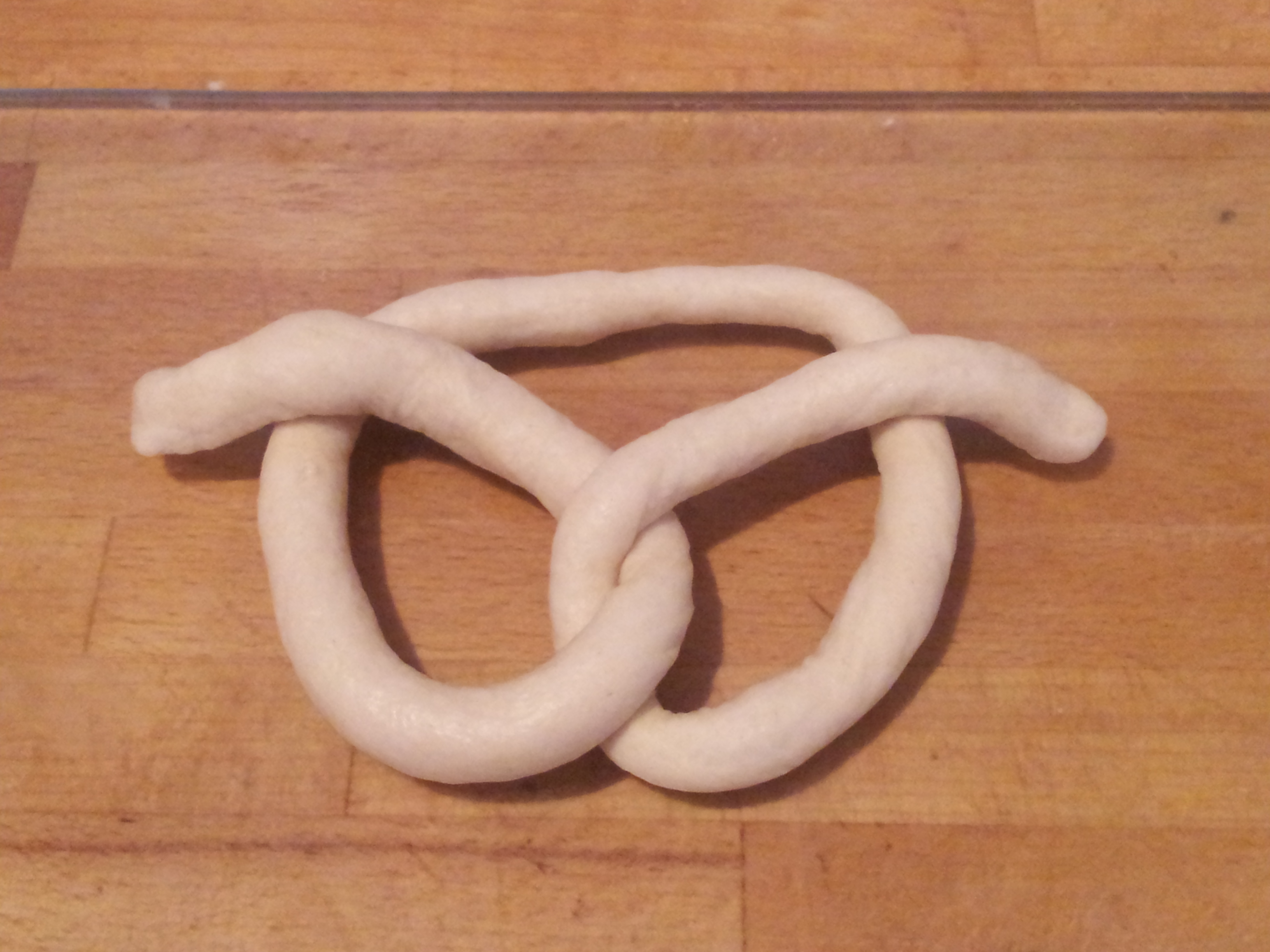
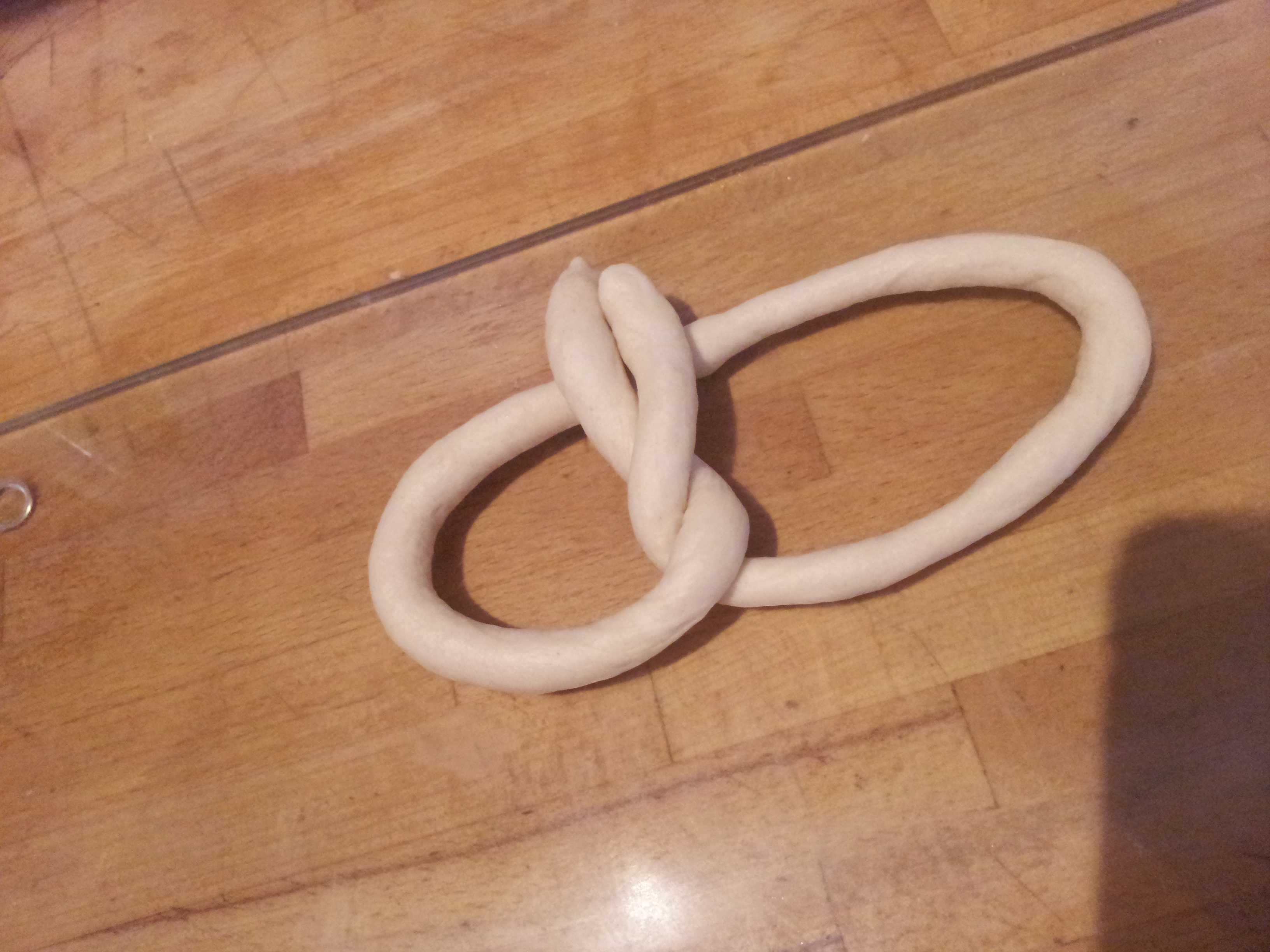
Stage 5: Take the loose ends of the dough and twist the strands together, one under the other up the centre of the pretzel circle.

Stage 6. Bring the loose ends two thirds of the way up the sides of the pretzel like arms

Stage 6. Bring the loose ends two thirds of the way up the sides of the pretzel like arms

Stage 6: Bring the loose ends two thirds of the way up the sides of the pretzel like arms. Reshape the circle of the pretzel as you go to keep the even shape.

Stage 7: Gently press the 'arms' of the pretzel into the dough to fix it in place.

Stage 7: Gently press the ‘arms’ of the pretzel into the dough to fix it in place.

Stage 7: Gently wrap the ‘arms’ of the pretzel around the pretzel. Gently press the arms into the dough to fix them in place.

Stage 8. Carefully line up your pretzels on a greased and lined baking tray

Stage 8. Carefully line up your pretzels on a greased and lined baking tray

Stage 8: Carefully line up your pretzels on a greased and lined baking tray. Cover them with greased cling film and leave them to prove again for another hour.

Stage 9: Give each pretzel a good coat of egg wash and water and sprinkle with rock salt before baking

Stage 9: Give each pretzel a good coat of egg wash and water and sprinkle with rock salt before baking

Stage 9: Give each pretzel a good coat of egg wash and water and sprinkle with rock salt before baking. In hindsight I went a bit mad with the rock salt. It kind of burns the tongue when you put that much on! I might in the future smash up the rock salt with a pestle and mortar to get smaller chunks and sprinkle a much smaller amount on!

The baked pretzels

The baked pretzels

Stage 10: Give the pretzels a good baking in the oven for 15 -20 minutes at 200 degrees C. These are snack sized rather than the extra large pretzels that I was eating in Berlin, which could probably constitute a main meal. So if you wanted to make yours larger you could divide your dough into 6 lumps rather than 12 and shape them to your hearts content.

The golden pretzel

The golden pretzel

After a quick bake in the oven these mini pretzels beauties are ready to be devoured! The most complicated bit of the entire process is the shaping and after a couple of goes you soon get used to the technique. I’m sure you will end up developing your own pretzel twisting style too. I adore these pretty bread shapes and will most definitely be making them again. They look impressive, so you can wow your friends with your technical know how and let them imagine you’ve spent countless hours in the kitchen preparing treats for them.

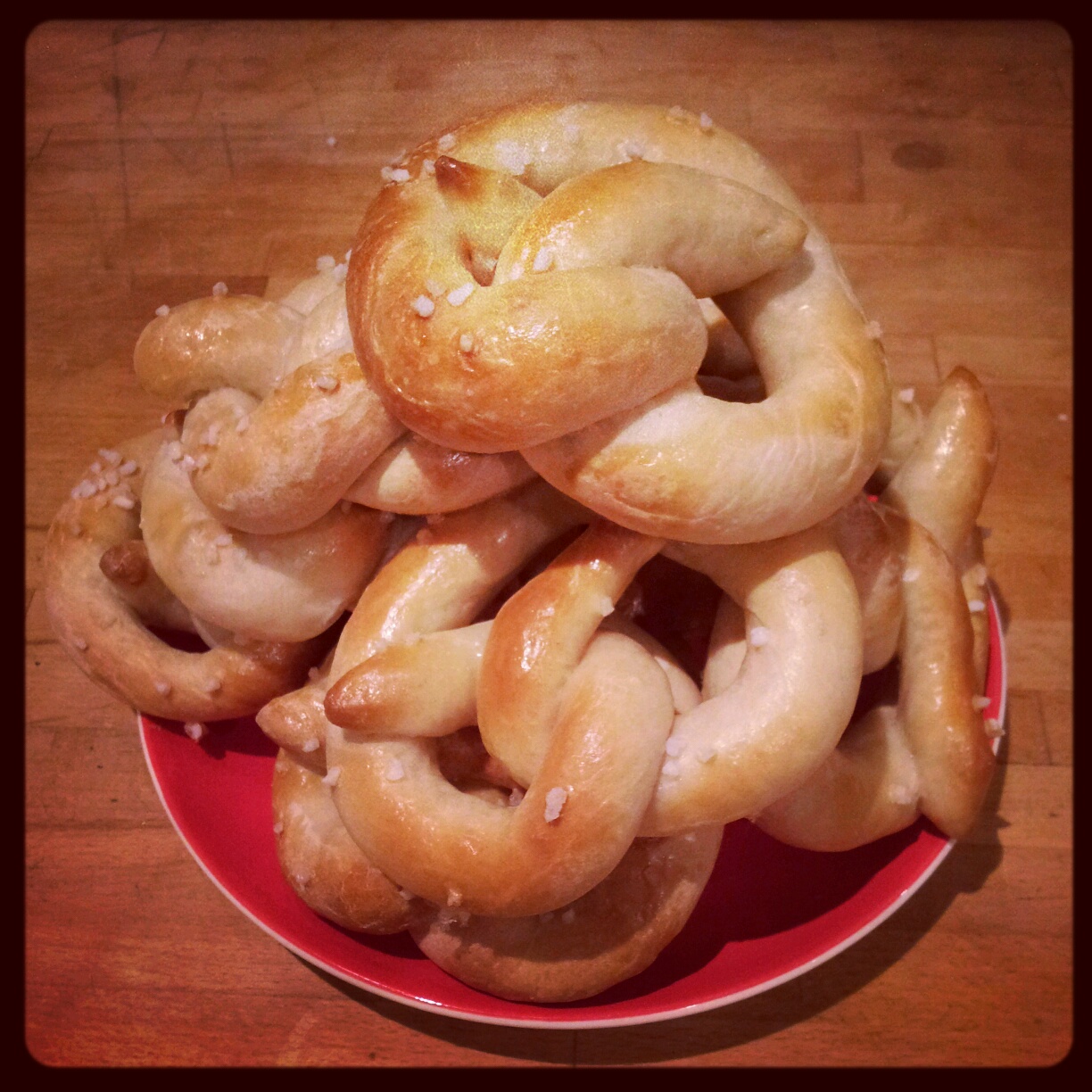
Piles of Pretzels

Piles of Pretzels

They also taste amazing with their glistening golden crust. White bread can sometimes be a bit plain, but as the pretzel is thin it takes on the depth of flavour from the egg yolk and salt. Combined with the chewy texture, they are like a plaited bit of bread heaven.  You could even make sweet pretzels if you prefer, with cinnamon and sugar coatings, or add sesame seeds or poppy seeds for a bit of variation. Then you can enjoy them for breakfast lunch and dinner! I may attempt some wholemeal pretzels too to inject some health into my bread products. I will also be attempting extra large pretzels with the distinctive slash as soon as possible! Things I used to create Mini Pretzels Pretzel Dough Recipe

  • 350g strong white flour
  • 1 tsp instant dried yeast
  • 1 tsp salt
  • 1/2 tsp sugar
  • 215ml of luke warmwater
  • 10ml olive oil

Egg Wash Topping

  • 1 egg yolk mixed with a tbsp of water
  • A sprinkling of rock salt to decorate
  • (Or you could dust them in cinnamon sugar, poppy seeds, or sesame seeds if you wish!)

Bake for 15-20mins until golden brown at 200 degrees C